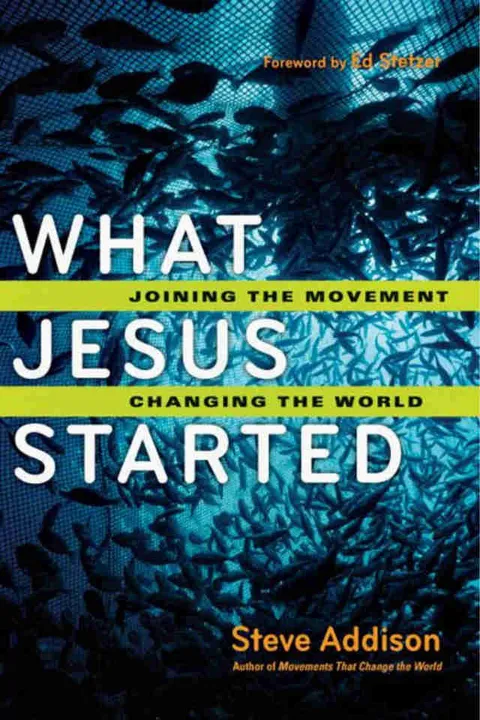

What Jesus Started: Joining The Movement Order Printed Copy
- Author: Steve Addison
- Size: 1.6MB | 257 pages
- |
Others like what jesus started: joining the movement Features >>
About the Book
"What Jesus Started: Joining the Movement" by Steve Addison explores the principles of disciple-making movements and how regular Christians can participate in spreading the message of Jesus. It offers practical advice and examples of how to follow in the footsteps of Jesus by making disciples and starting a movement of believers. The book emphasizes the power of everyday people to bring about meaningful change and growth within the Christian community.
Billy Graham
Billy Graham (born November 7, 1918, Charlotte, North Carolina, U.S.—died February 21, 2018, Montreat, North Carolina), American evangelist whose large-scale preaching missions, known as crusades, and friendship with numerous U.S. presidents brought him to international prominence.
Conversion and early career
The son of a prosperous dairy farmer, Billy Graham grew up in rural North Carolina. In 1934, while attending a revival meeting led by the evangelist Mordecai Ham, he underwent a religious experience and professed his “decision for Christ.” In 1936 he left his father’s dairy farm to attend Bob Jones College (now Bob Jones University), then located in Cleveland, Tennessee, but stayed for only a semester because of the extreme fundamentalism of the institution. He transferred to Florida Bible Institute (now Trinity College), near Tampa, graduated in 1940, and was ordained a minister by the Southern Baptist Convention. Convinced that his education was deficient, however, Graham enrolled at Wheaton College in Illinois. While at Wheaton, he met and married (1943) Ruth Bell, daughter of L. Nelson Bell, a missionary to China.
By the time Graham graduated from Wheaton in 1943, he had developed the preaching style for which he would become famous—a simple, direct message of sin and salvation that he delivered energetically and without condescension. “Sincerity,” he observed many years later, “is the biggest part of selling anything, including the Christian plan of salvation.” After a brief and undistinguished stint as pastor of Western Springs Baptist Church in the western suburbs of Chicago, Graham decided to become an itinerant evangelist. He joined the staff of a new organization called Youth for Christ in 1945 and in 1947 served as president of Northwestern Bible College in Minneapolis, Minnesota.
Evangelism
Graham’s emergence as an evangelist came at a propitious moment for 20th-century Protestants. Protestantism in the United States was deeply divided as a result of controversies in the 1920s between fundamentalism and modernism (a movement that applied scholarly methods of textual and historical criticism to the study of the Bible). The public image of fundamentalists was damaged by the Scopes Trial of 1925, which concerned the teaching of Charles Darwin’s theory of evolution in public schools in Tennessee; in his writings about the trial, the journalist and social critic H.L. Mencken successfully portrayed all fundamentalists as uneducated country bumpkins. In response to these controversies, most fundamentalists withdrew from the established Protestant denominations, which they regarded as hopelessly liberal, and retreated from the larger society, which they viewed as both corrupt and corrupting. Although Graham remained theologically conservative, he refused to be sectarian like other fundamentalists. Seeking to dissociate himself from the image of the stodgy fundamentalist preacher, he seized on the opportunity presented by new media technologies, especially radio and television, to spread the message of the gospel.
In the late 1940s Graham’s fellow evangelist in Youth for Christ, Charles Templeton, challenged Graham to attend seminary with him so that both preachers could shore up their theological knowledge. Graham considered the possibility at length, but in 1949, while on a spiritual retreat in the San Bernardino Mountains of southern California, he decided to set aside his intellectual doubts about Christianity and simply “preach the gospel.” After his retreat, Graham began preaching in Los Angeles, where his crusade brought him national attention. He acquired this new fame in no small measure because newspaper magnate William Randolph Hearst, impressed with the young evangelist’s preaching and anticommunist rhetoric, instructed his papers to “puff Graham.” The huge circus tent in which Graham preached, as well as his own self-promotion, lured thousands of curious visitors—including Hollywood movie stars and gangsters—to what the press dubbed the “canvas cathedral” at the corner of Washington and Hill streets. From Los Angeles, Graham undertook evangelistic crusades around the country and the world, eventually earning international renown.
Despite his successes, Graham faced criticism from both liberals and conservatives. In New York City in 1954 he was received warmly by students at Union Theological Seminary, a bastion of liberal Protestantism; nevertheless, the theologian Reinhold Niebuhr, a professor at Union and one of the leading Protestant thinkers of the 20th century, had little patience for Graham’s simplistic preaching. On the other end of the theological spectrum, fundamentalists such as Bob Jones, Jr., Carl McIntire, and Jack Wyrtzen never forgave Graham for cooperating with the Ministerial Alliance, which included mainline Protestant clergy, in the planning and execution of Graham’s storied 16-week crusade at Madison Square Garden in New York in 1957. Such cooperation, however, was part of Graham’s deliberate strategy to distance himself from the starchy conservatism and separatism of American fundamentalists. His entire career, in fact, was marked by an irenic spirit.
Graham, by his own account, enjoyed close relationships with several American presidents, from Dwight Eisenhower to George W. Bush. (Although Graham met with Harry Truman in the Oval Office, the president was not impressed with him.) Despite claiming to be apolitical, Graham became politically close to Richard Nixon, whom he had befriended when Nixon was Eisenhower’s vice president. During the 1960 presidential campaign, in which Nixon was the Republican nominee, Graham met in Montreaux, Switzerland, with Norman Vincent Peale and other Protestant leaders to devise a strategy to derail the campaign of John F. Kennedy, the Democratic nominee, in order to secure Nixon’s election and prevent a Roman Catholic from becoming president. Although Graham later mended relations with Kennedy, Nixon remained his favourite politician; indeed, Graham all but endorsed Nixon’s reelection effort in 1972 against George McGovern. As Nixon’s presidency unraveled amid charges of criminal misconduct in the Watergate scandal, Graham reviewed transcripts of Oval Office tape recordings subpoenaed by Watergate investigators and professed to be physically sickened by his friend’s use of foul language.
Legacy of Billy Graham
Graham’s popular appeal was the result of his extraordinary charisma, his forceful preaching, and his simple, homespun message: anyone who repents of sins and accepts Jesus Christ will be saved. Behind that message, however, stood a sophisticated organization, the Billy Graham Evangelistic Association, incorporated in 1950, which performed extensive advance work in the form of favourable media coverage, cooperation with political leaders, and coordination with local churches and provided a follow-up program for new converts. The organization also distributed a radio program, Hour of Decision, a syndicated newspaper column, “My Answer,” and a magazine, Decision. Although Graham pioneered the use of television for religious purposes, he always shied away from the label “televangelist.” During the 1980s, when other television preachers were embroiled in sensational scandals, Graham remained above the fray, and throughout a career that spanned more than half a century few people questioned his integrity. In 1996 Graham and his wife received the Congressional Gold Medal of Honor, the highest civilian award bestowed by the United States, and in 2001 he was made an Honorary Knight Commander of the Order of the British Empire (KBE). Graham concluded his public career with a crusade in Queens, New York, in June 2005.
Graham claimed to have preached in person to more people than anyone else in history, an assertion that few would challenge. His evangelical crusades around the world, his television appearances and radio broadcasts, his friendships with presidents, and his unofficial role as spokesman for America’s evangelicals made him one of the most recognized religious figures of the 20th century.
lean into the hill - a runner’s lesson for the christian life
Sometimes I wonder if the apostle Paul might have been a runner. Running is a curiously common theme in his sermons and letters. He refers to his own life and ministry as running (1 Corinthians 9:26; Galatians 2:2; Philippians 2:16) and describes the Galatians’ (past) faith in similar terms, “You were running well” (Galatians 5:7). He also asks the Thessalonians to pray for him, “that the word of the Lord may speed [run] ahead and be honored” (2 Thessalonians 3:1). He speaks of human effort and exertion (in contrast to divine mercy in election) as running (Romans 9:16 NASB). He preached in Antioch about John the Baptist “finishing his course” (Acts 13:25), expressed to the Ephesian elders his desire that “only I may finish my course” (Acts 20:24), and wrote in his final letter, “I have finished the race” (2 Timothy 4:7). While walking  serves as his more common image of the Christian life (nearly thirty times in his letters), Paul’s theology had a place for speaking in more intense, even aggressive terms as well — of a kind of athletic capacity in the Christian life, as he wrote to the Corinthians, Do you not know that in a race all the runners run, but only one receives the prize? So run that you may obtain it. (1 Corinthians 9:24) Whether Paul was a runner or not, many Christians have testified (myself included) to finding the regular experience of pushing the body beyond comfort to be of value beyond just physical health. Paul, after all, asserts that “bodily training is of some value,” even as he emphasizes that “godliness is of value in every way” (1 Timothy 4:8). And bodily training is all the more valuable when it serves godliness — when lessons learned in pushing the body translate directly into the instincts of a healthy soul. Lean into the Hill We each face our own hills each day. It might begin with getting out of bed. It might be initiating a conversation we expect to be difficult. Or starting into work or schoolwork or yard work. We all encounter hills; some more, some less. And when we do, it takes more effort to keep putting one foot in front of the other. Again and again, we face challenges big and small. And when we do, what is our default? Will we keep stepping? Slow down? Stop all together? Or lean in? Fellow runners might know the feeling. You’re tired but continuing to strain toward the finish. You come upon a hill. Your natural response will be to slow down and slog through it. Stopping to walk can feel tempting. But another mentality is to lean in. Push yourself to get over it. Pummel your body for a purpose, as Paul did (1 Corinthians 9:27). Expend more energy first. Get over the hill sooner, then enjoy the down slope. Once a runner has learned what rewards lie on the other side of a hill, “leaning in” can become the new default, and become an instinct to develop in the rest of life — learning to press through resistance, rather than backing off as a reflex. Develop the Instinct It is human and modern to take the path of least resistance and avoid the hills in life we know we should be climbing each day. This is one reason we can be so easily distracted. It’s not just our latest devices and the savvy attention merchants tricking us into distraction. Deep down we want to be distracted. Humans have craved and found distractions for centuries; the digital avenues for it have simply made distraction even easier. We typically want to avoid what we know we really should be doing because the hills that matter most are the hardest ones to climb. “The hills that matter most are the hardest ones to climb.” Here’s where “bodily training” and exercise helps not only the body but the will. Physical exertion can help us develop the mentality to lean into tasks we resist instead of avoiding them and procrastinating — to “take resistance as a spur to action instead of avoidance” (Mark Forster, Get Everything Done , 152). Instead of automatically slowing down, or turning around, when we come to a hill, we can learn to lean in . Learn to see the right hills as opportunities for fruitfulness, for what really matters — for genuine “productivity” on God’s terms. Today we are surrounded by a wealth of technologies that condition our souls and bodies to expect comfort, and encourage our minds to go to work calculating easiest means  rather than best outcomes . Without intentionality, we will be shaped by our flesh’s path of least resistance rather than the Spirit’s call to bear fruit. If we don’t take deliberate steps to rise above the increasingly low bars of discomfort in our society, we will be pulled down into the pit of lethargy around us. We will become (or remain) modern, soft, increasingly lazy, sedentary, and unproductive. But in Christ, we have cause to move in another direction — to “not be conformed to this world, but be transformed by the renewal of [our minds]” (Romans 12:2), and bodies. To present them as living sacrifices (Romans 12:1). When in doubt, we don’t want to default to what’s easiest. We want to pursue what’s most important, knowing that such things are typically the most mentally, emotionally, and physically demanding. Look Through the Hill One way to learn to “lean into the hill” is to learn to look to the reward. For the runner, it is “the eyes of faith” that fuel us to press harder, when part of us would rather slow down, because we’re looking beyond the hill in front of us. Just a few more minutes, and the hill will be behind me, and I will be happier for having leaned in rather than having given in. The more we learn to look to the reward on the other side of the hill, the more — strange as it may seem at first — we learn to taste joy even on the upside. Even now. The eyes of faith begin to realize , or taste , in seed form, in the moment of hardship, the joy that is to come. Faith is a tasting now, in the present and its discomforts, of the full reward to come. Whether Paul made a habit of running or not, he had learned how to lean in. When he met conflict in Philippi, he leaned in, and bade the church do so with him. “It has been granted to you that for the sake of Christ you should not only believe in him but also suffer for his sake, engaged in the same conflict  that you saw I had and now hear that I still have” (Philippians 1:29–30). Resistance to the gospel challenged the apostle. But he didn’t back down. He engaged. He leaned in. He continued to run, and invited others to join him. So too in Thessalonica. Conflict came, and Paul leaned in. “Though we had already suffered and been shamefully treated at Philippi, as you know, we had boldness in our God to declare to you the gospel of God in the midst of much conflict” (1 Thessalonians 2:2). And yet, example though he is, Paul is not the supreme leaner, but his Lord. Jesus Leaned In Jesus “set his face to go to Jerusalem” (Luke 9:51). Why? “For it cannot be that a prophet should perish away from Jerusalem” (Luke 13:33). This was emphatically not the easiest path but the hardest. The greatest of hills. He would perish , he said, and in the worst possible way: on a cross. “Even as shame was set immediately before Jesus’s face, he looked to the joy on the far side, and leaned into the Hill.” When Hebrews exhorts us to “run with endurance the race that is set before us” (Hebrews 12:1), he also shows us how: “ looking to Jesus , the founder and perfecter of our faith,” who leaned in, himself looking to the reward — “who for the joy that was set before him endured the cross, despising the shame, and is seated at the right hand of the throne of God” (Hebrews 12:2). The resistance mentioned is not the one we might expect: shame. We cringe at even the thought of the physical anguish of the cross. And we should; it was literally excruciating. And yet what Hebrews highlights here is not the physical pain, horrible as it was, but the shame. It was a public, prolonged, naked execution at a crossroads. The unspeakable bodily pain of the cross would have been equaled, if not surpassed, by the shame. Yet such pain and shame  didn’t send Jesus retreating. Rather, he saw the reward on the other side of the shame. Even as such barriers were set immediately before his face, he looked to the joy on the far side, and leaned into the Hill.