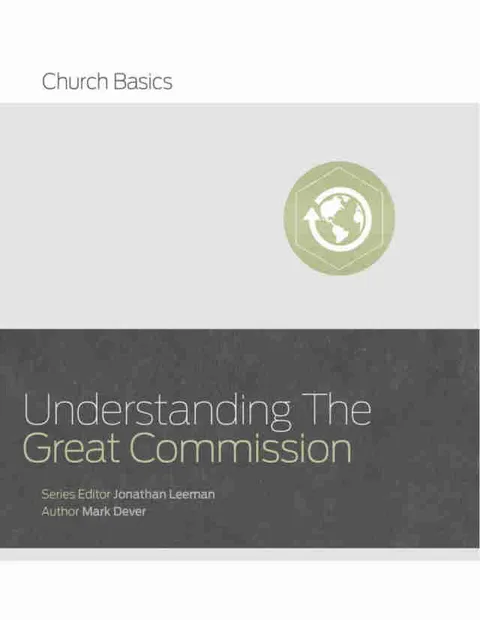

Understanding The Great Commission Order Printed Copy
- Author: Jonathan Leeman
- Size: 618KB | 56 pages
- |
Others like understanding the great commission Features >>






-160.webp)
About the Book
"Understanding the Great Commission" by Jonathan Leeman is a comprehensive exploration of the biblical mandate for Christians to make disciples of all nations. Leeman unpacks the historical context and theological significance of the Great Commission, emphasizing the importance of obedience and including practical guidance for believers to fulfill this mission in their everyday lives. Ultimately, the book challenges readers to prioritize evangelism and discipleship as integral components of their faith.
C.T. Studd

the lake of fire
"For there is nothing covered, that shall not be revealed; neither hid, that shall not be known. Therefore whatsoever ye have spoken in darkness shall be heard in the light; and that which ye have spoken in the ear in closets shall be proclaimed upon the housetops. And I say unto you my friends, Be not afraid of them that kill the body, and after that have no more that they can do. But I will forewarn you whom ye shall fear: Fear him, which after he hath killed hath power to cast into hell; yea, I say unto you, Fear him." Luke 12:2-5 Never were words ever spoken more solemn, more terrible, and arresting than these words of the Lord Jesus Christ as He warns His hearers against the danger of being cast into an eternal Hell. And coming from the lips of the gentle, loving, kind and compassionate Jesus, they fall upon our ears with terrific emphasis. Hardest of Messages In this and several messages to follow, we propose to talk on the subject of the "Bible Hell." As we prepared these massages, we were torn between two violent emotions. As we thought on the subject of our future destinies, our hearts warmed with the thought that the saved would spend eternity in Heaven, and we thrilled at the glorious revelation of the Scriptures concerning the future abode of the saved. But when we studied and contemplated the awful revelation of Scripture concerning the eternal abode of the lost and the damned, and studied the subject of a Bible Hell, we were shocked with fear and trembling at the revealing Word of God concerning this place called "Hell" in the Scriptures. It is also called "The Lake of Fire," and the "Perdition" of the unsaved, and the place of "Outer Darkness." I must frankly acknowledge that it was only after severe heart struggle that I finally persuaded myself, and concluded that I must preach on this subject at this time. I do wish that I could believe that there is no Hell for the wicked. I wish that I did not need ever to preach on this terrible subject. I would give almost anything if I could preach only on the love of God continuously and never have to mention the wrath of God upon the sinner. I must honestly confess that I have tried to find excuses for not having to preach on this subject at all. No Choice But the preacher of the Gospel has no choice in these matters. He is under constraint to preach the full counsel of God, and everything the Word contains. The dire warning of Ezekiel 3:17 and 18 kept ringing, ringing in my ears, and finally persuaded me: "Son of man, I have made thee a watchman unto the house of Israel: therefore hear the word at my mouth, and give them warning from me. When I say unto the wicked, Thou shalt surely die; and thou givest him not warning, nor speakest to warn the wicked from his wicked way, to save his life; the same wicked man shall die in his iniquity; BUT HIS BLOOD WILL I REQUIRE AT THINE HAND." Ezekiel 3:17-18 That was enough for me, and I promised God that very moment that by His grace I would warn the wicked with all of my might and power, and keep my hands clean of the blood of my fellow men. The reason then for preaching on the subject of hell may be given under four heads: 1. It is the clear revelation of Scripture. 2. It is commanded that we warn men against it. 3. The modern pulpit is almost completely silent on the subject and that necessitates someone raising his voice about this matter. 4. Hell is a moral necessity in a moral universe. First of all then, the Bible clearly teaches a place called by various names, where the wicked and the unrepentant and the Christ-rejecting will spend eternity. It has been called the Lake of Fire, the Second Death, the Place of Outer Darkness, the Place prepared for the Devil and his angels, and many other highly descriptive names, all summed up in the one word, Hell. The word itself occurs some fifty-three times in our English King James version of the Scriptures; thirty-two times it occurs in the Old Testament, and twenty-one times it is found in the New Testament. However, the word rendered "hell" in our English Bible is a translation of at least three different Hebrew words. The word, whenever it occurs in the Old Testament, without exception is always "sheol," and never refers to "hell" at all, but instead to the temporary abode of the souls of the dead in the center of the earth until the Resurrection of Jesus. Of the twenty-one times the word "hell" occurs in our English Bible in the New Testament, it is the translation of the word "hades " at least ten times. Hades, mentioned ten times is the Greek word for the Hebrew "sheol," and both of them refer to the same place of the lost dead in the heart of the earth. In the ten instances then of the twenty-one occurrences of the word "hell " in the New Testament, it means not the eternal abode of the lost, or the Lake of Fire, but the temporary abode of the wicked in sheol-hades until they will finally be cast into the Lake of Fire at the end of the ages. In Revelation 20:14 we read: "And death and hell (hades) were cast into the lake of fire..." Rev. 20:14 The souls of the lost are in hades now. At the end of the Kingdom Age they will be bodily resurrected in the second resurrection, and then cast body and soul into the Lake of Fire. Be sure, therefore, first of all to distinguish between sheol-hades, the temporary abode of the lost, and Hell, which is the eternal abode of those who now already are in sheol-hades. While on this aspect of the subject, there is one other word in the Bible also translated "hell." It occurs only once in the Scriptures, and is found in II Peter 2:4 where we read: "For if God spared not the angels that sinned, but cast them down to hell, and delivered them into chains of darkness, to be reserved unto judgment." II Peter 2:4 Here is God's revelation concerning some of the fallen angels who were cast down to "hell," but again we must remind you that the word translated "hell" is a mistranslation of the original. The word in the Greek is "tartaroo," and refers not to the Lake of Fire, but to a special place prepared for a certain group of fallen angels until finally they, too, with Satan, their leader, will be cast into the Lake of Fire (Revelation 20:10). In the balance of the instances where the word "hell" occurs, it is a translation of quite another word, the Greek word, "gehenna." Let me repeat, the word "hell" occurs fifty-three times in your King James version. In twenty-one instances in the New Testament it is not "gehenna," but should have been translated "hades" and not "hell." In one instance (II Peter 2:4) it again is a mistranslation of the word, "tartaroo," and does not refer to the Lake of Fire. Jesus Uses It Ten Times In the remaining eleven instances where the word, "hell" occurs in the Bible, it is a translation of the Greek word, "gehenna," and refers to the eternal abode of the lost in the Lake of Fire. And now here comes one of the most amazing, arresting things of all. In ten out of these eleven times where the word occurs in the New Testament, it falls from the lips of the gentle Jesus, and only once by any other, James in James 3:6. I emphasize this tremendous fact—ten of the eleven occurrences in which the word, "gehenna" (hell) is used in the Bible, it is uttered by the loving, gentle, compassionate, kind and sympathetic Lord Jesus Christ who came to save people from Hell. Twice it is used by Christ in His Sermon on the Mount. Again we emphasize this fact, because modern theology would do away with the fact of a literal Hell. We are told over and over again that God is so loving, so kind, so long-suffering, so tender, that He would never even think of sending His creatures into a literal Hell. We are told, therefore, not to preach on judgment and sin and condemnation and on the Lake of Fire, for this is a medieval, pagan doctrine, a hangover from the dark ages, and pagan polytheism. We are told, "preach the Beatitudes, preach the Golden Rule, preach the Sermon on the Mount. We are admonished to preach on these subjects. Yes, indeed, we should preach the Sermon on the Mount, but if we do, we will have to preach on the subject of Hell, for the first two times that the word "hell" is ever used in the New Testament, it is used by the Lord Jesus Christ Himself in no other place but in the Sermon on the Mount (Matthew 5:22 and Matthew 5:29). Hell Is a Fact Beloved, hell is a dreadful fact. We may rebel against it, we may try to do away with it. I, too, wish I could believe that there is no eternal Hell, but to do so I must throw away my Bible, make Jesus a mistaken scarecrow, violate every rule of moral justice in the universe, and give up my faith in a God who is holy, just and righteous. If there is no eternal doom to be saved from, then the coming of a Saviour was unnecessary, His death a miscarriage of justice on the part of God, and the Bible becomes a book of scary, bogie-man pessimism. If there is no Hell, then every Gospel preacher who warns sinners to flee from the wrath to come is a despicable, repulsive, calamity howler, and ought to be silenced immediately and forever. But if God and the Bible are right, and therefore there is a Hell, then by the very same token, the preacher who does not lift up his voice and cry and warn sinners to flee from the wrath to come, becomes a pitiable, unfaithful traitor to his fellow men, and disobedient to God and to His Word. If you think that these statements are drastic, please, please let me quote again, before closing, the passage I gave you at the beginning of this message. First, Luke 12:4: "And I say unto you my friends, Be not afraid of them that kill the body, and after that have no more that they can do. But I will forewarn you whom ye shall fear: Fear him, which after he hath killed hath power to cast into hell; yea, I say unto you, Fear him." Luke 12:4-5 Or will you listen to this. Jesus is again speaking in Matthew 10:28: "And fear not them which kill the body, but are not able to kill the soul: but rather fear him which is able to destroy both soul and body in hell." Matthew 10:28 Oh, my friend, either these words of our Lord Jesus Christ are true or they are not true at all. It is one or the other. It cannot be anything else. If they are not true, then of course, the Lord Jesus Christ was mistaken, and we might just as well throw our entire Bible away. But these words are the truth, they are God's Word. It is what Jesus Himself said, and this being so, what else can I do as the messenger of God than to cry out, Hurry, Hurry, Hurry, Flee from the wrath to come, before it is too late. I have no other alternative, as the words of Ezekiel ring again in my heart: "When I say unto the wicked, Thou shalt surely die; and thou givest him not warning, nor speakest to warn the wicked from his wicked way, to save his life; the same wicked man shall die in his iniquity; but his blood will I require at thine hand." Ezekiel 3:18 Oh, may God help me to keep my hands clean of the blood of my fellow men. In our coming messages, the Lord willing, we shall speak on where Hell is, what it is, how long it will last, and other matters clearly revealed in the Bible. But before we close this message, I must tell you how you may escape this awful fate in the Lake of Fire. God says He is not willing that any should perish, and He has made a way of escape through His Son, Jesus Christ; Jesus Christ the Son of God who died on the Cross and rose again from the grave to save you from eternal doom. His Word clearly says: "He that heareth my word, and believeth on him that sent me, hath everlasting life, and shall not come into condemnation; but is passed from death unto life." John 5:24 "For whosoever shall call upon the name of the Lord shall be saved." Romans 10:13 Oh, call on Him now. Cry to Him in faith to save you. Receive Him now and believe His Word: "Him that cometh to me I will in no wise cast out." John 6:37 Chapter Two "And he saith unto him, Friend, how camest thou in hither not having a wedding garment? And he was speechless. Then said the king to the servants, Bind him hand and foot, and take him away, and cast him into outer darkness; there shall be weeping and gnashing of teeth." Matthew 22:12-13 Jesus and the Bible teach beyond all controversy and beyond every shadow of doubt that there is both a Heaven for the saved and a Hell for the lost. Personally, I would ten times rather preach on heaven than on the subject of hell. I wish that I could believe that there is no eternal hell for the lost; but to do so, I would have to reject the Bible, refuse to believe Jesus, and violate every single principle of moral justice in the universe. This truth of the eternal perdition of the lost is the whole background of Calvary, for if there is no doom and judgment from which to be saved, there is neither point nor reason for the suffering and the death of a Saviour, for the very depth of His agony and his suffering speaks to us of the awfulness of the judgment from which He came to save us. We are, therefore, commanded to preach not only heaven for believers, but eternal doom for the wicked, much as we tremble at and shrink from preaching on the subject of a Bible Hell. It is simply impossible for the faithful preacher to relieve himself of this imperative responsibility, so definitely laid down in the Word of God. Silence of the Pulpits I have felt the necessity of preaching on this subject emphatically for a long, long time. We gave four reasons for this in our previous message: 1. The Bible clearly teaches the fact of a Bible Hell. 2. We are definitely commanded to warn men to flee from the wrath to come. 3. There is a deathly silence on this subject in many pulpits, and therefore, necessitates our emphasis on this truth again. 4. Hell is a moral necessity in a moral universe. We take up therefore now our third compelling reason, the inescapable reason for teaching this very unpopular and painful subject which we are dealing with at present. The idea of punishment forever and ever is in itself so very unpleasant a thought that the subject of Hell is seldom heard in the average pulpit in the land today, and never heard at all in many, many churches. You can hear the word "hell" used far more frequently on the street, on the train, in the business offices, than from the pulpits. Profane men use it in cursing, far oftener than many preachers use it in their pulpits. It is avoided on every hand, in the very place where it should be spoken the most. Satan's Trick It is a clever trick of Satan, our adversary, to take away the fear of God and the fear of hell from the hearts of men. Glibly we are told, "Don't preach judgment, don't scare people with caricatures of an angry God. Tell us about the love of God, His goodness, the dignity of man, and the universal fatherhood of God." But, my friend, that does not change the Word of God nor does it change the facts before us. Hell may have lost its terrors, but it hasn't lost any of its reality. It is still a Scriptural fact revealed in the Bible. A friend, a radio listener, wrote me some time ago and said, "I am surprised that a man of your training with a college, university and seminary background, could still believe in that old, antiquated, moth-eaten, disproved apparition of the age of superstition and paganism, a literal Hell. No modem scholar believes that at all any more." Well, so then I am not a scholar, if this is true. But suppose that no intelligent scholar believes anymore in eternal punishment. What does that prove? It still does not change God's Word one iota. Of course, it just isn't true that all scholarship has discarded belief in a literal Hell. There are still thousands of the greatest scholarly men in the world who do believe it, and have been saved from it through faith in the Lord Jesus Christ. But even though all the wise men and all the theologians and all the scholars in the world should reject it—so what? It would still be true. I don't suppose there was a single scholar in Noah's day who believed a word that Noah was preaching concerning a flood which was imminent. But it came just the same. Not only does the Bible record it, but even geology bears testimony to this fact. There were no scholars in Lot's day who believed the coming judgment of Sodom and Gomorrah, but it came just the same and they perished in it. The scholars of Jesus' day paid but scant attention to our Lord when He warned of the destruction of Jerusalem, and the judgment of God upon the nation of Israel, but it came just the same. Ah, yes, my friend, "Let God be true and every man a liar" (Romans 3:4). Satan surely delivered a master-stroke when he convinced man that hell was not real, but just a figment of the imagination, and an outmoded fancy. Few there are, therefore, who today still believe in a Bible Hell. Men use the word so glibly, whereas if they only realized what the Bible says about it, they would tremble at the word. Today we hear on every hand and read in our magazines all sorts of joking about this awful place, and it is made the butt of many a gag and a joke to entertain the poor, blind souls who themselves face this awful doom. Key to Revival If we are to have a revival of soul winning, it will come only when we return without compromise or apology to the preaching of the awfulness and the filthiness of sin, the holiness of God, and the certainty of a Bible Hell. Read the history of revivals throughout the ages and you will find that in every instance it came as a result, and was accompanied by, the preaching not only of the love of God, but the wrath of God upon sinners. We read a lot about the "key to revival"; but I declare that the real key is a return to good old-fashioned Methodist preaching of the holiness of God, His hatred for sin, and a revival of some good fire and brimstone preaching for sinners. I believe the Bible, I believe every bit of it. I believe what it says about the love of God, about His mercy, His grace, His patience, His long suffering. I believe what it says about Heaven. But I also believe that God is holy, perfect, just, righteous, and will in no wise clear the guilty but will insist that every disobedience and transgression receive its just recompense of reward. And since I am bound to believe this, if I am to be consistent, I would be a despicable hypocrite if I did not warn men about it. Bible Is Clear Let me quote for you just a few passages, verbatim, taken from God's own Holy Word. If you believe the Bible you will be convinced; if you do not believe the Bible, of course, then we have no common ground to start with, and we have no more to say to you at all. You become then, like a ship without a rudder, a sailor without a compass. In II Thessalonians 1:8 we read, as Paul is speaking here under inspiration, that the Lord is coming: "In flaming fire taking vengeance on them that know not God, and that obey not the gospel of our Lord Jesus Christ: Who shall be punished with everlasting destruction from the presence of the Lord, and from the glory of his power." II Thessalonians 1:8-9 And the Apostle John in Revelation tells us: "But the fearful, and unbelieving, and the abominable, and murderers, and whoremongers, and sorcerers, and idolaters, and all liars, shall have their part in the lake which burneth with fire and brimstone: which is the second death." Revelation 21:8 Or listen to the Lord Jesus Christ Himself as He describes the destiny of the wicked in Matthew 25: "Then shall he say also unto them on the left hand, Depart from me, ye cursed, into everlasting fire, prepared for the devil and his angels: And these shall go away into everlasting punishment: but the righteous into life eternal." Matthew 25:41, 46 It is hardly necessary, I am sure, to quote additional passages to show what the Bible says about the future destiny of the wicked. I am not trying to convince you that there is a Hell, not at all; I am merely trying to show you what the Bible says clearly concerning this place. Then if you reject it, you are not rejecting my word, but God's own holy, infallible Word. If you differ with me, that is not serious, for I too may be wrong, but if you differ with the teaching of the Word of God, you do it only at the peril and the expense of your own immortal soul. If you don't believe it, you will have to take it up with Him, who is the Author, the One who wrote this Book, and not with me. All that I can do and am trying to do is to tell you what God says, and then the decision must, of course, be up to you. Must Be a Hell We have time before we close this message on the subject, "The Lake of Fire" to say a word about the absolute moral necessity of future retribution. Again and again we hear the argument, "I can't imagine a loving God sending His creatures to an eternal place of suffering. I can't believe that a loving God would allow His creatures to suffer in a literal Hell." Well, my friend, that doesn't happen to be the point at all. Your sentiments, after all, have nothing to do with it. It is entirely a question, as far as I am concerned, of what God has to say, not what I think or what any other man thinks. I do declare, that was the argument the Devil gave to Eve. God had said to Eve. "The day thou eatest thereof thou shalt surely die." The Devil placed doubt in the mind of Mother Eve, and said, "ye shall not surely die." It was his opinion against the opinion of God, and I repeat again, that I do wish that I did not have to believe in the eternal Lake of Fire. But in addition to the clear teaching of the Word of God and the holiness of God, my common sense and my reason demands that there must be a place of retribution. The fact of Hell rests upon the very foundation of a moral universe. Do away with the punishment of evildoers, and the whole moral fabric and integrity of society breaks down completely. Basis of Government The basis of all good government is justice. Evildoers must be punished. We have laws to punish the thief, the murderer, the liar, the robber, the traitor, the rebel. No one denies that this is just and right. Every jail and prison in the world is a monument to the necessity of a moral government and the justice of punishing the criminal. What a world this would be if there were no laws to govern, and no penalty for the criminal and the transgressor? We even inflict the death penalty as the punishment for certain crimes and no one questions the right of the government to do so. Why then object to the right of a sovereign God of Heaven and earth to punish His rebelling subjects and creatures. Deny this, and I repeat, the whole moral fabric of the universe immediately breaks down. This world is so full of inequalities, there must be a reckoning some day. If death ends all, and there is no retribution for evil, how then do we explain the despots who lived in luxury here below, oppressing their fellow men, murdering, pillaging, subjecting others to their atrocities. Think of the Hamans, the Neros, and the Hitlers whose hands are stained with the blood of thousands and millions of innocents. Did death end all for these men? Is there no punishment for such? Then my faith in the moral integrity of the God of the universe must go by the board entirely. Ah, no, my friend, a God of love who would let sin go unpunished would be no God at all. He would do less than even human justice demands. How explain all the suffering and the death and tears, heartache and sorrow, disease and pain and separation in the world! How explain war, which slays millions and the pestilences which kill millions more, and famines with its countless millions! If God is a God of love only, will you explain to me why He permits these things to happen? If God is a God of love only and will not let His creatures suffer, then please tell me why these things are in the world today with an Omnipotent, Loving God ruling over all. But again we would close on a more hopeful and glorious note. There is a remedy, thank God. There is salvation, there is hope. If God had made no way of escape, how hopeless all would be. But listen, listen, my friend. It is still also true that: "God so loved the world, that he gave his only begotten Son, that whosoever believeth in him should not perish, but have everlasting life." John 3:16 Your hope, my friend, lies in receiving God's offer of salvation, not in rebelling against His justice, or denying His right to punish the wicked. Why not settle this whole business right now by receiving the Lord Jesus Christ and then, "There is therefore now no condemnation to them which are in Christ Jesus..." Romans 8:1 Why not believe God's Word, admit your sin, confess and repent, and receive Jesus Christ as your own Saviour for eternity, and be saved from your sin and the wrath to come. God help you to do it. Why take a chance, why gamble with eternity? Suppose you are right, and there is no Bible Hell, then I who do believe in it, still am losing nothing. But suppose you are wrong then you have everything to lose. I who believe the Word then have everything to gain—and nothing to lose. But you have nothing to gain and everything to lose by rejecting God's remedy of salvation. Believe, Believe, Believe on the Lord Jesus Christ and thou shalt be SAVED. Chapter Three "And the beast was taken, and with him the false prophet that wrought miracles before him, with which he deceived them that had received the mark of the beast, and them that worshiped his image. These both were cast alive into a lake of fire burning with brimstone." Revelation 19:20 In this terrible, awesome verse we have the record of the first occupants ever to be thrown into Hell. These two men, the beast and the false prophet, are the first individuals ever to be cast into the Lake of Fire. Hell today is completely empty, totally devoid of all occupants. The lost are in Hades according to the Word of God. The fallen angels are in the special place called tartarus in 2nd Peter 2:4. After the tribulation period and at the return of the Lord Jesus Christ in glory to this earth, these two men, the beast and the false prophet, will be cast into this place called the Lake of Fire. Here they remain for a period of one thousand years, and then a millennium later they are joined by their master, Satan and the Devil. We have the record of this casting of Satan into Hell in Revelation 20:7: "And when the thousand years are expired, Satan shall be loosed out of his prison. ...and fire came down from God out of heaven, and devoured them. And the devil that deceived them was cast into the lake of fire and brimstone, where the beast and the false prophet are, and shall be tormented day and night for ever and ever." Revelation 20:7, 9, 10 Not Annihilation This is an important passage which must not be overlooked. For one thousand years these two men, the beast and the false prophet, are in the Lake of Fire, but they are not destroyed. After one thousand years when Satan joins them we read definitely, "And the Devil was cast into the lake of fire where the beast and the false prophet ARE." After a thousand years they are still there, alive. We cannot therefore teach that Hell is annihilation. It is not in any sense a burning out of existence. The Lost So far then, we have two groups in the Lake of Fire. At the beginning of the thousand years the beast and the false prophet are cast into hell. One thousand years later Satan is also cast into the same place with them, and then soon to be joined by all his wicked followers, the unsaved and the lost. In the last verse of this same chapter we read: "And whosoever was not found written in the book of life was cast into the lake of fire." Revelation 20:15 Origin of the Lake of Fire While the Bible has a great deal to say concerning the subject of Hell, there are some things which our Lord has not seen fit to reveal to us at this time, and on which the Bible is either silent or only gives the faintest suggestions. We do not know, for instance, when Hell was created, nor where it is located. As to its origin, we can safely say, however, that it was not a part of God's original creative act. In Genesis 1:1 we have the account of the original creation. Before the first verse of Genesis 1:1 there was nothing, of course, except God. God all alone in that perfect holy, family love-life of Father, Son and Holy Spirit. In this beginningless life of the great eternal "I Am," God planned a creation to be called into being at a time that He Himself in sovereign wisdom should choose. In the plan of this original creation described in Genesis 1:1, Hell was not included. That must have been a subsequent provision. In Genesis 1:1 we read, for instance: "In the beginning God created the heaven and the earth." Genesis 1:1 Now will you please notice very carefully that this was the beginning of the creation—not the beginning of the existence of God. In John 1:1 we are distinctly told that in the beginning when God created the universe, "the heavens and the earth," He already was. The Creator is un-created. And so John tells us: "In the beginning WAS the Word, and the Word WAS with God, and the Word WAS God." John 1:1 The verb translated "was" is a Greek verb used only of the existence of God. It denotes existence without reference to any beginning at all. In the following verse in John 1 we read this concerning the creation: "All things were made by him; and without him WAS not any thing made that WAS made." John 1:3 In this verse again the verb "was" occurs three times, twice as "was" and once as "were"; but in this instance it is quite another word which denotes existence from a beginning. It literally means to "become." What a wonderful evidence of divine inspiration. When John uses a verb with reference to God, he uses the word "was" which means to exist without any beginning, but immediately when he begins to speak about the creation, he changes the word and uses another which means "to become" or to "exist from a beginning." In the beginning, then, God created the heavens and the earth. The word in your Bible is heaven (singular) but in the Hebrew text it is plural, "heavens." The word is "shamayim" the ending IM, being the plural ending, just as the letter "s" denotes plurality in our English language. The reference is, of course, to more than one heaven. The Bible distinguishes at least three heavens, the lower heaven (auronos); the middle heaven (mesoranios), and the upper heaven (eporanios). The lower is the atmospheric heaven of air and of clouds and of vapor enveloping the earth. The mid-heaven is the planetary, astronomical starry heaven, and beyond this, is the third or the upper heaven, also called in Scripture, "the heaven of heavens." But No Hell When God created the heavens and the earth, it included at least the two lower of these heavens, and we believe the atmospheric heaven and the planetary heaven were created at this time, and possibly the third heaven. Remember the word is in the plural, "shamayim," the heavens. But strange, and yet not so strange, there is no mention of Hell in this original creation. The Bible does not say: "In the beginning God created the heavens and the earth and hell." No, Hell is significantly omitted. Of course, God being omniscient knew that sin would come, and a Hell would become necessary later on, but before sin entered, there was no Hell prepared by God, Hell was a later provision. When Was It Prepared? The question then arises, "When did God prepare this Lake of Fire?" To this we cannot give a positive, definite answer, but it must have been after the fall of the angels. From the book of Job we learn that the angels (called morning stars) were present at the original creation of the earth. There is much evidence that the original earth, millions upon millions of years ago, was the habitation of these created angels. And then Lucifer, the archangel, and the leader of the angelic hosts, rebelled against Almighty God with a host of lesser angelic beings, and as a result was cast both out of the earth, and out of heaven, and banished to the upper atmosphere. Some wicked angels are in the place called "tartarus" today (2 Peter 2:4). Now because of the sin of these fallen angels, together with Satan, God prepared a place to which they will be consigned in everlasting damnation, to be tormented day and night forever and ever. This is plain from a statement of our blessed Lord Himself, when He says in Matthew 25:41 of the judgment of the wicked in the words we quoted before: "Then shall he say also unto them on the left hand, Depart from me, ye cursed, into everlasting fire, PREPARED FOR THE DEVIL AND HIS ANGELS." Matthew 25:41 What a tremendous solemn revelation! The fires of everlasting Hell were never meant for mankind. They were never meant for you, my poor sinner friend. It was prepared for the Devil and his angels. God never made man for Hell, nor did He make Hell for man. If man goes there, it will be only because he chooses to do so by refusing to receive God's wonderful gift of love and salvation. You will never be able to blame God for sending you into the everlasting fires. Only Two Masters There are only two destinies then, Heaven and Hell. There are only two masters, Christ and the Devil. And you, my friend, as well as I, can serve only one of these. It must be one or the other, Jesus said: "No man can serve two masters." And if you serve Christ here below, it is wholly just and fitting and right that you should spend eternity in bliss in Heaven with the One whom you loved and served here below. But if you choose to serve the Devil, and refuse to receive the Lord Jesus Christ, let me ask you honestly and sincerely, isn't it right and just and proper, consistent and wholly fitting that you should spend eternity with your master, whom you have chosen to serve, even the Devil, in the place of torment prepared for the Devil and his angels? It is your own choice, my friend. You can blame no one else. Certainly there can be no argument here. When this place of torment was prepared we, of course, do not know; but we do know that it was made necessary by sin, and particularly the sin of the angels, and prepared as the place of eternal punishment for the Devil, his angels, and all who choose to follow him, rather than be saved by the Lord Jesus Christ. Ah, my precious friend, as we contemplate these thoughts, why not take Jesus Christ as your Saviour? How awful to be the companion of the Devil throughout eternity in the place of outer darkness. Hell never was meant for you and God does not want you to go there. If you do, it will be your own fault in refusing to receive God's offer of Heaven and salvation. If you end up in the place of eternal doom, it will be over the very body of the Crucified Son of God, so why not receive Him now? Where is Hell? We have just time for one more question concerning the Bible Hell, and then in our next and last message on this dread subject we shall discuss the questions: Who is there now? Who will still go there in the future? What will be the conditions there? And how long will it last? But now, "Where is the Lake of Fire?" Again the Bible gives no definite answer. It may be some blazing star a million light years removed from this earth. It may be some burned out, ruined planet. We just don't know. One or two things we do know, however. It is complete separation from God, the God of light. He says, "Depart from me, ye wicked, into the place prepared for the Devil and his angels." And it is called the place of outer darkness. Outer Darkness But it is not only darkness, but it is called "outer darkness." We may translate it as "Uttermost darkness." A place so far removed from God and probably from the universe as we see it today, that not a single ray of light will ever penetrate. To grope in Stygian darkness without one ray of hope, banished from God forever, in the place of which Jesus says: "...there shall be weeping and gnashing of teeth." Matthew 24:51 Why do I say these things? Why do I preach on Hell? Why do I remind you of this, and repeat all these very unpleasant things? Listen, my friend, it's because I love you more than you will ever realize, and I want you to be saved. God loves you and He wants you to be saved. It will be a tremendous relief when I have finished these messages, I assure you. I have preached under tremendous pressure and a heavy burden for lost men and women. But God is my witness, I could not do anything else. If a doctor knew you had a terrible disease, but also knew an absolute remedy, he would be a devil if he didn't warn you and suggest the remedy. If I knew a bridge was out down the track, and I didn't try to flag down the train. I would be a murderer. If I saw your house on fire, and you were asleep in the house, and I did not try to awaken you, what kind of a brute would I be? Well, my friend, what would you think of me, a preacher of the Gospel called to warn men and women of the coming judgment, if I did not warn you. If I for fear of being unpopular or of being criticized should fail to cry out to you, "Flee from the wrath to come," there are no words to describe my despicable condition. And so here is the remedy. Right where you are you can be saved from sin, and judgment, and the fear of Hell forever. Here it is: Simply acknowledge that you are a sinner, believe God's Word, and then accept His promise of salvation. With your head bowed now will you say: "Lord Jesus, I, a poor, lost sinner, the best I know how, now trust thee to save me. I accept thee as my Lord, I believe thou didst die for me and rise again to save me for eternity." My friend, that is all you need to do. "Believe on the Lord Jesus Christ, and thou shalt be saved." Chapter Four "And the devil that deceived them was cast into the lake of fire and brimstone, where the beast and the false prophet are and shall be tormented day and night for ever and ever." Rev. 20:10 "And death and hell [hades] were cast into the lake of fire. This is the second death. And whosoever was not found written in the book of life was cast into the lake of fire." Rev. 20:14-15 In these awesome words, the Holy Spirit, through John, tells us of the final end and destiny of the Devil, and all his followers who have rejected God's wonderful salvation. We make no apologies for this revelation. We merely tell you what the Word of God has to say. If you have any objections, you can take them up with the Author of this Book, the One who wrote it. The Bible therefore teaches that there is an eternal Heaven for the saved, and an eternal Hell for the lost. Every single branch of Christendom has believed in the doctrine of final retribution and it is embodied in all the creeds of all the great branches of Christendom from the very beginning. Very true, today it is not being preached in many, many churches, but if you will investigate, you will find that it is still written in their creeds, whether its ministers preach their creeds or not. But our belief in a literal Hell is not based on church dogmas, religious creeds, human opinions, or the sentiments of men, but upon the infallible Word of God. My feelings and my sentiments too rebel against the idea of a literal, eternal Hell, but I am compelled to believe it because my own judgment convinces me and God says it. If it is not true, then there is no moral justice in the universe, but if it is true, I must, I must warn you to seek refuge in Jesus Christ. It is a Place In a former message, we told you the Bible does not locate Hell. We do not know where it is, except that it is in outer space and in outer darkness. However, while we do not know the exact location, we do know it is a literal place. Jesus said that "body and soul" would be cast into hell. Two literal men, the beast and the false prophet, enter it in Revelation 19, and a literal Devil joins them in Revelation 20. Origin of the Name The word "hell" in the original is "gehenna." There is no word for "hell" found in the New Testament, although the word "sheol" is so translated in the King James English version, but is corrected in the revised version. The word "hell" occurs only eleven times, and of these eleven times Jesus uses the word ten times. The word, "gehenna" itself comes from two Hebrew words, "gay" meaning "a gorge" and the word "Hinnom"; and the two words together mean "the gorge or valley of Hinnom." It was the place where the wicked king of Israel, Manasseh, sacrificed his children in the fire (2 Chron. 33:6). It was called "the Valley of Hinnom." Gehenna, then, is the Greek form of the Valley of Hinnom. It was a place of fire and death and sorrow. Later on, the word "gehenna" was applied to the gorge or the valley outside the city of Jerusalem, where the refuse and the garbage and the offal of the sacrifices were cast to be burned. It corresponds to our version of the city dump, with its vermin and smoldering fires; hence, Jesus' description of it as a place "where the worm never dies, and the fire is never quenched." Jesus' Picture This place of burning outside of the city of Jerusalem our Lord Jesus Christ uses as a figure to describe the place of the lost in the Lake of Fire, called by Him, "gehenna" and "hell." The Valley of Hinnom was a literal place, and Gehenna is a literal place. You may insist that this is only a figure, but that again, my friend, cannot alter the fact. If the description of burning, and a Lake of Fire is a figure, then how much more awful the reality itself must be than the figure is itself! Who is There? There is no one in Hell today. Satan is not there, for he will not be cast into Gehenna until after his final rebellion in Revelation 20. Today, we are told he, "as a roaring lion, walketh about, seeking whom he may devour" 1 Peter 5:8 The fallen angels who kept not their first estate are not there, for 2nd Peter 2:4 tells us they are reserved unto judgment in the place called tartarus. The lost are not there, for they are today in sheol-hades, in the center of the earth, and will not be cast into the Lake of Fire until after the judgment of the great white throne (Revelation 20). Hell today then, is empty. Its first occupants as we told you before, will be the beast and the false prophet (Revelation 19:20), to be followed a thousand years later by Satan (Revelation 20:10) and then to be joined by all the lost at the end of the world (Revelation 20:15). The Duration And now we take up the matter on which there is a great difference of opinion. All who believe the Bible, believe in the existence of some kind of a hell. But all are not agreed as to its character and duration. How long will the Lake of Fire last, and how long will the lost be there? There are some who teach that the wicked will be utterly consumed and annihilated in Hell, and burned up into ashes. Still others teach that they will be delivered after a longer or shorter period of time, and therefore, Hell is a sort of a purgatory, more than a place of actual punishment. We believe that the Bible is quite clear on the matter, however. Much as we shrink in fear, and recoil at the idea of eternal punishment, we have no choice but to tell you what God says and the Bible teaches, and then it will make no difference what anyone else may have to say. The wicked are said to be cast into Hell forever and forever. Now the word, "ever," is "aion" in the Greek and means "an age." An age is an indefinite period of time. The expression, "forever and ever," then, means "the ages of the ages," or "indefinite periods of indefinite periods of time." This was the Greek's way of expressing eternity, everlasting or eternal. We seldom weary you with Greek or Hebrew words, but this matter is so vital, so important, that we are going to ask your indulgence just this once. Then go to your concordance or your Greek lexicon, or better still, go to your own pastor, and ask him about it. Here it is. The expression, "forever and ever" is a translation of the Greek phrase "tous aionas ton aionon." Now this expression, "Tous Aionas Ton Aionon,'' translated "forever and ever" in the Bible is used exactly thirteen times in the last book of the Bible alone. Now follow this carefully. This expression translated "forever and ever" occurring thirteen times in Revelation alone is used: 1. Nine times for the existence of God; that is, nine times God is said to live or reign "forever and ever," and the expression is "Tous Aionas Ton Aionon." 2. One time it is used for the eternal existence of the saints in Heaven. 3. Once it is used for the eternal torment of the Devil in Hell. 4. In the other two times the same identical expression is used for the duration of the suffering of the lost in eternal torment. Do you see what is involved in this, my friend, when we teach that when the Bible says "forever and ever," it means FOREVER AND EVER? It is a serious error to say that "forever and ever," is not eternal. If the Bible says that the wicked are cast into the Lake of Fire forever and ever, it must mean just that. If it does not mean "eternal," then it cannot mean that God is eternal, that Jesus is eternal, that the saints will be in Heaven eternally. For the same identical phrase is used to designate all of them. If it means "forever," therefore, in one place it must by every rule of logic mean "forever'' in every other place. Degrees in Gehenna Before we close this series, however, there is one more thing that we want to make clear. While Hell is described in the Bible as a place of torment and suffering, not all the occupants in the Lake of Fire will, by any means suffer in the same degree. To some, Hell will be a little heaven compared with what it will be for others. God's judgment will be according to justice and righteousness, for "his mercy endureth forever." It will be absolutely fair and just. Nowhere is this more clearly taught than in Revelation 20. "And I saw a great white throne, and him that sat on it, from whose face the earth and the heaven fled away; and there was found no place for them. And I saw the dead, small and great, stand before God; and the books were opened: and another book was opened, which is the book of life: and the dead were judged out of those things which were written in the books, ACCORDING TO THEIR WORKS." Rev. 20:11-12 Now I would have you notice particularly those words: ACCORDING TO THEIR WORKS. This same thing is repeated again in verse 13. This judgment therefore, is according to their works. It is to determine the DEGREE of their punishment. The destiny of the lost was settled forever when they died. That was determined by their rejection of the Lord Jesus Christ. Salvation does not depend upon works, but on faith alone. But here at the final judgment these lost, whose eternal abode in Hell was already determined and settled by their rejection of Christ, are now to be judged as to the degree of their punishment, determined by the light which they have rejected, the opportunities they have enjoyed, and the works that they have done. It will be infinitely more tolerable in the day of judgment for the pagan who never heard the Gospel at all than for you who have heard and rejected the invitation of the grace of God over and over again. I repeat, therefore, that Hell will be heaven for some who have never had the opportunities which others have had, compared to those of you who have lived in Christian lands, heard the Gospel over and over again, and then rejected it. Our Lord Jesus Christ Himself said: "For unto whomsoever much is given, of him shall be much required: and to whom men have committed much, of him they will ask the more" Luke 12:48 Again our Lord said in Matthew 11:21 to 24: "Woe unto thee, Chorazin! woe unto thee, Bethsaida! for if the mighty works, which were done in you, had been done in Tyre and Sidon, they would have repented long ago in sackcloth and ashes. But I say unto you, It shall be more tolerable for Tyre and Sidon at the day of judgment than for you. And thou, Capernaum, which art exalted unto heaven, shalt be brought down to hell: for if the mighty works, which have been done in thee, had been done in Sodom, it would have remained until this day. But I say unto you, That it shall be more tolerable for the land of Sodom in the day of judgment, than for thee." Matthew 11:21-24 From this it is perfectly clear that added light and added opportunity will make for added responsibility. And so we repeat, that not all will suffer alike in the Lake of Fire. It will depend upon the opportunity which has been rejected. If one is to be lost, therefore, in the end, then it would be far better that such an one had never heard the Gospel, far better would it be to die in pagan ignorance and heathen darkness, than to be lost in the land of light and opportunity after hearing the Gospel, and the pleading of the Spirit of God. If you are going to be lost, my friend, it would be infinitely better if you had never heard the message of salvation, if you had never heard this broadcast, yea, it would be better for you if you had never been born. The very fact that you have again once more heard the warning in these broadcasts increases your responsibility, and leaves you without any excuse. Now this concludes our series on this difficult subject, "The Bible Hell." I personally feel a deep sense of relief as I conclude this series. Never have I dreaded a subject as I have this one; never before have I felt the opposition of Satan as much as I have during these messages which I have given. Never have I been more severely tempted to pass by this difficult subject and to speak on something else. But I also feel not only a sense of relief that the job is done, but a sense of relief because I have been faithful in warning you. If any of you awaken bye and bye in the place of outer darkness, you will never be able to rise up against me and say, "that preacher knew about this place, he knew I was going to go here, but yet for fear of being called an old fogy, for fear of being unpopular, he failed to warn me." No, my friends, my hands are clean of your blood. Why not flee to Jesus now? Why not accept Him before it is forever too late? Bow your head, acknowledge your sin, call on Him to save you, and then believe His promise: "Whosoever shall call upon the name of the Lord shall be saved." Romans 10:13 Won't you come to Him now? God help you. From The Lake of Fire. Four Radio Sermons by M. R. DeHaan. [Grand Rapids, Mich.: Radio Bible Class, 194-?].