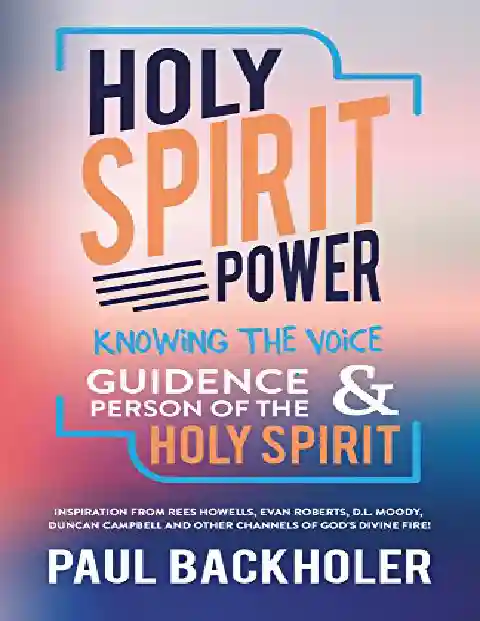

Holy Spirit Power: Knowing The Voice, Guidance And Person Of The Holy Spirit Order Printed Copy
- Author: Paul Backholer
- Size: 949KB | 202 pages
- |
Others like holy spirit power: knowing the voice, guidance and person of the holy spirit Features >>
About the Book
"Holy Spirit Power" by Paul Backholer is a comprehensive guide to understanding the Holy Spirit's role in the lives of believers. In this book, Backholer explores the ways in which the Holy Spirit communicates with and guides individuals, as well as the importance of developing a personal relationship with the Spirit. Through a combination of biblical teachings and personal anecdotes, the author offers practical advice on how to tap into the power of the Holy Spirit in order to live a more fulfilling and fruitful Christian life.
Eric Liddell
Eric Henry Liddell was born on 16th January 1902 in Tientsin (Tianjin) North China, second son of the Rev. & Mrs. James Dunlop Liddell who were missionaries with the London Mission Society.
He was educated from 1908 to 1920 at Eltham College, Blackheath, school for the sons of missionaries. Eric, with his older brother Rob, were left at their boarding school while their parents and sister, Jenny, returned to China.
During the boysâ time at Eltham College, their parents, sister and new brother Ernest came home on furlough two or three times and were able to be together as a family â mainly living in Edinburgh.
Although born in China and educated in England, Eric Liddell lived in Scotland at various times during his life.
In 1920, Eric joined his brother Rob at Edinburgh University to read for a BSc in Pure Science.
During this period he played rugby for Scotland and trained to run at the Olympics.
Athletics and rugby played a large part in Ericâs University life. He ran in the 100 yards and the 220 yards for Edinburgh University and later for Scotland. He played rugby for Edinburgh University and in 1922 played in seven Scottish Internationals with A.L. Gracie.
Eric Liddell was a gifted rugby player and played for the Edinburgh Univerisity 1st XV team.
He also played international rugby for Scotland and gained seven international caps as a wing-threequarter, scoring four tries thanks to his searing pace.
As a result of having insufficient time for both running and rugby, he chose the former, aiming for the 100 meters in the Paris Olympics. When he learned that the heats were to be run on a Sunday, he switched to the 400 metre competition as he was not prepared to run on a Sunday.
He won a gold medal for the 400 metres and a bronze medal for the 200 metres at the Paris Olympics.
He also travelled briefly to the USA in 1924 to compete in an athletics tournament. He returned to Edinburgh after the Paris Olympics and he graduated from Edinburgh University.
Eric Liddell lived for a short time in Gillespie Crescent before moving to a house in Merchiston Place.
Recollections of Eric Liddell By Sir Arthur Marshall
The Cambridge University Athletics Club had an invitation from Pennsylvania to take a team of seven to the Pennsylvanian Games in March 1924, and I was one of the seven. Eric Liddell, the Scot from Edinburgh University, the 1923 AAA 100 yards Champion, had been personally invited and travelled with us. We stayed at the very comfortable Pennsylvanian Cricket Club. I am afraid none of, including Eric Liddell, managed to win an event at the Pennsylvanian Games.
We travelled back in a small slow ship of the American United Line called âThe Republicâ â a ten day crossing. Eric Liddell entered in the fun and games on the boat, including the Fancy Dress Dance. Whilst he was very strict about religion. Eric and I became good friends and saw much of two American sisters, Freddie and Edith, who were travelling to âdo Europeâ, including the UK. They said they were going to be in Paris for the Olympic Games, and we said if we were there at the same time we hoped we could meet.
Harold Abrahams had set his whole life on winning the Olympic 100 Metres â it had become and obsession with him. Liddellâs achievement in winning the 1923 AAA 100 Yards in the record time of 9 7/10 seconds was a devastating blow to Abrahams and shook him to the core. To date Abrahams had been a consistent 10 seconds 100 yards winner but had only slightly broken 10 seconds on one or two occasions. He knew in the Olympics he would be up against overseas competition, particularly from the Americans, but this new and very serious opposition out of the blue and on his doorstep had come at a time when Harold had established his 100 yards supremacy in the UK. To achieve level pegging with Eric Liddellâs new record time, Harold had to improve his performance by two or three yards with the help of his trainer Sam Mussabini. It must have been a tremendous relief to Harold when it became known early in 1924 that Eric had decided to concentrate on the 400 metres and, because of his religious principles, would not compete in the Olympic 100 metres as first heats were always run on Sunday.
Eric had in turn become completely dedicated to winning an Olympic Medal within the restrictions of his faith. He was a famous Scottish international rugger player, and gave up his rugger to enable him to concentrate on his Olympic ambitions, which became very deep-rooted, and his work suffered. Winning an Olympic Gold Medal became a priority, second only to his religion, and the ambition to win this event became part of his religion.
Recollections of Eric Liddell By Sir Arthur Marshall
The team travelled to Paris days before the Olympics started and had a big send-off at Victoria Station.
The silence at the start of the 100 metres and 400 metres was quite electric. Harold Abrahams won the 100 metres in a new Games record time.
In spite of all that has been said about Abrahamsâ 100 metres, the 400 metres in some way provided the greatest thrill of the meeting with the world record being broken by Eric Liddell three times in two days. It was thought that Liddell had some chance of winning, but nobody thought Liddell capable of the amazing performance he achieved in the final. As far as the crowd were concerned they were well informed about Liddellâs dedication to his religion and his refusal to run in the first round of the 100 metres on the Sunday; they also knew of his determination to win this event. The occasion was enlivened by the support given to Liddell by the pipes and drums of the Cameron Highlanders.
The silence and pent-up excitement at the start of the race could be felt. Liddell went ahead at the start and maintained his pace throughout, finishing in what at the time was described as âa most lion-hearted mannerâ winning by three yards from Fitch, an American. This was probably the greatest achievement of the VIIIth Olympiad, and superlatives were showered on Liddell by the press of the entire world. Liddell was short and not a pretty runner but just pounded along virtually at the same pace all the way, with a finish as if he was making a final dash for a try in a rugger match with an opponent bearing down on him and about to tackle from behind.
After Eric had won the 400 metres Gold Medal, Eric and I made contact with Freddie and Edith, the American sisters, and took them to a Tango Tea Dance in the Champs Elysees.
Footnote: Along with sacrificing his place in the 1924 Olympics 100m, Eric Liddell also gave up two other races in which Great Britain held high hopes of winning gold that year â the 4 x 100m and 4 x 400m, whose finals also took place on a Sunday.
After the Olympics
After the Olympics and his graduation, he returned to North China where he served as a missionary from 1925 to 1943 â first in Tientsin (Tainjin) and later in Siaochang. During his first furlough in 1932 he was ordained as a minister.
1930 - 1932
On furlough from China studying at Congregational College. After completing his studies he was ordained as a minister on 22nd June 1932. During this time he lived in a hostel in George Square which belonged to the Edinburgh Medical Missionary Society.
During these periods Eric Liddell attended Morningside Congregational Church at the corner of Chamberlain Road and Morningside Road.
Morningside Congregational Church
The Church building (pictured here on the right) was originally built for North Morningside United Presbyterian Church who used it until 1881 when it became too small. They then built a new, larger, church on the other side of the road (which is now the Eric Liddell Centre).
From 1881 the old church was home to the Morningside Athenaeum Club before the Congregational Church purchased it in 1890.
In 1928 this church was demolished and a new one erected (which is now Morningside United Church).
Eric Liddell would have attended meetings in both buildings during his two extended stays in Edinburgh. The old church from 1920 to 1925 and the current building (Morningside United Church) from 1930 to 1932. He also preached at the church on a number of occasions.
On his return to China, he married Florence Mackenzie (of Canadian missionary parentage) in Tientsin in 1934. They had three daughters; Patricia, Heather and Maureen, who now all live in Canada.
Living in China in the 1930s was potentially very dangerous and in 1937 Eric was sent to Siaochang where he joined his brother Rob. He was now crossing the Japanese army lines.
In 1941 life in China was becoming so dangerous that the British Government advised British nationals to leave. Florence and the children left for Canada.
During 1941 â 1943 Eric stayed in Tientsin, then in 1943 he was interned in Weishien camp until his death in 1945.
The Eric Liddell Centre
The United Presbyterian Church merged with the Free Church of Scotland in 1900 and then, in 1929, this merged with the Church of Scotland.
The United Presbyterian Church built in 1879 became known as Morningside North parish Church. By 1980 the building was no longer in use and became the Holy Corner Church Centre.
This was an initiative of the three remaining churches at Holy Corner: Morningside United Church (a merger between the Congregational and Church of Scotland congregations and in joint membership of the United Reformed Church and Church of Scotland), Christ Church (Scottish Episcopal Church) and Morningside Baptist Church.
As the project developed the centreâs name was changed to The Eric Liddell Centre in recognition of his involvement in the life of one of the founding churches and the local community during his time living here.
what would judas do
Wednesday plants the suicidal seed of Holy Week: betrayal. Before there could be a Garden, there had to be a seed â the inception of insurrection. Jesus gloriously paid for our redemption with blood, but his blood was murderously bought with money. The promised Savior sold for just thirty pieces of silver. Jesus had taught his disciples, including the one who would betray him, âNo one can serve two masters, for either he will hate the one and love the other, or he will be devoted to the one and despise the other. You cannot serve God and moneyâ (Matthew 6:24). No one. Not Judas. Not you or me. The Love of Money Murdered Jesus The Pharisees loved money (Luke 16:14), feared men (Matthew 26:5), and hated Jesus (Matthew 26:4). That formula may be lived out before you more than you realize. The love of money often looks merely practical. The fear of men can hide behind masks. But the Bible is clear: If you love money and fear men, you cannot love God or escape hell (Luke 16:13; John 5:44) â and you become a card-carrying member of the crowd who crucified the Author of life (Acts 3:15). The cross â that horrifying drama of hatred â was only a symptom of the Phariseesâ craving for money, approval, and power. It was as if they bought a billboard to advertise their love for money, and set on a hill for all to see. But they would never do something so obvious. What would the people say? They âfeared the peopleâ (Luke 22:2). In fact, the peopleâs love  for Jesus was half the reason the religious leaders hated him so much. The authorities were cowards with cravings. They had to find a way to kill him quietly (Matthew 26:3â5). They had to find a way to murder an innocent man without losing any esteem or influence. First they needed an insider â someone close enough to Jesus to betray him, but far enough from Jesus to betray him. In other words, they needed a perp dressed like the Pope. âThen one of the twelve, whose name was Judas Iscariot, went to the chief priests and said, âWhat will you give me if I deliver him over to you?ââ (Matthew 26:14â15). âWhen they heard it, they were glad and promised to give him moneyâ (Mark 14:11). They found their man, someone who loved money as much as they did, someone who was willing to offend and ostracize even his closest friends for a pay day. The market had opened against the Messiah, and Judas was there to profit. As Randy Alcorn writes, âSatan works on the assumption that every person has a price. Often, unfortunately, he is right. Many people are willing to surrender themselves and their principles to whatever god will bring them the greatest short-term profitâ ( Money, Possessions, and Eternity , 41). Judas sold out the Savior, and for just thirty pieces of silver (Matthew 26:15). The Love of Money Makes a Name If you love money â value money and what it can buy above all else â you cannot love God. You will hate him, maybe quietly or privately and hypocritically â but you will hate him. And that hatred will mark you and follow you everywhere. That kind of divine rejection and betrayal renames a person. It defines you. For example, look at how Judas is talked about in the Gospels. â . . . Simon the Zealot, and Judas Iscariot, who betrayed him .â (Matthew 10:4) âJudas, who would betray him , answered, âIs it I, Rabbi?â He said to him, âYou have said so.ââ (Matthew 26:25) â . . . and Judas Iscariot, who betrayed him .â (Mark 3:19) â . . . and Judas the son of James, and Judas Iscariot, who became a traitor .â (Luke 6:16) âBut Judas Iscariot, one of his disciples ( he who was about to betray him ), said,â (John 12:4). âHe spoke of Judas the son of Simon Iscariot, for he, one of the Twelve, was going to betray him .â (John 6:71) âJudas, who betrayed him , was standing with them.â (John 18:5) Instead of being a faithful disciple guiding people to follow Jesus, he âbecame a guide to those who arrested  Jesusâ (Acts 1:16). What will be the testimony of your life â of your spending and giving? Will it be clear to others that you used what God had given you to lead others to  his Son, or will it be plain that you surrendered to the gods of the material and drew people away from  Jesus? Did you guide the blind to sight, or help blind them to death? The Love of Money Leads to Regret Judasâs affair did not fair so well for him. âThen when Judas, his betrayer, saw that Jesus was condemned, he changed his mind and brought back the thirty pieces of silver to the chief priests and the eldersâ (Matthew 27:3). Drowning in shame, he screamed for a refund. Confronted with the horror of his exchange, the money had lost its allure. What have I done?! What awful trade have I made?! Take it all back, and give me Jesus! There was no turning back for Judas, no return policy on this rejection. He killed himself in the overwhelming waves of regret and remorse (Matthew 27:5). However, there is time to turn back for you. Luke quotes Jesus for the greedy today, âTake care, and be on your guard against all covetousness, for oneâs life does not consist in the abundance of his possessionsâ (Luke 12:15). When life begins to seem like one long mission to make more money, someone is lying to you. Wake up and give back the silver before it crucifies you. John Piper writes, âWhen you are dying . . . money walks away from you. It abandons you. It will not go with you to help you. And nothing that you bought with it can go eitherâ ( Money, Sex, and Power , 65). And again later, â[The love of money] substitutes a dollar bill for the divineâ (71). The love of money leads only to regret and loss. Reject Judas, Receive Joy Ask yourself what Judas would do in your situation. How would he feel about your current income, shopping habits, and retirement savings? How uneasy would he be about your generosity? Does your budget begin to look like his, just two thousand years later? Refuse to follow Judas in his betrayal, and reject all that money promises to be in place of God. Find your security and satisfaction in something supernatural, eternal, and free. Piper goes on, reflecting on Paul in Philippians 4:11â13, When the stock market goes up or he gets a bonus, he says, I find Jesus more precious and valuable and satisfying than my increasing money . And when the stock market goes down or he faces a pay cut, he says, I find Jesus more precious and valuable and satisfying than all that I have lost . The glory and beauty and worth and preciousness of Christ is the secret of contentment that keeps money from controlling him. ( Money, Sex, and Power , 65) When our joy is no longer in our money but rather is in God . . . our money becomes the visible extension of joy in God, directed toward others. . . . Treasuring God above all things turns money into the currency of worship and love. ( Money, Sex, and Power , 123) Instead of surrendering to our cravings for more, letâs pour ourselves, every penny, into telling the world God  is our treasure â right now, later in retirement, and forever in eternity â and spending whatever it takes to bring others into that joy and security with us.