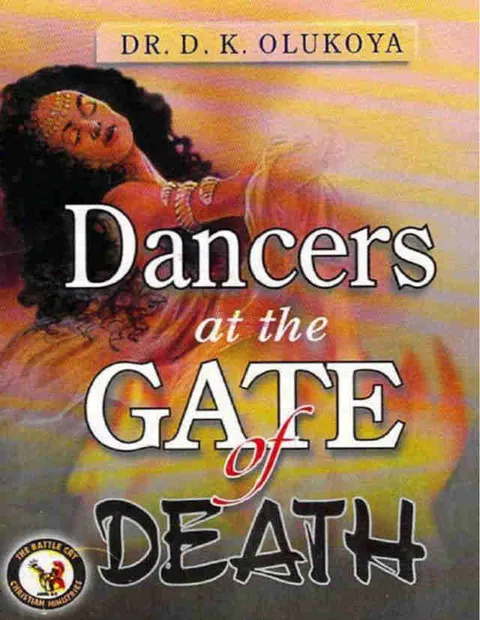

Others like dancers at the gate of death Features >>
Possessing The Gates Of The Enemy
Opening The Gates Of Heaven

Discerning The Voice Of God

Holy Spirit, Your Helper
The Power Of A Praying Woman

Prayer Warrior

101 Weapons Of Spiritual Warfare

High Level Warfare
Rebuilding The Tabernacle Of David: Back To The Future
The Beginner's Guide To Intercessory Prayer
About the Book
"Dancers at the Gate of Death" by D. K. Olukoya is a spiritual warfare guide that explores the dangers of occult practices and the influence of evil forces in the world. It discusses the power of prayer, faith, and spiritual warfare in overcoming these dark influences and urges readers to seek salvation and protection through God. The book offers practical advice for living a victorious and spiritually fulfilling life.
Jane Grey
Lady Jane Grey is one of the most romanticized monarchs of Tudor England. Her nine-day reign was an unsuccessful attempt to maintain Protestant rule. This challenge cost her the throne and her head.
Who Was Lady Jane Grey?
Lady Jane Grey's life began with promise and high expectations but ended tragically, due in part to the ambitions of her father and the religious strife of the times. The great-granddaughter of Henry VII, Grey was named the successor to Edward VI during a tumultuous competition for the throne. She was deposed as Queen of England by Mary Tudor on July 19, 1553 — nine days after accepting the crown. Grey was beheaded in London on February 12, 1554.
Early Life
Jane Grey was born in 1537, in Leicester, England, the oldest daughter of Henry Grey and Lady Frances Brandon and the great-granddaughter of Henry VII. Her parents saw to it that she received an excellent education, intended to make her a good match for the son of a well-positioned family. At the age of 10, Jane went to live with the conspiratorial Thomas Seymour, Edward VI’s uncle, who had only recently married Catherine Parr, the widow of Henry VIII. Jane was raised as a devout Protestant and proved to be an intelligent and engaged young woman, remaining close to Thomas Seymour and Catherine Parr until Parr’s death in childbirth in 1548. Seymour was executed for treason in 1549.
Arranged Marriage
Henry Grey, now Duke of Suffolk, introduced his beautiful and intelligent daughter Jane to the royal court in 1551. In order to consolidate his family’s power, Grey arranged for the marriage of two of his daughters to scions of two other prominent families. In a triple wedding in 1553, Jane married Lord Guildford Dudley, the son of the Duke of Northumberland, alongside the groom’s sister Katherine, who married Henry Hastings, heir to the Earl of Huntingdon. Jane Grey’s sister Catherine married the heir of the Earl of Pembroke in the same ceremony.
Background on England's State of Affairs
After Henry VIII’s death in 1547, his only male heir, Edward, assumed the throne. Sickly with tuberculosis and only 10 years old at the time of his coronation, Edward VI was easily manipulated by calculating individuals such as the fiercely Protestant John Dudley, Duke of Northumberland, who acted as regent to the young king. By January 1553, it was clear Edward was dying, and Dudley was desperate to prevent the throne from passing to Edward’s half-sister, Mary Tudor, a devout Catholic. As the daughter of Henry VIII and Catherine of Aragon, Mary became a pawn in Henry’s quest for a male heir. Henry had divorced Catherine, declaring his marriage null because she was the former wife of his deceased brother. This also deemed Mary illegitimate in the eyes of the court.
Queen for Nine Days
In early 1553, John Dudley brought forth the same charge against Mary and convinced Edward to continue to support the Protestant Reformation by declaring Jane his successor. Edward VI died on July 6, 1553, and the 15-year-old Lady Jane Grey, somewhat reluctantly but dutifully, agreed to become Queen of England and was crowned four days later. However, she faced strong opposition from Mary Tudor and Parliament, both citing the 1544 Law of Succession, which clearly stated Mary should be queen. Public support for Jane’s rule evaporated when it was learned that the unpopular Dudley was behind the scheme.
With opposition mounting against Jane Grey, many of her supporters quickly abandoned her, including her father, who futilely attempted to save himself by supporting Mary as queen. The council didn't buy it and declared him a traitor. On July 19, 1553, Jane’s nine-day reign ended, and she was imprisoned in the Tower of London. John Dudley was condemned for high treason and executed on August 22. On November 13, Jane and her husband, Guildford Dudley, were likewise found guilty of treason and sentenced to death, but because of their youth and relative innocence, Queen Mary did not carry out the sentences.
Execution
Alas, Jane’s father, Henry Grey, sealed her fate and that of her husband when he joined Sir Thomas Wyatt’s insurrection against Mary after she announced, in September 1553, that she intended to marry Philip II of Spain. It didn’t help her cause when Jane condemned Mary’s reintroduction of the Catholic Mass to the Church. When Mary’s forces suppressed the revolt, she decided it best to eliminate all political opponents. On the morning of February 12, 1554, Jane watched from her cell window as her husband was sent to the executioner’s block. Two hours later she would meet the same fate. As she stood before the chopping block, she is believed to have stated that she recognized her act had violated the queen’s law, but that she was innocent before God.
Legacy
Lady Jane Grey has been viewed as a Protestant martyr for centuries, “the traitor-heroine” of the Reformation. Over the centuries, her tale has grown to legendary proportions in popular culture, through romantic biographies, novels, plays, paintings and films. Yet, her reign was so short, she had no impact on the arts, science or culture. No laws or shifts in policy were passed during her brief nine-day rule. Perhaps her youth and willingness to be of service to the ambitions of others for what she believed was the greater good is her most impressive legacy.
Heaven Will Be Better Than Eden
When we read about the garden of Eden in Genesis 1 and 2, we can’t help but feel drawn to its beauty and abundance and innocence. It must have been wonderful to live in such a pristine environment, with every need met, to experience an intimate marriage full of delight in each other, and to have a satisfying sense of purpose in ruling over God’s creation together. In fact, we often hear people talk about the future in terms of a return to, or restoration of, Eden. But to speak of the new creation in terms of a restoration of Eden is actually a reduction of what God has planned for his people and for his world. Eden was never intended to be the end. It was always headed somewhere — somewhere even more glorious: new heavens and a new earth (2 Peter 3:13; Revelation 21:1–2). Rather than thinking of Eden in terms of perfection, we should think of it in terms of potential. Eden was unspoiled, but it was also unfinished; it was unsullied, but it was also incomplete. As Adam and Eve were fruitful and multiplied, more offspring in the image of God would come to glorify God by enjoying him forever. As they worked and kept the garden, the boundaries of Eden would expand, and the glory of their royal rule would increase. Just as Eden was not yet all that God intended the home he shared with his people to be, so Adam and Eve were not yet all that God intended his people to be. They were sinless, but they were vulnerable to temptation. They were alive, but they were vulnerable to death. They were made in God’s image, and crowned with a measure of his glory, but they weren’t yet as glorious as God intended them to be. If they obeyed God regarding the forbidden tree, they would be able to eat of the tree of life and enter into the unending, glorious life promised by the tree of life. But, of course, that’s not what happened. Garden Gone Wrong “Rather than thinking of Eden in terms of perfection, we should think of it in terms of potential.” When Satan slithered into Eden in the form of a serpent, Adam did not crush his head then and there but listened to and obeyed him. So rather than extending the boundaries of Eden, Adam and Eve were expelled from Eden. Rather than more fully sharing the glory of the image of God, the image of God in them became marred. Rather than entering into the endless Sabbath rest, they were plunged into the restlessness of the wilderness of this world. But God’s plan for his people and the place he intends to share with them could not be hindered by human sin. God’s plan for his creation was then, and remains now, to establish his kingdom in a new creation, ruled by his Son and his Son’s bride who will share his glory and enjoy his presence in an eternal Sabbath rest. So why does this plan matter? Why does it matter that we understand that God’s original and still-in-place plan always has been headed toward an escalation of the excellencies of the original Eden? Understanding Eden orients us toward a better home. Sometimes we get sick of this world, and we find ourselves very homesick for the next. But what we long for is not merely a return to Eden. Eden was beautiful, but it wasn’t secure. Evil made its way into Eden and brought ruin with it. The new creation, where we will make our home forever, will be completely secure. “Nothing unclean will ever enter it, nor anyone who does what is detestable or false” (Revelation 21:27). It will be a vast garden city, filled with a “ransomed people for God from every tribe and language and people and nation” (Revelation 5:9). As the bride of Christ, we will share this home with our perfect Bridegroom. We won’t just hear his sound in the garden (Genesis 3:10); we “will see his face” (Revelation 22:4). Understanding Eden compels us to be joined to the true Adam. The first Adam failed in the work God gave him to do. Jesus, the second Adam, accomplished the work he was given to do, declaring from the cross, “It is finished!” (John 19:30). The first Adam failed to obey regarding a tree. Jesus obeyed regarding the tree of Calvary. The first Adam failed to love and protect his bride. But Jesus loved his bride by giving himself up for her. Understanding the failure of Adam in Eden compels us to take hold of the true Adam, Jesus. We all are born connected by our shared humanity to the first Adam, physically alive but spiritually dead. Unless something supernatural happens, we remain spiritually dead. It is when our eyes are opened to the beauty of Christ, and we respond in repentance and faith, that something supernatural does happen. We become joined to Christ by faith so that we are made spiritually alive with his life. Understanding Eden fills us with anticipation for future glory. To be joined to the risen Christ is to have the newness and glory and life of the greater Eden breaking into our lives in the here and now. “If anyone is in Christ, he is a new creation. The old has passed away; behold, the new has come” (2 Corinthians 5:17). We find that the glory of the future transforms our sense of shame now. A settled sense of the security of the future soothes our fear of death now. A growing sense of our identity as citizens of heaven changes how we see ourselves now. Truly taking in the love relationship we’re going to enjoy forever warms our hearts toward Christ now. “We’re looking forward to the consummation of all that Eden was intended to be.” But the glory we experience now is nothing compared with the glory to come. One day Christ is going to come and call us to rise from our graves. He’s going to give us resurrected, glorified bodies that are fit for living forever with him. We’ll experience all that God has planned, and been preparing, to share with his people from the very beginning. We’re not merely looking forward to a restoration of what Eden once was. Instead, we’re looking forward to the consummation of all that Eden was intended to be. Jesus, the true Adam, our glorious Bridegroom, the Seed who crushed the serpent’s head (Genesis 3:15), will not fail to lead us into all that God is preparing for us — a home even better than Eden. Article by Nancy Guthrie