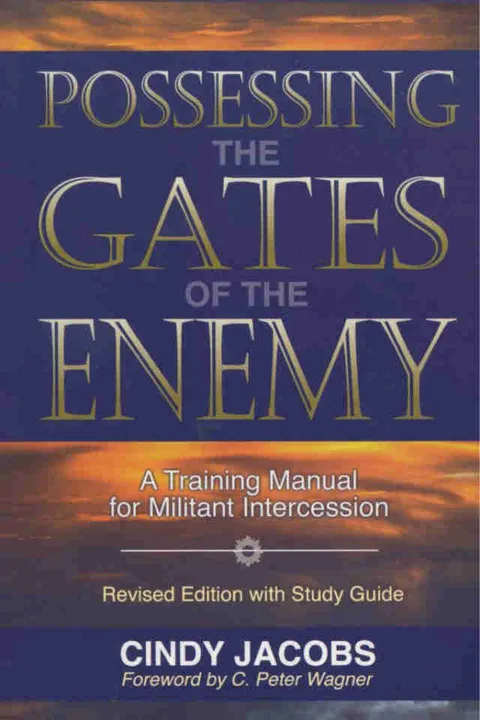

Possessing The Gates Of The Enemy Order Printed Copy
- Author: Cindy Jacobs
- Size: 5.64MB | 230 pages
- |
Others like possessing the gates of the enemy Features >>
Secrets Of The Psalms

Discerning The Voice Of God
Dancers At The Gate Of Death
Getting Result In The War Room: Prayer
Smite The Enemy And He Will Flee
Understanding The Power Of Praise
Opening The Gates Of Heaven
Operating In The Courts Of Heaven

Casting Your Cares Upon The Lord

Confessions Of A Battle Weary Prayer Warrior
About the Book
"Possessing the Gates of the Enemy" by Cindy Jacobs is a spiritual warfare guide that teaches readers how to recognize and combat the strategies of the enemy in order to secure victory in their lives. Jacobs provides practical advice and biblical principles to help individuals effectively pray, intercede, and stand firm against the powers of darkness. The book emphasizes the importance of understanding spiritual authority and using it to overcome obstacles and experience breakthroughs in various areas of life.
Calvin Miller
Calvin Miller was a pastor, professor and storyteller, best known for The Singer Trilogy, a mythic retelling of the New Testament story in the spirit of C. S. Lewis and J. R. R. Tolkien. Miller passed away on the afternoon of August 19, 2012, due to complications after heart surgery. He was 75.
A prolific artist and a writer's writer, Miller garnered respect and praise throughout his career from peers like Luci Shaw, Max Lucado and Philip Yancey. He was the author of more than forty books of popular theology and Christian inspiration including such recent books as Letters to Heaven, The Path of Celtic Prayer, Letters to a Young Pastor and his memoir Life Is Mostly Edges.
In addition to his twenty years of pastoral service at Westside Church in Omaha, Nebraska, Miller was also a great mentor to many students and leaders through his preaching and pastoral ministry classes at Beeson Divinity School. Calvin Miller, never one to multiply words, used just four to describe his rule of life: "Time is a gift."
RESCUE FROM THE SLUSH PILE
In October 1973 one important book was rescued from the slush pile (the stack of unsolicited manuscripts every publisher receives) by assistant editor Don Smith. He read a manuscript by a little-known Baptist pastor in Nebraska that was a poetic retelling of the life of Jesus—portraying him as a Troubadour. Both he and Linda Doll excitedly encouraged Jim Sire to take this imaginative manuscript seriously. In February 1974 Sire wrote the author, Calvin Miller, that IVP wanted to publish his book The Singer.
Months before, Miller had been waking up nights, stirred to write this tale, perhaps unconsciously inspired by the recent Broadway hits Jesus Christ Superstar and Godspell. Later Miller wrote:
When the manuscript was done, I sent it to Jim Sire at InterVarsity Press. “It’s good,” he said, “but we want to think about it a couple of weeks before we give you an answer.” So I waited until finally the letter came. They were going to do it. Jim Sire had done his Ph.D. on John Milton, and the fact that he liked it was joy immeasurable to me. “But,” he cautioned, “we’re going to print five thousand of these. They may not do well—in fact we may end up with four thousand of them on skids in our basement for the next ten years. Still, it’s a good book and deserves to be in print.”
Far more than a thousand copies sold. Actually, over three hundred times that amount sold in its first decade. It became “the most successful evangelical publication in this genre.” The Singer was followed in two years by The Song (paralleling the story of the early church in Acts) and two years after that by The Finale (inspired by the book of Revelation). Publication of The Singer changed Miller’s life. Even though he stayed in the pastorate for many years, it set him on a course of writing and speaking that he could not have imagined.
When Our Waiting Will Be Over
My favorite songs are ones that make my heart burn with longing. They’re songs that have unusual power to, as C.S. Lewis put it, rip open my “inconsolable secret” — the secret “which pierces with such sweetness,” yet is so hard to capture in words, since “it is a desire for something that has never actually appeared in our experience” (The Weight of Glory, 29–30). Which is why among my favorites is a song written by Bob and Jordan Kauflin, “When We See Your Face.” The song taps into subterranean longings and triggers profound emotions in me. I am not one to cry easily, but I rarely can listen to it without tears. So, I usually listen to it alone, sparing others the awkwardness of a weeping middle-aged man. Lest it appear suspicious to anyone, let me say up front that I was not asked to promote this song. I asked permission to write about it, receiving no benefit beyond what the song itself delivers — which is a benefit more precious than gold. For my soul very much needs this song’s reminder, especially as another year passes and I am another year older, still fighting against the relentless darkness, still waiting, still desiring something that has never actually appeared in my experience. Not yet. It remains a desire for a promised appearing — an appearing I’m growing to increasingly love (2 Timothy 4:8). I share this song because I assume you also need its precious reminder. And perhaps it will tap into your piercing, sweet, inconsolable secret too. Though the Dark Is Overwhelming Though the dark is overwhelming And the brightest lights grow dim Though the Word of God Is trampled on by foolish men Though the wicked never stumble And abound in every place We will all be humbled when we see Your face It doesn’t take reaching our middle or elder years to know just how dark the world can be. But I can attest now to a cumulative effect it has upon the soul the longer one lives here. And I do not claim to have suffered greatly — yet. Prolonged exposure to confounding darkness is a wearisome experience (Psalm 73:16). It is not merely the physical effects of aging that tempt many of us to retreat from action as we enter the older demographic columns. It’s also the spiritual and psychological effects of prolonged dealing with evil that infects and harms our families, friendships, churches, vocations, societies, and nations. We probably thought ourselves more a match for it in the optimistic bloom of youth, but experience put us in our place. The evil is beyond our strength and our comprehension. Hope can take a beating in the relentless battle against darkness. Until we remember. Until we remember that one day all oppressive darkness will be banished from the experience of the saints (Revelation 22:5), and that even now, even as the darkness rages (Revelation 12:12), it is passing away as the true light shines (1 John 2:8). We remember that we were never supposed to know and understand the evil we face (Genesis 3:7) — of course it’s a wearisome task! Only the Omniscient and Omnipotent can comprehend it and not grow weary (Isaiah 40:28). We remember that he promised us, “In the world you will have tribulation. But take heart; I have overcome the world” (John 16:33). We remember that our great task, the one way we truly conquer darkness, is to trust him (Proverbs 3:5–6) and obey him (John 14:15). And the great day that will end all night — the day of the joyful humbling of the redeemed righteous and the horrible humbling of the condemned wicked (Philippians 2:10–11) — will be inaugurated when we see the face of Jesus (1 Corinthians 13:12). All Our Sins Will Be Behind Us And the demons we’ve been fighting Those without and those within Will be underneath our feet To never rise again All our sins will be behind us Through the blood of Christ erased And we’ll taste Your kindness when we see Your face I’m so sick of Satan and his wretched wraiths that I don’t even want to give them the attention of a mention — except to say that one day (hear this, you horrid hoard!), the almighty foot of the Son of Man will come down once for all upon the heads of the great dragon and all his infernal snakes, and we will wrestle them no more (Ephesians 6:12; Revelation 20:10). But we also remember something far, far sweeter — and growing sweeter every year we grow older and come more to terms with just how intractable and entwined our demon-like indwelling sin is in the very members of our bodies (Romans 7:23). We remember that our sin will someday be behind us. Oh, we know that Jesus has paid our ransom in full (1 Timothy 2:6) and that by God’s grace through faith (Ephesians 2:8) we have been clothed in Christ’s righteousness (Philippians 3:9), so that God even now sees us justified, as if we had never sinned and always obeyed (Romans 3:26). It is, for now, an almost incomprehensibly glorious thing. But one day, our blood-bought innocence, our holy purity, will cease to be primarily a forensic reality we embrace by faith. On that day we will fully experience what it’s like to be righteous in every atom of our resurrected bodies and every dimension of our eternal, immaterial souls. We will have no more sin. No more tainted motives, no more illicit desires, no more damned selfish ambition. We will know in every part of our being what it’s like to fully obey the Great Commandment as if it’s the most natural thing in the world — for it will be! And we will worship the Lamb who was slain for us with unclouded minds and hearts bursting with joy. We will taste this unfathomably gracious kindness of Jesus when we see his face. All the Waiting Will Be Over All the waiting will be over Every sorrow will be healed All the dreams it seemed Could never be will all be real And You’ll gather us together In Your arms of endless grace As Your Bride forever when we see Your face The waiting will be over. I can’t write that sentence with dry eyes. Most of our Christian experience in this dark valley is hopeful waiting for what we so long to see (Romans 8:25). And much of that waiting is accompanied by hopeful groaning (Romans 8:20): groaning in illness, groaning in grief, groaning in disappointment and perplexity over the terrible, violent brokenness of the world and the inscrutable purposes of our only wise God (Romans 16:27), whose ways are not our ways (Isaiah 55:8). And we hopefully groan, like a bride, with longing for the consummate intimacy of knowing the Lover of our souls, even as we have been fully known (1 Corinthians 13:12). But one day — our Groom has promised it will be “soon” (Revelation 22:20) — the waiting will be over. And he will come, our Hero, of which all legendary heroes are but copies and shadows, and he will save us to the uttermost (Isaiah 35:4; Hebrews 7:25). And all that is dark and diseased and damaged and destroyed will pass away like a bad dream and become the shadows of the great yesterday (Psalm 90:4–5), serving only to heighten our savoring of the bright, eternal today (Revelation 22:5). And of all the light in which we delight, the fairest will be his face. We’ll Be Yours Forevermore We will see, we will know Like we’ve never known before We’ll be found, we’ll be home We’ll be Yours forevermore Having once been lost, we will fully know just how found we are (Luke 19:10). Having once known our Savior in such a small part, we will fully know him — as much as the finite can fully know the Infinite (1 Corinthians 13:12). We will be fully his and fully home — forever. Home. That is our inconsolable secret, isn’t it? That piercing sweetness, that desire for what has never actually appeared in our experience, yet somehow we know it is where we truly belong. I think that’s what this song taps into: our homesickness for a place we’ve not been, and a sense of alienation in the very places we were born. We don’t belong here, where it’s dark, depraved, and demonic, and where our sweetest experience is the blessed hope we taste in the future promises we trust. We long for home. For home is where we will meet the One we have loved, though we have not seen him (1 Peter 1:8). Home is where we will see his face. Article by Jon Bloom