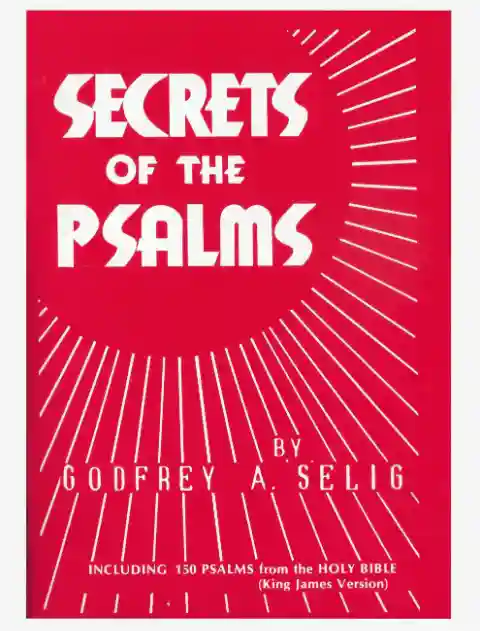

Others like secrets of the psalms Features >>

Secrets Of Answered Prayer
Dancers At The Gate Of Death
Possessing The Gates Of The Enemy
-160.webp)
Carriers Of The Glory (Becoming A Friend Of The Holy Spirit)
Secrets Jesus Shared

Secret Sources Of Power
Opening The Gates Of Heaven
-160.webp)
Hearing God (Developing A Conversational Relationship With God)

Discerning The Voice Of God
-160.webp)
Rebuilding The Tabernacle Of David: Back To The Future
About the Book
"Secrets of the Psalms" by Godfrey Selig is a guide that delves into the spiritual and magical properties of the Book of Psalms in the Bible. The book explores how the Psalms can be used for prayer, protection, healing, and manifestation of desires. It includes explanations of each Psalm and provides instructions for utilizing them in rituals and spells for various purposes. Ultimately, the book is a resource for those seeking to deepen their understanding and connection to the power of the Psalms for spiritual growth and personal transformation.
Richard Wurmbrand
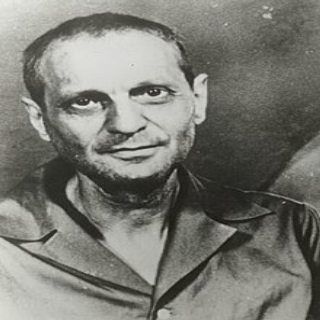 Richard Wurmbrand (1909 – 2001) was born in 1909 in Bucharist in the country of Romania. He was the youngest of four boys born in a Jewish family. He lived with his family in Istanbul for a short time. When he was 9, his father died and the Wurmbrands returned to Romania when he was 15.
He was sent to study Marxism in Moscow. When he returned, he was already a Comintern Agent. A Comintern Agent was a member of the Communist International Organisation which intended to fight:
Like other Romanian Communists, he was arrested and released several times.
He married Sabina Oster on 26th October 1936. Wurmbrand and his wife went to live in an isolated village high in the mountains of Romania. But, as a athiest there was no peace to be found in his heart. So one day, when his heart was in a state of turmoil he cried out:
“God, if perchance you exist, it is Your duty to reveal yourself to me.”
Shorthly after he prayed that prayer, he met a German carpenter in his village who gave him a bible. The carpenter and his wife had been praying earnestly that God would bring a Jew to his village, because the carpenter wanted to bring a Jew to Christ, because Jesus was a Jew. So the carpenter gave him a Bible to read. Wurmbrand said, when he opened that Bible he could not stop weeping. He had read the Bible before but it had meant nothing to him. This time when he opened the Bible he could barely read it because of the copious amount of tears that filled his eyes. Sometime later he found out the carpenter and his wife had been praying earnestly for him. Wurnbrand said that every word that he read were like flames of love burning in his heart. He realized for the first ime in his life that there was a God of love who loved him, even though he had beeen living a bad life and had nurtured a hated towards the concept of a ‘loving’ God.
The Power of Intercessory Prayer
But now for the first time he knew that Jesus had suffered at the cross of Calvary for his sins and he was loved and accepted of God. Richard and his wife became believers in Jesus the Messiah. All the hatred that he had formerly held toward God was washed away under the blood of Christ and Richard and his wife Sabrina were born of the Spirit. That is the power of intercessory prayer!
Richard prepared himself for the ministry. He was ordained as an Anglican minister in 1938 at the start of world war 2. Both Richard and his wife were arrested several times. They were beaten and hauled before a Nazi court. They suffered under the Nazi regime throughout world war 2. But Richard said, it was only a taste of what was to come.
Russian Troups Enter Romania
Towards the end of world war 2, Richard Wurmbrand became a Lutheran and he pastored a Lutheran church in Romania. But, the same year, 1 million Russian troups entered and occupied the entire territory of Romania.
Within a very short space of time the Communists took over Romania. The reign of terror began. Out of fear 4,000 priests, pastors & ministers became Communists overnight. They confessed their allegience and loyalty to the new Communist Government because they all feared for their survival.
Romania’s Resistance
Harsh persecutions of any enemies of the Communist government started with the Soviet occupation in 1945. The Soviet army behaved as an occupation force (although theoretically it was an ally against Nazi Germany), and could arrest virtually anyone at will. Shortly after Soviet occupation, ethnic Germans (who were Romanian citizens and had been living as a community in Romania for 800 years) were deported to the Donbas coal mines. Despite the King’s protest, who pointed out that this was against international law, an estimated 70,000 men and women were forced to leave their homes, starting in January 1945, before the war had even ended. They were loaded in cattle cars and put to work in the Soviet mines for up to ten years as “reparations”, where about one in five died from disease, accidents and malnutrition.
Once the Communist government became more entrenched, the number of arrests increased. All strata of society were involved, but particularly targeted were the pre-war elites, such as intellectuals, clerics, teachers, former politicians (even if they had left-leaning views) and anybody who could potentially form the nucleus of anti-Communist resistance. The existing prisons were filled with political prisoners, and a new system of forced labor camps and prisons was created, modeled after the Soviet Gulag. Some of the most notorious prisons included Sighet, Gherla, Piteşti and Aiud, and forced labor camps were set up at lead mines and in the Danube Delta.
Underground Church
Richard and his wife knew that Christianity and Communism were totally opposed to each other. They knew that a true follower of Christ cannot compromise. So they created an “Underground Church” movement to preach the pure gospel of Christ and to reach out to the unsaved people of Romania and secondly to reach out secretly to the Russian soldiers. They secretly printed thousands of Bibles and Christian literature and distributed it to the Russian soldiers. Many of the Russian soldiers were convicted and they gave their life to Christ.
So the underground church grew. But, in 1948 the Secret Police arrested Wurmbrand and he was placed in solitary confinement for 3 years. He was then transferred to a group cell for the next five years. Whilst in prison he continued to win the other prisoners to Christ. After 8 years in prison he was released and he immediately resumed his work with the undergound church. A few years later, 1959, he was arrested again and was sentenced to 25 years in prison. However, after spending 5 years in prison an organisation called the Christian Alliance negotiated with the Communist Government and they managed to secure his release for a fee of $10,000. They quickly got Richard Wurmbrand out of Romania and took him to England, then to the USA.
In 1966, Richard was called to Washington DC to give his testimony before the United States Senate. He took off his shirt to show the Senate the scars and the wounds that he received whilst he served time in prison under the Communist Government in Romania.
The newspapers throughout the USA, Europe and Asia carried his story all across the world. Christian leaders called him the “Voice of the Underground Church.”
In 1967, with a $100 old typewriter and 500 names and addresses, Richard Wurmbrand published the first issue of THE VOICE OF THE MARTYRS newsletter. This newsletter was dedicated to communicating the testimonies and trails facing our brothers and sisters in restricted nations worldwide. Richard wrote:
“The message I bring from the Underground Church is:
“Don’t abandon us!”
“Don’t forget us!”
“Don’t write us off!”
“Give us the tools we need! We will pay the price for using them!”
“This is the message I have been charged to deliver to the free church.”
Richard Wurmbrand and his wife travelled throughout the world to establish a network of over 30 offices. Their primary aim was to call Christians to shoulder their responsibility and to demonstrate the real substance of their faith by supporting their brothers and sisters in Christ who are being persecuted in heathen lands.
The VOICE OF THE MARTYRS newsletter continues to inform, and lead to action, Christians throughout the free world of the plight of those who suffer for their faith in Jesus Christ. Throughout their network of offices around the world, the newsletter is published in over 30 different languages. To this cause, VOICE OF THE MARTYRS presses on, serving in nearly 40 countries around the world where our brothers and sisters are systematically persecuted.
The writer of the Book of Hebrews brings a convicting word to the Christian church:
” Remember them that are in bonds, as bound with them; and them that suffer adversity, as being yourselves also in the body.”
(Hebrews 13:3)
We have a responsibility to those who suffer for their faith in Christ.
Today, there is an estimated 200 million Christians in heathen nations who are suffering persecution for their faith in Christ.
Richard Wurmbrand (1909 – 2001) was born in 1909 in Bucharist in the country of Romania. He was the youngest of four boys born in a Jewish family. He lived with his family in Istanbul for a short time. When he was 9, his father died and the Wurmbrands returned to Romania when he was 15.
He was sent to study Marxism in Moscow. When he returned, he was already a Comintern Agent. A Comintern Agent was a member of the Communist International Organisation which intended to fight:
Like other Romanian Communists, he was arrested and released several times.
He married Sabina Oster on 26th October 1936. Wurmbrand and his wife went to live in an isolated village high in the mountains of Romania. But, as a athiest there was no peace to be found in his heart. So one day, when his heart was in a state of turmoil he cried out:
“God, if perchance you exist, it is Your duty to reveal yourself to me.”
Shorthly after he prayed that prayer, he met a German carpenter in his village who gave him a bible. The carpenter and his wife had been praying earnestly that God would bring a Jew to his village, because the carpenter wanted to bring a Jew to Christ, because Jesus was a Jew. So the carpenter gave him a Bible to read. Wurmbrand said, when he opened that Bible he could not stop weeping. He had read the Bible before but it had meant nothing to him. This time when he opened the Bible he could barely read it because of the copious amount of tears that filled his eyes. Sometime later he found out the carpenter and his wife had been praying earnestly for him. Wurnbrand said that every word that he read were like flames of love burning in his heart. He realized for the first ime in his life that there was a God of love who loved him, even though he had beeen living a bad life and had nurtured a hated towards the concept of a ‘loving’ God.
The Power of Intercessory Prayer
But now for the first time he knew that Jesus had suffered at the cross of Calvary for his sins and he was loved and accepted of God. Richard and his wife became believers in Jesus the Messiah. All the hatred that he had formerly held toward God was washed away under the blood of Christ and Richard and his wife Sabrina were born of the Spirit. That is the power of intercessory prayer!
Richard prepared himself for the ministry. He was ordained as an Anglican minister in 1938 at the start of world war 2. Both Richard and his wife were arrested several times. They were beaten and hauled before a Nazi court. They suffered under the Nazi regime throughout world war 2. But Richard said, it was only a taste of what was to come.
Russian Troups Enter Romania
Towards the end of world war 2, Richard Wurmbrand became a Lutheran and he pastored a Lutheran church in Romania. But, the same year, 1 million Russian troups entered and occupied the entire territory of Romania.
Within a very short space of time the Communists took over Romania. The reign of terror began. Out of fear 4,000 priests, pastors & ministers became Communists overnight. They confessed their allegience and loyalty to the new Communist Government because they all feared for their survival.
Romania’s Resistance
Harsh persecutions of any enemies of the Communist government started with the Soviet occupation in 1945. The Soviet army behaved as an occupation force (although theoretically it was an ally against Nazi Germany), and could arrest virtually anyone at will. Shortly after Soviet occupation, ethnic Germans (who were Romanian citizens and had been living as a community in Romania for 800 years) were deported to the Donbas coal mines. Despite the King’s protest, who pointed out that this was against international law, an estimated 70,000 men and women were forced to leave their homes, starting in January 1945, before the war had even ended. They were loaded in cattle cars and put to work in the Soviet mines for up to ten years as “reparations”, where about one in five died from disease, accidents and malnutrition.
Once the Communist government became more entrenched, the number of arrests increased. All strata of society were involved, but particularly targeted were the pre-war elites, such as intellectuals, clerics, teachers, former politicians (even if they had left-leaning views) and anybody who could potentially form the nucleus of anti-Communist resistance. The existing prisons were filled with political prisoners, and a new system of forced labor camps and prisons was created, modeled after the Soviet Gulag. Some of the most notorious prisons included Sighet, Gherla, Piteşti and Aiud, and forced labor camps were set up at lead mines and in the Danube Delta.
Underground Church
Richard and his wife knew that Christianity and Communism were totally opposed to each other. They knew that a true follower of Christ cannot compromise. So they created an “Underground Church” movement to preach the pure gospel of Christ and to reach out to the unsaved people of Romania and secondly to reach out secretly to the Russian soldiers. They secretly printed thousands of Bibles and Christian literature and distributed it to the Russian soldiers. Many of the Russian soldiers were convicted and they gave their life to Christ.
So the underground church grew. But, in 1948 the Secret Police arrested Wurmbrand and he was placed in solitary confinement for 3 years. He was then transferred to a group cell for the next five years. Whilst in prison he continued to win the other prisoners to Christ. After 8 years in prison he was released and he immediately resumed his work with the undergound church. A few years later, 1959, he was arrested again and was sentenced to 25 years in prison. However, after spending 5 years in prison an organisation called the Christian Alliance negotiated with the Communist Government and they managed to secure his release for a fee of $10,000. They quickly got Richard Wurmbrand out of Romania and took him to England, then to the USA.
In 1966, Richard was called to Washington DC to give his testimony before the United States Senate. He took off his shirt to show the Senate the scars and the wounds that he received whilst he served time in prison under the Communist Government in Romania.
The newspapers throughout the USA, Europe and Asia carried his story all across the world. Christian leaders called him the “Voice of the Underground Church.”
In 1967, with a $100 old typewriter and 500 names and addresses, Richard Wurmbrand published the first issue of THE VOICE OF THE MARTYRS newsletter. This newsletter was dedicated to communicating the testimonies and trails facing our brothers and sisters in restricted nations worldwide. Richard wrote:
“The message I bring from the Underground Church is:
“Don’t abandon us!”
“Don’t forget us!”
“Don’t write us off!”
“Give us the tools we need! We will pay the price for using them!”
“This is the message I have been charged to deliver to the free church.”
Richard Wurmbrand and his wife travelled throughout the world to establish a network of over 30 offices. Their primary aim was to call Christians to shoulder their responsibility and to demonstrate the real substance of their faith by supporting their brothers and sisters in Christ who are being persecuted in heathen lands.
The VOICE OF THE MARTYRS newsletter continues to inform, and lead to action, Christians throughout the free world of the plight of those who suffer for their faith in Jesus Christ. Throughout their network of offices around the world, the newsletter is published in over 30 different languages. To this cause, VOICE OF THE MARTYRS presses on, serving in nearly 40 countries around the world where our brothers and sisters are systematically persecuted.
The writer of the Book of Hebrews brings a convicting word to the Christian church:
” Remember them that are in bonds, as bound with them; and them that suffer adversity, as being yourselves also in the body.”
(Hebrews 13:3)
We have a responsibility to those who suffer for their faith in Christ.
Today, there is an estimated 200 million Christians in heathen nations who are suffering persecution for their faith in Christ.
God Can Meet Us in the Ashes
Strict practitioners would not have approved of my methods, but on one long ago mid-winter Wednesday, I smeared ashes on the foreheads of my two preschoolers and myself. An offering of the hardwood that had heated our home the day before, these ashes were not “ceremonially correct” in any way. At the time, I did not know that traditional Ash Wednesday ashes come from the remains of Palm Sunday palms. I did not even know about the forty days of Lent to follow. However, I did know about sin — my own and my children’s. We were in “time out” season with one of our sons. At our wits’ end, we had exhausted Dr. Dobson, Elisabeth Elliot, and every parenting resource available in the nineties. “Why is it so hard to be good?” our little Dobson-buster would ask. His younger brother’s eyes would fill with tears whenever they were caught in collaborative naughtiness. In this parenting pressure cooker, maternal apologies had become a daily occurrence. I was hoping to model repentance — while at the same time atoning for sharp words and a short fuse. “I was wrong; please forgive me” were the words through which my sons were learning that their mother had not outgrown the struggle against sin. Ash Wednesday gives Christians an opportunity to grow in our understanding of where to take that struggle. Reclaiming Lent for Christ Historically, our earliest Protestant ancestors revolted against the idea of Lenten practices, and with good reason. In the pre-Reformation mind, penitence, ashes, and self-denial had become ends in themselves. Gradually, however, a biblical understanding of lament has re-entered Christian orthodoxy, anchored in an embrace of our fallen-ness. Ashes on the forehead rightly represent our need to “repent in dust and ashes” (Job 42:5–6), and our identity as “a people of unclean lips [who] dwell in the midst of a people of unclean lips” (Isaiah 6:5). Jesus pronounced a blessing upon those who recognize their poverty of spirit and mourn the effects of sin on their life and in the world (Matthew 5:3–4). Grounded in gospel truth that prompts genuine penitence without crippling guilt and deep conviction without devastating shame, Ash Wednesday invites the believer to a renewed awe of our great salvation. While there is no merit in the wearing of ashes, a season of mourning leading up to Easter may actually enhance our celebration of Resurrection Sunday. A Wednesday to Teach In my challenging season of parenting, Ash Wednesday became a visual aid, a teaching tool to reassure my young sons that our sin does not signal the end of God’s love for us. In our home, hymns around the breakfast table always matched the season, and one year, we learned all four verses of a “cross hymn” in the weeks leading up to Easter. Rich hymns of the faith offer deep gospel truth that requires explanation (but not dilution) for little singers: When I survey the wondrous cross On which the Prince of Glory died, All the vain things that charm me most I sacrifice them to His blood. The vain-ness of the “vain things” Isaac Watts wrote about becomes abundantly clear when we remember that nothing lasts forever. “Remember that you are dust” is the lyric of Ash Wednesday. God made us from dust, and our bodies do not live forever. This is a dying world we inhabit: everything from goldfish to grandfathers eventually stops living. And we mourn the loss. Without becoming morbid or frightening, we can prepare our children for the inevitability of death by putting it in the context of the gospel. Thomas á Kempis prescribed a regular pondering of and preparation for death as a route to happiness. Author Gary Thomas suggests that we present-day believers ought to join á Kempis in allowing the reality of death to act “like a filter, helping us to hold on to the essential and let go of the trivial.” For believers, the “essential” is the eternal, and the eternal comes to us through the cross. The paradox of death leading to rebirth only appears to be a contradiction. All of Christ’s gifts are given to us through death — his death. And it will only be through a different death — our death — that we will finally receive the fullness of life that Jesus died to impart. A Wednesday to Remember My sons and I stood before a mirror together, the three of us with our smudged foreheads. We talked about our struggle to obey God and our sadness over sin — the sin that causes mayhem in our home, hurt feelings between brothers, and, worst of all, separation from a God who loves us. When a little boy is struggling with disobedience, even as a preschooler, he already feels the grit and grind of life on a fallen planet. He may not be able to comprehend sin’s cosmic scale: “For the creation was subjected to futility, not willingly, but because of him who subjected it, in hope. . .” (Romans 8:20). But he is already well-acquainted with the collective groaning, and can love the truth about the hope of our future deliverance from the struggle: “. . . that the creation itself will be set free from its bondage to corruption and obtain the freedom of the glory of the children of God” (Romans 8:21). Reading selected, age-appropriate portions of the crucifixion story from Luke 22 and thinking about Jesus’s willingness to endure the weight of all the sins of the entire world on his body provides a focus for the wearing of our ashes as a symbol of our grief — mourning that we have sinned and caused division from God and sadness over the suffering Jesus endured when he died in our place. A Wednesday to Rejoice If good behavior is all I have to bring to Jesus, he cannot help me. The warm welcome of the gospel on a frigid day in early spring takes into account a little boy’s hopelessness in the face of temptation. Our sin does not signal the end of our relationship with God. It’s a beginning, for it turns out that weakness is a powerful claim upon divine mercy. Learning to hate sin at a young age, to war against it, and to receive God’s forgiveness is a celebratory milestone. There is a reason to rejoice because of Christ’s obedience to all that God commanded. Then, his love in paying the penalty for our failure to obey gives us a reason for hope, even against the backdrop of my own parenting fiascos and my sons’ serial naughtiness. God knows well the stuff we are made of. “He remembers that we are dust” (Psalm 103:14). As a loving heavenly Father, he longs to supply every need for righteous living — in fact it is only his righteousness that will suffice. This orientation provides a solid foundation for a lifelong relationship built on the assurance that God’s purposes will not be thwarted by my sin. He delights to meet me and my children in the ashes. Article by Michele Morin