
Others like boy meets girl Features >>
Sex Is Not The Problem (Lust Is)
I Kissed Dating Goodbye
Sex Is Not The Problem (Lust Is)
Singles With A Difference

Well Worth The Wait
7 Myths About Singleness
Every Young Man's Battle

When God Writes Your Love Story

Smarts Girls Guide To God, Guys, And The Galaxy
Training For Purity & Righteousness: Eyes Of Honour
About the Book
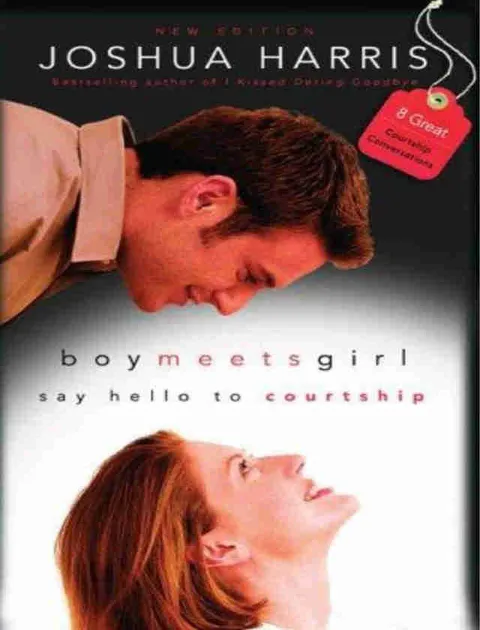
"Boy Meets Girl" by Joshua Harris explores the principles of Christian courtship and relationships. The book emphasizes the importance of purity, communication, and intentionality in dating and offers practical advice for navigating romantic relationships in a way that honors God. Through personal anecdotes and Biblical insights, Harris challenges readers to pursue healthy and lasting relationships rooted in faith and love.
Adoniram Judson
Born in Malden, Massachusetts, the son of Adoniram Judson, Sr., a Congregational clergyman, and Abigail (Brown), Judson graduated from Brown University (B.A., M.A.) and in the first class of Andover Theological Seminary (1810). His interest in missions began in 1809 when he read Claudius Buchananâs sermon âThe Star in the East.â With ministerial friends he started the Society of Inquiry, a seminary study group on missions. In 1810 he was licensed to preach by the Orange, Vermont, Congregational Association preparatory to the pastoral ministry; however, he had strong inclinations toward overseas missions. In June of that year, Judson, Samuel Newell, Samuel Nott, Jr., and Gordon Hall presented themselves to the Massachusetts General Association for missionary service, and the American Board of Commissioners for Foreign Missions (ABCFM) was formed as a result. Following an unsuccessful attempt to secure an appointment from the London Missionary Society in England, Judson persuaded the ABCFM to support three couples and two single men on a mission to the East. Judson was the lead candidate of the first commissioning service for the American overseas missionaries held at Salem (Massachusetts) Tabernacle on February 6, 1812.
Following a sendoff with great fanfare, Judson and his bride, Ann (Haseltine), sailed with the Newells for India in 1812. During the four-month voyage, the couple carefully studied the baptismal positions of the English Baptists in order to controvert the Baptist position; however, when they arrived at Calcutta, they adopted Baptist principles and were baptized by William Carey. Upon their change of sentiments, the Judsons resigned from the ABCFM and plans were laid for the creation of a Baptist mission society in the United States.
By order of the British East India Company, the Judsons were forced to leave India. Surreptitiously escaping to Rangoon, Burma (Myanmar), in 1813, they established a station that became the first mission of American Baptists. Their work included evangelism and Bible translation. In 1842, following completion of Judsonsâs first dictionary, the couple relocated to Ava, to establish greater influence with the government. However, Adoniram Judson was charged with being an English spy and was imprisoned in June 1824. In a 21-month period of incarceration during the Anglo-Burmese War, he suffered from fever and malnutrition and underwent a forced march. As a result of the courage and resourcefulness of his wife, he was released in February 1826 to serve as a translator for the Burmese government during negotiations for the Treaty of Yandabo. Ann Judson died of complications of smallpox later the same year.
To enlarge his efforts, Judson moved his mission to Moulmein in 1828. There, with the assistance of Jonathan Wade, he built a church and school and continued work on the Burmese Bible, which he completed in 1834. Later that year, he married Sarah Hall Boardman, widow of George Dana Boardman and a gifted linguist and teacher. In 1845, following the birth of their eight child, Sarahâs health declined and the Judsons embarked for the United States. Sarah died en route; Judson completed the trip and remained in the United States for nine monthsâ furlough. While his strength had been greatly reduced and he suffered chronic laryngitis, he was hailed as a hero throughout the Christian community.
While at Madison University in upstate New York, he met and married Emily Chubbock, a writer and educator. They returned to Burma in 1846 for continued work on an enlarged Burmese dictionary, which was finished in 1849. Shortly afterward, Judson contracted a respiratory fever and, attempting to travel to a better climate, died at sea.
Brackney, William H., âJudson, Adoniram,â in Biographical Dictionary of Christian Missions, ed. Gerald H. Anderson (New York: Macmillan Reference USA, 1998), 345-46.
This article is reprinted from Biographical Dictionary of Christian Missions, Macmillan Reference USA, copyright © 1998 Gerald H. Anderson, by permission of Macmillan Reference USA, New York, NY. All rights reserved.
A Letter to Younger Me About Money
If you listen to anyone in their senior years long enough, youâll eventually hear something like, âIf I knew then what I know now . . . â But seniors arenât the only ones who feel that way. At age thirty, I find myself already saying the same thing about money. Recently, I left a financial planning firm after working as a creative director and wealth coach. I learned more in one year about financial stewardship than I had learned in my first 29 years of life. While working at the firm, I discovered the sorry state of my familyâs finances. I knew we werenât great with money, but I didnât realize the extent of our financial ignorance and problems. I also discovered that I wasnât alone. After six months at the firm, I was able to counsel clients who needed basic financial coaching, and it wasnât pretty. Regardless of income, most were living paycheck to paycheck, and they were up to their eyeballs in debt. Today, twenty-somethings are bombarded with opportunities to make poor financial decisions. At the relatively young age of thirty, I often find myself saying, âI wish I knew at twenty what I know today about money.â If I could have a conversation with my twenty-year-old self about money, here are three things I would tell him. 1. Money cannot buy you happiness. Throughout my twenties, I viewed money as the solution to most of my problems. This belief dictated how I spent my time and, ultimately, my earnings. At one point, I had seven jobs while pursuing a masterâs degree. But I was still broke and in debt, and I never finished my studies. Rather than a source of joy, money became a cruel master (Matthew 6:24). What Iâve discovered is that my experience is all too common. The sad thing is that so few of us seem to learn from our mistakes. We keep trying to pursue happiness through more money. Some will point to studies that suggest thereâs a correlation between money and happiness. One article reported that each additional dollar earned per year reduces peopleâs negative emotions â but that effect disappears at about $200,000 annually. In other words, money is a limited help at best, and certainly doesnât buy lasting happiness, as any honest observer of wealthy people can quickly perceive. Ultimately, money is a means to an end. A dollar or a piece of gold is only as valuable as what we can trade for it. And money is dangerous. It gives the illusion of granting access to anything. So we can easily elevate it to the throne that should be reserved only for our ultimate provider: God, the giver of all good things. So I would tell my twenty-year-old self: Donât try to buy happiness with money. This would have dramatically changed my finances, especially with regard to debt. 2. Donât borrow money carelessly. In my twenties, I borrowed foolishly, and Iâm still paying for it. From student loans to credit cards, I went into debt without giving it a second thought. Debt allowed me to get what I wanted when I wanted it. And the best part? I didnât have to wait or ask for permission. This is the great temptation every twenty-something faces in an age when money is so easily borrowed. The Bible doesnât condemn debt as inherently sinful, but it clearly warns us that money shouldnât be borrowed haphazardly. And Scripture also tells us that when we incur a debt, it is evil not to pay what we owe. Romans 13:8 says, âLet no debt remain outstanding, except the continuing debt to love one anotherâ (NIV). And Psalm 37:21 says, âThe wicked borrows and does not repay, but the righteous shows mercy and givesâ (NKJV). If I could counsel my twenty-year-old self on debt, hereâs what I would say: Donât borrow money unless you absolutely have to. There is too much at stake to borrow money without giving it careful thought. If youâre considering a credit card or a loan, count the costs, and beware of the risks. And once in debt, I would say, Make a plan to eliminate it as soon as possible. 3. Save, give, and spend money proactively. âA wise man thinks ahead; a fool doesnât and even brags about it!â (Proverbs 13:16 TLB). One of the worst mistakes I made with money was failing to plan wisely. When I received a paycheck or extra cash, I lacked direction. Like the fool in that Proverb, I was proud that I didnât budget. I absolutely hated the idea. Budgeting felt intimidating and seemed like a lot of work. Besides, as long as I didnât plan, I could remain in denial that I was a poor steward of the resources God had given me. I could pretend I was giving and spending wisely and no one could confirm or deny it. And I could make spending decisions based mostly on my feelings. This felt like freedom, but it wasnât. Now I would say this to my foolish twenty-year-old self: Making a plan for your money may help give you dominion over it. Being planless is not being free; being planless makes you a slave to money. But a good financial plan turns money into your slave to serve what you really value. You will be empowered to save, give, and spend money proactively rather than reactively. Itâs Not Too Late to Change Hindsight is indeed twenty-twenty. And itâs not like I now manage money perfectly. Even though I understand more now how to handle money, I donât always act on my knowledge. But over the last year, Iâve come a long way. And if I canât help my twenty-year-old self, I hope I can help others avoid the mistakes I made, or help them make changes like Iâve had to make. No matter how old we are, itâs not too late to correct our course. Weâre never too old to stop trying to buy happiness with money, or to get out of debt as soon as possible, or to begin governing money instead of being governed by money. We want to serve God and not money (Matthew 6:24). But the less intentional we are with our money, the more likely we will end up serving it, for good stewardship is impossible without intentionality. Article by Phillip Holmes