
Others like the crippled lamb Features >>



-160.webp)




About the Book
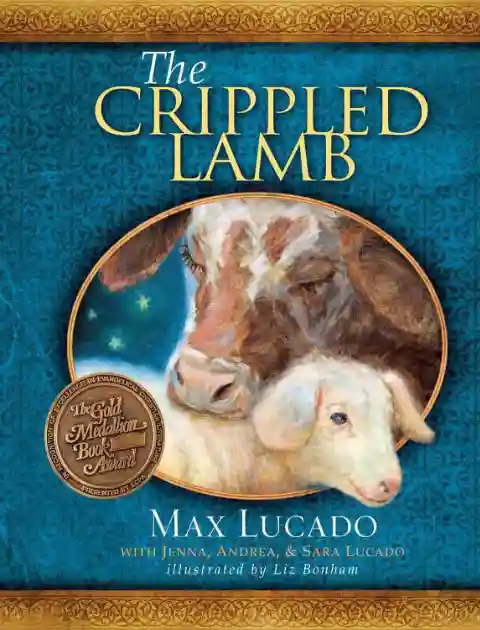
"The Crippled Lamb" is a heartwarming children's book written by Max Lucado. It tells the story of a lamb named Joshua who feels different from the others because he is born with a crippled leg. Despite feeling left out, he eventually discovers that his uniqueness is a gift from God, and he plays a special role in the birth of Baby Jesus. The book teaches valuable lessons about acceptance, friendship, and the true meaning of Christmas.
Nabeel Qureshi
why god loves people who hate each other
The church is filled with lots of dangerously different people. There are rich and poor, old and young, male and female. We have families with fifteen children and fifty-year-old unmarrieds. There are Republicans and Democrats, executives and janitors, athletes, artists, and teachers. And the differences get even deeper — American, African, Asian, Latin, and Middle Eastern. Not to mention our personalities — outgoing and shy, bold and meek, patient and ambitious, emotional and unaffected, rational and relational. There’s no mystery why the Bible has so much to say about stress, conflict, and reconciliation between believers. How could there not be friction in a family like ours? A First-Century Food Fight Remember when Paul called out Peter in front of everyone? When the apostles — a very small group of very like-minded men who alone mediate the very words of Christ — don’t always get along, it could easily discourage the rest of us, right? Paul said, “I opposed him to his face” (Galatians 2:11). So what was he so worked up about? Peter had stopped eating with Gentile believers to preserve his image among the Jews, and many had followed his example (2:12–13). But is that really that big of a deal? It may seem like Paul blew an empty seat in a lunchroom way out of proportion, but he didn’t. Paul saw that Peter’s decision denied the world-changing, death-defeating, unifying work of Christ. Through the gospel, God was doing something uniquely beautiful and glorious by not only reconciling people to himself, but also bringing them together in love across every imaginable barrier and boundary. Why Did God Make Us So Different? We might be lulled into forgetting all of our differences are due to the God himself, who knit us together, every cell and disposition, before we were even born (Psalm 139). He’s never surprised that we’re different. In fact, he knows every difference completely and intimately because he designed them. Think for a minute about the thousands of years now of bloody, almost unrelenting, hostile conflict between Jews and Gentiles. God did that. God made Israel “distinct from every other people on the face of the earth” (Exodus 33:16). He set them violently against every neighboring nation (Deuteronomy 7:2). It was the worldwide rehearsal of Joseph and his fancy coat, when his father made him the enemy of all his brothers by setting him apart with his special love (Genesis 37). Why would he design Jews and Gentiles for so much division and destruction? For this reason: “[Christ] himself is our peace, who made us both one and has broken down the wall of hostility . . . and reconciled us both to God in one body through the cross, thereby killing the hostility” (Ephesians 2:14, 16). The God-designed differences — even hostilities — between these two peoples was meant to show the invincible power of the gospel message to produce love. When Two Become One God’s full acceptance of us in Jesus binds up the brokenness in our relationships. That’s a significant, intentional part of the most important plan in history, God’s plan to save his children from every tribe, tongue, people, and nation. Christ came to repair what our rebellion had wrecked in our relationship with him, but he also came to reunite us in love with people different than us in every imaginable way. Through the gospel, in light of every conceivable contrast, God has united us in at least three remarkable realities. 1. We are one in death. This is where Paul turns first with Peter. “We know that a person is not justified by works of the law but through faith in Jesus Christ. . . . By works of the law no one will be justified” (Galatians 2:16). Self-righteousness has never rescued anyone from God’s wrath, because no one has lived and loved God’s law flawlessly. “None is righteous, no, not one” (Romans 3:10). Therefore, we all — without exception — were dead in our sin and without hope in ourselves (Ephesians 2:1; Romans 6:23). 2. We are one in hope. “In Christ Jesus you are all sons of God, through faith. For as many of you as were baptized into Christ have put on Christ. There is neither slave nor free, there is no male and female, for you are all one in Christ Jesus. And if you are Christ’s, then you are Abraham’s offspring, heirs according to promise” (Galatians 3:26–29). Everything that elevates us over one another in everyday society is eliminated before our heavenly Father for eternity. We can’t escape comparison, class, and cliques in this life, but God embraces us each equally from every family, country, and social status. In Christ, we are all — without exception and distinction — complete and full heirs of eternal life, the world, and God himself. 3. Therefore, we are one in life. Jesus promised the world would see him in our love for one another (John 13:35). How much more powerfully will they see him in our love for one another when we’re really, really different? When we love people like us, we don’t surprise many people in the world. But there’s a strange and beautiful love across boundaries that they simply cannot explain. It’s a love that restores the broken (Galatians 6:1) and bears heavy, inconvenient, painful burdens (Galatians 6:2). It’s a life that loves to do good to everyone, especially to those with whom we’re one in Christ (Galatians 6:10). Miraculously, there’s a oneness in this diverse family that “fulfills the law of Christ.” The happy, servant-hearted, committed, mutually beneficial relationship between flawed and different sinners displays the character and glory of God. Seeing Differences Differently The gospel turns haters into brothers, enemies into sisters. One of the most powerful and winsome things that Jesus purchased with his death was unlikely love. So we have to learn to see our differences differently, to see the contrasts and even inconveniences as unique canvases for Christ and his redeeming love for us.