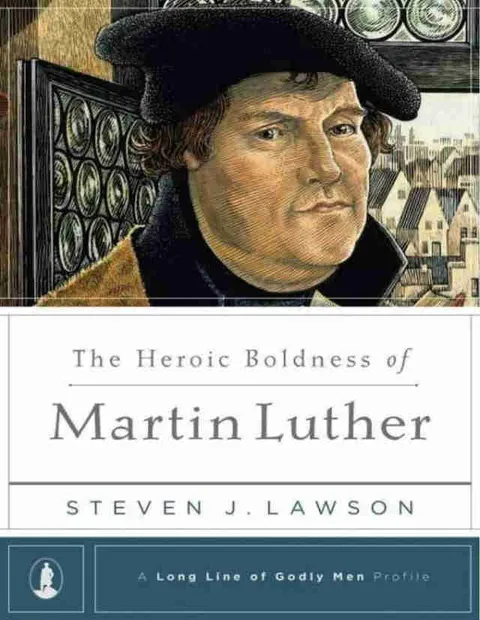

The Heroic Boldness Of Martin Luther Order Printed Copy
- Author: Steven J. Lawson
- Size: 1.12MB | 118 pages
- |
Others like the heroic boldness of martin luther Features >>

The Heroes Of Faith
Foxes Books Of Martyrs

Hearts Of Fire - Eight Women In The Underground Church And Their Stories Of Costly Faith

The Great Life Of St Benedict

The Great Visions Of Ellen G White

Smith Wigglesworth: A Man Who Walked With God

Early History Of The Christian Church - The Fourth Century

Twelve Extraordinary Women

A Joyful Pilgrimage

10,000 Miles For A Miracle
About the Book
"The Heroic Boldness of Martin Luther" by Steven J. Lawson is a biography that explores the life and impact of Martin Luther, a key figure in the Protestant Reformation. Lawson highlights Luther's courage in challenging the teachings of the Catholic Church and his unwavering commitment to biblical truth. The book showcases Luther's boldness in standing up for his beliefs and his enduring influence on Christian theology.
John Stott

the father's house and the way there
"Let not your heart be troubled: ye believe in God, believe also in me. In my Father's house are many mansions: if it were not so, I would have told you. I go to prepare a place for you. And if I go and prepare a place for you, I will come again, and receive you unto myself; that where I am, there ye may be also. And whither I go ye know, and the way ye know. Thomas saith unto him, Lord, we know not whither thou goest; and how can we know the way? Jesus saith unto him, I am the way, the truth, and the life: no man cometh unto the Father, but by me" (John 14:1-6). In these verses, there are two outstanding truths emphasized: first, that of the Father's house, and second, our Lord's personal return for His own. We are all familiar with the fact, I presume, that the Bible was not written in chapters and verses. These breaks in the text were put in by editors, and that in rather recent years, some of them as late as the time of the Protestant Reformation. And sometimes the chapter breaks seem to come at rather unfortunate places. I think such is the case here. Who, for instance, beginning to read the first verse of chapter fourteen, connects it in his mind with our Lord's words to the Apostle Peter at the close of chapter thirteen? And yet, there is a very real connection. The Lord Jesus had been giving His last messages to His disciples. He had intimated that soon they would forsake Him and flee. He had told them that He was going away and for the present they could not come where He was to go. And in verse thirty-six of chapter thirteen we read: "Simon Peter said unto him, Lord, whither goest thou? Jesus answered him, Whither I go, thou canst not follow me now; but thou shalt follow me afterwards." He was going, you see, to the Father's house. He was going home to God by way of the cross and resurrection, and Peter could not follow immediately. But the Lord says, "Thou shalt follow Me afterwards." Peter did not understand that, and he said to Him: "Lord, why cannot I follow Thee now? I will lay down my life for Thy sake" (John 13:37). "Jesus answered him, Wilt thou lay down thy life for My sake? Verily, verily, I say unto thee, The cock shall not crow till thou hast denied Me thrice" (John 13:38). And then He immediately adds: "Let not your heart be troubled: ye believe in God, believe also in Me." You see, the Lord Jesus is addressing these words, of course, to all His disciples, but directly — directly — to the disciple who was to deny Him in so short a time. And this is surely very comforting for our hearts. Peter was to fail the Lord — Jesus knew he would fail — but deep in Peter's heart there was a fervent love for the Lord Jesus. And when he said, "I will lay down my life for Thy sake," he meant every word of it. But he did not realize how untrustworthy his own heart was. It was a case of the spirit being willing, but the flesh weak. And Jesus knew something of the fearful discouragement that would roll over the soul of Peter when he awoke to the realization of the fact that he had been so utterly faithless in the hour of his Master's need. In the very time that Jesus needed someone to stand up for Him and to say boldly, "Yes, I am one of His, and I can bear witness to the purity of His life and to the goodness of His ways" — at that time Peter, frightened by the soldiers gathered about, denied any knowledge of his Saviour. And, oh, the days and nights that would follow as he would feel that surely he must be utterly cast off, surely the Lord could never put any trust in him again! But if he remembered these words, what a comfort they must have brought to his poor aching heart! For Jesus is practically saying, "I know all about it, Peter. I know how you are going to fail, but I want you to know this; in My Father's house are many mansions, and you are going to share one of those mansions with Me some day. I am not going to permit you, Peter, to be utterly overcome. I am not going to permit you to go into complete apostasy. You will fall, but you will be lifted up again, and you will share with Me a place in the many mansions." When He says, "Let not your heart be troubled," He does not mean, "Do not be exercised about your failure," for He Himself sought to exercise the heart of Peter, and in a wonderful way restored him by the Sea of Galilee later on. But He means this: "Do not be cast down. Do not allow the enemy of your soul to make you feel there is no further hope, there is no opportunity for you." I wonder if I am speaking to someone this evening who has failed, perhaps, as Peter failed. Under the stress of circumstances you, too, have denied your Lord, denied Him in acts if not in words, and the adversary of your soul is saying to you now, "It is all up with you; your case is hopeless. You knew Christ once, but you have failed so miserably, He would never own you again." Oh, let me assure you His interest in you is just as deep as it ever was. If you truly trusted Him as your Saviour, the fact that you failed so grievously, and the fact that you mourn over it, only emphasizes the truth that you belong to Him. Still He says, "[Return], O backsliding children, [unto Me]; for I am married unto you" (Jer. 3:14) — not, "I am divorced from you." And therefore He waits for you to come back and confess your failure and your sin, and He has promised complete restoration, for, "If we confess our sins, he is faithful and just to forgive us our sins, and to cleanse us from all unrighteousness" (1 John 1:9). And some day for you, too, there will be a place in the Father's house. "Let not your heart be troubled: ye believe in God, believe also in Me." You see, in the days gone by before Jesus came to them at all, the people of Israel did have faith in the one true and living God. Now they had never seen Him, and Jesus is saying to His disciples, "You have believed in God when you couldn't see Him, now I am going away in a little while and you won't be able to see Me, but I want you to trust Me just the same as when I was here. Just as you have believed in the unseen God through the years, I want you to put your faith in Me, the unseen Christ, after I have gone back to the Father." Do we have that implicit trust and confidence in Him, realizing that He is deeply interested in every detail of our own lives? The Word says, "Casting all your care upon Him; for He careth for you" (1 Pet. 5:7). There is absolutely nothing that concerns His people that He Himself is not concerned about. And therefore He would have us put away all the stress and all the anxiety. He says, "Be careful [anxious] for nothing; but in every thing by prayer and supplication with thanksgiving let your requests be made known unto God" (Phil. 4:6). "Ye believe in God, believe also in Me." And then He adds, "In My Father's house are many mansions." "My Father's house," and by that of course He means Heaven, and He is speaking of a place, a place to which He was going, and a place into which some day He will take all His own. I often hear people say, "Heaven is a condition rather than a place." Heaven is both a place and a condition. It is true we do not read a great deal about Heaven in the Bible. Somebody has said, "Heaven is the land of no more." We have more in the Bible about what will not be in Heaven than about what will be there. Remember in the book of Revelation we read that there will be no more sin, there will be no more tears, there will be no more pain, there will be no more sorrow, there will be no more curse, there will be no more darkness, there will be no more distress of any kind in the Father's house. The Father's house is the place where Christ is, and that is the place to which the redeemed are going. Some of you may have thought the expression here, "In My Father's house are many mansions," is rather peculiar. Somehow or other, the word mansion to most of us in the United States has an accustomed meaning that it did not originally have. When we see a great building we call that a mansion. But the word as originally used did not have that meaning at all. It had rather the meaning of an apartment, as we use that word today, a splendid apartment. So one building might have many mansions in it. And Jesus is telling us, "In My Father's house are many apartments, many resting-places." There is a place, an individual place, for every one of His own, all in that Father's house. "If it were not so, I would have told you." What does He mean by that? The Jews had had a belief in a heaven of bliss after death, and Jesus said, "If you had been wrong in that, I would have corrected you." But because He didn't correct it but rather affirmed it, we know that it is true, that there is a glorious home beyond the skies for the redeemed which we shall share with Him by-and-by. He adds, "I go to prepare a place for you." What does He mean by that? You see the mansions are different from what they were before He went back there. Before He went back to the Father's house, the sin question had never been settled. Before He went back to the Father's house, the veil had not been rent, the blood had not been sprinkled on the mercy-seat. So the saints of old went to Paradise on credit. They did not have the same blessed access into the immediate presence of God that the saints have now. We read in the Epistle to the Hebrews that we have now come to the spirits of just men made perfect. They were the spirits of just men of all the centuries before the cross; God had redeemed them and taken them to Paradise, but they were not yet made perfect. They could not be until the precious blood of Jesus was shed on the cross. Now having settled the sin question, He entered into the holiest with His own blood in antitypical fashion, sprinkled His own blood on the mercy-seat above, and now a place is prepared in the holiest for all of His own, and the spirits of just men of the past have been perfected and we who believe now are perfected forever. So we are all suited to that place to which we are going. "I go to prepare a place for you." And then He said, "And if I go and prepare a place for you, I will come again, and receive you unto Myself; that where I am, there ye may be also." Now I know that a great many people think of this as a word in regard to death, and of course, when a believer dies, that believer goes to be with Christ. But we are never told in Scripture that in the hour of death Christ comes for His people. If we may draw an analogy from something our Lord said when He was here on earth, we gather that that is hardly true. We are told that a dear child of God was dying — he was a beggar, it is true. He was an outcast, lying at the rich man's gate, but he was a real son of Abraham. He had faith in the God of all grace. And the beggar died, we are told, and was carried by the angels into Abraham's bosom. Angels carried the poor beggar — poor no longer — into Paradise. What I rather gather from that, is that the last ministry of angels, who are ever keeping watch over the people of God, will be to usher them into the presence of God. He is yonder in the Father's house, and His angels usher His saints into His presence. But He is speaking of something different here. Death is the believer going to be with Christ. That is what the Scripture tells us — "Absent from the body ... present with the Lord" (2 Cor. 5:8); "To depart, and be with Christ; which is far better" (Phil 1:23). But a believer going home to be with Christ is spoken of as being unclothed, having laid his body aside. He is there in the presence of the Lord a glorified spirit, but he is there waiting for his redeemed body. When the Lord Jesus fulfils that which is spoken here in the fourteenth chapter of John, then believers will receive their glorified bodies and will be altogether like Him. This coming, referred to here, is developed for us more fully in the fourth chapter of the First Epistle to the Thessalonians. There we read in verse thirteen: "I would not have you to be ignorant, brethren, concerning them which are asleep" —that is, saints whose bodies are sleeping in the graves but whose spirits are with Christ— "But I would not have you to be ignorant, brethren, concerning them which are asleep, that ye sorrow not, even as others which have no hope. For if we believe that Jesus died and rose again, even so them also which sleep in Jesus will God bring with him. For this we say unto you by the word of the Lord, that we which are alive and remain unto the coming of the Lord shall not prevent them which are asleep. For the Lord himself shall descend from heaven with a shout, with the voice of the archangel, and with the trump of God: and the dead in Christ shall rise first: Then we which are alive and remain shall be caught up together with them in the clouds, to meet the Lord in the air: and so shall we ever be with the Lord" (1 Thessalonians 4:13-17). This is the coming our Saviour refers to when He says: "If I go and prepare a place for you, I will come again and receive you unto Myself" (John 14:3). It is at that coming that the expectation of our completed redemption will be fulfilled. In Romans eight the Apostle Paul tells us in verse nineteen: "For the earnest expectation of the creature waiteth for the manifestation of the sons of God." Verses twenty-two and twenty-three: "For we know that the whole creation groaneth and travaileth in pain together until now. And not only they, but ourselves also, which have the firstfruits of the Spirit, even we ourselves groan within ourselves, waiting for the adoption—" What does he mean by that? —"to wit, the redemption of our body." Our spirits have already been redeemed, we have already received the salvation of our souls, but we are waiting for the complete salvation of the body, the redemption of the body at the coming of the Lord Jesus Christ. "For we are saved by hope: but hope that is seen is not hope" (Rom. 8:24). What hope is it then? The hope of the coming of our Lord. And to this He refers again in the third chapter of the Epistle to the Philippians, where we read in verse twenty: "For our conversation is in heaven; from whence also we look for the Saviour, the Lord Jesus Christ: Who shall change our vile body, that it may be fashioned like unto his glorious body, according to the working whereby he is able even to subdue all things unto himself." This is the glorious event that will take place when the Lord comes back again, when He comes back for us. There is the widest difference, you see, between this and the time when He is manifested as the Son of Man to deal in judgment with the godless world and eventually to set up His kingdom. This was a little secret the Lord was revealing to these apostles that night in the upper room. In the three Synoptic Gospels it was not mentioned. It was the Apostle Paul who was the chosen instrument to develop it, but it seems that the Lord Jesus, just before He went away, had a secret welling up in His heart, as it were, which He could not hold back any longer and He must tell them a little about it, so He says, "I am going away, but I am going to prepare a place for you. But if I go and prepare a place for you, I will come again and receive you" — not, "I will send the death angel for you," or any other angel, but "I will come again, and receive you unto Myself, that where I am there ye may be also." You see, He will never be satisfied until every one of His redeemed people is with Him in the glory in the Father's house. His heart is yearning for that. Now a word about the Father's house. Notice it is the Father's house, and the Father's house is for all the Father's children. We hear a great many strange things these days. Some people would try to tell us that it is only the deeply spiritual people of God that will be caught up with the Lord Jesus at His coming. When people talk like that, how little understanding they have of the Father's heart! You think of a normal father or mother here on earth, with, say, eight or ten children, and that is quite a family, isn't it? The father's house is open to all the children. I pity the home, and pity the children where the father or the mother makes distinctions among their children. I think it is a sad thing when out of a number of children one perhaps occupies a special place in the heart of the father and the others are held at a distance. "Oh," but you say, "maybe one or two are naughty children. Of course the father couldn't love naughty children as much as he loves the good children." Is that true? Why, even the naughty children are so dear to the father's heart that they give him many sleepless nights as he thinks about their naughtiness. He loves them and truly longs to see them all that they ought to be. There is always a welcome for them at the father's house. We need to remember, too, that in the Father's house above, there is no distinction. People often say to me, "Oh, if I can just get into Heaven and get a seat behind the door, I shall be satisfied. I know I don't deserve anything better." My dear friend, you don't deserve to get there at all. I don't deserve to go there. But I am not going there because I deserve to go, but I am going to Heaven because I have been born again, and the Lord Jesus Christ is preparing a place for me, and the Father's house is for all the Father's children. Another thing is this: There are no seats behind the door over yonder! I wish I could say it so loudly that everybody would get hold of it. There is nothing like that in the Word of God. There are no distinctions in the welcome that believers will have in the Father's house. I repeat, the Father's house has the same welcome for all the Father's children. You say, "Well, but doesn't the Bible indicate some will have greater rewards than others?" Oh, yes, but rewards have nothing to do with the welcome into the Father's house. The rewards especially have to do with the coming glorious kingdom, of course given in Heaven, given at the judgment-seat of Christ, but the differences are in the kingdom. For instance, look at the Second Epistle of Peter: "So an entrance shall be ministered unto you abundantly into—" Into what? Into heaven? No; it is not true that some people will get an abundant entrance into Heaven and other folk will not have anything like so warm and cordial a welcome. What does it mean? It says that some people have an entrance ministered unto them abundantly. Yes, but into what? "Into the everlasting kingdom of our Lord and Saviour Jesus Christ" (2 Peter 1:11). Do not confuse, or confound, in your thinking, the Father's house with the everlasting kingdom. The Father's house is the home of the saints; the everlasting kingdom is the sphere of service and rewards, where through all eternity, first in the Millennium and then in the ages to come, we shall be serving our blessed Lord who has prepared a place for us in the Father's house... The Father's house is the home of all the Father's children. But we make our own places in the kingdom by our own devotedness to the Lord Jesus Christ. Do you get the difference? So there is a place for all in the Father's house. About the way there. Will everybody get to the Father's house? I wish that they would. Richard Baxter used to pray, "Oh, God, for a full Heaven and an empty hell!" But alas, alas, many persist in rebellion against God and so that prayer can never be answered! There is only one way to the Father's house. And what is that way? I have had people say to me so many times, "We are traveling different roads, but we will all get to Heaven at last." No, no; I don't find that in my Bible. My Bible says, "There is a way that seemeth right unto a man, but the end thereof are the ways of death" (Prov. 16:25), and it warns me against taking the broad way that leads to destruction and tells me to take the narrow way that leads to life. And so here Jesus says, "And whither I go ye know, and the way ye know. Thomas saith unto Him—" Thomas was honest and he was never afraid just to blurt out all the truth. He said, "We don't know what You are talking about. We have to confess we are ignorant, and we don't know where You are going, and how can we know the way?" Jesus said unto him — and, oh, dear friends, you get what He said, for it is for you as well as for Thomas — "Jesus saith unto him, I am the way, the truth, and the life: no man cometh unto the Father, but by Me" (John 14:6). Oh, don't talk about many ways. There is only one — Jesus is the only way. There is none other name under heaven given among men whereby we must be saved, but the name of Jesus. Have you come to Him? Are you trusting Him? If you are, you are on the way to the Father's house, and now you can wait with equally glad expectation for the hour of His return, for He said, "If I go, I will come again, and receive you unto Myself." When will He come? We can't tell that, but we are waiting for Him day by day. "I know not when the Lord will come Or at what hour He may appear, Whether at midnight or at morn, Or at what season of the year. I only know that He is near, And that His voice I soon shall hear. I only know that He is near, And that His voice I soon shall hear." From Care for God's Fruit Trees and Other Messages by H.A. Ironside. Rev. ed. New York: Loizeaux Brothers, [1945].