
Others like the financial peace planner Features >>

Financial Excellence

Financial Stewardship

Financial Breakthrough

Financial Security In The Last Days

Laws Of Prosperity

How God Taught Me About Prosperity
-1-160.webp)
Your Money Or Your Life: 9 Steps To Transforming Your Relationship With Money And Achieving Financial Independence

Everyday Millionaire

Real-Life Economics
Help, God! I'm Broke!
About the Book
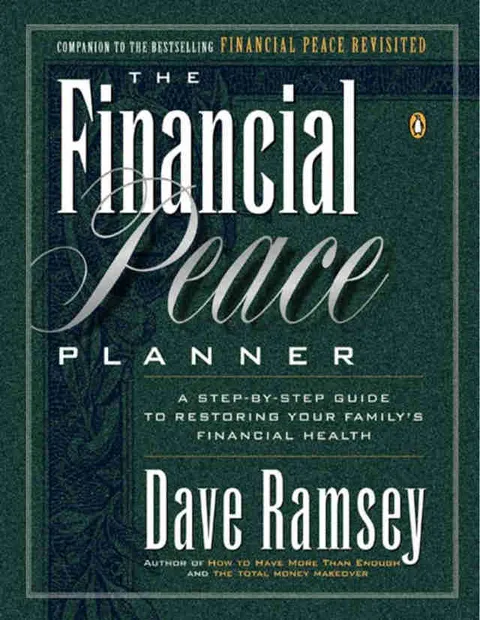
"The Financial Peace Planner" by Dave Ramsey is a comprehensive guide to achieving financial stability and peace of mind. Ramsey outlines a step-by-step plan to get out of debt, build savings, and invest wisely. The book provides practical advice on budgeting, cutting expenses, and setting achievable financial goals. Ramsey emphasizes the importance of living below your means, avoiding debt, and taking control of your financial future. Overall, "The Financial Peace Planner" is a valuable resource for anyone looking to improve their financial situation and achieve long-term financial security.
Fanny Crosby

Friend, You Can Be Ready to Die
Years ago I read somewhere that, during the Victorian era, people talked often about death, and sex was the taboo subject. By now we have flipped it. We talk freely about sex, and death is the taboo subject. To me, what’s odd is this: even Christians shy away from talking about death. For crying out loud, we’re going to heaven! Why should we fear anything ? Our Lord died and rose again — for us. Yes, the blunt truth can seem intimidating. Here it is: We don’t need to go looking for it. Sooner or later, something bad will come find us and take us out. But why not accept that, and prepare for it, and rejoice our way through it? Thanks to the risen Jesus, death is no longer a crisis. It is now our release. So, Death, you sorry loser, we will outlive you by an eternity. We will even dance on your grave, when “death shall be no more” (Revelation 21:4). But for now, among the many ways to prepare for death — like buying life insurance, making a proper will, and so forth — here are two truths that can help you prevail when your moment comes. Both insights come from an obscure passage near the end of Deuteronomy. Your Final Obedience First, your death will be your final act of obedience in this world below. Near the end of his earthly life, Moses received a surprising command from God: Go up this mountain . . . and view the land of Canaan, which I am giving to the people of Israel for a possession. And die on the mountain which you go up . . . (Deuteronomy 32:49–50) Moses obeyed the command, by God’s grace. His death, therefore, was not his pathetic, crushing defeat; it was his final, climactic act of obedience. As you can see in the verse, it was even what we call a mountaintop experience. “Your death will be your final act of obedience in this world below.” Sadly, our deaths are usually painful and humiliating. But that’s obvious. Down beneath the surface appearances, the profound reality is this: your death too will be an act of obedience, for you too are God’s servant, like Moses. The Bible says about us all, “ Precious in the sight of the Lord is the death of his saints” (Psalm 116:15). He will not throw you away like a crumpled-up piece of trash. He will receive you as his treasured friend. Your death might be messy here on earth, but it will not be disgusting to God above. It will be, to him, “precious” — that is, valued and honored. It will be you obeying the One who said, “Follow me” (Matthew 4:19). You followed him with a first step, and you will follow him with a last step. And when you’re thinking about it, don’t worry about failing him at that final moment. He who commands you will also carry you. Given the grandeur of a Christian’s death, I have to admit that I have never seen a Christian funeral do justice to the magnitude of the moment. We try, but our services fall short. Only by faith, looking beyond our poor efforts at doing honor, can we truly savor the wonder of a Christian’s crowning glory. Even still, let’s make every Christian funeral as meaningful as it can be by believing and declaring the truth. A blood-bought sinner has just stepped on Satan’s neck and leapt up into eternal happiness, by God’s grace and for his glory. The day of your funeral, this uncomprehending world will stumble along in its oblivious way. But your believing family and friends will understand what’s really going on. And they will rejoice. This being so, why not look forward to dying? Paul was so eager for his day of release, he honestly couldn’t decide whether he’d rather keep serving Jesus here or die and go be with Jesus there: “What shall I choose? I do not know! I am torn between the two” (Philippians 1:22–23 NIV). When our work here is finally complete, why stay one moment longer? Of course, just as God decides our birthday (which we do know), so God also decides our deathday (which we do not know). Let’s bow to his schedule. But right now, by faith, let’s also start sitting on the edge of our seats in eager anticipation. And when he does give the command, “Die,” we then can say, “Yes, Lord! At long last!” And we will die. He will help us obey him even then — especially then. Your Happy Meeting Second, your death will be your happy meeting with the saints in that world above. Not only did God command Moses to die, but he also deepened and enriched Moses’s expectations of his death: Die on the mountain which you go up, and be gathered to your people, as Aaron your brother died in Mount Hor and was gathered to his people. (Deuteronomy 32:50) To be with our Lord in heaven above is the ultimate human experience. But he himself includes in that sacred privilege “the communion of saints,” to quote the Apostles’ Creed. When you die, like Moses, you will be gathered to your people — all the believers in Jesus who have gone before you into the presence of God. Heaven will not be solitary you with Jesus alone. It will be you with countless others, surrounding his throne of grace, all of you glorifying and enjoying him together with explosive enthusiasm (Revelation 7:9–10). Right now, in this world, we are “the church militant,” to use the traditional wording. But even now, we are one with “the church triumphant” above. And when we die, we finally enter into the full experience of the blood-bought communion of saints. Think about it. No church splits, no broken relationships, not even chilly aloofness. We all will be united before Christ in a celebration of his salvation too joyous for any petty smallness to sneak into our hearts. You will like everyone there, and everyone there will like you too. You will be included. You will be understood. You will be safe. No one will kick you out, no one will bully you, no one will slander you — not in the presence of the King. And you will never again, even once, even a little, disappoint anyone else or hurt their feelings or let them down. You will be magnificent, like everyone around you, for Jesus will put his glory upon us all. Facing Death with Calm Confidence Even now, by God’s grace, we have come to the heavenly Jerusalem, and to innumerable angels in festal gathering, and to the assembly of the firstborn who are enrolled in heaven, and to God, the judge of all, and to the spirits of the righteous made perfect, and to Jesus, the mediator of a new covenant. (Hebrews 12:22–24) “Why should we, citizens of the heavenly city, ever fear anything about earthly death?” They all are there, right at this very moment, in the invisible realm. It’s only an inch away. And the instant after your last breath in this dark world, you will awaken to that bright world above, where you will be welcomed in and rejoiced over. Saint Augustine might smile and nod with deep dignity. Martin Luther might give you a warm bear hug. Elisabeth Elliot might gently shake your hand. And maybe for the first time ever, you’ll discover how good it feels to really belong . Here’s my point. Why should we, citizens of the heavenly city, ever fear anything about earthly death? By faith in God’s promises in the gospel, let’s get ready now so that we face it then with calm confidence — and even with bold defiance.