





GIP Library icon

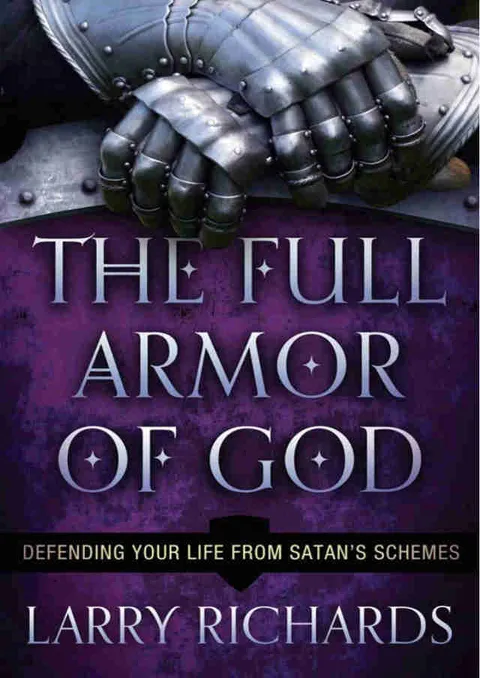
The Full Armor Of God The Full Armor Of God

The Full Armor Of God Order Printed Copy

  • Author: Larry Richards
  • Size: 1.43MB | 130 pages
  • |
Continue with
Google Twitter
LOG IN TO REVIEW
About the Book


"The Full Armor of God" by Larry Richards explores the importance of spiritual warfare and being prepared to combat the forces of evil. The book provides practical guidance on how to put on the full armor of God as outlined in Ephesians 6:10-18, in order to stand firm in faith and overcome challenges in life. Through biblical examples and personal anecdotes, Richards demonstrates the power and protection that come from fully equipping oneself with God's armor.

John Owen

John Owen John Owen’s life was incredibly difficult. Born in 1616 and dying in 1683, Owen lived through the deaths of his first wife and all of his children, several of whom died in very early childhood. He supported his last surviving daughter when her marriage broke down. He contributed to a political revolution, watched it fail, saw the monarchy restored and wreak a terrible revenge on republicans, and lived in and around London during the persecution that followed. For twenty years he would have seen the decapitated heads of his friends on display around the city. He died fearing that the dissenting churches had largely abandoned the doctrine of the Trinity and justification by grace alone through faith alone in Christ alone; and, with Charles II about to be replaced by his openly Catholic brother James, believing that the English Reformation was almost over. Owen was one of the most published writers in the seventeenth century. He published around 8 million words. These writings included books on theology and spirituality, politics and economics, and ranged in length from the largest commentary ever published on the epistle to the Hebrews to a short Latin poem that has never been reprinted. For not all of Owen’s works have been kept in print. The most widely circulating nineteenth-century edition, most of which is published by the Banner of Truth, did not include Owen’s sermon manuscripts that are kept in various English libraries, nor the book for children that Owen published in 1652. Owen was one of England’s earliest children’s authors. The catechisms that Owen published (1645) outlined what he expected children in his congregation to know. These catechisms were published before the Westminster Assembly published its better-known examples. But Owen’s catechisms are in many ways simpler. The Primer (1652), which Owen prepared after the death of several of his children during the years of poor harvests and disease at the end of the 1640s, showed what Owen expected of an ideal Christian home. Its routine would be built around Bible reading and prayer, he believed, and his little book included sample prayers that children could learn to pray in mornings, evenings, and at meals. Owen argued that those who led church services should take account of the needs of children. Services that were too long, he believed, did no one any good. Adult believers should not need written prayers, he believed, and these should be banned from public worship. But children were different and needed all the help they could get. Owen enjoyed many warm friendships. His social network included many of the most famous writers in seventeenth-century England. Among his friends and rivals were John Milton, Andrew Marvell, John Bunyan, and Lucy Hutchinson. Owen fell out with Milton and became the subject of one of his sonnets. Owen helped Marvell publish one of his most controversial political pamphlets. He encouraged his publisher, Nathanial Ponder, to publish Bunyan’s Pilgrim’s Progress. And he appears to have supported Lucy Hutchinson during her move into London, when she attended and took notes upon his preaching and translated large parts of his Theologoumena Pantodapa (1661)—a translation of which has been published with the title Biblical Theology. Owen’s letters reveal his kindness and care as a pastor, especially to mothers grieving their children’s death. Owen was deeply political. He preached to Members of Parliament on the day after the execution of Charles I, and pinned his hopes for the reformation of church and society on their efforts to transform England into a protestant republic. During the 1650s, under the leadership of Oliver Cromwell, Owen served on important committees that sought to establish a religious foundation for the new regime. But he grew dismayed by the ways in which the Cromwell family, and the administration they led, seemed to turn away from godly values. In 1658, he worked with leading army officers to create a crisis that, he likely hoped, would call the regime back to its earlier ideals. It failed, and instead created the crisis that was resolved by the restoration of the monarchy, the return of Charles II, and the persecution of dissenters that followed. During the Restoration, Owen kept his head down, and, as persecution slackened in the later 1660s, published pamphlets that argued that dissenters were the economic lifeblood of the English nation. But he was chastened by his attempts at political intervention and came increasingly to realize that his focus should be on things eternal. Owen often changed his mind. As his developing attitudes to political intervention suggest, Owen committed himself to some beliefs and behaviors that he came to regret. In his early years, he changed his churchmanship from Presbyterianism to Congregationalism. He innovated as a Congregationalist, installing as a co-elder and preacher a man who would not be ordained for several years. He argued for the weekly celebration of the Lord’s Supper, though it is not clear that he ever persuaded any of his congregations to practice it. He thought carefully about the end times and came to believe that, in the latter days, a large number of Jewish people would be converted to Christianity and would return to live in the Promised Land. He dismissed a great deal of discussion about the millennium, but became convinced that the binding of Satan had yet to be achieved. Owen changed his mind because he kept on studying the Bible. Owen was biblical, through and through, and depended just as much on the Holy Spirit. He certainly believed in a learned ministry–after all, he had taught theology at Oxford and done his best to promote godliness within the student body. But he also trusted the Holy Spirit to guide ordinary Christians in small group Bible studies that did not need to be policed by a formally trained expert. Aside from his own Bible study, which advanced on the serious scholarship represented by the three thousand titles that were included in the catalog of his library published soon after his death, Owen encouraged church members to meet together to study Scripture in private. Owen trusted the Bible and the work of the Spirit after writing about both. Owen was not a philosophically-driven, rationalist theologian. His writing abounds in biblical citations. It is molded and contoured by biblical revelation. But he warned that Christians could approach their study of the Bible with absolutely no spiritual advantage to themselves. Christians who approached the study of the Bible without absolute dependence upon the Spirit who inspired and preserved it would gain no more benefit than Jewish readers did from their Scriptures, he argued. Christians should never choose between entire dependence upon the Bible and the Spirit. Owen believed that the goal of the Christian life was knowing God. Before Owen, no one had ever shown clearly how Christians relate to each person of the Trinity. Owen described the goal of the gospel as revealing the love of the Father, who sent the Son as a redeemer of his people, who would be indwelt, provided with gifts, and united together by the Spirit. Owen’s Communion with God is among his most celebrated achievements—and no wonder. It is the exhalation of his devotion to Father, Son, and Spirit, and the discovery of the limitless love of God. Owen is much easier to read than many people imagine. There is a mystique to Owen—a widespread feeling that his books are too difficult and best left to expert theologians. But Owen’s greatest books were written as sermons for an audience of teenagers. Publishers have begun to modernize Owen’s language in new editions of his works. Now more than ever, it’s time to pick up Owen and find his encouragement for the Christian life.

the only certain hope on earth

“It is the hope that kills you,” as many English football (soccer) fans say. Is it not better to have low expectations instead of hoping your team will do well, only to see those hopes dashed in sometimes cruel ways? The world has an idea of hope that sees it as an optimistic expectation that something good may happen in this life or, for the religious, the life to come. People cannot help but hope; it is part of our DNA as humans. We hope for good health, a good marriage, good weather, or an enjoyable holiday. Many even hope for a better life after the life they have lived on earth, which explains why so many claim that loved ones (including animals) are “smiling down” upon them after their death. Much of the hope that is found in the world lacks promise and certainty, which is like building a house on sand. Christian hope is very different from worldly hope. Christian hope is a Spirit-given virtue enabling us to joyfully expect what God has promised through Jesus Christ. It is, therefore, thoroughly Trinitarian. Height of Our Hope Christian hope looks to God because he is “the God of hope” (Romans 15:13). Because of the resurrection of Christ, Peter says that our “faith and hope are in God” (1 Peter 1:21). The degree to which we find God desirable and excellent will be the same to which hope plays a role in our lives. Our view of God will affect the hope we possess. A small god begets a small hope; but knowing God and Christ (John 17:3), which is eternal life, is ground for possessing a hope that bursts forth in our souls on a daily basis. The psalmist describes the blessed person as the one “whose help is the God of Jacob, whose hope is in the Lord his God” (Psalm 146:5). Consider the words of Thomas Aquinas on this: Wherefore the good which we ought to hope for from God properly and chiefly is the infinite good, which is proportionate to the power of our divine helper, since it belongs to an infinite power to lead anyone to an infinite good. Such a good is eternal life, which consists in the enjoyment of God Himself.  For we should hope from Him for nothing less than Himself, since His goodness, whereby He imparts good things to His creature, is no less than His essence . Therefore the proper and principal object of hope is eternal happiness. ( Summa Theologica , II-II.17.2) In short, Aquinas is saying that our joy is connected to our hope, which is connected to our Savior, which is connected to our God. Christian hope exists only when we hope in the God and Father of our Lord Jesus Christ (1 Peter 1:13). The height of our hope is God himself. Certain as God’s Promises Certain conditions characterize biblical hope: it must be good, it must be in the future, it involves some degree of difficulty (for example, patient suffering), and it must be founded on God’s promises. Those who persevere, by faith, shall attain what we hope for: the sight of our Savior (Titus 2:13). “Christian hope is a Spirit-given virtue enabling us to joyfully expect what God has promised through Jesus Christ.” This hope of the blessed vision of Christ is based not only upon the fact that we know he will return, but also on the knowledge that God dwells in us. This explains Paul’s language in Romans 15:13, “May the God of hope fill you with all joy and peace in believing, so that by the power of the Holy Spirit you may abound in hope.” Hope arises from not only objective promises, but also an internal “pull” toward God and Christ by his Spirit. Thus, Christian hope is not about probable hope or about mere conjecture concerning things future, but about great certainty. Faith, Hope, and Love Faith in God through Christ by the Spirit gives rise to Christian hope. Faith and hope bear an intimate relation to one another (Romans 4:18–21; 5:2; 15:13; Galatians 5:5; Ephesians 1:18–19; Colossians 1:23; 1 Timothy 4:10; Hebrews 11:1; 1 Peter 1:21). Faith is the foundation of hope, so that hope without faith is no hope at all. We believe God in order to hope in what we believe. But faith also returns to hope to give it courage to persevere. If faith apprehends God’s promises, hope expects what he promises. In times of trouble, despair, and suffering, faith and hope feed on God and his promises. The difference between faith and hope is not easy to discern. Simply put, faith believes, but hope waits patiently. (Yet there is an aspect whereby faith also requires patience.) God is the object of hope, as it specifically focuses on his goodness to us in Christ. Faith not only looks to God but also trembles at his threatenings (when appropriate). Hope remains free of such fear. Faith and love can relate to a present or future object, but hope looks to the future alone. And of course, faith and hope also bear an intimate relation to love. If hope relates to faith in terms of our expectations, hope relates to love in terms of our desire. Love requires desire, so the more we desire the good, the more we will love it. Equally, hope requires desire. The more we desire what is promised, the more we hope for it. Since faith focuses on Christ, hope will always be present where there is true faith. And since faith focuses on Christ, love will always accompany faith and hope because God and Christ are the object of faith and hope — how can we not love the one we believe has saved us and promised so much for the future? Thus, faith, hope, and love give expression to our Christian life (1 Corinthians 13:13; Colossians 1:4). Hope That Purifies The life of hope yields many benefits to the Christian, such as the expectation of eternal life (Titus 1:2; 3:7), salvation (1 Thessalonians 5:8), heaven (Colossians 1:5), the resurrection (Acts 23:6), the gospel (Colossians 1:23), God’s calling (Ephesians 1:18; 4:4), and our inheritance (Ephesians 1:18). But there is also a “duty” bound up with hope, namely, purification of our souls: “Everyone who thus hopes in him purifies himself as he is pure” (1 John 3:3). This command follows one of the greatest promises of Christian hope: “Beloved, we are God’s children now, and what we will be has not yet appeared; but we know that when he appears we shall be like him, because we shall see him as he is” (1 John 3:2). Those who have the hope of being made like Christ in body and soul must also have the present desire to be  pure . While in sanctification the accent is often on what God does, here in 1 John 3:3 the accent is on what we do. Christians, if they embrace a hope of seeing Christ face to face, are to purify themselves. In other words, hope has a moral effect. The pursuit of purity arises out of our possession of hope. Hope gives birth to sanctification; and as we are sanctified, we hope even more because we get closer to God. Besides John, Peter also makes this point. He speaks of the future promise of the new heavens and new earth to his readers (2 Peter 3:13), and then reasons, “Therefore, beloved, since you are waiting for these, be diligent to be found by [God] without spot or blemish, and at peace” (2 Peter 3:14). “Our joy is connected to our hope, which is connected to our Savior, which is connected to our God.” Likewise, Paul writes, “Since we have these promises, beloved, let us cleanse ourselves from every defilement of body and spirit, bringing holiness to completion in the fear of God” (2 Corinthians 7:1). The promises Paul speaks of include our adoption as sons and daughters, wherein God makes his dwelling and walks among us (2 Corinthians 6:16, 18). These promises are, of course, realized in this life, but they also await a type of consummation that we can all look forward to (see Romans 8:23). Christian hope has present realities, one of which includes our sanctification. In this matter, our faith clings ever so tightly to our hope, as we seek to be holy as God is holy. Hope Unlike the World’s In the church today, we have underemphasized the future motivation (our Christian hope) for how to live the sanctified life. As with the Lord’s Supper, we do not only look back to Christ’s death but also look now to the risen Christ and forward to the future blessings that await us. This is the purification of the truly hopeful. Our hope is unlike the world’s. The world’s hope is often vague, uncertain, a wish thrust up at the stars. But Christian hope is solid, certain, future, and cleansing. It lasts as long as the eternal God lives, and stands as tall as he stands. He is our hope, for apart from him, no such thing exists (Ephesians 2:13).

Feedback
Suggestionsuggestion box
x