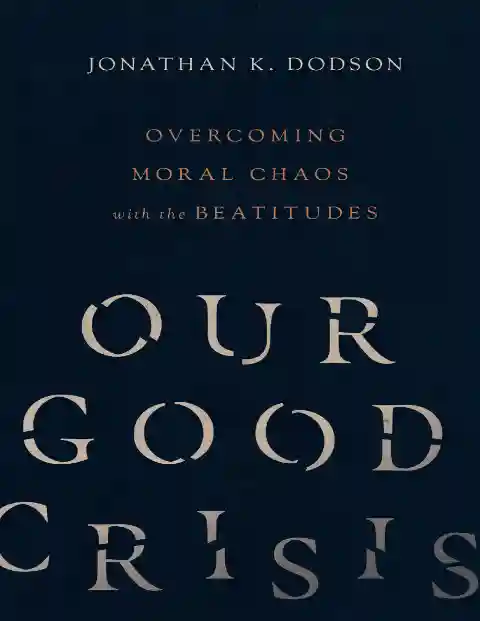

Our Good Crisis - Overcoming Moral Chaos With The Beatitudes Order Printed Copy
- Author: Jonathan K. Dodson
- Size: 3.04MB | 176 pages
- |
Others like our good crisis - overcoming moral chaos with the beatitudes Features >>

Shine On - Overcoming Persecution

Longing For Godliness - Restoring God’s Image Within Us
-160.webp)
God Is Watching You: How The Fear Of God Makes Us Human
The Assignment Vol 4: The Pain And The Passion

Dressed To Kill (Spiritual Warfare And Armour)

The Freedom Of Self Forgetfulness
True Community
Zeal Without Burnout
-160.webp)
Invisible Supply (Finding The Gifts Of The Spirit Within)
Shake Off The Dust
About the Book
"Our Good Crisis" by Jonathan K. Dodson explores the relevance of the Beatitudes in addressing the moral chaos of our times. Dodson offers insights on how to apply the teachings of Jesus in our lives, navigating the challenges of today's culture with grace and wisdom. Through a deep dive into the Beatitudes, he offers a roadmap for overcoming moral confusion and finding hope in the midst of chaos.
Jackie Hill Perry

Today Is Just in Time
His circumstances were a nightmare. Not only did he live in the land of whoredom, standing on the brink of national judgment, but his job seemed more like a sick joke than a divine commission. Go marry a prostitute and get her pregnant, God told Hosea, because I have a message to send my sinful people (Hosea 1:2). No prophet of Israel received convenient instructions, but this was about as rough as it ever got. Not to mention, all this drama — this real-life theater — was for a faithless people. Israel had it good from God, until they coopted his blessing to serve Baal, doubling down their opulence, partying hard, and forgetting all about the One who had called them out of slavery. The relationship between ancient Israel’s sin and their forgetfulness is not ironic. If sin makes people stupid (and it does), spiritual adultery makes us oblivious: She did not know that it was I who gave her the grain, the wine, and the oil, and who lavished on her silver and gold, which they used for Baal. . . . [Israel] went after her lovers and forget me, declares the Lord. (Hosea 2:8; 4:6, 10–12) They were filled, and their heart was lifted up; therefore they forgot me. (Hosea 13:6) I took them up by their arms, but they did not know that I healed them. (Hosea 11:3) Grace on the Edge Now the time had come to reap God’s wrath — hence the prophetic work of Hosea. “I will punish them for their ways and repay them for their deeds” (Hosea 4:9). The charges had piled up. Judgment was breathing down their necks. Any day now, we’d be saying if we were there, and things are about to blow. Wholesale captivity is right around the corner, and before that, an invading Assyrian army. But then there’s a call to repentance. The context is so pervasively negative, commentators have debated whether it’s serious or sarcasm. Come, let us return to the Lᴏʀᴅ; for he has torn us, that he may heal us; he has struck us down, and he will bind us up. After two days he will revive us; on the third day he will raise us up, that we may live before him. Let us know; let us press on to know the Lᴏʀᴅ; his going out is sure as the dawn; he will come to us as the showers, as the spring rains that water the earth. (Hosea 6:1–3) Hosea is for real. He means it. This book is laced with surprising words of grace; even in the midst of accusation, mercy is busting at the seams (Hosea 2:14–23; 3:1–5; 10:12; 11:1–12; 12:9; 14:1–9). In the rubble of Israel’s wickedness, in the aftermath of their apostasy, the plea still goes forth: Let us know him; Let us press on to know the Lord. Mighty in His Mercy It is a plea for us as much as for them. Know the Lord, Hosea says. Even in their mess, even in their shambled condition, when the icky-ness of their past sin is corroding the present, Hosea holds out the invitation: Today, would you turn? Will you press on to know him now? There is a theological fact to grasp here — or perhaps more, a divine emotion to feel. Just when all we can imagine is stern, hard, cold; there is warmth, eyes of hope, hands held forth. God is not like us, after all. Maybe one shot and we’re done. Maybe a few more here and there, depending on our mood, differing measures of grace, or various personalities. But not with God. How can I give you up, O Ephraim? How can I hand you over, O Israel? . . . My heart recoils within me; my compassion grows warm and tender. I will not execute my burning anger; I will not again destroy Ephraim; for I am God and not a man, the Holy One in your midst, and I will not come in wrath. (Hosea 11:8–9) As he told Moses so many years before, God tells us again: he is holy by his mercy — and it is always available to his people if they would but turn and trust him. Turning Today Which means, no matter what your yesterday looked like, the invitation is open still. Today is just in time. Like Puddleglum told Eustace and Jill, after they had muffled their obedience, while they were clearly frustrated, feeling like idiots, assuming they’d ruined everything, “Aslan’s instructions always work: there are no exceptions. But how to do it now — that’s another matter” (Silver Chair, 121). Stop for a moment, and think. It does not matter what happened yesterday, or last year, or that one time back then. What matters is this moment, now, when the mercy of God in Jesus is extended to you. All is not calloused. Remember, Jesus died in your place and took the wrath that belongs to you, if you would but trust him. As sure as the sun comes up, as sure as it rains, God has promised mercy to his people when they repent (1 John 1:9; 2 Chronicles 7:14). God’s mercy is always available to his people if they would but turn and trust him. Whatever wreck your life might be, however nightmarish your circumstances seem, Jesus is ready to embrace you. His righteousness is ready to clothe you. The mighty wave of his mercy is growing higher and higher, soon to crash over your soul, if you would just turn, if you would but seek him. Would you? Even in the midst of your mess, would you turn to him? Let us know; let us press on to know the Lord. Article by Jonathan Parnell Pastor, Minneapolis, Minnesota