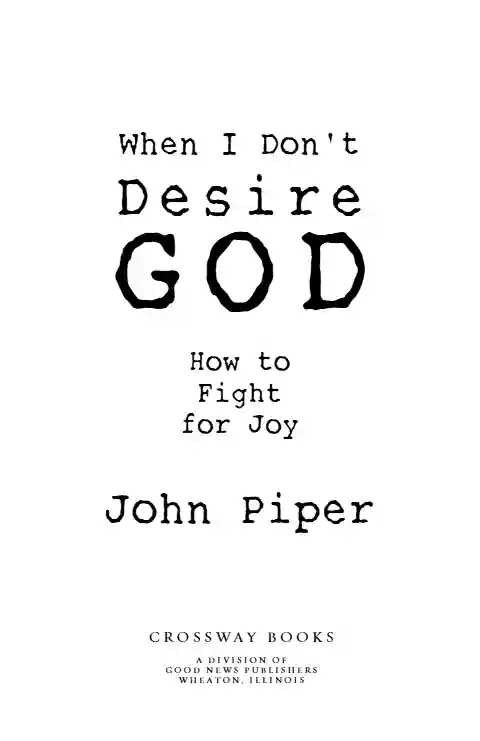





About the Book
"When I Don't Desire God" by John Piper explores the reasons why Christians may struggle with their desire for God and offers practical guidance on how to cultivate a deep and lasting affection for God. Piper discusses the importance of delighting in God and provides insights on how to overcome spiritual dryness and apathy in one's faith journey. Through biblical teachings and personal anecdotes, Piper encourages readers to actively pursue a vibrant relationship with God and find true satisfaction in Him alone.
Nick Vujicic

The Awl
I saw a good Samaritan Slow down and stop. “This is that kind of road; and none Of my sweet business here.” Atop The hill just to the east he saw The restful spires Of Jericho. “There is no law,” He thought, “no statute that requires My bother, let alone the chance Of injury.” But conscience rose and put a glance Of his own son for him to see Before his father-eyes. He crossed The lonely road, And whispered to himself, “The cost Of this assault is not his load Alone. Perhaps his father waits In Jericho.” He knelt. “Such are the fates Samaritans endure.” Then, “No! This is a Jew!” And worse, much worse: The man was dead. “Now what?” he thought. “It is a curse To die and rot without a bed Beneath the ground. And he is young. His father will Be searching soon, perhaps.” He clung To one small metal awl until, In his dead hand, it pierced his skin, As if to say To highway thieves: “Not this, not in My life will this be snatched away.” The good Samaritan put him Upon his beast, And set his face to do the grim, Bleak work of bearing the deceased Up to Jerusalem to find A leather row Where some young tanner had been signed To take a load to Jericho. He stopped at the first shop, “Can you Say if a man Was sent with leather goods down through The road to Jericho?” “I can. But hardly yet a man! In age, Or worth, I think. For all I know, his grief and rage Drove him to steal the lot, and drink His sorry way to Gerasa. His father’s sick With fear. There was a bruhaha The night he left. He tried to stick A man because his mother’s name Was smeared. He slashed Him with a tanner’s awl. He came By here to get his load, and lashed It to his mule and disappeared. His mother died Last year. The old man with the beard, Down at the corner, right hand side, That’s his dad.” “Thank you.” Hesitant, And burdened down With death, he waited at the front, Until the old man, with a frown, Said, “What you got for sale there, sir?” “It’s not for sale, Or trade, or deals. But if it were, You’d pay me anything. This veil Lies on the treasure of your life: Your son. And in His hand, unstolen in the strife. There is an awl thrust through his skin.” The old man lifted up the cloak, And put it back. “I found him on the road.” “Your folk Hate Jews, my friend. And there’s no lack Of corpses on that road. What do You want from me For this?” “I want to know from you About the awl. And I would be Obliged if you would tell me what It means.” “All right. A year ago, tonight, we shut His mother’s eyes. And every light Went out for him. But just before She died, she called Him. It was early, and a score Of birds were singing. So enthralled, She seemed, then said to him, ‘My child, With singing birds, I give you now my awl.’” He smiled, “She always had a way with words.” John Piper