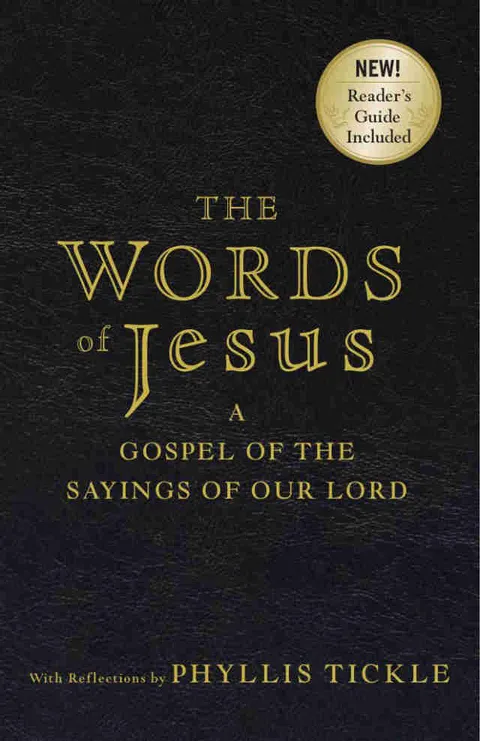

The Words Of Jesus: A Gospel Of The Sayings Of Our Lord With Reflections Order Printed Copy
- Author: Phyllis Tickle
- Size: 2.73MB | 257 pages
- |
Others like the words of jesus: a gospel of the sayings of our lord with reflections Features >>
The Songs Of Jesus
Stories Of Great Gospel Hymns
The Days Of His Presence
Experiencing The Words Of Jesus
A Word Of Wisdom In Due Season
The Christian's Secret Of A Happy Life
Words Of Wisdom: A Life-Changing Journey Through Psalms And Proverbs
The Seven Words Of Our Lord On The Cross
Hungry For More Of Jesus
-160.webp)
The Ministry Of The Psalmist (Music Ministry)
About the Book
"The Words of Jesus" is a compilation of the sayings of Jesus from the Gospels, accompanied by reflections and insights from author Phyllis Tickle. The book serves as a guide to understanding and internalizing the teachings of Jesus, offering readers a deeper connection to their faith and a closer relationship with God.
Henry Martyn
Heaven Will Be Better Than Eden
When we read about the garden of Eden in Genesis 1 and 2, we can’t help but feel drawn to its beauty and abundance and innocence. It must have been wonderful to live in such a pristine environment, with every need met, to experience an intimate marriage full of delight in each other, and to have a satisfying sense of purpose in ruling over God’s creation together. In fact, we often hear people talk about the future in terms of a return to, or restoration of, Eden. But to speak of the new creation in terms of a restoration of Eden is actually a reduction of what God has planned for his people and for his world. Eden was never intended to be the end. It was always headed somewhere — somewhere even more glorious: new heavens and a new earth (2 Peter 3:13; Revelation 21:1–2). Rather than thinking of Eden in terms of perfection, we should think of it in terms of potential. Eden was unspoiled, but it was also unfinished; it was unsullied, but it was also incomplete. As Adam and Eve were fruitful and multiplied, more offspring in the image of God would come to glorify God by enjoying him forever. As they worked and kept the garden, the boundaries of Eden would expand, and the glory of their royal rule would increase. Just as Eden was not yet all that God intended the home he shared with his people to be, so Adam and Eve were not yet all that God intended his people to be. They were sinless, but they were vulnerable to temptation. They were alive, but they were vulnerable to death. They were made in God’s image, and crowned with a measure of his glory, but they weren’t yet as glorious as God intended them to be. If they obeyed God regarding the forbidden tree, they would be able to eat of the tree of life and enter into the unending, glorious life promised by the tree of life. But, of course, that’s not what happened. Garden Gone Wrong “Rather than thinking of Eden in terms of perfection, we should think of it in terms of potential.” When Satan slithered into Eden in the form of a serpent, Adam did not crush his head then and there but listened to and obeyed him. So rather than extending the boundaries of Eden, Adam and Eve were expelled from Eden. Rather than more fully sharing the glory of the image of God, the image of God in them became marred. Rather than entering into the endless Sabbath rest, they were plunged into the restlessness of the wilderness of this world. But God’s plan for his people and the place he intends to share with them could not be hindered by human sin. God’s plan for his creation was then, and remains now, to establish his kingdom in a new creation, ruled by his Son and his Son’s bride who will share his glory and enjoy his presence in an eternal Sabbath rest. So why does this plan matter? Why does it matter that we understand that God’s original and still-in-place plan always has been headed toward an escalation of the excellencies of the original Eden? Understanding Eden orients us toward a better home. Sometimes we get sick of this world, and we find ourselves very homesick for the next. But what we long for is not merely a return to Eden. Eden was beautiful, but it wasn’t secure. Evil made its way into Eden and brought ruin with it. The new creation, where we will make our home forever, will be completely secure. “Nothing unclean will ever enter it, nor anyone who does what is detestable or false” (Revelation 21:27). It will be a vast garden city, filled with a “ransomed people for God from every tribe and language and people and nation” (Revelation 5:9). As the bride of Christ, we will share this home with our perfect Bridegroom. We won’t just hear his sound in the garden (Genesis 3:10); we “will see his face” (Revelation 22:4). Understanding Eden compels us to be joined to the true Adam. The first Adam failed in the work God gave him to do. Jesus, the second Adam, accomplished the work he was given to do, declaring from the cross, “It is finished!” (John 19:30). The first Adam failed to obey regarding a tree. Jesus obeyed regarding the tree of Calvary. The first Adam failed to love and protect his bride. But Jesus loved his bride by giving himself up for her. Understanding the failure of Adam in Eden compels us to take hold of the true Adam, Jesus. We all are born connected by our shared humanity to the first Adam, physically alive but spiritually dead. Unless something supernatural happens, we remain spiritually dead. It is when our eyes are opened to the beauty of Christ, and we respond in repentance and faith, that something supernatural does happen. We become joined to Christ by faith so that we are made spiritually alive with his life. Understanding Eden fills us with anticipation for future glory. To be joined to the risen Christ is to have the newness and glory and life of the greater Eden breaking into our lives in the here and now. “If anyone is in Christ, he is a new creation. The old has passed away; behold, the new has come” (2 Corinthians 5:17). We find that the glory of the future transforms our sense of shame now. A settled sense of the security of the future soothes our fear of death now. A growing sense of our identity as citizens of heaven changes how we see ourselves now. Truly taking in the love relationship we’re going to enjoy forever warms our hearts toward Christ now. “We’re looking forward to the consummation of all that Eden was intended to be.” But the glory we experience now is nothing compared with the glory to come. One day Christ is going to come and call us to rise from our graves. He’s going to give us resurrected, glorified bodies that are fit for living forever with him. We’ll experience all that God has planned, and been preparing, to share with his people from the very beginning. We’re not merely looking forward to a restoration of what Eden once was. Instead, we’re looking forward to the consummation of all that Eden was intended to be. Jesus, the true Adam, our glorious Bridegroom, the Seed who crushed the serpent’s head (Genesis 3:15), will not fail to lead us into all that God is preparing for us — a home even better than Eden. Article by Nancy Guthrie