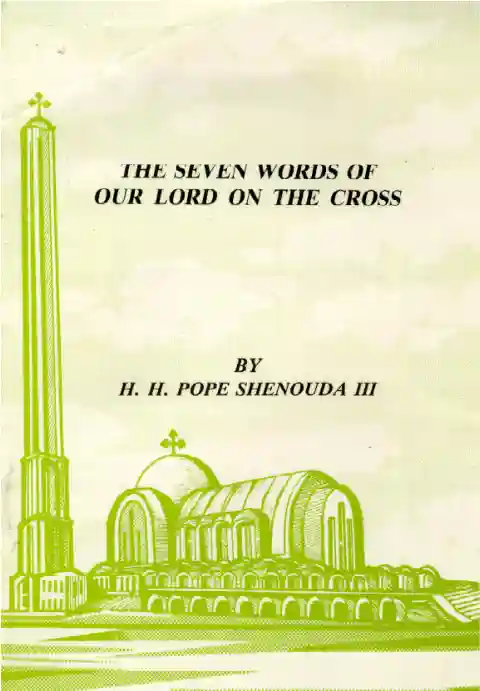

The Seven Words Of Our Lord On The Cross Order Printed Copy
- Author: Pope Shenouda III
- Size: 638KB | 67 pages
- |
Others like the seven words of our lord on the cross Features >>
The Sermon On The Mount
The Sermon On The Mount
The Power Of God's Names
The Shelter Of The Most High
God's Word For You "Fear Not"
The Pleasures Of God: Meditations On God’s Delight
A Word Of Wisdom In Due Season
The Words Of Jesus: A Gospel Of The Sayings Of Our Lord With Reflections
Hungry For More Of Jesus

The Christian's Secret Of A Happy Life
About the Book
"The Seven Words Of Our Lord On The Cross" is a book by Pope Shenouda III that explores the seven last sayings of Jesus as he hung on the cross. Through insightful commentary and reflections, the book delves into the profound meanings of these words and their significance in the context of Christian theology and salvation. Pope Shenouda III offers readers a deeper understanding of Jesus' sacrifice and the powerful message of love, forgiveness, and redemption conveyed through his final words.
Oral Roberts
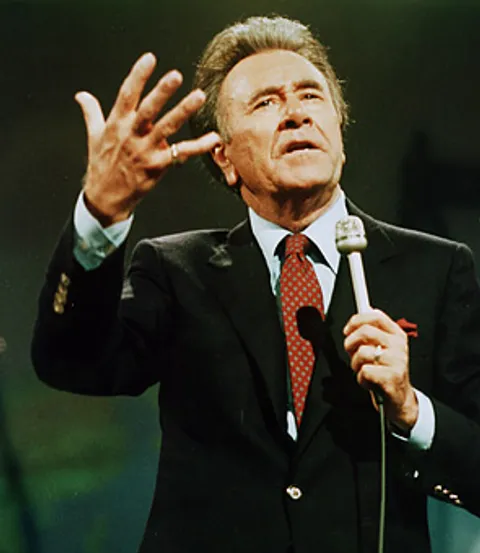 Granville Oral Roberts was born January 24, 1918 in Pontotoc County, near Ada, in Oklahoma. His parents were deeply religious. His father was a farmer who also preached the gospel and established Pentecostal Holiness churches. His mother regularly prayed for the sick and led people to Christ. While she was still pregnant, Robert's mother committed Oral to God's service. Even though Oral had a very strong stutter his mother would tell him that one day God would heal his tongue and he would speak to multitudes.
The Roberts family was desperately poor. When Roberts was 16 he moved away from home, hoping for a better life. He rejected God and his upbringing. He started living a wild life and his health collapsed. Roberts had contracted tuberculosis. He returned home and eventually dropped to 120 pounds. He was a walking skeleton. God spoke to his older sister, Jewel, and told her that He was going to heal Oral. During this same time Oral turned his heart back to God and gave his life to Christ. A traveling healing evangelist named George Moncey came to Ada and held meetings in a tent. Oral's elder brother was touched when he saw friends of his healed in the meeting. He decided that he should get Oral and bring him to be healed. On the way to the meeting God spoke to Oral and said "Son, I'm going to heal you and you are to take my healing power to your generation. You are to build me a University and build it on My authority and the Holy Spirit." Once at the meeting Oral waited until the very end. He was too sick to get up and receive prayer, and so had to wait for Moncey to come to him. At 11:00 at night his parents lifted him so he could stand. When Moncey prayed for him the power of God hit him and he was instantly healed. Not only that but every bit of his stutter was gone!
After Roberts was healed he began to travel the evangelistic circuit. He met and married Evelyn Lutman, a school teacher from the same Holiness Pentecostal background as Roberts. They had their first child Rebecca and then the entire family began traveling as ministers. In 1942 they left the evangelistic field for a while and Roberts became a pastor. He also returned to college to further his education. While a pastor he prayed for a church member whose foot was crushed. The foot was instantly healed. God continued to speak to Roberts about his call to the multitudes. God called him to an unusual fast. Roberts was to read the four gospels and the book of Acts three times consecutively, while on his knees, for thirty days. God began to reveal Jesus as the healer in a new way. God also began to give Roberts dreams where he would see people's needs as God saw them. God called him to hold a healing meeting in his town. A woman was dramatically healed, several people were saved and Roberts' ministry changed overnight.
Roberts resigned his church in 1947 and began an itinerant ministry. Notable healings began to occur. One man tried to shoot Roberts. God used the story to bring him media attention, which expanded his ministry very quickly. Roberts felt called to purchase a tent and take his evangelistic ministry to larger cities. His first tent held 3,000 but he quickly exchanged it for a tent that held 12,000. In July 1948 The Oral Roberts Evangelistic Association was established. Oral began traveling continuously throughout the United States. Like many of his Pentecostal brethren Roberts held inter-racial meetings. This brought him a lot of negative attention from groups who didn't like his stand. He even received death threats for not holding segregated meetings. In 1956 Roberts was invited to Australia. He held meetings in Sydney and Melbourne. In Melbourne there were outright physical attacks and destructive gangs. He was literally driven out of the city for praying for the sick. Often when people discuss the healing revival of the 1950s Oral Roberts and William Branham are listed as the most widely recognized leaders of the movement. Others came along side and many emulated them, but they were the most widely recognized personalities.
Roberts was a man who understood and used the media for his benefit. Roberts began publishing a magazine almost immediately upon starting his ministry. He grasped the power of radio and television. In 1954 Roberts began filming his crusades. He began playing his sermons on radio and then airing the crusade tapes during evening television prime time. Unfortunately there is some evidence that healing meetings were scripted ahead of time, and not all healings were genuine. People began writing to the Ministry headquarters by the thousands. They were accepting Christ as their savior after seeing a person healed on TV. By 1957 the ministry was receiving 1,000 letters a day and he was getting thousands of phone calls. He established a round the clock prayer team to answer calls and pray for people who contacted the ministry. In 1957 Roberts claimed 1,000,000 salvations. Between 1947 and 1968 Roberts conducted over 300 major Crusades. Money was flowing into the organization at an unprecedented rate.
In the late 1950s the healing movement was waning and ministries were under attack for their lack of financial accountability. Roberts began to move on the vision God gave him to build a University. It was chartered in 1963 and became open to students in 1965. Roberts was having a significant national impact in the late 1950s and early 1960s. For several years his named appeared in the Top 100 list of the nation's most respected people. Although Roberts continued to hold healing meetings his focus shifted to the University and the television programs.
The 1970s and 80s brought many crises to the Roberts family. Their daughter Rebecca and son-in-law Marshall were killed in a plane crash. Their son Ronnie struggled with depression after serving in Vietnam and also declaring himself gay. He grew despondent after losing his job and committed suicide. Richard Roberts got a divorce. After Richard remarried he and his wife lost a new born son within two days. Roberts began teaching a doctrine of "seed faith" where he claimed that if you gave to his ministry then God would pay you back in multiplied ways. The television ministry received heavy criticism for the constant requests for money. The Roberts were living an extravagance lifestyle while many of their supporters were not wealthy. Financial questions were raised in how Roberts used University endowment funds to purchase personal homes and cars.
In 1977 Roberts had a vision to build a hospital where people not only received care but received healing prayer. It was to be called City of Faith. Roberts put his heart and soul into the project, believing that God would build it as He had the University. The hospital struggled along and Roberts called his followers to give to the project, believing he had a vision from God to raise the money. Roberts even claimed twice that if money didn't come in that Jesus would "take him home." The hospital was built, but never succeeded financially, and finally closed in 1989. Financial giving was plummeting for both the Oral Roberts Evangelistic Association and Oral Roberts University.
Roberts retired in 1993, at the age of 75. Roberts, with his wife Evelyn, moved to California to live near the coast. Evelyn died in May 2005. Although Roberts influence waned after the problems of the 1970s and 1980s, he was still recognized for his pioneering work on the "sawdust trail", television evangelism, and building a Christian University. He often appeared on religious broadcasting networks as a recognized leader in the healing movement of the last half century. He died December 15, 2009 at the age of 91.
Oral Roberts' legacy is a mixed one. Roberts brought the truth of God's healing to the public in a way that few others accomplished in his lifetime. His financial and personal issues and increasingly extravagant claims eventually brought his ministry into disrepute. The University he established continued to have financial crises under the leadership of his son Richard Roberts. It was only after Richard stepped down in 2009 and new leadership took over the University that it stabilized financially. The University is no longer connected to the Oral Roberts Evangelistic Association.
Granville Oral Roberts was born January 24, 1918 in Pontotoc County, near Ada, in Oklahoma. His parents were deeply religious. His father was a farmer who also preached the gospel and established Pentecostal Holiness churches. His mother regularly prayed for the sick and led people to Christ. While she was still pregnant, Robert's mother committed Oral to God's service. Even though Oral had a very strong stutter his mother would tell him that one day God would heal his tongue and he would speak to multitudes.
The Roberts family was desperately poor. When Roberts was 16 he moved away from home, hoping for a better life. He rejected God and his upbringing. He started living a wild life and his health collapsed. Roberts had contracted tuberculosis. He returned home and eventually dropped to 120 pounds. He was a walking skeleton. God spoke to his older sister, Jewel, and told her that He was going to heal Oral. During this same time Oral turned his heart back to God and gave his life to Christ. A traveling healing evangelist named George Moncey came to Ada and held meetings in a tent. Oral's elder brother was touched when he saw friends of his healed in the meeting. He decided that he should get Oral and bring him to be healed. On the way to the meeting God spoke to Oral and said "Son, I'm going to heal you and you are to take my healing power to your generation. You are to build me a University and build it on My authority and the Holy Spirit." Once at the meeting Oral waited until the very end. He was too sick to get up and receive prayer, and so had to wait for Moncey to come to him. At 11:00 at night his parents lifted him so he could stand. When Moncey prayed for him the power of God hit him and he was instantly healed. Not only that but every bit of his stutter was gone!
After Roberts was healed he began to travel the evangelistic circuit. He met and married Evelyn Lutman, a school teacher from the same Holiness Pentecostal background as Roberts. They had their first child Rebecca and then the entire family began traveling as ministers. In 1942 they left the evangelistic field for a while and Roberts became a pastor. He also returned to college to further his education. While a pastor he prayed for a church member whose foot was crushed. The foot was instantly healed. God continued to speak to Roberts about his call to the multitudes. God called him to an unusual fast. Roberts was to read the four gospels and the book of Acts three times consecutively, while on his knees, for thirty days. God began to reveal Jesus as the healer in a new way. God also began to give Roberts dreams where he would see people's needs as God saw them. God called him to hold a healing meeting in his town. A woman was dramatically healed, several people were saved and Roberts' ministry changed overnight.
Roberts resigned his church in 1947 and began an itinerant ministry. Notable healings began to occur. One man tried to shoot Roberts. God used the story to bring him media attention, which expanded his ministry very quickly. Roberts felt called to purchase a tent and take his evangelistic ministry to larger cities. His first tent held 3,000 but he quickly exchanged it for a tent that held 12,000. In July 1948 The Oral Roberts Evangelistic Association was established. Oral began traveling continuously throughout the United States. Like many of his Pentecostal brethren Roberts held inter-racial meetings. This brought him a lot of negative attention from groups who didn't like his stand. He even received death threats for not holding segregated meetings. In 1956 Roberts was invited to Australia. He held meetings in Sydney and Melbourne. In Melbourne there were outright physical attacks and destructive gangs. He was literally driven out of the city for praying for the sick. Often when people discuss the healing revival of the 1950s Oral Roberts and William Branham are listed as the most widely recognized leaders of the movement. Others came along side and many emulated them, but they were the most widely recognized personalities.
Roberts was a man who understood and used the media for his benefit. Roberts began publishing a magazine almost immediately upon starting his ministry. He grasped the power of radio and television. In 1954 Roberts began filming his crusades. He began playing his sermons on radio and then airing the crusade tapes during evening television prime time. Unfortunately there is some evidence that healing meetings were scripted ahead of time, and not all healings were genuine. People began writing to the Ministry headquarters by the thousands. They were accepting Christ as their savior after seeing a person healed on TV. By 1957 the ministry was receiving 1,000 letters a day and he was getting thousands of phone calls. He established a round the clock prayer team to answer calls and pray for people who contacted the ministry. In 1957 Roberts claimed 1,000,000 salvations. Between 1947 and 1968 Roberts conducted over 300 major Crusades. Money was flowing into the organization at an unprecedented rate.
In the late 1950s the healing movement was waning and ministries were under attack for their lack of financial accountability. Roberts began to move on the vision God gave him to build a University. It was chartered in 1963 and became open to students in 1965. Roberts was having a significant national impact in the late 1950s and early 1960s. For several years his named appeared in the Top 100 list of the nation's most respected people. Although Roberts continued to hold healing meetings his focus shifted to the University and the television programs.
The 1970s and 80s brought many crises to the Roberts family. Their daughter Rebecca and son-in-law Marshall were killed in a plane crash. Their son Ronnie struggled with depression after serving in Vietnam and also declaring himself gay. He grew despondent after losing his job and committed suicide. Richard Roberts got a divorce. After Richard remarried he and his wife lost a new born son within two days. Roberts began teaching a doctrine of "seed faith" where he claimed that if you gave to his ministry then God would pay you back in multiplied ways. The television ministry received heavy criticism for the constant requests for money. The Roberts were living an extravagance lifestyle while many of their supporters were not wealthy. Financial questions were raised in how Roberts used University endowment funds to purchase personal homes and cars.
In 1977 Roberts had a vision to build a hospital where people not only received care but received healing prayer. It was to be called City of Faith. Roberts put his heart and soul into the project, believing that God would build it as He had the University. The hospital struggled along and Roberts called his followers to give to the project, believing he had a vision from God to raise the money. Roberts even claimed twice that if money didn't come in that Jesus would "take him home." The hospital was built, but never succeeded financially, and finally closed in 1989. Financial giving was plummeting for both the Oral Roberts Evangelistic Association and Oral Roberts University.
Roberts retired in 1993, at the age of 75. Roberts, with his wife Evelyn, moved to California to live near the coast. Evelyn died in May 2005. Although Roberts influence waned after the problems of the 1970s and 1980s, he was still recognized for his pioneering work on the "sawdust trail", television evangelism, and building a Christian University. He often appeared on religious broadcasting networks as a recognized leader in the healing movement of the last half century. He died December 15, 2009 at the age of 91.
Oral Roberts' legacy is a mixed one. Roberts brought the truth of God's healing to the public in a way that few others accomplished in his lifetime. His financial and personal issues and increasingly extravagant claims eventually brought his ministry into disrepute. The University he established continued to have financial crises under the leadership of his son Richard Roberts. It was only after Richard stepped down in 2009 and new leadership took over the University that it stabilized financially. The University is no longer connected to the Oral Roberts Evangelistic Association.
host as you are - practicing hospitality as a family
Love God and love your neighbor . This is the Butterfield family motto. It makes us humble, messy, and on the frontline in our neighborhood. And being on the frontline isn’t pretty. “Hospitality means being profoundly unselfish, and small children need help to see the blessing in this.” Take for example last March, when the pandemic hit. We were supposed to batten down the hatches, disinfect everything, including the family cat, and remain socially distanced at all times, but schools closed before parents were home from work. So after the first week of lockdown, I looked like the little old lady who lived in the shoe. Our house was open, boisterous, noisy, and full of students who would have been in class. I could visualize getting arrested in my apron for violating governor’s stay-at-home and social-distancing orders. While that hasn’t happened, other things have happened that have made me realize that children play a vital and central role in Christian hospitality. Indeed, I couldn’t practice hospitality without them. Consider six touch points for children’s central role in Christian hospitality. 1. Hospitality is a mission of the church. Sometimes we American Christians privatize hospitality in false ways. Hospitality isn’t a Butterfield thing. It’s a church thing. And children are a blessed part of our church. Jesus loves children and so do we. As the church seeks to evangelize the world, the homes of church members become gospel outposts, places where we bring the gospel to the neighborhood. This is very good news for people with young children. It means that the burden is not on you to be different. It means that your unsaved neighbors will benefit from seeing that you also decorate with plastic dinosaurs and LEGOs. And it also means that you do not always have to be in hospitality mode. As Edith Schaeffer said, doors have hinges for a reason. 2. Hospitality puts the church on the frontline. When inviting unsaved neighbors over, Kent and I always invite our church family, too. The more the merrier, especially in the summer. Your unsaved neighbors will benefit from seeing many different models of the covenant family, including singles (whose church membership renders them a covenant family) and older people. Many Christian hands make the care of little ones easier. Also, with the church family on deck, your children will not feel neglected or isolated as they participate in hospitality. Hospitality means being profoundly unselfish, and small children need help to see the blessing in this. 3. Hospitality puts hot-button topics on the frontline. Our family is made by adoption and all of our children are biracial. Christians know that oppression, violence, and discrimination are sin, but we do not believe that racism, for example, is itself a “meta-narrative” — a paradigm that declares all white people are racists, all black people victims, all social structures complicit in a white hegemonic hatred machine, and any white family who has adopted children of color as colonizing micro-aggressionists. If these things were true, then the Butterfield family doesn’t exist. And yet here we stand, opening the door to everyone. When your family is on the frontline, it has the opportunity to showcase the love of Christ, the purpose of natural law, the harmony of the biblical callings of male and female, and the shallowness of the modern social construction of race. It exposes idols and tears down strongholds and reveals how the love of Christ transcends sociology (shocking as this may be). 4. Hospitality builds relationships within the family. Hospitality is a joy for small children when they get to have some agency in the process. Especially when you are opening your home to others in the neighborhood with small children, your children should be enlisted as hosts. They can set the kids’ table and make the kids’ menu. And with platters of chicken nuggets, watermelon, and popsicles, don’t be surprised if some of the neighborhood dads are found sampling the children’s fare. Your children can also be prepared to think like Jesus would about having children over who haven’t gone to church and don’t (yet) know Jesus. Your children need to be guided in how to be good hosts who lead and set examples (and don’t follow bad ones). And you should set clear boundaries for safety. In our house, there is no playing in children’s bedrooms. Ever. We have a big back yard with a trampoline, and we think that a knock on the head is safer than anything that happens behind a closed door. Working together to have a hospitable home also puts all hands on deck — from the smallest to the largest. Children can’t clean the house as well as you can, but even a small child can sweep up tumbleweeds of dog hair and throw trash in the kitchen can. Value their contributions. 5. Hospitality cares about what neighbors care about. When you open your home to neighbors, you set a table that welcomes them. You ask them about food allergies and other sensitivities. You remember these things and you go out of your way to care about what they care about. You practice becoming all things to all people in the hopes of saving some (1 Corinthians 9:22). You help your children to respect differences that they don’t understand (yet). 6. Hospitality is all for one and one for all. If you have small children whose bedtime is 7:30, consider having neighbors over for Saturday lunch instead of Saturday dinner. Don’t think of your children as a burden — ever. Work with the capacities, limitations, and skills of each member of your family. Be a team. Be in sync with each other’s rhythms and needs. “Hospitality isn’t a performance. It’s a Christian grace that involves the whole family.” And when guests arrive, don’t segregate the children, but integrate them. We live in a world that segregates everything. Show the beauty in working together. And at the end of the meal, the older children can put the dishes in the sink and distribute the Bibles. The little children can play with LEGOs on the floor while the family patriarch opens the Bible to the watching world and prays for the power of the resurrected Christ to guide, encourage, correct, and save. Your children will grow up watching you plead for your neighbors to put their faith in Christ. They will inherit an integrated faith, not a compartmentalized one, where parents act like Christians from ten to noon on Sunday, but the rest of the time operate in an orbit of selfish ambition. Hospitality isn’t a performance. It’s a Christian grace that involves the whole family.