
Others like stories of great gospel hymns Features >>
About the Book
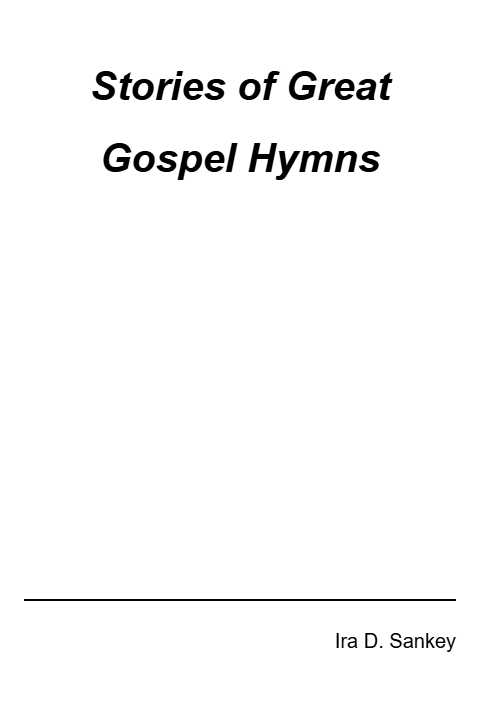
"Stories Of Great Gospel Hymns" by Ira D. Sankey is a collection of stories and background information on some of the most beloved hymns in Christian worship. The book explores the origins and meanings behind famous hymns such as "Amazing Grace" and "How Great Thou Art", shedding light on the history and inspiration behind these timeless songs.
A.W. Pink
Arthur Walkington Pink (1 April 1886 â 15 July 1952) was an English Bible teacher who sparked a renewed interest in the exposition of Calvinism or Reformed Theology. Little known in his own lifetime, Pink became "one of the most influential evangelical authors in the second half of the twentieth century."[1]
Biography Arthur Walkington Pink was born in Nottingham, England, to a corn merchant, a devout non-conformist of uncertain denomination, though probably a Congregationalist.[2] Otherwise, almost nothing is known of Pink's childhood or education except that he had some ability and training in music.[3] As a young man, Pink joined the Theosophical Society, an occult gnostic group in contemporary England, and he apparently rose to enough prominence within its ranks that Annie Besant, its head, offered to admit him to its leadership circle.[4] In 1908 he renounced Theosophy for evangelical Christianity.[5]
Desiring to become a minister but unwilling to attend a liberal theological college in England, Pink very briefly studied at Moody Bible Institute in Chicago in 1910 before taking the pastorate of the Congregational church in Silverton, Colorado. In 1912 Pink left Silverton, probably for California, and then took a joint pastorate of churches in rural Burkesville and Albany, Kentucky.[6] In 1916, he married Vera E. Russell (1893â1962), who had been reared in Bowling Green, Kentucky, and Pink's next pastorate was at Scottsville Baptist Church, Scottsville, Kentucky.[7] Then the newlyweds moved in 1917 to Spartanburg, South Carolina, where Pink became pastor of Northside Baptist Church.[8]
By this time Pink had become acquainted with prominent dispensationalist Fundamentalists, such as Harry Ironside and Arno C. Gaebelein, and his first two books, published in 1917 and 1918, were in agreement with that theological position.[9] Yet Pink's views were changing, and during these years he also wrote the first edition of The Sovereignty of God (1918), which argued that God did not love sinners who had not been predestined unto salvation, and that He had deliberately created "unto damnation" those who would not accept Christ.[10] Whether because of his Calvinistic views, his nearly incredible studiousness, his weakened health, or his lack of sociability, Pink left Spartanburg in 1919 believing that God would "have me give myself to writing."[11] But Pink then seems next to have taught the Bibleâwith some successâin California for a tent evangelist named Thompson while continuing his intense study of Puritan writings.
In January 1922, Pink published the first issue of Studies in the Scriptures, which by the end of the following year had about a thousand subscribers and which was to occupy most of his time for the remainder of his life and become the source for dozens of books, some arranged from Studies articles after his death.[12] In 1923 Pink suffered a nervous breakdown, and he and his wife lived with friends in Philadelphia until he regained his health. In 1925, the Pinks sailed to Sydney, Australia, where he served as both an evangelist and Bible teacher at the Ashfield Tabernacle. But his impolitic preaching of Calvinist doctrine resulted in a unanimous resolve of the Baptist Fraternal of New South Wales not to endorse him. From 1926 to 1928, Pink served as pastor of two groups of Strict and Particular Baptists.[13]
Returning to England, Pink was invited to preach at a pastorless church in Seaton, Devon; but though he was welcomed by some members, the overseers thought his installation as pastor would split the church.[14] In the spring of 1929, Pink and wife returned to her home state of Kentucky where he intended to become pastor of the Baptist church in Morton's Gap. Once again his hopes were unrealized. To a friend he wrote, "I am more firmly convinced today than I was 14 months ago that our place is on the 'outside of the camp.' That is the place of 'reproach,' of loneliness, and of testing."[15] In 1930 Pink was able to start a Bible class in Glendale, California, while also turning down opportunities to speak in some Fundamentalist churches.[16] The following year, the Pinks rented an unpainted wooden house in Union County, Pennsylvania, where a small group met; then in 1933 they moved to York, Pennsylvania.
Pink decided that if his ministry was to be totally one of writing, he could do that just as well in England. In September 1934 he and his wife moved to Cheltenham, Gloucestershire, near honorary agents of Studies in the Scriptures. Pink seems to have finally given way to despair. To a friend he wrote "that those of my friends who would dearly like to help me are powerless to do so; while those who could, will not. And in a very few years at most it will be too late. What I have gone through the last seven years is so reacting on my physical and mental constitution, that ere long I shall be incapacitated even if doors should be opened unto me. However, I can see nothing else than to attempt to seek grace to bow to the Lord's sovereign pleasure, and say, 'Not my will, but thine be done.'"[17]
In 1936, the Pinks moved to Hove, on the south coast near Brighton. After the death of his father in 1933, Pink received enough of the estate to allow him and his wife to live very simply without financial concerns; and between 1936 until his death in 1952, Pink devoted himself completely to Studies in the Scriptures. Vera believed her husband's almost unrelenting work schedule unhealthy, and she remarkably succeeded in having him take up stamp collecting as a hobby.[18] In 1940, Hove became a regular target of German air raids, and the Pinks moved to Stornoway, Isle of Lewis, Outer Hebrides, Scotland, where they remained for the rest of his life. The island was a bastion of Calvinism, but church services were held mostly in Scots Gaelic, and visitors were not especially welcomed in any case.[19] Pink governed his time in study and writing with "military precision." To a friend he wrote that he went out to shop and get exercise for an hour, six days a week, but that otherwise he never left his study except when working in a small garden. While in Hove, he even published a note in Studies advising subscribers that "it is not convenient for us to receive any visitors, and respectfully ask readers who may visit these parts to kindly refrain from calling upon us, but please note that we are always glad to hear from Christian friends."[20] Rather than attend church, on Sunday mornings, Pink spent time ministering to readers by letter.[21]
In 1951 Vera became aware that Pink was failing. He lost weight and was in pain but refused to take any medicine that might dull his mind and hinder him from completing his work. He died on 15 July 1952. His last words were "The Scriptures explain themselves." Pink left enough written material to allow publication of Studies until December 1953.[22] Vera Pink survived her husband by ten years and after his death made new friends and mingled more freely with others.[23]
Influence
It is alleged that Pink's personality made it difficult for him to have a successful pastoral ministry. He has been criticized for being too individualistic and of too critical a temperament, lacking the benefit of thorough theological discussions with other men of similar gifts. One young pastor, Rev. Robert Harbach who corresponded with Pink for years remembered a very different Pink, who possessed a "pastor's heart." Pink's correspondence with Harbach (until Pink's failing health ended their correspondence in 1949) was warm, heartfelt and fatherly. Early in their correspondence, Pink wrote "I want you to feel perfectly free to call on me for any help I may be able to render you. I am in touch with a number of young pastors, and I deem it part of my work, and a privilege, to offer what advice I can."[24]
Pink's acclaimed contemporary D. Martyn Lloyd-Jones received spiritual benefit from reading Pink and recommended him to others. To one young minister, he said, "Don't waste your time reading Barth and Brunner. You will get nothing from them to aid you with preaching. Read Pink."[25] But Lloyd-Jones also said, "If I had behaved as Pink did, I would have achieved nothing. Nothing at all... I had to be very patient and take a very long-term look at things. Otherwise I would have been dismissed and whole thing would have been finished."[26] Furthermore, without the assistance and companionship of his wife, who dedicated herself completely to him and his work, Pink would have (as he freely admitted) "been overwhelmed" and probably would have achieved little even in writing.[27]
Theologically Pink was rejected during his lifetime because of his opposition to Arminianism; but after his death, there was a major shift of evangelical opinion towards Calvinistic theology. By 1982, Baker Book House had published 22 of Pink's books and sold 350,000 total copies. Nevertheless, it was Pink's Sovereignty of God that did "more than any other in redirecting the thinking of a younger generation." After Banner of Truth Trust republished it in 1961âmodifying it to remove Pink's alleged hyper-Calvinismâthe book sold 177,000 copies by 2004.[28]
References
7. "NEW LIGHT ON THE EARLY MINISTRY OF A. W. PINK (PART 2)". The Arthur W. Pink Archive. Retrieved 27 June 2020.
13. Murray argues that Pink left the first of these two groups because he was not Calvinistic enough for them because he asserted belief in the "free offer of the gospel and in human responsibility to receive the gospel.", 77-123; R. P. Belcher, "Pink, Arthur Walkington," Timothy Larson, ed., Biographical Dictionary of Evangelicals (Downers Grove, IL: IVP, 2003), 529. Ronald Hanko argues that "Pink never taught that God loves everyone or desires to save everyone, or promises salvation to everyone in the gospel, as the Banner does." Ronald Hanko, "The Forgotten Pink," British Reformed Journal No. 17 (Jan-March 1997), 4.
23. Murray, 283. She was remembered by one of these friends as "an elegant and gracious lady with a radiant expression and a loving and lively interest in people."
28. Murray, 314â15. The Banner of Truth Trust edition has been criticized for omitting nearly half the original work, including three entire chapters. Hanko, "The Forgotten Pink."
can i follow my new heart
âWhy shouldnât I follow my heart? If I am a Christian â if God has caused me to be âborn againâ and has given me âa new heartâ â isnât my new heart trustworthy?â Readers have raised some version of this objection when Iâve exhorted Christians, âDonât follow your heart.â And the objection is warranted. After all, the Bible clearly teaches that in this era of the new covenant, God writes his law on our new hearts so that we willingly follow him (Jeremiah 31:31â34; Hebrews 8:8â12). This would seem to not merely imply, but even mandate, that Christians should follow their hearts. But the Bibleâs description of what a regenerated person actually experiences in this age reveals a more spiritually and psychologically complex picture â one that I believe gives Christians biblical warrant to cultivate a healthy suspicion of what they recognize as their heartsâ desires. So, while we may, and hopefully will, reach a point in our lives as Christians where itâs right, at times, to follow our hearts, allow me to make a brief case that the phrase actually undermines Christians as they labor and struggle to discern their various desires, and that Scripture itself discourages us from thinking this way. War Within How might we summarize the complex picture the Bible paints of the born-again experience in this already-not-yet age? The New Testament explains that when the Spirit brings us from spiritual death to spiritual life (John 5:24; Romans 6:13), we enter a strange new reality. Our regenerated new self  emerges, âcreated after the likeness of God in true righteousness and holiness.â And yet our â old self , which belongs to [our] former manner of life,â is still âcorrupt through deceitful desiresâ (Ephesians 4:22â24). We are âborn of the Spiritâ (John 3:6) while still inhabiting the âflesh,â our âbody of deathâ in which ânothing good dwellsâ (Romans 7:18, 24). âThe hearts of regenerated people are not yet fully free from the influence of their flesh.â When Christians are born again, we enter into a lifelong internal war where âthe desires of the flesh are against the Spirit, and the desires of the Spirit are against the flesh, for these are opposed to each other, to keep you from doing the things you want to doâ (Galatians 5:17). Stepping back and viewing these desires objectively, âthe works of the fleshâ that result from fleshly desires âare evident,â and so is âthe fruit of the Spiritâ (Galatians 5:19â23). But Christians often struggle â on the ground, in real time â to discern the desires of the Spirit from the desires of the flesh. This is why the New Testament Epistles are full of exhortations and corrections addressed to Christians. James tells his readers (and us at relevant times) that their âpassions are at war withinâ them (James 4:1). Peter warns his readers (and us), âDo not be conformed to the passions of your former ignoranceâ (1 Peter 1:14). Paul describes this internal experience of warring passions as âwretchedâ (Romans 7:24). And he admonishes the Colossian Christians (and us) with strong language: âPut to death therefore what is earthly in you : sexual immorality, impurity, passion, evil desire, and covetousness, which is idolatryâ (Colossians 3:5). Why did these apostles feel the need to speak this way to regenerated people? Because the hearts of these regenerated people were not yet fully free from the influence of their flesh, their old selves. Follow the Spirit Much of the Christian life is a war to die to remaining sin and live by the Spirit. John Piper calls it âthe main battle of the Christian lifeâ: The main battle is to see our hearts renovated, recalibrated, so that we donât want to do those sinful external behaviors, and donât just need willpower not to do them, but the root has been severed and we have different desires. In other words, the goal of change â of sanctification, of the Christian life â is to be so changed that we can and ought to follow our desires. Thatâs exactly right. And when we have been so changed through progressive sanctification, so renovated that our hearts (and therefore our desires, dispositions, motives, emotions, and passions) are, as Piper says, âcalibrated to Christ,â then we should  follow our hearts. However, at any given time within our churches, small groups, friendships, and families, different Christians are at different places for different reasons in this heart-renovation process. Some hearts are more sanctified, and therefore more reliable to follow, than others. I think thatâs why we donât hear the apostles generally counsel us to follow our hearts in our fight of faith against remaining sin, but rather to follow the Holy Spirit . Let Not Sin Reign Paul is the one who delves most deeply into this issue: âI say, walk by the Spirit, and you will not gratify the desires of the fleshâ (Galatians 5:16). He devotes most of Romans 6â8 to explaining the nature of the strange new-self/old-self, Spirit/flesh reality of the Christian life, including Romans 8:13: âIf you live according to the flesh you will die, but if by the Spirit you put to death the deeds of the body, you will live.â Paul lays the theological foundation of our understanding by explaining âthat our old self was crucified with [Christ] in order that [our] body of sin might be brought to nothing, so that we would no longer be enslaved to sinâ (Romans 6:6). Our new selves were âraised with Christâ (Colossians 3:1) so that âwe too might walk in newness of lifeâ (Romans 6:4). Therefore, we âmust consider [ourselves] dead to sin and alive to God in Christ Jesusâ (Romans 6:11). In light of this, Paul admonishes us, Let not sin therefore reign in your mortal body, to make you obey its passions. Do not present your members to sin as instruments for unrighteousness, but present yourselves to God as those who have been brought from death to life, and your members to God as instruments for righteousness. For sin will have no dominion over you, since you are not under law but under grace. (Romans 6:12â14) And how do we do this? By learning to âset [our] minds on the things of the Spiritâ and not on âthe things of the fleshâ (Romans 8:5) â by learning to follow the Spirit, to âwalk by the Spiritâ (Galatians 5:16), because âall who are led by the Spirit of God are sons of Godâ (Romans 8:14). Follow the Treasure One of the reasons I find âfollow your heartâ generally unhelpful as counsel for Christians is that many of us, from the time we were young, have absorbed this as a pop-cultural creed that says if we just look deep into our hearts, weâll be shown our deepest truth, and discover the way we should go. Given the significant amount our sinful flesh still influences our hearts, itâs not hard to see how this phrase can easily increase confusion when applying it to the Christian life. âSome hearts are more sanctified, and therefore more reliable to follow, than others.â I also donât believe the Bible encourages that idea since, when it comes to engaging our hearts, far and away what we hear in it is counsel to âdirect our hearts,â not to follow them. We see that clearly in Paulâs instructions above. God made our hearts to follow, not to lead. And what do our hearts follow? Jesus gives the clearest answer: âWhere your treasure is, there your heart will be alsoâ (Matthew 6:21). In time, our heart always pursues (follows) our treasure. When we are born again, the eyes of our hearts are enlightened (Ephesians 1:18) and, through faith, we begin to see the Treasure: God himself in Christ. And since our heart learns to pursue the object  that stirs its greatest affections, its treasure , I suggest we not counsel each other to âfollow your heart,â but instead to âfollow the Treasure.â Looking into our hearts for direction can be spiritually hazardous. It is usually more helpful for us to direct our hearts to what is most valuable and delightful. Which is why I believe David counsels us, âDelight yourself in the Lord, and he will give you the desires of your heartâ (Psalm 37:4).