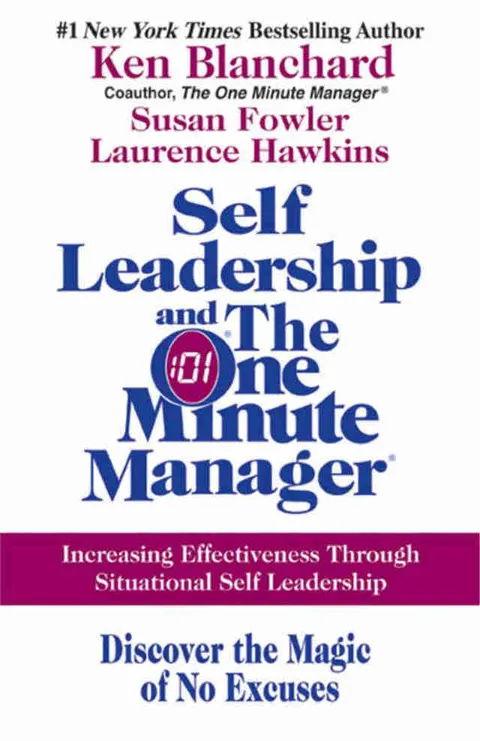

Self Leadership And The One Minute Manager Order Printed Copy
- Author: Ken Blanchard
- Size: 948KB | 171 pages
- |
Others like self leadership and the one minute manager Features >>
Leadership Mastery
The Leadership Style Of Jesus

Faith And The Marketplace
Good Leaders Ask Great Question

Leadership, The Power Of A Creative Life
The Leader Who Had No Title
Words That Change Minds - The 14 Patterns For Mastering The Language Of Influence

As A Man Thinketh
Collaborating With The Enemy (How To Work With People You Donât Agree With Or Like Or Trust)
The Little Red Book Of Wisdom
About the Book
"Self Leadership and the One Minute Manager" by Ken Blanchard is a practical guide on how individuals can take control of their own leadership development. The book emphasizes the importance of self-awareness, setting goals, and taking responsibility for one's actions in order to become an effective leader. Blanchard introduces the concept of Situational Leadership II and provides strategies for improving communication, goal setting, and motivation. Overall, the book offers valuable insights and techniques for individuals looking to enhance their leadership skills.
Mosab Hassan Yousef
Mosab Hassan Yousef (Arabic: Ů
ؾؚب Řس٠ŮŮŘłŮ; nicknamed "The Green Prince"; born 5 May 1978) is a Palestinian who worked undercover for Israel's internal security service Shin Bet from 1997 to 2007.
Shin Bet considered him its most valuable source within the Hamas leadership. The information Yousef supplied prevented dozens of suicide attacks and assassinations of Israelis, exposed numerous Hamas cells, and assisted Israel in hunting down many militants, and incarcerating his own father, Hamas leader Sheikh Hassan Yousef. In March 2010, he published his autobiography titled Son of Hamas.
In 1999, Yousef converted to Christianity, and in 2007 he moved to the United States. His request for political asylum in the United States was granted pending a routine background check in 2010.
Biography
Mosab Hassan Yousef (later Joseph) was born in Ramallah, a city 10 kilometers (6.2 mi) north of Jerusalem. His father, Sheikh Hassan Yousef, was a Hamas leader who spent many years in Israeli prisons. He is the oldest of five brothers and three sisters.
When Yousef was growing up, he wanted to be a fighter because that was according to him what was expected of Palestinian children in the West Bank. Yousef was first arrested when he was ten, during the First Intifada, for throwing rocks at Israeli settlers. He was further arrested and jailed by Israel numerous times. As his father's eldest son, he was seen as his heir apparent, and became an important part of the Hamas organization.
Yousef said he saw the light after a stint with his dadâs comrades in an Israeli jail during the mid-1990s. At Megiddo Prison, he witnessed Hamas inmates leading a brutal year-long campaign to weed out supposed Israeli collaborators. "During that time, Hamas tortured and killed hundreds of prisoners,â he said, recalling vivid memories of needles being inserted under finger nails and bodies charred with burning plastics. Many, if not all, had nothing to do with Israeli intelligence. âI will never forget their screams,â he continued. âI started asking myself a question. What if Hamas succeeded in destroying Israel and building a state. Will they destroy our people in this way?â
Yousef's doubts about Islam and Hamas began forming when he realized Hamas' brutality, and that he hated how Hamas used the lives of suffering civilians and children to achieve its goals. Yousef was held by Shin Bet agents in 1996. While in prison, he was shocked by Shin Bet's interrogation methods, which he considered humane, when compared to how Hamas operatives tortured imprisoned suspected collaborators. He decided to accept a Shin Bet offer to become an informant.
Espionage career
Beginning with his release from prison in 1997, Yousef was considered the Shin Bet's most reliable source in the Hamas leadership, earning himself the nickname "The Green Prince" â using the color of the Islamist group's flag, and "prince" because of his pedigree as the son of one of the movement's founders. The intelligence he supplied to Israel led to the exposure of many Hamas cells, as well as the prevention of dozens of suicide bombings and assassination attempts on Jews. He has claimed that he did not inform for money, but rather that his motivations were ideological and religious, and that he only wanted to save lives.[13] In order to thwart any suspicions of collaboration, the Shin Bet staged an arrest attempt, telling the Israel Defense Forces to launch an operation to arrest him, and then provided him intelligence allowing him to escape at the last minute, after which he went into hiding for the rest of his career.
Yousef says he supplied intelligence only on the condition that the "targets" would not be killed, but arrested. This led to the detention of several key Palestinian leaders, including Ibrahim Hamid, a Hamas commander in the West Bank, and Marwan Barghouti. Also, Yousef claims to have thwarted a 2001 plot to assassinate Shimon Peres, then foreign minister and later President of Israel. According to his former Shin Bet officer, "Many people owe him their lives and don't even know it."
Conversion to Christianity
According to his story, Yousef met a British missionary in 1999 who introduced him to Christianity. Between the years 1999 and 2000, Yousef gradually embraced Christianity. In 2005, he was secretly baptized in Tel Aviv by an unidentified Christian tourist. He left the West Bank for the United States in 2007, and lived some time in San Diego, California, where he joined the Barabbas Road Church.
In August 2008, Yousef publicly revealed his Christianity, and renounced Hamas and the Arab leadership, thereby endangering himself and exposing his family in Ramallah to persecution. Yousef has also claimed that his aim was to bring peace to the Middle East; he hopes to return to his homeland when there is peace.
Yousef has stated that despite his conversion to Christianity, he is "against religion", and does not adhere to any denomination of Christianity. He has stated, "Religion steals freedom, kills creativity, turns us into slaves and against one another. Yes, I am talking about Christianity as well as Islam. Most Christians I have seen, seem to have missed the point, that Jesus redeemed us from religion. Religion is nothing but man's attempts to get back to God. Whether it is Islam, Christianity, Judaism, Buddhism, Hinduism, animism, any ism. Religion can't save mankind. Only Jesus could save mankind through his death and resurrection. And Jesus is the only way to God."
Autobiography
Yousef's co-authored autobiography, Son of Hamas: A Gripping Account of Terror, Betrayal, Political Intrigue, and Unthinkable Choices, written with the assistance of Ron Brackin, was published in March 2010.
Yousef's brother Ouwais denounced the report about his brother's activities, saying: "It was full of lies; it's all lies." Ouwais also revealed that the last contact between his family and Mosab took place more than a year before the news of his spying. Sheikh Hassan Yousef, Mosab's father, while in an Israeli prison, disowned his son for spying for Israel. The Haaretz report on Yousef was described by Hamas MP Mushir al-Masri as "psychological war being waged against the Palestinian people... [it] did not deserve a response".
Deportation threats and political asylum
For a time, Yousef was threatened with deportation from the U.S., after his request for political asylum was denied, since statements in his book about working for Hamas were interpreted as "providing material support to a U.S.-designated terrorist organization", despite Yousef's explanation that they were "intended to undermine the group". His case then proceeded to the deportation stage, despite Yousef's advocates' warning that he would likely be executed by the Palestinian Authority if deported to the West Bank.
On 24 June 2010, Shin Bet handler Gonen Ben Itzhak, who for 10 years worked with Yousef under the cryptonym "Loai", revealed his own identity in order to testify on behalf of Yousef at an immigration hearing in San Diego. Ben-Yitzhak described Yousef as a "true friend", and said, "he risked his life every day in order to prevent violence".
Partially as a result of this, Immigration Court Judge Richard J. Bartolomei, Jr., ruled on 30 June 2010, that Yousef would be allowed to remain in the United States after being fingerprinted and passing a routine background check.
He is a frequent guest speaker on various American news channels, where he talks about the atrocities committed by Hamas.
Films
A documentary adaptation of Son of Hamas titled The Green Prince, directed and written by Nadav Schirman, premiered at the 2014 Sundance Film Festival, where it won the Audience Award for World Cinema: Documentary. The Green Prince will be re-made into a live-action feature film.
Yousef is collaborating with US-based actor and film producer Sam Feuer in the production of two films: a feature film adaptation of Yousef's book Son of Hamas and documentary The Green Prince, and a historical depiction of the life of the Muslim prophet Muhammad based on the accounts of eighth-century historian Ibn Ishaq.
Views and controversies
Some elements of Yousef's story have been questioned. Former Shin Bet Deputy Chief Gideon Ezra described Yousef's claims as "too good to be true", and stated that, "there are hundreds of collaborators like him. He is not unusual. He just decided to write a book about it." The conversion to Christianity narrative promoted by Yousef and his book publishers remains unsubstantiated as well. Critics have alleged that Yousef claimed he was a Christian (for a longer period of time) in order to help secure asylum in the United States. This tactic is common for Muslim immigrants seeking to avoid deportation to countries where apostasy laws exist. However, he has since become an active figure in evangelical non-denominational Christianity in America, and has appeared on programs such as The 700 Club. Interest in the book from Christian readers helped make it a New York Times best-seller. During an appearance on The 700 Club to promote his book "Son of Hamas", he was welcomed and interviewed by host Pat Robertson.
At an "End Times Prophecy" conference in 2010, hosted by California-based evangelist Greg Laurie, Yousef told the crowd in attendance that Islam is "the biggest lie in human history." He further suggested at the conference that the Quran should not be legal in the United States ("banned on American soil").
In May 2016, talking to a Jerusalem Post conference in New York, Yousef claimed that at one time that he was working for, and being paid by, Israel, the United States, the Palestinian Authority, and Hamas, all at the same time. He went on to say that Islam as a whole is comparable to Nazism, and must be defeated.
âOne Anotherâ Your One and Only
Whatâs your favorite charge, or piece of counsel, you have heard in a wedding homily? Any Christian minister who has performed a wedding knows the challenge and opportunity of that moment. We have a precious few minutes to capture the moment and hang out a vision for the newlyweds to pursue for the rest of their days. On more than one occasion, I have surprised the couple with this charge: âEnjoy this day with everything you have, and when it is over, in one way, pretend like it never happened.â You can probably imagine their facial expressions. If it werenât such a formal moment, Iâm sure they would interrupt, âWhat do you mean, âPretend like it never happenedâ? Weâve been waiting for this day for so long!â After a brief pause to allow their curiosity to grow, I go on to explain the wisdom behind my intentionally provocative words. The key to understanding the charge is in the phrase âin one way.â Kissing Pursuit Goodbye I am not charging couples to pretend like their wedding day never happened in every way, or even in most ways. Marriage brings many new and wonderful realities that are to be embraced with joyful seriousness. That said, I have observed that kissing the bride is often followed by kissing goodbye a way of loving each other. For so many, the wedding day marks the end of a way of relating that can be best characterized as the pursuit. While the specific practices may differ from one couple to another, the principle often remains the same: the dating days are characterized by a pursuit of the one we love, but as the months and years pass, the pursuit sadly gets left behind. Itâs often replaced by a new âmarriedâ way of relating that could be characterized as existing together. This far-too-common pattern of relating can be summarized: Pursue. Catch. Exist. âKissing the bride is often followed by kissing goodbye a way of loving each other.â While this dynamic of existing together often becomes the norm, what if there were another way? What if the transition from singleness to marriage should be and could be summarized differently? Consider this: Pursue. Catch. Pursue. I choose the phrases âshould beâ and âcould beâ because I am convinced that many spouses either lack a vision for why they should keep pursuing each other or they lack practical help in how to make it a reality (or both!). Why We Pursue Before rushing to discuss how we love one another, the Christian spouse would be well served to first clarify why. This question finds its answer in the way we are loved by God. Godâs love for us establishes the bullseye for how we seek to love one another. We are called to love just as God loves us (John 13:15; Ephesians 4:32; 5:29). And this is clear: we are loved by a pursue-catch-pursue God. David captured Godâs never-ending pursuit when he declared, âSurely goodness and mercy shall follow [or pursue] me all the days of my life, and I shall dwell in the house of the Lord foreverâ (Psalm 23:6). David rejoices in the reality that Godâs pursuit wasnât only to get him into his house, but it continues while he lives there. The apostle Paul gives an even longer view of the âhound of heavenâ when he declares that for all eternity God will be showing âthe immeasurable riches of his grace in kindness toward us in Christ Jesusâ (Ephesians 2:7). Our God is ever in pursuit, and we are to follow his lead in the way we love â and first and foremost in the way we love our spouse. Itâs worth clarifying that our goal is reflection, not perfection. None of us can perfectly love a spouse like Jesus does in all ways and at all times. While perfection is not the expectation, Spirit-filled followers of Christ should expect to consistently grow in our ability to reflect the love of God to our one and only. Consistent over Elaborate When I encourage couples to keep pursuing each other, I can already hear the objections, as if the idea is something out of a fairy tale, rather than one rooted in reality. âWe canât do that.â âWe donât have the time or the money for that.â âWe have jobs, kids, responsibilities, and more often than not feel like we are being crushed each day.â âThereâs just no way we can pursue one another like when we were dating and engaged.â These objections might be more valid if the call were to consistently pursue each other in elaborate ways. While elaborate pursuits have their place in a marriage, thatâs not the first type of pursuit that couples should focus on. To put it in a phrase: consistent is greater than elaborate. Think about the love ethos of your marriage like building a fire. Before we add the large (elaborate) pieces of firewood, we first build a base of heat through placing many tiny sticks, twigs, and leaves. In fact, if we try to place a large piece of firewood too early, it will do the opposite of what we want. Instead of igniting the fire, it will put it out. The same is true in our marriages. When we neglect the small and consistent daily acts of pursuit, our elaborate attempts will often backfire. (Yes, I speak from personal experience.) The marriage that keeps the fire burning through each passing age and life stage is one in which both spouses commit to consistently, even daily, pursue one another. Little More Kindness Many spouses think too much about pursuing in elaborate ways and too little about consistent, everyday expressions of love. Our consumer-driven society leads us to focus on holidays and special days, when what our marriages often need most is a little more kindness and thoughtfulness each and every day. What if the missing piece in your marriage has little to do with figuring out how to love your spouse differently than everyone else? What if the secret to a better marriage is in learning to love your spouse just like you are called to love everyone else? I have often heard people say, âThe Bible doesnât give much guidance about marriage.â While the Bible may not speak exclusively about the relationship between husbands and wives as often as weâd like, it says a great deal about how we are to treat one another in Christ. God has given us dozens of specific âone anotherâ commands in the mouth of Jesus and the letters of the apostles. He calls us to be kind to one another (Ephesians 4:32), serve one another (Galatians 5:13), forgive one another (Colossians 3:13), encourage one another (Hebrews 3:13), honor one another (Romans 12:10), live in harmony with one another (Romans 12:16), pray for one another (James 5:16), and submit to one another (Ephesians 5:21) â just to name a few. âHusbands and wives, you are called to âone anotherâ your âone and only.ââ Husbands and wives, you are called to one-another your one-and-only. These small, seemingly simple expressions of intentional and authentic interest in your spouse, expressed consistently over time, can radically alter the culture of your marriage. First Steps Toward Each Other Sadly, many spouses seem content to take the âone anotherâ commands out into the world during the day, but then leave them on the front porch as they walk into the home. How tragic would it be to have a Christian home with defined callings for husband and wife but without consistent and discernible Christlike love? God does not mean for a few explicit passages about marriage to replace all of Godâs commands for how we treat one another. No, our one-and-only should be the first person we one-another. Our marriage love will be kindled by first committing to love our special one as we are called to love everyone. For many of us, this process begins with repentance. We have demanded to receive one-and-only love from our spouse, yet neglected to give one-another love to our spouse. If this is you, seek Godâs help, ask your spouse to forgive you, and find a list of the âone anotherâ commands in the New Testament. Read prayerfully over them and look for a few that the Holy Spirit presses on your heart to begin focusing on even this week. As you begin to one-another your one-and-only, you will be laying kindling and blowing oxygen on the fires of your marriage. Article by Matt Bradner