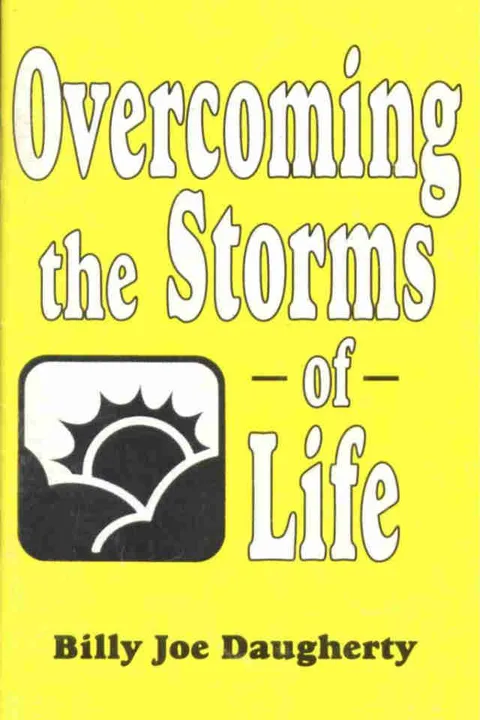

Overcoming The Storms Of Life Order Printed Copy
- Author: Billy Joe Daugherty
- Size: 839KB | 52 pages
- |
Others like overcoming the storms of life Features >>
About the Book
"Overcoming the Storms of Life" by Billy Joe Daugherty is a Christian self-help book that offers guidance and encouragement for navigating difficult times and finding strength in one's faith. Through personal stories, biblical teachings, and practical advice, Daugherty empowers readers to overcome challenges and emerge stronger on the other side. The book emphasizes the power of prayer, faith, and perseverance in overcoming life's storms.
John Alexander Dowie
By John Alexander Dowie (1847 – 1907)
I sat in my study in the parsonage of the Congregational Church at Newtown, a suburb of the beautiful city of Sydney, Australia. My heart was very heavy, for I had visited the sick and dying beds of more than thirty of my flock, and I had cast the dust to its kindred dust into more than forty graves within a few weeks. Where, oh where, was He Who used to heal His suffering children? No prayer for healing seemed to reach His ear, and yet I knew His hand had not been shortened. Still it did not save from death even those for whom there was so much in life to live for God and others. Strong men, fathers, good citizens, and more than all, true Christians sickened with a putrid fever, suffered nameless agonies, passed into delirium, sometimes with convulsions, and then died.
Oh, what aching voids were left in many a widowed or orphaned heart. There were many homes where, one by one, the little children, the youths and the maidens lay stricken, and after a hard struggle with the foul disease, they too, lay cold and dead. It seemed sometimes as if I could almost hear the triumphant mockery of evil ringing in my ear whilst I spoke to the bereaved ones the words of Christian hope and consolation. Disease, the foul offspring of its father, Satan, and its mother Sin, was defiling and destroying the earthly temples of God’s children and there was no deliverance.
There I sat with sorrow-bowed head for my afflicted people, until the bitter tears came to relieve my burning heart. Then I prayed for some message, and oh, how I longed to hear some words from Him Who wept and sorrowed for the suffering long ago, a Man of Sorrows and Sympathies. The words of the Holy Ghost inspired In Acts 10:38, stood before me all radiant with light, revealing Satan as the Defiler, and Christ as the Healer. My tears were wiped away, my heart strong, I saw the way of healing, and the door thereto was opened wide, so I said, “God help me now to preach the Word to all the dying around, and tell them how Satan still defiles, and Jesus still delivers, for He is just the same today.”
A loud ring and several raps at the outer door, a rush of feet, and there at my door stood two panting messengers who said, “Oh, come at once, Mary is dying; come and pray. “With just a feeling as a shepherd has who hears that his sheep are being torn from the fold by a cruel wolf, I rushed from my house, ran without my hat down the street, and entered the room of the dying maiden. There she lay groaning and grinding her clenched teeth in the agony of the conflict with the destroyer. The white froth, mingled with her blood, oozing from her pale and distorted mouth. I looked at her and then my anger burned. “Oh,” I thought, “for some sharp sword of heavenly temper keen to slay this cruel foe who is strangling that lovely maiden like an invisible serpent, tightening his deadly coils for a final victory.”
In a strange way, It came to pass; I found the sword I needed was in my hands, and in my hand I hold it still and never will I lay It down. The doctor, a good Christian man, was quietly walking up and down the room, sharing the mother’s pain and grief. Presently he stood at my side and said, “Sir, are not God’s ways mysterious?” Instantly the sword was flashed in my hand, the Spirit’s sword, the Word of God. “God’s way?!” I said, pointing to the scene of conflict, “How dare you call that God’s way of bringing His children home from earth to Heaven? No sir, that is the devil’s work and it is time we called on Him Who came to destroy the work of the devil, to slay that deadly foul destroyer, and to save this child. Can you pray, Doctor, can you pray the prayer of faith that saves the sick?” At once, offended at my words, my friend was changed, and saying,” You are too much excited, sir, it is best to say ‘God’s will be done,’” and he left the room.
Excited?! The word was quite inadequate for I was almost frenzied with divinely imparted anger and hatred of that foul destroyer, disease, which was doing Satan’s will. “It is not so,” I exclaimed, “no will of God sends such cruelty, and I shall never say ‘God’s will be done’ to Satan’s works, which God’s own Son came to destroy, and this is one of them.” Oh, how the Word of God was burning in my heart: “Jesus of Nazareth went about doing good, and healing all that were oppressed of the devil; for God was with Him.” And was not God with me? And was not Jesus there and all His promises true? I felt that it was even so, and turning to the mother I inquired,” Why did you send for me?” To which she answered, “Do pray, oh pray for her that God may raise her up.” So we prayed.
What did I say? It may be that I cannot recall the words without mistake, but words are in themselves of small importance. The prayer of faith may be a voiceless prayer, a simple heartfelt look of confidence into the face of Christ. At such moment, words are few, but they mean much, for God is looking at the heart. Still, I can remember much of that prayer unto this day, and asking God to aid, I will attempt to recall it. I cried, “Our Father, help! and Holy Spirit, teach me how to pray. Plead Thou for us, oh, Jesus, Savior, Healer, Friend, our Advocate with God the Father. Hear and heal, Eternal One! From all disease and death, deliver this sweet child of yours. I rest upon the Word. We claim the promise now. The Word is true, ‘I am the Lord that heals thee.’ Then heal her now. The Word is true, ‘I am the Lord, I change not.’ Unchanging God, then prove Yourself the healer now. The Word is true. ‘These signs shall follow them that believe in My Name, they shall lay hands on the sick, and they shall recover.’ And I believe and I lay hands in Jesus’ Name on her and claim this promise now. Your Word is true. ‘The prayer of faith shall save the sick. Trusting in You alone. I cry. Oh, save her now, for Jesus’ sake. Amen!”
Then, the maid lay in sleep so deep and sweet that the mother asked in a low whisper, “Is she dead?” “No,” I answered, in a whisper lower still. “Mary will live; the fever is gone. She is perfectly well and sleeping as an infant sleeps.” I was smoothing the long dark hair from her now peaceful brow, and feeling the steady pulsation of her heart and cool moist hands. I saw that Christ had heard, and that once more, as long ago in Peter’s house, “He touched her and the fever left her.” Turning to the nurse, I said, “Get me at once, please, a cup of cocoa and several slices of bread and butter.” Beside the sleeping maid we sat quietly and almost silently until the nurse returned, and then I bent over her and snapping my fingers called, “Mary!”
Instantly she woke, smiled and said, “Oh, sir, when did you come? I have slept so long;” then stretching her arms out to meet her mother’s embrace, she said, “Mother, I feel so well.” “And hungry, too?” I asked, pouring some of the cocoa in a saucer and offering it to her when cooled by my breath. “Yes, hungry too,” she answered with a little laugh, and drank and ate again, and yet again until all was gone. In a few minutes, she fell asleep, breathing easily and softly. Quietly thanking God. We left her bed and went to the next room where her brother and sister also lay sick of the same fever. With these two, we prayed and they were healed too. The following day all three were well and in a week or so they brought me a little letter and a gift of gold, two sleeve links with my monogram, which I wore for many years. As I went away from the home where Christ as the Healer had been victorious, I could not but have somewhat in my heart of the triumphant song that rang through Heaven, and yet I was not a little amazed at my own strange doings, and still more at my discovery that He is just the same today.
Excerpt from the Sermons of John Alexander Dowie Champions of Faith by Gordon Lindsay
The Soundtrack of Heaven
The book of Revelation confuses many Christians. Filled with beasts, angels, living creatures, wars, lightning, thunder, prophecies, and visions, its story can be a bit overwhelming for any of us. Something like a Marvel movie on steroids. Not surprisingly, scholars differ widely on what it all means. Some try to tie it to actual people and events in history. Others assign most of Revelation to the future. Still others believe God is giving us repeated descriptions of what is taking place now in the church age. Wherever we land on the bigger picture, Revelation gives us a series of windows into reality that are both hard to miss and easier to understand: its songs. Woven into the fabric of the book are around a dozen choruses, both spoken and sung. That shouldn’t surprise us given how often in Scripture drawing near to God is expressed and encouraged through singing. But these songs of heaven are unique. They’re written by God himself, and they show us what singing in God’s presence will really be like. And we may be singing some form of these particular choruses forever. Even now, though, they have much to teach us. Songs of Exuberance Let’s admit it. The descriptions of the singing of heaven put the sound of any rock concert or sports stadium to shame, not to mention most churches. Myriads of myriads and thousands of thousands, saying with a loud voice . . . (Revelation 5:11–12) And I heard every creature in heaven and on earth and under the earth and in the sea . . . (Revelation 5:13) And all the angels . . . fell on their faces before the throne. (Revelation 7:11) Then I heard what seemed to be the voice of a great multitude, like the roar of many waters and like the sound of mighty peals of thunder . . . (Revelation 19:6) “The example of heaven challenges the assumption that congregational worship should be reserved and subdued.” Both audibly and visually, we’re confronted with the fact that those who truly grasp God’s nature and what he’s accomplished will be moved to sing. As Dennis Johnson writes, Revelation shows us that “those who dwell with God in heaven constantly break forth in song, overwhelmed with joy and adoration by his perfections in himself and by his awesome achievements in creation and redemption” (Triumph of the Lamb, 330). The example of heaven challenges the assumption that congregational worship should be reserved and subdued. While we cite proof texts, claim to honor tradition, and avoid looking too fanatical, might it be that we’re actually just failing to see how great God’s glory in Christ really is? Songs of Explanation Heaven’s songs give us insight into the character of God, the works of his hands, and why he does what he does. We don’t hear any of the simple, repetitious 7-11 songs (7 words repeated 11 times — or more!) that are so popular today. Rather, the lyrics shed real light on what’s happening in the world and in the heavenly throne room. ILLUMINATING HOLINESS For instance, at the beginning of Revelation 4, John is shown an open door in heaven. He paints a moving picture of what he sees and hears. A throne. An emerald-like rainbow. Flashes of lightning. Peals of thunder. But what does it all mean? Revelation 4:8 tells us: Holy, holy, holy, is the Lord God Almighty, who was and is and is to come! God is thrice holy — righteous, omnipotent, eternal, set apart. The song of verse 11 further explains that God created all things and sustains all things for his pleasure: Worthy are you, our Lord and God, to receive glory and honor and power, for you created all things, and by your will they existed and were created. (Revelation 4:11) UNFOLDING REDEMPTION At the beginning of chapter 5, John hears a new song, sung to the Lamb: Worthy are you to take the scroll and to open its seals, for you were slain, and by your blood you ransomed people for God from every tribe and language and people and nation, and you have made them a kingdom and priests to our God, and they shall reign on the earth. (Revelation 5:9–10) The Lamb could open the scroll because he was slain, a reference to his substitutionary death on the cross. His death ransomed people for God from every tribe, language, people, and nation, a reference to the international scope of the gospel invitation. The ransomed will be a kingdom and priests to God who will reign forever on earth, a statement showing that God’s promise to make Israel “a kingdom of priests and a holy nation” (Exodus 19:6) was fulfilled in the church, made up of both Jews and Gentiles. In short, despite the turmoil and tests of the present age, God will surely have a diverse people for his glory with whom he will live forever. After an outpouring of praise for the Lamb’s attributes (Revelation 5:12), we hear another song, declaring Jesus’s divinity as clearly as any passage in Scripture: “To him who sits on the throne and to the Lamb be blessing and honor and glory and might forever and ever!” (Revelation 5:13). In a similar way, our songs should be filled with the character, nature, purposes, actions, and heart of God. Words don’t get in the way of worship. They give substance and meaning to it. Songs of Encouragement When God gave John the prophecy of Revelation, Christians were already facing varying degrees of persecution, and it was expected to increase. Pressures to conform to a pagan culture, and even to participate in the idolatry of emperor worship, came at Christians from every direction. What would give John’s readers faith to endure and courage to stand against opposition? What would strengthen their resolve as they saw friends and family members taken from their homes and martyred for their allegiance to King Jesus? The knowledge that God’s throne is immovable, sovereign, and eternal. The saints needed to be reminded that, in the heavenly realms, God’s authority and rule are not only affirmed, but celebrated: The kingdom of the world has become the kingdom of our Lord and of his Christ. (Revelation 11:15) We give thanks to you, Lord God Almighty, who is and who was, for you have taken your great power and begun to reign. (Revelation 11:17) Hallelujah! Salvation and glory and power belong to our God, for his judgments are true and just; for he has judged the great prostitute who corrupted the earth with her immorality, and has avenged on her the blood of his servants. (Revelation 19:1–2) How often do our songs both detail the forces of evil arrayed against us and point us clearly to the God who has triumphed over them in Christ? David Peterson asks, Do our hymns and acclamations . . . challenge us to take a firm stand against every manifestation of Satan’s power and to bear faithful witness to the truth of the gospel in our society? It is not good enough to sing certain items merely because they make the congregation feel good! (Engaging with God, 278) “Words don’t get in the way of worship. They give substance and meaning to it.” When we sing together, our strength comes not from aiming to feel and emote, but to see and hear. We want to see God reigning on his throne with absolute justice, wisdom, and power over every terrorist, virus, dictator, and manifestation of evil in our day. And we want to hear and join in the cries of jubilation that are already ascending to the God who can do all things and whose purposes cannot be thwarted (Job 42:2). Songs of Expectation Endurance is one thing. Expectation is another. It’s possible to sing through dark seasons, discouraging outcomes, heart-wrenching losses, relentless opposition, and dwindling resources with grit, resolve, and stoicism. But that doesn’t describe the songs of heaven. Not even close. They’re marked by joy. And that joy stems from a confident expectation that God will accomplish everything he has promised. The final songs of Revelation describe God overcoming all evil, the nations bowing down in worship, and the bride of Christ finally beholding her groom, King Jesus, at a never-ending royal celebration of grace. All nations will come and worship you, for your righteous acts have been revealed. (Revelation 15:4) Hallelujah! For the Lord our God the Almighty reigns. Let us rejoice and exult and give him the glory, for the marriage of the Lamb has come, and his Bride has made herself ready; it was granted her to clothe herself with fine linen, bright and pure. (Revelation 19:6–8) Do our songs help people clearly understand that what’s yet to come is not only certain but worth celebrating now? Do we fill them with anticipation for our glorious future in Christ, when “all the waiting will be over, every sorrow will be healed, all the dreams it seemed could never be will all be real”? Our songs help bring into sharper focus the things hoped for and unseen that God has promised to us. Transformed Through Singing Will our earthly songs look and sound exactly like the songs of heaven? No. But can the songs of heaven motivate us to sing with greater passion, understanding, confidence, and anticipation now? Absolutely. G.K. Beale writes, Is it possible . . . that, as we declared the same truths about God as the heavenly beings do, the same Holy Spirit who is pictured as being before the throne would deepen and transform our understanding of God and his glory in a way that touches our whole being, in its spiritual, intellectual, emotional, and even physical components? (Revelation: A Shorter Commentary, 108) It’s not only possible. It’s God’s intention. So, may we joyfully model our singing after the songs of heaven until, by the grace of God, they are no longer just a worthy goal, but the sound of present reality. Article by Bob Kauflin