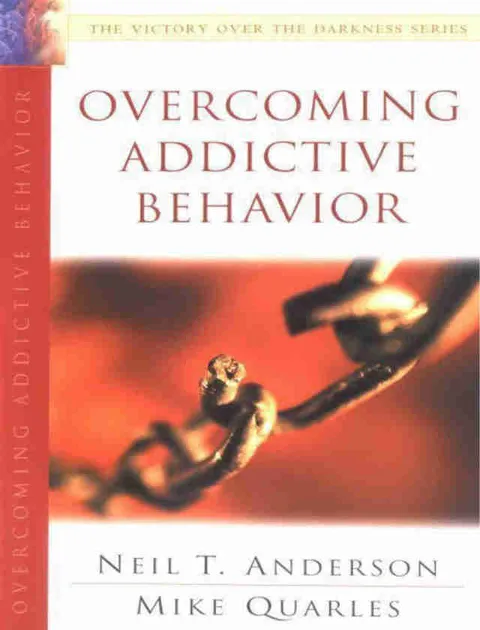

Others like overcoming addictive behavior Features >>
-160.webp)






About the Book
"Overcoming Addictive Behavior" is a comprehensive guide that provides strategies and tools for individuals struggling with addiction. The book offers practical advice on how to identify addictive behaviors, develop healthy coping mechanisms, and create a support network to overcome substance abuse and other addictive habits. It also explores the underlying causes of addiction and offers insights into how to break the cycle of addictive behavior for long-term recovery.
Nick Vujicic

the courage you need in life’s uncertainty
“Jump! I’ll catch you!” When my son was young, getting him from the side of the pool into the water was difficult. His eyes darted side to side, quickly losing confidence, as his imagination surmised all the horrors associated with jumping. Only when I could get him to fix his attention on me would he find the confidence to bend his knees and spring off the side of the pool. Like my son, we are regularly confronted with situations that are overwhelming, unknown, or threatening. What does it look like for us to spring with confidence into every situation that the Lord brings into our lives? Four Ways to Walk in Faith Isaiah 7 tells the story of a king in crisis. When the Judean King Ahaz heard that Syria and Israel created an alliance to withstand the advancing Assyrian threat, his heart shook with fear (Isaiah 7:2). Seeking to strengthen their hand against Assyria, the Syro-Ephraimite coalition intended to use military force to depose Ahaz and coerce Judah to join them, as well. Ahaz responded to the imminent threat like a good king. He inspected the city’s water supply. How long can the city withstand a siege? Ahaz had been conditioned to believe that military threats require military responses. Yet, God responds to Ahaz by sending the prophet Isaiah, who relayed four commands from the Lord, each of which recalls other parts of the Old Testament: be careful, be quiet, do not fear, do not let your heart be faint. These four commands echo down the halls of Israel’s collective memory with the intention of reminding Ahaz of the provisions of faith. These commands are helpful for us too as we fight for faith amidst the challenges of our lives. 1. Be Mindful Moses instructed the Israelites before they entered the Promised Land: they will live in houses they did not build, drink wine from vineyards they did not plant, eat until they are full. But, Moses warns them in Deuteronomy 6:12, “take care lest you forget the Lord, who brought you out of the land of Egypt, out of the house of slavery.” At the moment of crisis, God acknowledged that Ahaz’s battle was not just outside the city walls, but also in his mind. It was essential for Ahaz to remember who he was and the history he had with God. In the same way, during times of uncertainty, cultivating memory and identity as those who are in Christ is essential for accessing the resources of faith to respond to present challenges. 2. Be Quiet This is an important theme in Isaiah. In Isaiah 30:15, God says, “In quietness and in trust shall be your strength.” Quietness in Isaiah does not mean the absence of noise, but the absence of agitation. In fact, peace and joyful shouting are themes that merge together in Isaiah 14:7 and 55:12. At the moment of crisis, Ahaz needed to find calm and certain confidence in God — something his water supply could never fully provide. 3. Do Not Fear The phrase recalls God’s providence, promises, and purposes. God uses these words when he appears to Abram, Moses, Joshua, and Elijah. It may seem trite to tell Ahaz not to fear. But the rationale is implicit: God was with him, for him, and had made promises to him. Ahaz, then, needed to respond on the basis of that conviction. Similarly, I need to recalibrate my perspective around God when faced with uncertain circumstances. John Oswalt summarizes, “If we can believe that the transcendent One is really immanent, and the immanent One truly transcendent, then there is reason to live courageously and unselfishly” ( Isaiah, 211). 4. Do Not Faint This is an exact quotation from Deuteronomy 20:3–4, where Moses prepares the Israelites for facing their enemies in battle. The priest was to come to the front of the line of soldiers and say, “let not your heart faint. Do not fear or panic or be in dread of them, for the Lord your God is he who goes with you to fight for you.” At the moment of crisis, with a mind that remembers, a soul free from agitation, and a renewed conviction that God is for me and with me, I can respond with courageous faith. A Picture of Courageous Faith In southwest Rwanda, along the shores of Lake Kivu, is a peninsula, where missionaries from the region have gathered annually since 1942 for spiritual renewal. On the far end of the peninsula is a cliff, into which thrill-seeking missionaries from a previous generation lodged a long, rigid, slab of wood — called “the plank” — thirty feet off the surface of the water. I have approached the plank many times. I stand looking, hearing my children behind me. “Come on, Dad!” “He won’t jump!” I am distracted by local children gathering in canoes to watch. I think about others who have jumped — and hurt themselves. I feel certain that I will fall off the cliff by even getting near the plank! I have never jumped. I have a friend named Jeff, who does not blink at the threats imposed by the plank. He steps onto the plank, walks a few paces, pulls himself up into an overhanging tree, climbs even higher, turns backward, and launches into a backflip as he springs out over the water. This is a picture of how I want to live — not carelessly, but confidently — springing with confidence into every situation that the Lord brings into my life — not simply conditioned to respond according to my own resources, but convinced that the provisions of faith provide all that I need to respond with confidence in any situation.
-480.webp)