
Others like how to bring men to christ Features >>






About the Book
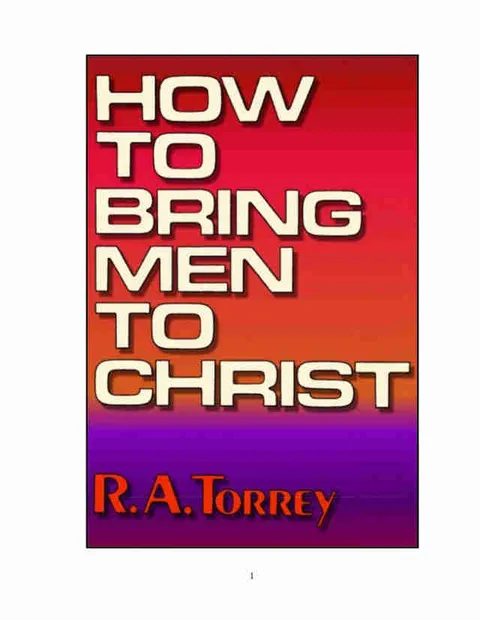
"How to Bring Men to Christ" by R.A. Torrey is a practical guide on evangelism and sharing the Christian faith with others. Torrey provides helpful tips and strategies for effectively reaching out to men and leading them to salvation in Christ. The book emphasizes the importance of prayer, personal evangelism, and relying on the power of the Holy Spirit in bringing others to faith. It is a valuable resource for individuals looking to become more effective in their witness and ministry efforts.
Reinhard Bonnke
 Reinhard Bonnke (19 April 1940 - 7 December 2019) was a German-American Pentecostal evangelist, principally known for his gospel missions throughout Africa. Bonnke had been an evangelist and missionary in Africa since 1967. In Nigeria’s city, Lagos, in 2000, a single service is believed to have been attended by 1.6 million people. Christ for all Nations (CFAN), an organisation founded by Bonnke, claims he preached Christ to more than 79 million non believers.
Early life
Reinhard Bonnke was born on 19 April 1940, in the city of Königsberg, East Prussia, Germany, the fifth son of Hermann Bonnke, an army logistics officer in the Reichswehr who fought on the Eastern Front; his paternal grandfather was August Bonnke, the owner of a windmill in Trunz, East Prussia (now Milejewo, Poland), who was healed of an unknown ailment by the evangelist Luis Graf in 1922, but died during the evacuation of East Prussia in 1945. His mother was Metaa Bonnke (née Scheffler). Bonnke had six siblings: Martin, Gerhard, Jurgen, Peter and Felicitas, his only younger sibling and his only sister.
With his mother and siblings, he was taken to Denmark during the evacuation of East Prussia and spent some years in a displaced persons centre before settling in Gluckstadt, West Germany. After his own war service, his father became a pastor in the village of Krempe. He became a born-again Christian at the age of nine after his mother spoke with him about a sin that he had committed. He sensed a call from God to serve as a missionary in Africa from the age of 10 and said that he had the experience of baptism in the Holy Spirit.
Bonnke studied at the Bible College of Wales in Swansea, Wales, UK, where he was inspired by the director, Samuel Rees Howells. In one meeting Howells spoke of answered prayer; after this meeting, Bonnke prayed, "Lord, I also want to be a man of faith. I want to see your way of providing for needs." Passing through London, he had a chance meeting with the preacher George Jeffreys. As he walked, he came across a house with a nameplate on the front that said “George Jeffreys”. He wondered if it could be the great George Jeffreys who had founded the Elim Pentecostal churches in Ireland and England. He prayed for the young student and imparted grace to him.
After graduation, he pastored in Germany for seven years, including establishing a congregation in Flensburg which met in a former rum factory.
African mission
His work in Africa began in 1967. He arrived in South Africa and almost immediately encountered the apartheid system, which he developed an antipathy towards, which in turn caused friction between him and the minister who oversaw him in South Africa. Bonnke subsequently accepted a position to oversee three churches in Lesotho, but began again from scratch after he discovered that unbiblical practices had emerged in the congregations he was to oversee.
In the first few years of his work, Bonnke encountered poor results from his evangelistic efforts and felt frustrated at the pace of his ministry. Then he had a recurring dream featuring a picture of the map of Africa being splattered with blood and heard the voice of God crying "Africa Shall Be Saved". This ultimately led him to adopt large-scale evangelism, rather than the traditional small-scale missionary approach. He rented a stadium in Gaborone, Botswana, and preached with little cooperation from local churches. The first meetings saw about 100 people attending, but this number grew swiftly.
In 1974, Bonnke founded the mission organisation Christ for all Nations (CfaN). Originally based in Johannesburg, South Africa, the headquarters were relocated to Frankfurt, Germany, in 1986. This was done primarily to distance the organisation from South Africa's apartheid policy at the time.[9] Today CfaN has 9 offices across 5 continents.
Bonnke began his ministry holding tent meetings that accommodated large crowds. According to an account published by the Christian Broadcasting Network, in 1984 he commissioned the construction of what was claimed to be the world's largest mobile structure - a tent capable of seating 34,000; this was destroyed in a wind storm just before a major meeting and therefore the team decided to hold the event in the open air instead. According to this account, the event was subsequently attended by over 100,000 people which is far greater than the 34,000 seating capacity the tents could have contained. For various reasons, usually due to insufficient capacity, the 34,000-seat tent was only used once, in Harare, Zimbabwe, in 1986.
In addition to South Africa, Bonnke would also hold many campaigns in other African countries including Nigeria and Kenya and became known as "the Billy Graham of Africa." In the 5 February 2001 edition of Graham's Christianity Today, journalist Corrie Cutrer stated that Bonnke had set "record-breaking attendances" at recent events he held in Nigeria. Bonnke announced his "farewell gospel crusade" to be held in Lagos, Nigeria, in November 2017. Lagos is also the location of a gospel crusade held in 2000 which, according to CfaN, is the organization's largest to date, drawing an attendance of six million people in a 5-night crusade, and as much as 1.6 million attendance in one day. In 2009 Bonnke appointed his successor, Daniel Kolenda who continues to lead the ministry. In 2020, following Bonnke's death, Christ for all Nations launched the CfaN Evangelism Bootcamp. In 2022 Schools of Evangelism were started in South Africa, and Europe and Fire Camps were launched in dozens of nations on six continents. Today, more than 4,000 evangelists have been trained by Christ for all Nations and more than 91-million decisions for Christ have been counted. In 2024, in the 50th year of the ministry, CfaN is conducting 50 gospel crusades throughout the African continent.
Persecution
Kano riots, subsequent expulsion from Nigeria, and return to the country
In 1991, during Bonnke's visit to Kano in Nigeria, there were riots in the city as Muslims protested over remarks he had reportedly made about Islam in the city of Kaduna on his way to Kano. A rumour was spread that Bonnke was planning to "lead an invasion" into Kano. Muslim youths gathered at the Kofar Mata Eide-ground where they were addressed by several clerics who claimed that Bonnke was going to blaspheme Islam. About 8,000 youths gathered at the Emir's palace and after noon prayers the riots ensued, during which many Christians sustained various injuries and several churches were burned. Official reports state that at least eight people were killed, although other research and reports place the number as being as much as 500 as many of the Christians who were killed were thrown into wells and the attacks were spread between multiple locations.
Despite the state governor absolving Bonnke of any blame for the incident, Bonnke's subsequent attempts to return to Nigeria were denied, as the Nigerian Embassy refused his visa applications. In 2000, a new civilian government in Nigeria was elected to power, and President Olusegun Obasanjo, a Christian, invited Reinhard Bonnke to return to the country. Bonnke returned to Nigeria and held a crusades in Benin City in the south. He would deny reports that the Northern Region of Nigeria's Council of Ulamas banned him from entering northern Nigeria.
Bonnke held many crusades in Nigeria after 2000, and conversion rates were significantly higher than in many other African nations, with one campaign achieving a conversion of 1.1 million people. Nigeria would be where his final international crusade would be held, in Lagos in 2017.
Personal life
After graduating from the Bible College of Wales and returning to Germany, Bonnke led a series of meetings in Rendsburg. He began receiving speaking invitations from all around Germany and the rest of the world. Bonnke met Anni Suelze at a gospel music festival and admired the grace which she showed when a mistake led to her losing a music competition. He offered to preach at the church she attended and over time they fell in love. They married in 1964 and had three children: Kai-Uwe Friedrich, known as "Freddy", Gabrielle and Suzanne.
Death
Bonnke died on 7 December 2019. The month before, he had announced on his official Facebook page that he had undergone femur surgery and needed time to "learn how to walk again". Nigerian President Muhammadu Buhari, who is Muslim, praised Bonnke for his frequent visits to Nigeria and described his death as a "great loss to Nigeria".
His appointed successor is the evangelist Daniel Kolenda.
He would be buried in Gotha, Florida's Woodlawn Memorial Park, with his memorial stone being shaped to resemble Africa.
Reinhard Bonnke (19 April 1940 - 7 December 2019) was a German-American Pentecostal evangelist, principally known for his gospel missions throughout Africa. Bonnke had been an evangelist and missionary in Africa since 1967. In Nigeria’s city, Lagos, in 2000, a single service is believed to have been attended by 1.6 million people. Christ for all Nations (CFAN), an organisation founded by Bonnke, claims he preached Christ to more than 79 million non believers.
Early life
Reinhard Bonnke was born on 19 April 1940, in the city of Königsberg, East Prussia, Germany, the fifth son of Hermann Bonnke, an army logistics officer in the Reichswehr who fought on the Eastern Front; his paternal grandfather was August Bonnke, the owner of a windmill in Trunz, East Prussia (now Milejewo, Poland), who was healed of an unknown ailment by the evangelist Luis Graf in 1922, but died during the evacuation of East Prussia in 1945. His mother was Metaa Bonnke (née Scheffler). Bonnke had six siblings: Martin, Gerhard, Jurgen, Peter and Felicitas, his only younger sibling and his only sister.
With his mother and siblings, he was taken to Denmark during the evacuation of East Prussia and spent some years in a displaced persons centre before settling in Gluckstadt, West Germany. After his own war service, his father became a pastor in the village of Krempe. He became a born-again Christian at the age of nine after his mother spoke with him about a sin that he had committed. He sensed a call from God to serve as a missionary in Africa from the age of 10 and said that he had the experience of baptism in the Holy Spirit.
Bonnke studied at the Bible College of Wales in Swansea, Wales, UK, where he was inspired by the director, Samuel Rees Howells. In one meeting Howells spoke of answered prayer; after this meeting, Bonnke prayed, "Lord, I also want to be a man of faith. I want to see your way of providing for needs." Passing through London, he had a chance meeting with the preacher George Jeffreys. As he walked, he came across a house with a nameplate on the front that said “George Jeffreys”. He wondered if it could be the great George Jeffreys who had founded the Elim Pentecostal churches in Ireland and England. He prayed for the young student and imparted grace to him.
After graduation, he pastored in Germany for seven years, including establishing a congregation in Flensburg which met in a former rum factory.
African mission
His work in Africa began in 1967. He arrived in South Africa and almost immediately encountered the apartheid system, which he developed an antipathy towards, which in turn caused friction between him and the minister who oversaw him in South Africa. Bonnke subsequently accepted a position to oversee three churches in Lesotho, but began again from scratch after he discovered that unbiblical practices had emerged in the congregations he was to oversee.
In the first few years of his work, Bonnke encountered poor results from his evangelistic efforts and felt frustrated at the pace of his ministry. Then he had a recurring dream featuring a picture of the map of Africa being splattered with blood and heard the voice of God crying "Africa Shall Be Saved". This ultimately led him to adopt large-scale evangelism, rather than the traditional small-scale missionary approach. He rented a stadium in Gaborone, Botswana, and preached with little cooperation from local churches. The first meetings saw about 100 people attending, but this number grew swiftly.
In 1974, Bonnke founded the mission organisation Christ for all Nations (CfaN). Originally based in Johannesburg, South Africa, the headquarters were relocated to Frankfurt, Germany, in 1986. This was done primarily to distance the organisation from South Africa's apartheid policy at the time.[9] Today CfaN has 9 offices across 5 continents.
Bonnke began his ministry holding tent meetings that accommodated large crowds. According to an account published by the Christian Broadcasting Network, in 1984 he commissioned the construction of what was claimed to be the world's largest mobile structure - a tent capable of seating 34,000; this was destroyed in a wind storm just before a major meeting and therefore the team decided to hold the event in the open air instead. According to this account, the event was subsequently attended by over 100,000 people which is far greater than the 34,000 seating capacity the tents could have contained. For various reasons, usually due to insufficient capacity, the 34,000-seat tent was only used once, in Harare, Zimbabwe, in 1986.
In addition to South Africa, Bonnke would also hold many campaigns in other African countries including Nigeria and Kenya and became known as "the Billy Graham of Africa." In the 5 February 2001 edition of Graham's Christianity Today, journalist Corrie Cutrer stated that Bonnke had set "record-breaking attendances" at recent events he held in Nigeria. Bonnke announced his "farewell gospel crusade" to be held in Lagos, Nigeria, in November 2017. Lagos is also the location of a gospel crusade held in 2000 which, according to CfaN, is the organization's largest to date, drawing an attendance of six million people in a 5-night crusade, and as much as 1.6 million attendance in one day. In 2009 Bonnke appointed his successor, Daniel Kolenda who continues to lead the ministry. In 2020, following Bonnke's death, Christ for all Nations launched the CfaN Evangelism Bootcamp. In 2022 Schools of Evangelism were started in South Africa, and Europe and Fire Camps were launched in dozens of nations on six continents. Today, more than 4,000 evangelists have been trained by Christ for all Nations and more than 91-million decisions for Christ have been counted. In 2024, in the 50th year of the ministry, CfaN is conducting 50 gospel crusades throughout the African continent.
Persecution
Kano riots, subsequent expulsion from Nigeria, and return to the country
In 1991, during Bonnke's visit to Kano in Nigeria, there were riots in the city as Muslims protested over remarks he had reportedly made about Islam in the city of Kaduna on his way to Kano. A rumour was spread that Bonnke was planning to "lead an invasion" into Kano. Muslim youths gathered at the Kofar Mata Eide-ground where they were addressed by several clerics who claimed that Bonnke was going to blaspheme Islam. About 8,000 youths gathered at the Emir's palace and after noon prayers the riots ensued, during which many Christians sustained various injuries and several churches were burned. Official reports state that at least eight people were killed, although other research and reports place the number as being as much as 500 as many of the Christians who were killed were thrown into wells and the attacks were spread between multiple locations.
Despite the state governor absolving Bonnke of any blame for the incident, Bonnke's subsequent attempts to return to Nigeria were denied, as the Nigerian Embassy refused his visa applications. In 2000, a new civilian government in Nigeria was elected to power, and President Olusegun Obasanjo, a Christian, invited Reinhard Bonnke to return to the country. Bonnke returned to Nigeria and held a crusades in Benin City in the south. He would deny reports that the Northern Region of Nigeria's Council of Ulamas banned him from entering northern Nigeria.
Bonnke held many crusades in Nigeria after 2000, and conversion rates were significantly higher than in many other African nations, with one campaign achieving a conversion of 1.1 million people. Nigeria would be where his final international crusade would be held, in Lagos in 2017.
Personal life
After graduating from the Bible College of Wales and returning to Germany, Bonnke led a series of meetings in Rendsburg. He began receiving speaking invitations from all around Germany and the rest of the world. Bonnke met Anni Suelze at a gospel music festival and admired the grace which she showed when a mistake led to her losing a music competition. He offered to preach at the church she attended and over time they fell in love. They married in 1964 and had three children: Kai-Uwe Friedrich, known as "Freddy", Gabrielle and Suzanne.
Death
Bonnke died on 7 December 2019. The month before, he had announced on his official Facebook page that he had undergone femur surgery and needed time to "learn how to walk again". Nigerian President Muhammadu Buhari, who is Muslim, praised Bonnke for his frequent visits to Nigeria and described his death as a "great loss to Nigeria".
His appointed successor is the evangelist Daniel Kolenda.
He would be buried in Gotha, Florida's Woodlawn Memorial Park, with his memorial stone being shaped to resemble Africa.
Lord, Let Me Die - Mercy for Those Tired of Living
Over the years, I have talked with several Christians who have told me they wanted to die. They were of different ages and different ethnicities; they had different personalities and different reasons. But they each concluded that death was better for them now than life. It took courage to bring into the open the secret thoughts of death. Many others could not relate. Most of humanity had only run from the dread that gained on them moment by moment. Few had felt the impulse to stop, turn, and welcome the beast as a friend. Now these, again, were Christian men and women. They knew the horror of self-murder. They knew such a crime was not a romantic gesture between teenage lovers, but a heinous sin against the Author of life. When suicidal ruminations sought to guide them to another exit, even amid debilitating and cruel circumstances, they knew to resist Satan’s suggestions. By faith, they would continue, one foot in front of the other, until their all-wise Father brought them home. And a few had prayed for just that. “If you have asked God to take your life, the first thing to realize is that you are not alone.” If you have asked God to take your life, one of the first truths to realize is that you are not alone. God has heard such petitions before. For different reasons, at different times, from different pits, men and women of God have prayed to be taken away. And the prayers we find in Scripture come not just from normal saints like us, but from the ones we would least expect to struggle with this life: leaders and heroes of God’s people. Consider a few men of God, then, whose prayers the Holy Spirit captured to remind us we are not alone and, more importantly, to witness how our kind and gracious God deals with his own at their lowest. Job: The Despairing Father Oh that I might have my request, and that God would fulfill my hope, that it would please God to crush me, that he would let loose his hand and cut me off! (Job 6:8–9) I wager that anguished prayers for death are the most common. They come in the winter of life, when even songbirds are too cold to sing. Job, a righteous man without rival on earth (Job 1:8), now sits in the ashes, boils rising on his skin, surrounded by accusing friends, and plagued with a heart too heavy to carry. His shards of a prayer rise from the ruins of a former life: all his wealth gone, many of his servants slain, and what was more, all ten of his children buried beneath a house, collapsed by a great wind. Job, staggering with grief, curses the day of his birth: “Let the day perish on which I was born, and the night that said, ‘A man is conceived’” (Job 3:3). He muses aloud, “Why is light given to him who is in misery, and life to the bitter in soul, who long for death, but it comes not, and dig for it more than for hidden treasures, who rejoice exceedingly and are glad when they find the grave?” (Job 3:20–22). Death now glitters as a treasure, wafts as sweetness. He sees no reason to wait. Perhaps you, like Job, know great loss. Perhaps you sit in the rubble, scorned by former days and missing loves. You can’t bear any more; you gaze ahead into an endless night. Hope has turned its back. Consider afresh that God has not. “Continue believing. Continue trusting. This dark night is preparing for you an eternal weight of glory.” The Lord denied Job’s request. He had more compassion to give, more mercy, more communion, more repentance, even more children waiting on the other side. Job couldn’t yet imagine how his life might turn out to glorify God’s grace, as James summarizes: “You have heard of the steadfastness of Job, and you have seen the purpose of the Lord, how the Lord is compassionate and merciful” (James 5:11). Some sufferers may not find comfort in the fairy-tale ending of Job, but his renewed fortunes foreshadow not even half of yours in Christ. Continue believing. Continue trusting. This dark night is preparing for you an eternal weight of glory (2 Corinthians 4:17). Scars will do more than heal there. Moses: The Weary Leader If you will treat me like this, kill me at once. (Numbers 11:15) This is the second prayer for death we overhear from Moses on his long journey with the people. The first comes in his intercession for them following the golden-calf rebellion (Exodus 32:32). Here, he prays for death as an overburdened, fed-up leader. The rescued people of Israel, with sores still mending and Egypt still within view, complain “about their misfortunes.” Oh that we had meat to eat! We remember the fish we ate in Egypt that cost nothing, the cucumbers, the melons, the leeks, the onions, and the garlic. But now our strength is dried up, and there is nothing at all but this manna to look at. (Numbers 11:4–6) Ingratitude has warped their minds. Their memories suggest that slavery included a seafood buffet; meanwhile, the free miracle bread had grown bitter and bland. Did Moses really expect them to settle for second chef? The ingrates fix their eyes on Moses, mutinously mumbling about how much they missed Egypt. Moses looks up to God, and exclaims, I am not able to carry all this people alone; the burden is too heavy for me. If you will treat me like this, kill me at once, if I find favor in your sight, that I may not see my wretchedness. (Numbers 11:14–15) Notice again God’s gracious answer. He does not kill Moses, but instead provides seventy elders to aid him in his work, giving these men some of his Spirit. And for added measure, God promises to feed Israel meat — so much meat that it will come out of their nostrils and they will begin to loathe it (Numbers 11:20). If you weary under burdens too heavy for your feeble arms to carry, and could wish to die at times, see the God of Moses. Lean into him in prayer. Your compassionate Father will provide help to alleviate your load and hold up your arms to give victory. Jonah: The Angry Messenger Please take my life from me, for it is better for me to die than to live. (Jonah 4:3) The merciless prophet Jonah baffles many when they read the book bearing his name. He shows a calloused determination that Nineveh, capital city of Israel’s enemy the Assyrians, not receive mercy from God but rather destruction. He refuses to be an instrument of their salvation. God had renewed him after sailing away from his calling. God had rescued him from drowning in the sea. God had given him refreshing shade as he waited outside the city to watch it burn. Yet Jonah still would not put away his hatred. When he realized no doom would descend, It displeased Jonah exceedingly, and he was angry. And he prayed to the Lord and said, “O Lord, is not this what I said when I was yet in my country? That is why I made haste to flee to Tarshish; for I knew that you are a gracious God and merciful, slow to anger and abounding in steadfast love, and relenting from disaster. Therefore now, O Lord, please take my life from me, for it is better for me to die than to live.” (Jonah 4:1–3) Few in the West today face the temptation to want a whole people destroyed. The Assyrians were a brutal people — brutal to Jonah’s people. But perhaps we often murder in our hearts those who have wronged us. While they live, our life rots. To this, the Lord responds, again, patiently and compassionately, giving us shade while we scorch, asking us as a long-suffering Father, “Do you do well to be angry?” (Jonah 4:4). Most of the time, we do not do well. This prayer for death is foolish. Repentance is required. Go to your Father for help to extend that impossible forgiveness that you most freely received from him, that you might be able to pray, “Forgive us our debts, as we also have forgiven our debtors” (Matthew 6:12). Elijah: The Fearful Prophet [Elijah] was afraid, and he arose and ran for his life. . . . And he asked that he might die, saying, “It is enough; now, O Lord, take away my life, for I am no better than my fathers.” (1 Kings 19:3–4) We can attest truly that here stands one with a like nature to ours (James 5:17). Notice that this moment follows Elijah’s finest hour. The prophet of God won the showdown with Ahab and the 450 prophets of Baal. God rains down fire in front of all Israel to show that a true prophet walks among them. Or runs among them. After Jezebel hears that he had the 450 prophets of Baal killed, she vows to add Elijah to that number. “Then he was afraid, and he arose and ran for his life” (1 Kings 19:3). The hunted prophet hides in the wilderness, sits under a tree, tries to sleep, and prays not to wake: “O Lord, take my life.” Do you pray for death because you fear those living? Jesus tells us, “I tell you, my friends, do not fear those who kill the body, and after that have nothing more that they can do” (Luke 12:4). Beyond this, the story of Elijah invites us to survey our last year or our last week or our yesterday for reasons, often conspicuous, to continue entrusting ourselves to a faithful Creator while doing good. God, again, deals compassionately with Elijah. He calls him to rise and eat, provides a fresh meal for him in the wilderness, and gives provision for the journey ahead (1 Kings 19:5–8). Notice also the smiling kindness of God to Elijah in that the prophet, though threatened with death and praying for death, never dies (2 Kings 2:11–12). Paul: The Eager Apostle My desire is to depart and be with Christ, for that is far better. (Philippians 1:23) God’s predominant response to those men of God who prayed for death is fatherly compassion. Whether you be Jonah-like and tempted to despise God’s mercy toward others, or you cry out under your burdens like Moses, or run for your life like Elijah, or yearn for relief like Job, consider your gracious God. He meets Job with himself and a new beginning, Moses with seventy men to help, Jonah with a plant for shade, Elijah with food and drink for the journey ahead. And God himself, after all, through the finished work of his Son and the recreating work of his Spirit, turns death into an eager expectation for us, does he not? That enemy death must ferry us into that world for which we were remade. The apostle Paul, though not praying for death, shows us a redeemed perspective on our last foe. To me to live is Christ, and to die is gain. If I am to live in the flesh, that means fruitful labor for me. Yet which I shall choose I cannot tell. I am hard pressed between the two. My desire is to depart and be with Christ, for that is far better. (Philippians 1:21–23) We too can turn, face the monster in God’s perfect timing, and embrace it with a peace the world does not know. We too have a healthy longing to depart from this earth and be with Christ. We too have the Spirit, who inwardly groans as we await the consummation of our hope (Romans 8:23). We too pray, “Maranatha!” and long for this world’s last night because we long for this world’s new beginning. We do not long to die for death’s sake, nor merely to escape our troubles, but we do ache for an unending life with Christ that lies on the other side of sleep, and which we can taste more and more, even now, through his word and Spirit.