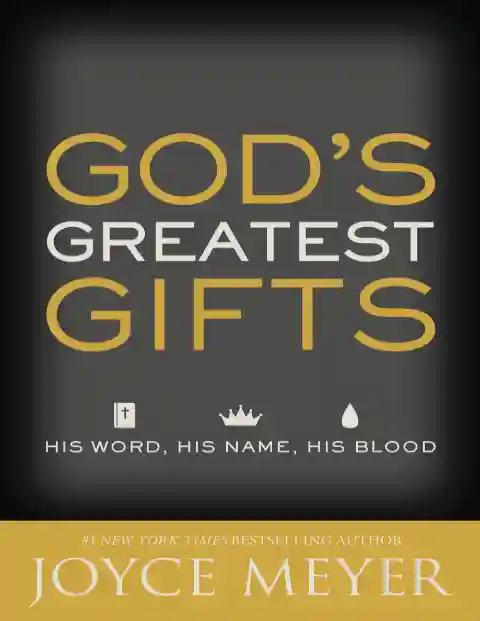

Gods Greatest Gifts - His Word, His Name, His Blood Order Printed Copy
- Author: Joyce Meyer
- Size: 1.48MB | 165 pages
- |
Others like gods greatest gifts - his word, his name, his blood Features >>
About the Book
In "God's Greatest Gifts," Joyce Meyer explores the profound impact of God's Word, His Name, and His Blood on the lives of believers. She emphasizes the power and importance of these gifts in experiencing spiritual transformation, healing, and victory in everyday life. Meyer's insights offer practical guidance for deepening one's faith and understanding of God's love and grace.
Richard Sibbes
Richard Sibbes was born in Tostock, Suffolk, four miles from Bury St. Edmunds, in 1577.[1] He is the eldest son of Paul Sibbes and Joane. His father was a wheelwright who hoped Sibbes would be in the same field of occupation. Instead of following the footsteps of his father, young Sibbes, out of love for reading, would choose books over wooden wheels.[2] Truly enough, throughout his lifetime, books were part of Sibbesâ life.[3] Proof of this interest to books is his accomplishments as a lecturer [pastor], fellow tutor, vicar, and for obtaining various degrees in his academic education.
Sibbesâ legacy of his seven-volume work was collected by A. B. Grosart which was published from 1862 to 1864.[4] Sibbesâ ministries and his works spread throughout England even after his death. However, he was never married.
Sibbes died on July 5, 1635, in his chambers at Grayâs Inn.[5] J. I. Packer noted that Sibbesâ left more than two million words on paper after his death.[6]
Educational Background
Sibbesâ started studying at St. Johnâs College, Cambridge when he was eighteen, in 1595. He then proceeded to finish a Bachelor of Arts in 1599. He received a fellowship grant in 1601. Sibbes continued studying, finishing a Master of Arts degree by 1602.
Sibbes became a prominent preacher in Cambridge and got the endorsement to apply for a Bachelor of Divinity. After his defense and fulfilling the requirements, he earned this degree in 1610.[7] Furthermore, in almost two decades, Sibbes received his Doctor of Divinity in 1627 after returning from London for his mastership at St. Katherine.[8]
Ministerial Experience and Vocation
Sibbesâ conversion happened after hearing Paul Bayneâs sermon in 1603. Bayne succeeded William Perkins at St. Andrews, Cambridge.[9] During Sibbesâ stay in Cambridge, as a fellow, he handled and supervised five to six students for a tutorial.[10] Sibbes held various vocations such as being chaplain, lecturer, and got a promotion from mere fellow to senior fellowship. After being a senior dean at St. John, Sibbes became the master of St. Katherineâs College in 1626.[11]
As a preacher, Sibbes received his ordination in Norwich, in 1607. He became the minister of Thurston in 1608. Later, in 1610, Sibbes accepted the offer as a lecturer of Holy Trinity Church, Cambridge until he was called to be a lecturer at Grayâs Inn, London, in 1617.[12] This lectureship lasts until his death.
Even during Sibbesâ mastership at St. Katherine, he remained a lecturer at Grayâs Inn. In 1633, through the appointment of King Charles I, Sibbes became the vicar of Holy Trinity Church, Cambridge. The positions held by Sibbes were mastership at St. Katherine, a lecturer at Grayâs Inn, and vicar of Holy Trinity Church.
Influence of the Heavenly Doctor
Throughout Sibbes ministries, prominence followed as he influenced many Puritan ministers. Sibbes, as an influencer, is known to be the âpastor of pastors,â not just in the Church of England but even to Presbyterians and Independent Congregationalists.[13] Sibbes was responsible for John Cottonâs conversion in 1612.[14]
Moreover, he persuaded John Prestonâs style in preaching, transforming from witty sermons to more plain but spiritual preaching.[15] Sibbesâ book, The Bruised Reed, encouraged Richard Baxter to gain settled-conviction on his conversion.[16] Likewise, Sibbes helped Thomas Goodwin, the chief editor of most of his works, to keep away from Arminianism.[17]
Sibbesâ ministry extends even to common people. Humphrey Mills, a layman, shared his testimony about Sibbesâ ministry. Mills was spiritually refreshed and brought to peace and joy after hearing Sibbesâ âsweet soul-melting Gospel-sermons.â[18] Sibbesâ encouragement did not end in the days of Puritans. Martyn Lloyd-Jones, one of the greatest preachers in the twentieth century, was grateful for Sibbesâ works. Lloyd-Jones, in his spiritual dryness, said that Sibbesâ books âquietened, soothed, comforted, encouraged, and healed [him].â[19]
Sibbes was a renowned Puritan throughout Cambridge, London, and even to Amsterdam. Mainly because of his various offices plus broad networks outside the church. He remained a moderate Puritan perceiving the Church of England as the true church. Sibbes encouraged other Separatists to return and warned the moderates not to dissent.
Yet many historians and scholars misinterpreted Sibbes in his theology and ministry. Thankfully, Mark Dever, in his recent work, argues contrary to many historians that Sibbes was dismissed in his ministry. Dever also concludes that Sibbes did not drift away from Calvinism, claiming that he was a thoroughly Reformed preacher and never became non-conformist, rather a moderate puritan.[20]
Sibbes, through his works, are still penetrating churches and seminaries up to this day. Recently, his seven-volume set was published by The Banner of Truth Trust in 2001. The best introduction for Sibbesâ works, personally, is his The Bruised Reed and the Smoking Flax. For Michael Reevesâ opinion, Sibbes is âthe best introduction to the PuritansâŚ. Reading him is like sitting in the sunshine: he gets into your heart and warms it to Christ.â[21]
References
[1] Alexander B. Grosart, âMemoir of Richard Sibbes, D.D.,â in Richard Sibbes, The Works of Richard Sibbes, ed. Alexander Grosart, 7 vols. (1862-1864; reprint, Carlisle, Pennsylvania: The Banner of Truth Trust, 2001), 1:xxvii.
[2] Joel Beeke, âRichard Sibbes on Entertaining the Holy Spirit,â in The Beauty and Glory of the Holy Spirit, ed. Joel Beeke and Joseph Pipa Jr. (Grand Rapids, Michigan: Reformation Heritage Books, 2012), 228. Cf. Joel Beeke and Mark Jones, A Puritan Theology: Doctrine for Life (Grand Rapids, MI: Reformation Heritage Books, 2012), chap. 36, Kindle.
[3] Joel Beeke and Randall Pederson, Meet the Puritans (Grand Rapids, MI: Reformation Heritage Books, 2006), 534-5.
[4] Mark Dever, âThe Works of Richard Sibbes,â in You Must Read: Books that Have Shaped Our Lives (Carlisle, PA: The Banner of Truth Trust, 2015), 154.
[5] Grosart, âMemoir,â in Sibbes, Works, 1:cxxxi.
[6] J. I. Packer, foreword to Richard Sibbes: Puritanism and Calvinism in Late Elizabethan and Early Stuart England, by Mark E. Dever (Macon, Georgia: Mercer University Press, 2000), ix.
[7] Dever, Richard Sibbes, 37-38. Bachelor of Divinity, according to Dr. Shawn Wright is equivalent with Master of Divinity today, âLectures in English Puritanismâ (The Southern Baptist Theological Seminary, Louisville, KY, Spring 2020), but the process is different. Dever noted in his work that Sibbes undergone two public preaching, one in English and another in Latin, and two defense topics chosen by the panelists.
[8] Grosart, âMemoir,â in Sibbes, Works, 1:cxi.
[9] Beeke and Pederson, Meet the Puritans, 534-5.
[10] Dever, Richard Sibbes, 30-31.
[11] Dever, 31-34, 46.
[12] Beeke and Pederson, Meet the Puritans, 534-6.
[13] Beeke, âRichard Sibbes on Entertaining the Holy Spirit,â 230.
[14] Dever, Richard Sibbes, 40.
[15] Beeke and Pederson, Meet the Puritans, 535-7.
[16] Richard Baxter, The Autobiography of Richard Baxter (Bedford St., London: J.M. Dent & Sons Ltd., 1931), 7. Baxterâs father bought Sibbesâ book from a peddler and gave it to Richard Baxter. Cf. Timothy K. Beougher, Richard Baxter and Conversion: A Study of the Puritan Concept of Becoming a Christian (Scotland, UK: Christian Focus Publications, 2007), 21.
[17] Dever, Richard Sibbes, 41.
[18] Ronald Frost, âThe Bruised Reed by Richard Sibbes (1577-1635)â in Kelly M. Kapic and Randal C. Gleason, The Devoted Life: An Invitation to the Puritan Classics (Downers Grove, IL: Intervarsity Press, 2004), 80-81. Quoting from a collection of Puritan testimonials by John Rogers, Ohel or Bethshemesh, A Tarbernacle for the Sun (London, n.p., 1653), 410.
[19] D. Martyn Lloyd-Jones, Preaching and Preachers (Grand Rapids, Michigan: Zondervan Publishing House, 1972), 175. Cf. Publisherâs Foreword to The Bruised Reed, by Richard Sibbes, x.
[20] Dever, Richard Sibbes, 211-8.
[21] Michael Reeves, âA Short Biography of Richard Sibbes,â in Richard Sibbes, Christ it Best; or, St. Paulâs Strait (Carlisle, PA: Banner of Truth Trust, 2012), 66.
the majesty of god mastered him: john calvin
In 1538, the Italian Cardinal Sadolet wrote to the leaders of Geneva trying to win them back to the Roman Catholic Church after they had turned to the Reformed teachings. John Calvinâs response to Sadolet uncovers the root of Calvinâs quarrel with Rome that would determine his whole life. Hereâs what Calvin wrote to the cardinal: â[Your] zeal for heavenly life [is] a zeal which keeps a man entirely devoted to himself, and does not, even by one expression, arouse him to sanctify the name of God â ( John Calvin: Selections from His Writings , 89). The issue for Calvin was not, ďŹrst, the well-known sticking points of the Reformation: justiďŹcation, priestly abuses, transubstantiation, prayers to saints, and papal authority. All those would come in for discussion. But beneath all of them, the fundamental issue for Calvin, from the beginning to the end of his life, was the issue of the centrality and supremacy and majesty of the glory of God. Calvin goes on and says to Sadolet that what he should do â and what Calvin aims to do with all his life â is âset before [man], as the prime motive of his existence, zeal to illustrate the glory of God â ( Selections , 89). This would be a ďŹtting banner over all of John Calvinâs life and work â zeal to illustrate the glory of God . The essential meaning of Calvinâs life and preaching is that he recovered and embodied a passion for the absolute reality and majesty of God. Captive to Glory What happened to John Calvin to make him a man so mastered by the majesty of God? And what kind of ministry did this produce in his life? He was born July 10, 1509, in Noyon, France, when Martin Luther was 25 years old and had just begun to teach the Bible in Wittenberg. When he was 14, his father sent him to study theology at the University of Paris, which at that time was untouched by the Reformation and steeped in Medieval theology. But ďŹve years later (when Calvin was 19), his father ran afoul of the church and told his son to leave theology and study law, which he did for the next three years at Orleans and Bourges. His father died in May of 1531, when Calvin was 21. Calvin felt free then to turn from law to his ďŹrst love, which had become the classics. He published his first book, a commentary on Seneca, in 1532, at the age of 23. But sometime during these years he was coming into contact with the message and the spirit of the Reformation, and by 1533 something dramatic had happened in his life. Calvin recounts, seven years later, how his conversion came about. He describes how he had been struggling to live out the Catholic faith with zeal when I at length perceived, as if light had broken in upon me, in what a sty of error I had wallowed, and how much pollution and impurity I had thereby contracted. Being exceedingly alarmed at the misery into which I had fallen . . . as in duty bound, [I] made it my ďŹrst business to betake myself to thy way [O God], condemning my past life, not without groans and tears. God, by a sudden conversion, subdued and brought my mind to a teachable frame. . . . Having thus received some taste and knowledge of true godliness, I was immediately inďŹamed with [an] intense desire to make progress. ( Selections , 26) What was the foundation of Calvinâs faith that yielded a life devoted utterly to displaying the glory and majesty of God? The answer seems to be that Calvin suddenly, as he says, saw and tasted in Scripture the majesty of God. And in that moment, both God and the word of God were so powerfully and unquestionably authenticated to his soul that he became the loving servant of God and his word the rest of his life. Henceforth he would be a man utterly devoted to displaying the majesty of God by the exposition of the word of God. Compelled to Geneva What form would that ministry take? Calvin knew what he wanted. He wanted the enjoyment of literary ease so he could promote the Reformed faith as a literary scholar. That is what he thought he was cut out for by nature. But God had radically different plans. In 1536, Calvin left France, taking his brother Antoine and sister Marie with him. He intended to go to Strasbourg and devote himself to a life of peaceful literary production. But one night, as Calvin stayed in Geneva, William Farel, the ďŹery leader of the Reformation in that city, found out he was there and sought him out. It was a meeting that changed the course of history, not just for Geneva, but for the world. Calvin tells us what happened in his preface to his commentary on Psalms: Farel, who burned with an extraordinary zeal to advance the gospel, immediately learned that my heart was set upon devoting myself to private studies, for which I wished to keep myself free from other pursuits, and ďŹnding that he gained nothing by entreaties, he proceeded to utter an imprecation that God would curse my retirement, and the tranquillity of the studies which I sought, if I should withdraw and refuse to give assistance, when the necessity was so urgent. By this imprecation I was so stricken with terror, that I desisted from the journey which I had undertaken. ( Selections , 28) The course of his life was irrevocably changed. Not just geographically, but vocationally. Never again would Calvin work in what he called the âtranquillity of . . . studies.â From now on, every page of the 48 volumes of books and tracts and sermons and commentaries and letters that he wrote would be hammered out on the anvil of pastoral responsibility. Unrelenting Exposition Once in Geneva, what kind of ministry did his commitment to the majesty of God produce? Part of the answer is that it produced a ministry of incredible steadfastness â a ministry, to use Calvinâs own description of faithful ministers of the word, of âinvincible constancyâ ( Sermons from Job , 245). But that is only half the answer. The constancy had a focus: the unrelenting exposition of the word of God. Calvin had seen the majesty of God in the Scriptures. This persuaded him that the Scriptures were the very word of God. He said, âWe owe to the Scripture the same reverence which we owe to God, because it has proceeded from Him alone, and has nothing of man mixed with itâ ( John Calvin: A Collection of Distinguished Essays , 162). His own experience had taught him that âthe highest proof of Scripture derives in general from the fact that God in person speaks in itâ ( Institutes of the Christian Religion , 1.7.4). These truths led to an inevitable conclusion for Calvin. Since the Scriptures are the very voice of God, and since they are therefore self-authenticating in revealing the majesty of God, and since the majesty and glory of God are the reason for all existence, it follows that Calvinâs life would be marked by âinvincible constancyâ in the exposition of Scripture. He wrote tracts, he wrote the great Institutes , he wrote commentaries (on all the New Testament books except Revelation, plus the Pentateuch, Psalms, Isaiah, Jeremiah, and Joshua), he gave biblical lectures (many of which were published as virtual commentaries), and he preached ten sermons every two weeks. But all  of it was exposition of Scripture. In his last will and testament, he said, âI have endeavored, both in my sermons and also in my writings and commentaries, to preach the Word purely and chastely, and faithfully to interpret His sacred Scripturesâ ( Selections , 35). This was the ministry unleashed by seeing the majesty of God in Scripture. The Scriptures were absolutely central because they were absolutely the word of God and had as their self-authenticating theme the majesty and glory of God. But out of all these labors of exposition, preaching was supreme. Godâs Voice in Every Verse Calvinâs preaching was of one kind from beginning to end: he preached steadily through book after book of the Bible. He never wavered from this approach to preaching for almost 25 years of ministry in St. Peterâs church of Geneva â with the exception of a few high festivals and special occasions. âOn Sunday he took always the New Testament, except for a few Psalms on Sunday afternoons. During the week . . . it was always the Old Testament.â To give you some idea of the scope of Calvinâs pulpit, he began his series on the book of Acts on August 25, 1549, and ended it in March 1554. After Acts he went on to the Epistles to the Thessalonians (46 sermons), Corinthians (186 sermons), the Pastoral Epistles (86 sermons), Galatians (43 sermons), Ephesians (48 sermons) â until May 1558. Then there is a gap when he was ill. In the spring of 1559, he began the Harmony of the Gospels and was not ďŹnished when he died in May 1564. On the weekdays during that season he preached 159 sermons on Job, 200 on Deuteronomy, 353 on Isaiah, 123 on Genesis, and so on. One of the clearest illustrations that this was a self-conscious choice on Calvinâs part was the fact that on Easter Day, 1538, after preaching, he left the pulpit of St. Peterâs, banished by the City Council. He returned in September 1541, over three years later, and picked up the exposition in the next verse. Divine Majesty of the Word Why this remarkable commitment to the centrality of sequential expository preaching? Three reasons are just as valid today as they were in the sixteenth century. First, Calvin believed that the word of God was a lamp that had been taken away from the churches. He said in his own personal testimony, âThy word, which ought to have shone on all thy people like a lamp, was taken away, or at least suppressed as to us.â Calvin reckoned that the continuous exposition of books of the Bible was the best way to overcome the âfearful abandonment of [Godâs] Wordâ ( Selections , 115). Second, biographer T.H.L. Parker says that Calvin had a horror of those who preached their own ideas in the pulpit. He said, âWhen we enter the pulpit, it is not so that we may bring our own dreams and fancies with usâ ( Portrait of Calvin , 83). He believed that by expounding the Scriptures as a whole, he would be forced to deal with all that God wanted to say, not just what he  might want to say. Third, he believed with all his heart that the word of God was indeed the word of God , and that all of it was inspired and proďŹtable and radiant with the light of the glory of God. In Sermon number 61 on Deuteronomy, he challenged pastors of his day and ours: Let the pastors boldly dare all things by the word of God . . . . Let them constrain all the power, glory, and excellence of the world to give place to and to obey the divine majesty of this word . Let them enjoin everyone by it, from the highest to the lowest. Let them edify the body of Christ. Let them devastate Satanâs reign. Let them pasture the sheep, kill the wolves, instruct and exhort the rebellious. Let them bind and loose thunder and lightning, if necessary, but let them do all according to the word of God . ( Sermons on the Epistle to the Ephesians , xii) The key phrase here is âthe divine majesty of this word.â This was always the root issue for Calvin. How might he best show forth for all of Geneva and all of Europe and all of history the majesty of God? He answered with a life of continuous expository preaching. This is why preaching remains a central event in the life of the church five hundred years after Calvin. If God is the great, absolute, sovereign, mysterious, all-glorious God of majesty whom Calvin saw in Scripture, there will always be preaching, because the more this God is known and the more this God is central, the more we will feel that he must not just be analyzed and explained â he must be acclaimed and heralded and magniďŹed with expository exultation.