
About the Book
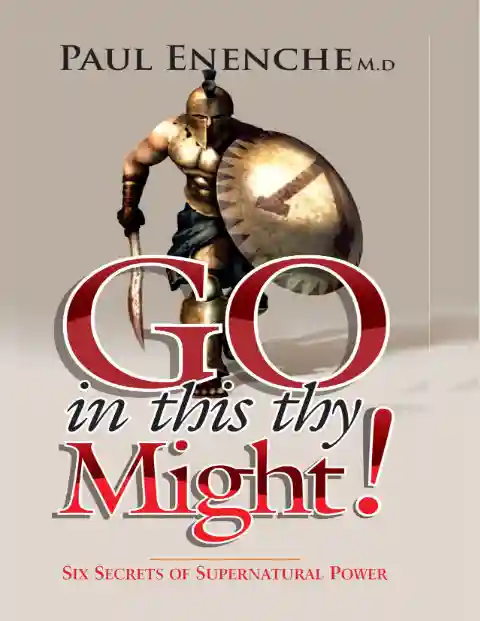
"Go In This Thy Might" by Paul Enenche MD is a motivational book that encourages readers to tap into their inner strength and potential to overcome obstacles and achieve success in life. The book emphasizes the importance of having a positive mindset, faith in oneself, and a strong determination to pursue one's goals and dreams. Through inspirational anecdotes and practical tips, the author inspires readers to unleash their full potential and live a purposeful life.
Eric Liddell
Eric Henry Liddell was born on 16th January 1902 in Tientsin (Tianjin) North China, second son of the Rev. & Mrs. James Dunlop Liddell who were missionaries with the London Mission Society.
He was educated from 1908 to 1920 at Eltham College, Blackheath, school for the sons of missionaries. Eric, with his older brother Rob, were left at their boarding school while their parents and sister, Jenny, returned to China.
During the boysâ time at Eltham College, their parents, sister and new brother Ernest came home on furlough two or three times and were able to be together as a family â mainly living in Edinburgh.
Although born in China and educated in England, Eric Liddell lived in Scotland at various times during his life.
In 1920, Eric joined his brother Rob at Edinburgh University to read for a BSc in Pure Science.
During this period he played rugby for Scotland and trained to run at the Olympics.
Athletics and rugby played a large part in Ericâs University life. He ran in the 100 yards and the 220 yards for Edinburgh University and later for Scotland. He played rugby for Edinburgh University and in 1922 played in seven Scottish Internationals with A.L. Gracie.
Eric Liddell was a gifted rugby player and played for the Edinburgh Univerisity 1st XV team.
He also played international rugby for Scotland and gained seven international caps as a wing-threequarter, scoring four tries thanks to his searing pace.
As a result of having insufficient time for both running and rugby, he chose the former, aiming for the 100 meters in the Paris Olympics. When he learned that the heats were to be run on a Sunday, he switched to the 400 metre competition as he was not prepared to run on a Sunday.
He won a gold medal for the 400 metres and a bronze medal for the 200 metres at the Paris Olympics.
He also travelled briefly to the USA in 1924 to compete in an athletics tournament. He returned to Edinburgh after the Paris Olympics and he graduated from Edinburgh University.
Eric Liddell lived for a short time in Gillespie Crescent before moving to a house in Merchiston Place.
Recollections of Eric Liddell By Sir Arthur Marshall
The Cambridge University Athletics Club had an invitation from Pennsylvania to take a team of seven to the Pennsylvanian Games in March 1924, and I was one of the seven. Eric Liddell, the Scot from Edinburgh University, the 1923 AAA 100 yards Champion, had been personally invited and travelled with us. We stayed at the very comfortable Pennsylvanian Cricket Club. I am afraid none of, including Eric Liddell, managed to win an event at the Pennsylvanian Games.
We travelled back in a small slow ship of the American United Line called âThe Republicâ â a ten day crossing. Eric Liddell entered in the fun and games on the boat, including the Fancy Dress Dance. Whilst he was very strict about religion. Eric and I became good friends and saw much of two American sisters, Freddie and Edith, who were travelling to âdo Europeâ, including the UK. They said they were going to be in Paris for the Olympic Games, and we said if we were there at the same time we hoped we could meet.
Harold Abrahams had set his whole life on winning the Olympic 100 Metres â it had become and obsession with him. Liddellâs achievement in winning the 1923 AAA 100 Yards in the record time of 9 7/10 seconds was a devastating blow to Abrahams and shook him to the core. To date Abrahams had been a consistent 10 seconds 100 yards winner but had only slightly broken 10 seconds on one or two occasions. He knew in the Olympics he would be up against overseas competition, particularly from the Americans, but this new and very serious opposition out of the blue and on his doorstep had come at a time when Harold had established his 100 yards supremacy in the UK. To achieve level pegging with Eric Liddellâs new record time, Harold had to improve his performance by two or three yards with the help of his trainer Sam Mussabini. It must have been a tremendous relief to Harold when it became known early in 1924 that Eric had decided to concentrate on the 400 metres and, because of his religious principles, would not compete in the Olympic 100 metres as first heats were always run on Sunday.
Eric had in turn become completely dedicated to winning an Olympic Medal within the restrictions of his faith. He was a famous Scottish international rugger player, and gave up his rugger to enable him to concentrate on his Olympic ambitions, which became very deep-rooted, and his work suffered. Winning an Olympic Gold Medal became a priority, second only to his religion, and the ambition to win this event became part of his religion.
Recollections of Eric Liddell By Sir Arthur Marshall
The team travelled to Paris days before the Olympics started and had a big send-off at Victoria Station.
The silence at the start of the 100 metres and 400 metres was quite electric. Harold Abrahams won the 100 metres in a new Games record time.
In spite of all that has been said about Abrahamsâ 100 metres, the 400 metres in some way provided the greatest thrill of the meeting with the world record being broken by Eric Liddell three times in two days. It was thought that Liddell had some chance of winning, but nobody thought Liddell capable of the amazing performance he achieved in the final. As far as the crowd were concerned they were well informed about Liddellâs dedication to his religion and his refusal to run in the first round of the 100 metres on the Sunday; they also knew of his determination to win this event. The occasion was enlivened by the support given to Liddell by the pipes and drums of the Cameron Highlanders.
The silence and pent-up excitement at the start of the race could be felt. Liddell went ahead at the start and maintained his pace throughout, finishing in what at the time was described as âa most lion-hearted mannerâ winning by three yards from Fitch, an American. This was probably the greatest achievement of the VIIIth Olympiad, and superlatives were showered on Liddell by the press of the entire world. Liddell was short and not a pretty runner but just pounded along virtually at the same pace all the way, with a finish as if he was making a final dash for a try in a rugger match with an opponent bearing down on him and about to tackle from behind.
After Eric had won the 400 metres Gold Medal, Eric and I made contact with Freddie and Edith, the American sisters, and took them to a Tango Tea Dance in the Champs Elysees.
Footnote: Along with sacrificing his place in the 1924 Olympics 100m, Eric Liddell also gave up two other races in which Great Britain held high hopes of winning gold that year â the 4 x 100m and 4 x 400m, whose finals also took place on a Sunday.
After the Olympics
After the Olympics and his graduation, he returned to North China where he served as a missionary from 1925 to 1943 â first in Tientsin (Tainjin) and later in Siaochang. During his first furlough in 1932 he was ordained as a minister.
1930 - 1932
On furlough from China studying at Congregational College. After completing his studies he was ordained as a minister on 22nd June 1932. During this time he lived in a hostel in George Square which belonged to the Edinburgh Medical Missionary Society.
During these periods Eric Liddell attended Morningside Congregational Church at the corner of Chamberlain Road and Morningside Road.
Morningside Congregational Church
The Church building (pictured here on the right) was originally built for North Morningside United Presbyterian Church who used it until 1881 when it became too small. They then built a new, larger, church on the other side of the road (which is now the Eric Liddell Centre).
From 1881 the old church was home to the Morningside Athenaeum Club before the Congregational Church purchased it in 1890.
In 1928 this church was demolished and a new one erected (which is now Morningside United Church).
Eric Liddell would have attended meetings in both buildings during his two extended stays in Edinburgh. The old church from 1920 to 1925 and the current building (Morningside United Church) from 1930 to 1932. He also preached at the church on a number of occasions.
On his return to China, he married Florence Mackenzie (of Canadian missionary parentage) in Tientsin in 1934. They had three daughters; Patricia, Heather and Maureen, who now all live in Canada.
Living in China in the 1930s was potentially very dangerous and in 1937 Eric was sent to Siaochang where he joined his brother Rob. He was now crossing the Japanese army lines.
In 1941 life in China was becoming so dangerous that the British Government advised British nationals to leave. Florence and the children left for Canada.
During 1941 â 1943 Eric stayed in Tientsin, then in 1943 he was interned in Weishien camp until his death in 1945.
The Eric Liddell Centre
The United Presbyterian Church merged with the Free Church of Scotland in 1900 and then, in 1929, this merged with the Church of Scotland.
The United Presbyterian Church built in 1879 became known as Morningside North parish Church. By 1980 the building was no longer in use and became the Holy Corner Church Centre.
This was an initiative of the three remaining churches at Holy Corner: Morningside United Church (a merger between the Congregational and Church of Scotland congregations and in joint membership of the United Reformed Church and Church of Scotland), Christ Church (Scottish Episcopal Church) and Morningside Baptist Church.
As the project developed the centreâs name was changed to The Eric Liddell Centre in recognition of his involvement in the life of one of the founding churches and the local community during his time living here.
The Year My World Fell Apart
Twenty-five years ago, my world fell apart. I had just turned 39, was happily married with five kids, and served as the associate pastor of a growing two-year-old church plant. My health was good, I enjoyed an active life, and ministry opportunities abounded. Everything looked good from the outside. But on the inside, it was a different story. Starting in January of 1994, fear, hopelessness, depression, detachment, anxiety, and emptiness became my daily companions. All my life, I had taken pride in my ability to think clearly, but suddenly, thoughts began racing through my mind that I couldnât stop. Panic attacks came regularly. I imagined I would be dead within months. And then there were the physical effects. Most days, I found it hard to catch my breath. My arms itched incessantly, and no amount of scratching relieved the sensation. When it didnât seem like a 200-pound weight pressed against my chest, I often felt an eerie hollowness. My face buzzed. I was light-headed. I spent many nights pacing and trying to pray. âThis Doesnât Happen to Pastorsâ Other than the normal pressures of a church planting pastor, there were no obvious reasons why I seemed to be going crazy. In an effort to rule out potential causes, I made an appointment with my doctor for a complete checkup. The results came back. I was âfine.â Nothing had prepared me for what I was going through. My internal accusations that âthis doesnât happen to pastorsâ only made me more frantic. I looked fruitlessly for something that would give me victory over whatever it was I was battling. Scripture. Prayer. Worship music. A retreat. A vacation. Even a trip to Canada during the âToronto blessing.â Nothing helped. Early on, I thought about seeing a counselor, maybe even a psychiatrist. I was aware of occasions when people with hormonal imbalances, an inability to sleep, or traumatic personal histories benefited from medical intervention. I wondered if drugs might help me get back on my feet to deal with what I was experiencing. I also identified with various labels I had read about. Nervous breakdown. Burnout. Anxiety disorder. Depression. Whatever was going on was affecting me emotionally, physically, mentally, and spiritually. The symptoms were too numerous and intense to think this was only a âsinâ problem. But no label I assigned to my condition identified root causes. If what I was experiencing originated in my own heart (as it seemed), I wanted to explore that first. I wanted to press in to the gospel to see what I might be missing. The next two and a half years were the hardest of my life. But knowing what I learned from them, they were, without a doubt, the best years. Many people, most significantly my wife, Julie, were invaluable means of grace during that time. I hope to be a means of grace to you or others you might know who have been through something similar to what Iâve been describing. These are a few of the lessons God taught me during that time. We Might Not Be Hopeless Enough About a year into my dark season, I told my good friend, Gary, that I felt dead inside. Life didnât make sense. I felt completely hopeless. Garyâs response was one Iâll never forget and have passed on to countless people, âI donât think youâre hopeless enough. If you were completely hopeless, youâd stop trusting in what you can do and trust in what Jesus has already done for you on the cross.â Our problem isnât that we have no hope. We just hope in things that arenât God. Our own abilities. A preferred outcome. Our reputation. Financial security. You fill in the blank. And when the idols weâve hoped in donât deliver as promised, we panic. We despair. We lash out. We go numb. Thatâs why the psalmists speak of hoping in the Lord and his word at least twenty-five times, and why David tells us to âhope in the Lord from this time forth and forevermoreâ (Psalm 131:3). Itâs easy and common to hope in something other than God. Blessed Are Those Who Know Their Need For most of my life up until that point, my heart aggressively served the idols of credit and control. Those idols revealed a selfish ambition that desired not only peopleâs approval but their applause, even their adoration. I wanted to receive the praise only God deserves. When I couldnât get everyone to think I was as great as I thought I was, or when I realized the world didnât bow to my desires, my idols punished me: mentally, emotionally, and physically. I thought I was a victim. I thought depression was âcoming on meâ from âout there.â Actually, I was the one producing it, through my own fears, unbelief, and false worship. I was forsaking my only hope of steadfast love (Jonah 2:8). Over time I came to see God was guiding the whole process in order to turn my heart to him. He wanted to wean me from my self-centered idolatry so I could find the greater joy of pursuing his glory instead of mine. Benefits We Donât Think We Need In the first year of my trial, I was often unaffected by normal spiritual disciplines like reading Scripture, gathering with the church on Sundays, and prayer. The promises of the Bible seemed like empty platitudes, meant for those who were doing well. In reality, I didnât see the depths of my need clearly enough. A friend introduced me to John Owenâs Sin and Temptation  and God used it to show me how deceived my heart could be. Rather than wondering why I felt so hopeless and fearful, I started to own those feelings as the effect of functionally seeing myself as my own savior. Apart from Jesus, I was completely hopeless and had every reason to fear. But Jesus died on the cross to save hopeless and fearful people. And I was one of them. That thought process, repeated a thousand times, pointed me again and again to the Savior I needed more than I had ever realized. Feelings Are Unreliable Proofs The Psalms teach us that a relationship with God involves our emotions. Godâs presence brings joy, Godâs promises bring comfort, Godâs provision brings satisfaction (Psalm 16:11; 119:50; 145:16). But I was trying to root my faith in my experiences rather than in Godâs word. I was looking to sustained peace as evidence that the Bible was true, and found myself chasing experiences rather than Jesus. When I was unaffected by the gospel, I began to see that other desires were at work in my heart. Selfish ambition. Self-atonement. Works-righteousness. A love of ease. Feelings tell me something is happening in my soul, but they donât necessarily tell me why I feel (or donât feel) a certain way. We discover that through patiently and consistently trusting and pursuing God (Proverbs 2:1â5). When I insist on finding relief from my emotional distress before I believe God, Iâm living by sight, not by faith. Self-Focus Wonât Ultimately Defeat Self-Sins In March of 1995, I went on a personal retreat. After 24 hours, I determined my problem was that I had been depending too much on my own righteousness and needed to trust in the righteousness of Christ. When I got home, I committed myself to a rigid discipline of Scripture memorization. Julie told me I came back more bound up than when I had left. One reason my dark season lasted so long was my belief that both the problem and solution ended in me. It was my lack of faith, my legalism, my poor choices. I needed to memorize more Scripture, do more, do less, do nothing, do everything. Over time, God graciously showed me that putting sin to death involves me but doesnât depend on me. Godâs grace comes to humble, needy people, never to those who think they deserve or can earn it. Robert Murray MâCheyneâs counsel is still wise: âFor every look at self, take ten looks at Christ!â His perfect life, substitutionary sacrifice, and glorious resurrection are a never-ending stream of delight, hope, and transformation (2 Corinthians 3:18). Take Every Temptation to Christ Maturity isnât freedom from temptation, but responding to temptation more often with what God has said and done for us in Christ. I often thought I was backsliding when the temptations of anxiety, fear, hopelessness, and depression reappeared (or even increased). In those moments, I was tempted to think what I had been doing and believing âdidnât work.â But John Owen observed, âYour state is not at all to be measured by the opposition that sin makes to you, but by the opposition you make to it.â In my discouragement, I was tempted to run to something other than Godâs word and the gospel as my refuge. I started to doubt that hearing the Bible preached on Sundays could do any good. But Godâs promises remain true no matter how many times we forget or neglect them. Jesus will always be the only Savior who died for my sins to bear my punishment and reconcile me to God (1 Peter 3:18). In him I am truly forgiven, justified, adopted, and eternally secure in Godâs love and care. As I continued to confess my inadequacy with phrases like, âYou are God, and I am not,â I saw more clearly how God alone will always be my rock, steadfast love, fortress, stronghold, deliverer, and refuge (Psalm 144:1â2). Traveling Through the Valley The lessons I learned during those years have shaped my walk with God to this day. I still battle many of the same sins I fought twenty-five years ago, but I fight with greater clarity and trust in the one who has won the war. Temptations are less frequent and less intense. Iâve been able to point others who have been going through similar seasons to the life-transforming hope we have in the gospel. Removing difficulties, problems, and trials isnât the only way God shows he is good. Instead of superficial solutions, Jesus actually delivers us from our false hopes of ultimate salvation, satisfaction, and comfort. We want relief from the pain â God wants to make us like his Son. We want a change in our circumstances â God wants a change in our hearts. A crucified and risen Savior proves once and for all heâs actually able to bring that change about. Iâve learned that the goal of the battle against emotional turmoil isnât simply emotional peace. The goal is to know Christ. That realization led me to pray at one point, âIf being like this for the rest of my life means that I will know you better, then leave me like this.â Thankfully, God didnât leave me like I was. He gave me a deeper trust in the care of my heavenly Father, a more passionate love for Jesus and the gospel, and a greater awareness of his Spiritâs presence. I know better now what Paul meant when he said, âTo live is Christ, and to die is gainâ (Philippians 1:21). Which is why I thank God that, in his abundant mercy, he caused my world to fall apart twenty-five years ago.