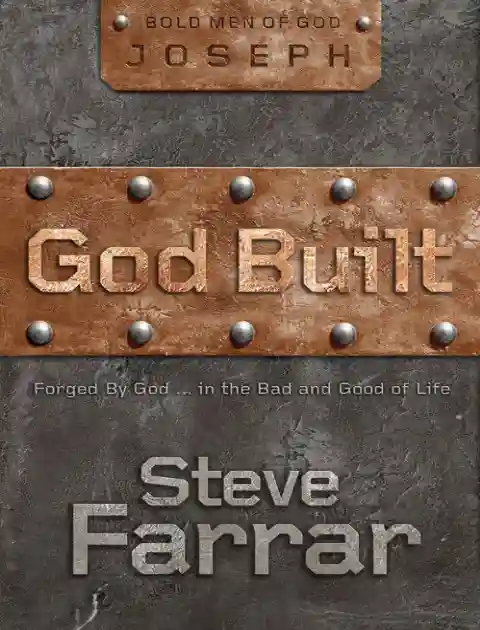

God Built - Forged By God In The Bad And Good Of Life Order Printed Copy
- Author: Steve Farrar
- Size: 1.39MB | 401 pages
- |
Others like god built - forged by god in the bad and good of life Features >>
A Quest For Godliness

The Force Of Integrity

Longing For Godliness - Restoring God’s Image Within Us

Lost And Found - Finding Hope In The Detours Of Life
God Cannot Lie: A Study On The Infallible Integrity Of Gods Word And The Importance Of Knowing The Word
Basic Elements Of The Christian Life Vol II
Our Good Crisis - Overcoming Moral Chaos With The Beatitudes
Spirit, Soul & Body

Loyalty And Disloyalty

Mantled For Greatness
About the Book
"God Built" by Steve Farrar is a motivational book that explores the idea of enduring and growing from life's challenges and struggles. Through biblical examples and personal anecdotes, Farrar emphasizes the importance of faith, perseverance, and reliance on God's strength to overcome obstacles and become the person He intends us to be. The book encourages readers to view their difficulties as opportunities for personal growth and spiritual development.
Manny Mill

The Power of a Praying Mother
If you follow the greatest men of God back to their beginnings, you will often find yourself in a hidden closet or lonely pew, where a mother kneels to pray. Look behind Augustine, and you will find Monica. Look behind Spurgeon, and you will find Eliza. Look behind Hudson Taylor, and you will find Amelia. And look at each of these mothers, and you will find earnest prayer. Those who know their Bibles should hardly be surprised. Like the star the wise men saw, the stories of God’s redemptive movements often lead us to a home where a woman, hidden from the great ones of the earth, caresses a heel that will one day crush a serpent. In the prayers of a mother, awakenings are born and peoples won, idols are toppled and devils undone, dry bones are raised and prodigals rescued. Again and again, before God laid his hand on a man, he laid it on his mother. Mother of the Kingdom “The dawn of the great new movements of God repeatedly occurs in women’s spaces,” Alastair Roberts writes. The word repeatedly is right. Over and again, redemptive history turns on a flawed but faithful mother bearing a son: Sarah and Isaac, Rebekah and Jacob, Rachel and Joseph, Ruth and Obed, Elizabeth and John, Eunice and Timothy — and, of course, Mary and Jesus. Among all these stories, however, one in particular illustrates the power of a praying mother. The books of 1 and 2 Samuel tell the story of how God turned Israel into a kingdom — how he sought “a man after his own heart” (1 Samuel 13:14) to sit on the throne and begin a royal line that one day would run to Jesus (2 Samuel 7:13–14). But where does this story of a king and a kingdom begin? With one infertile woman, pleading for a son. [Elkanah] had two wives. The name of the one was Hannah, and the name of the other, Peninnah. And Peninnah had children, but Hannah had no children. (1 Samuel 1:2) “If you follow the greatest men of God back to their beginnings, you will often find a mother kneeling to pray.” A barren woman and a fruitful rival: we’ve been here before (Genesis 16:1–6; 30:1–8). The stage is set for God to make a name for himself through a miraculous birth. And prayer will be his appointed means. Hannah’s Prayer Like Hagar before her, Peninnah can’t help pointing the finger at Hannah’s empty womb: “[Hannah’s] rival used to provoke her grievously to irritate her, because the Lord had closed her womb. So it went on year by year” (1 Samuel 1:6–7). But unlike Sarah before her, Hannah turns to God instead of turning against Peninnah. Listen to the simple prayer of a suffering woman, longing for an open womb: O Lord of hosts, if you will indeed look on the affliction of your servant and remember me and not forget your servant, but will give to your servant a son, then I will give him to the Lord all the days of his life, and no razor shall touch his head. (1 Samuel 1:11) We know the rest of the story. The Lord would hear Hannah and give her a son. And her son, Samuel, would establish Israel’s kingdom (1 Samuel 16:10–13), inaugurate the nation’s prophetic line (Acts 3:24; 13:20), and gain a standing beside Moses as a mediator of God’s people (Jeremiah 15:1). Through prayer, Hannah’s once-barren womb bore a son to rescue Israel. What might mothers learn from Hannah’s prayer today? 1. Anguish can be a good teacher. Years of infertility, joined with Peninnah’s mockery, had finally broken the dam of Hannah’s sorrow. The pain of hope deferred flooded her heart, and the flood could not be hidden. “Hannah wept and would not eat. . . . She was deeply distressed” (1 Samuel 1:7, 10). Yet, as so often happens, Hannah’s tears became a trail that led her to her knees. “After they had eaten and drunk in Shiloh, Hannah rose . . . and prayed to the Lord and wept bitterly” (1 Samuel 1:9–10). We don’t know what Hannah’s prayer life was like before this moment. But here, at least, anguish became her best teacher. In a world as broken as ours, anguish hems a mother in, behind and before. Some, like Hannah, feel the peculiar agony of wished-for motherhood. Others, the pain of pregnancy and childbirth itself. And still others, the sorrow of a child who has not yet been born again. What Augustine once said of his mother holds true for many: She wept and wailed, and these cries of pain revealed what there was left of Eve in her, as in anguish she sought the son whom in anguish she had brought to birth. (Confessions, 5.8.15) “Anguish often leads a mother to a prayer God longs to answer.” Anguish, we know, may tempt a mother toward bitterness, as it did both Sarah and Rachel for a time (Genesis 16:5–6; 30:1). But here, Hannah reveals a surprising truth: anguish often leads a mother to a prayer God longs to answer. 2. God delights in open hands. Two words in Hannah’s prayer rise to the surface through repetition: Lord (twice) and its counterpart, servant (three times). In her anguish, she does not forget that God is her Lord, high and wise above her, nor that she is his servant, bound to do his will. The famous words of Mary over a millennium later — “Behold, I am the servant of the Lord” (Luke 1:38) — are an echo of Hannah’s. Hannah’s open hands also appear in her remarkable vow: “If you will . . . give to your servant a son, then I will give him to the Lord all the days of his life, and no razor shall touch his head” (1 Samuel 1:11). Her promise not to cut her son’s hair refers to the Nazirite vow, by which a person’s life was devoted entirely to God (Numbers 6:1–5). Hannah says, in others words, “Give me a son, and I will give him back to you — heart and soul, body and mind, all the days of his life.” In response, God gives her a son to return to God. We should hesitate, of course, before drawing a straight line between a mother’s heart and how God answers her prayers. Some mothers pray with Hannah-like surrender, and still their wombs stay empty, or their children keep walking to the far country. Hannah’s story does teach us, however, that God loves to put gifts in open hands. He delights when a mother, welling up with maternal affection, wells up still more with desire for Christ and his kingdom. In Hannah’s case, her openhanded motherhood allowed Samuel to spend his days at the temple, where, the narrator tells us, “he worshiped the Lord” (1 Samuel 1:28). May God be pleased to do the same for many mothers’ sons. 3. A mother’s prayers can shake the world. The anguished prayer of 1 Samuel 1:11 is not the only prayer we hear from Hannah. When she brings her freshly weaned son to the temple, she prays again, this time soaring with praise (1 Samuel 2:1–10). And as we listen, we quickly realize that the story of Hannah and Samuel reaches far beyond the four walls of a happy home. Consider just her final words, which offer a fitting ending to a massive prayer: The adversaries of the Lord shall be broken to pieces; against them he will thunder in heaven. The Lord will judge the ends of the earth; he will give strength to his king and exalt the power of his anointed. (1 Samuel 2:10) Hannah, carried along by the Spirit, finds herself caught up in something far greater than her own domestic hopes: under God, her son would deliver Israel from its oppressors and establish a kingdom that one day would cover the earth. Hannah had simply prayed for a son — but in return, God answered far bigger than she asked. And so he still does. Eliza Spurgeon and Amelia Taylor prayed for saved sons, scarcely imagining that God would give a preacher to the masses and a missionary to the nations. And though not every son is a Samuel, or a Spurgeon, or a Taylor, who knows what lovers of orphans, or pastors of churches, or seekers of justice, or fathers of lost ones God is right now raising up through a faithful mother on her knees? With a God like ours, we can dare to dream — and pray. Mother for Every Mother The weeping, anxious Hannah of 1 Samuel 1 is not a woman out of a mother’s reach. She was not a well-known woman. She was not a put-together woman. So far as we know, she was not a particularly strong woman. But she was a praying woman. And through her prayers, God showed his great power. The God who crushed the serpent’s head by the woman’s offspring has more victories to win. Jesus dealt the deathblow, the blow no other son could give. But more of the devil’s kingdom needs crushing. And if we look behind the men who lift their heels, we will often find a mother like Hannah: anguished yet openhanded, praying for her boy. Article by Scott Hubbard