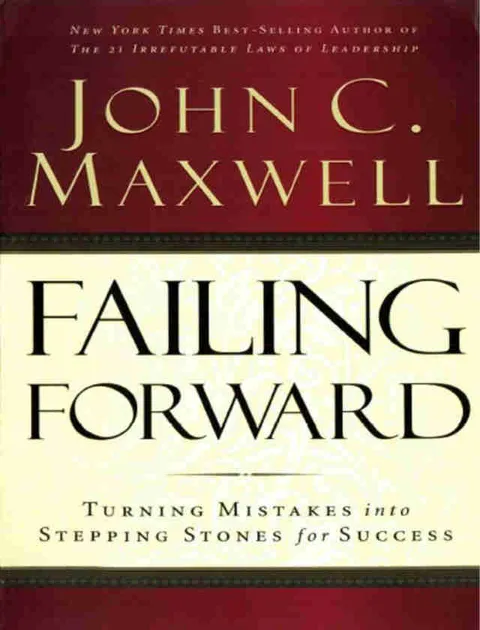

Others like failing forward Features >>










About the Book
"Failing Forward" by John Maxwell discusses the importance of viewing failure as a learning opportunity and stepping stone to success. The book explores how individuals can develop a resilient mindset, embrace their mistakes, and grow from setbacks to ultimately achieve their goals. Maxwell offers practical advice and strategies for turning failures into valuable experiences and using them to propel personal and professional growth.
Johnny Cash

Who Might Find God in Your Suffering
Do you feel prepared today to defend your faith in Jesus? If not, what would it take for you to feel ready? Have no fear of them, nor be troubled, but in your hearts honor Christ the Lord as holy, always being prepared to make a defense to anyone who asks you for a reason for the hope that is in you. (1 Peter 3:14–15) These verses are often quoted in conversations about evangelistic and apologetic strategies: Be prepared to make a defense. Meaning, study up on arguments against the Christian faith, anticipate the hardest questions someone might ask, and prepare convincing answers. However, while it is good and loving to carefully think through objections to Christianity, that is not the primary focus or emphasis of this charge. Peter is not encouraging merely a more informed faith, but a more sincere faith — a more fearful, joyful, and active faith. “Have no fear of them, nor be troubled,” he says, “but in your hearts honor Christ the Lord as holy, always being prepared to make a defense to anyone who asks you for a reason for the hope that is in you.” This kind of defense is not captured in apologetics books, but in our hearts. It’s not merely a matter of reading and thinking more (though both are essential), but of fearing, loving, and enjoying more. The best way to be prepared to defend your hope in Jesus is not to learn new, sophisticated arguments, but to honor Jesus as much as possible with what you already know. The best apologetic for Christianity is the real transformation already happening in you. Honor Christ as Holy Do you want to be prepared to make a defense for your hope? Pray then like this: “Our Father in heaven, hallowed be your name” (Matthew 6:9). Not just in my neighborhood, or city, or nation, but first and most deeply in me. Lord, make my heart a deep and vibrant reflection of your worth. Help me honor you as holy. “Peter is not encouraging merely a more informed faith, but a more sincere faith.” When it comes to witnessing, some of us might spend too much time worrying about intellectual answers to philosophical questions, rather than meditating on the holiness, the glorious otherness, of God. We may not mainly need to read more but to sit longer beneath the galaxies of what we know of him. We need to linger along the streams of his mercy. We need to sit near the window and listen to the thunder of his justice. We need to hike higher up the mountains of his authority and power. We need to wade a little farther out into the depths of his wisdom. For some, our hearts do not need to be piled high with information to be inflamed with the holiness of God but to take more seriously what we know and ask him to light it on fire. And as his holiness burns hotter within us, his light will shine brighter and brighter through us. Our passion and devotion will testify that he made and rules over all; that he loves and redeems sinners; that he satisfies the aches and longings we each carry; that he can be trusted, even through suffering; that he’s returning to make all things new. And as his holiness rises in our hearts, holiness increasingly invades our lives — how we speak and act and love (1 Peter 1:15–16; 2 Corinthians 3:18). Those who honor Christ as holy in their hearts cannot help but witness to him. Their lives and conversations are filled with evidence of sovereign love. Why Would Anyone Ask? But even if we honor Christ as holy in our hearts, even if we feel ready to give a defense for the hope within us, what would make someone ask (1 Peter 3:15)? When Peter wrote to these believers scattered across several regions (1 Peter 1:1), they were not safe believers sheltered in secure churches protected by tolerant governments. These Christians were following Jesus into the growing fires of hostility. They were challenging their culture’s favorite sins, claiming a Lord higher than the emperor, and choosing him over friends, parents, and even spouses, believing Jesus when he said they would receive a hundredfold (Matthew 19:29). And in the weeks and months that followed, they inherited not peace and comfort, but insults and slander (1 Peter 3:9; 4:4). And that suffering became a stunning platform for their hope. Why did anyone ask about their hope? Because they had hope when few others would — when they were treated unfairly. Because they did not fear what man said or did to them. Because trouble did not seem to trouble them anymore (1 Peter 3:14). They should have been anxious, but they weren’t. They should have been defensive, but they weren’t. They should have been bitter, but they weren’t. Their hope was surprising, confusing, odd. Odd enough to pique a neighbor’s curiosity. And when a neighbor’s curiosity compelled them to ask, they were met with surprising “gentleness and respect” (1 Peter 3:15). How these believers shared about Jesus proved their hope as much as anything they said about him. They spoke truth to cruelty with kindness. They received shame and yet held out dignity. They had the spiritual strength, by grace, both to endure abuse and to remain gentle. Do Not Be Surprised What might all of that mean, though, for Christians in less hostile times and places? If we don’t suffer like they did, should we expect anyone to ask about our hope? Well, we shouldn’t assume we won’t suffer like they did. Faithful followers of Jesus in Western societies either already have, or soon will, experience greater opposition to our faith — in our families, our workplaces, our neighborhoods, our social media feeds. In other words, we are likely about to experience (apart from revival) what the vast majority of faithful followers of Jesus in history have experienced. As John Piper observes, The church in America is slowly awakening from the distortion of 350 years of dominance and prosperity. Until recently, being a Christian in America has been viewed as normal, good, patriotic, culturally acceptable, even beneficial. (“Navigating Trials in the New America”) Christians have always been strangers and aliens in America, but some of us are finally beginning to feel just how foreign we are here. So, “do not be surprised at the fiery trial when it comes upon you to test you, as though something strange were happening to you” (1 Peter 4:12). They Will Malign Us Also, the fiery trials in Peter’s letters actually may be surprisingly similar to what we can increasingly expect today. While the persecution he was speaking into was pointed and intense, it seems to have been social and verbal, not physical: “They malign you” could be a good summary (1 Peter 4:4; see also 4:14). And the world will malign us for what we believe about Jesus, about abortion, about homosexuality, about race, about hell. In most places in America today, if everyone in our lives knew what we really believe, many would hate what we believe. And they may hate us — whether loudly or quietly, whether to our faces or to a coworker — for what we believe. The apostle Paul warns, “All who desire to live a godly life in Christ Jesus will be persecuted” (2 Timothy 3:12). Those of us who have not been persecuted in some way ought to begin asking some hard questions about all of the acceptance and approval we enjoy. Jesus said, “Woe to you, when all people speak well of you” (Luke 6:26). So do they? Does the warm admiration of a world that hates God alarm us? When You Suffer Even apart from potential social or political hostility, though, every follower of Christ still suffers in various ways. “The best apologetic for Christianity is the real transformation already happening in you.” James 1:2 says, “Count it all joy, my brothers, when you meet trials of various kinds” — not if, but when. Peter says that these trials are necessary “so that the tested genuineness of your faith — more precious than gold that perishes though it is tested by fire — may be found to result in praise and glory and honor at the revelation of Jesus Christ” (1 Peter 1:7). For any Christian in any society during any century, the question is not if we will suffer, but when we will suffer. And more importantly, will how we suffer call attention to our hope in Jesus — or call it into question? Whether our suffering is large or small, whether we endure persecution or infection or some other affliction, our pain exposes the world to our hope. Where do we look when life inevitably gets hard? What do we cling to when all else fails? Can the Christ we proclaim really bear the awful weight of our fears, anxieties, insecurities, and sins? He can, and he does, and he will. So honor him as holy, especially when suffering comes, and be ready to tell whoever might ask why you still have hope. Article by Marshall Segal Staff writer, desiringGod.org