
Others like failing forward Features >>
About the Book
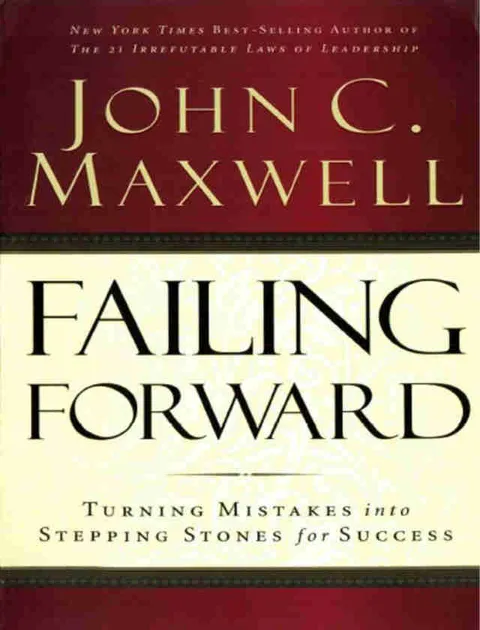
"Failing Forward" by John Maxwell discusses the importance of viewing failure as a learning opportunity and stepping stone to success. The book explores how individuals can develop a resilient mindset, embrace their mistakes, and grow from setbacks to ultimately achieve their goals. Maxwell offers practical advice and strategies for turning failures into valuable experiences and using them to propel personal and professional growth.
Isaac Watts

my wedding was supposed to be today
I made a life plan when I was ten years old (yeah, I know, crazy). It included all the normal things: graduate high school, go to college, travel the world. With regard to romance, though, I always assumed I would get married at 23, because “Why not?” and “Surely I’ll have met somebody by then.” So, in my late teens, I arbitrarily picked a date (today, April 22, 2017) as my likely wedding day because (a) it’s a few months before my 24th birthday and (b) I’ve always wanted a spring wedding. I added details about kids and jobs and travel along the way, but my plan has remained mostly unchanged. Pretty straightforward, right? Except the God I serve isn’t always a straightforward God. He is straightforward in what he wants from me: to act justly, love kindness, and to walk humbly with him (Micah 6:8), and to set nothing above him in my heart, mind, or soul (Deuteronomy 6:5). But what about beyond that? What about my wedding day? “I have had to learn to battle the temptations that creep into unwanted waiting and unwanted singleness.” Much to the woe of my control-desiring heart, he leaves much of it a surprise and mystery. To those who do not know him or trust him, the way he makes us wait may seem like stinginess or even evil. But in truth, he wants something better for us: for our trust and joy in him to flourish. As a planner, I must learn to live day-by-day by faith, not by sight, knowing that whatever he gives me is truly, deeply good for me (Romans 8:28). No matter how much his plans diverge from mine, no matter how much heartbreak those plans bring, no matter how far out of my comfort zone he pushes or pulls me, he is not only ultimately good, but his plans for me are also always better. Three Ways to Wait So, here on my “wedding day,” I’ve been single for several years now, including all of my five years as a Christian. I wasn’t asked out on a single date during college (and haven’t been since), so I have had to learn to battle the temptations that creep into unwanted waiting and unwanted singleness. Here are three lessons I have picked up in the fight. 1. Trust God to give you every good gift at the perfect time. While we wait, we will be tempted to doubt God’s love and ability. We are talking about the Lord who has built and leveled the nations throughout generations. He is the Lord who flooded the whole earth and held back the Red Sea long enough for his people to walk through on dry ground. Surely this great Lord of history can handle a small thing like the date of my wedding. And that’s what a wedding is: one day of millions of days. Not to say it isn’t important, but it also isn’t anywhere near ultimate. “My purity is not for me. My wedding is not for me. Marriage will not be for me. It is all for God.” Marriage is a gift. A gift isn’t earned or bargained for, and neither is a spouse. Pursuing maturity in Christ should be a consistent theme in any believer’s life, but never as currency to spend on something else. We pursue Christ not to “earn” a spouse, but in order to know Christ (Philippians 3:10). The gift isn’t given because the gift-receiver is fit enough, or tall enough, or smart enough. It is freely given because the gift-Giver is good. You cannot “earn” your way or “behave” your way to a spouse. God must give him or her to you in his own way, and at his time. 2. Make God the treasure and anchor of your life. While we wait, we will be tempted to envy others. There are many people getting married today that are not following the Lord and have (sometimes flagrantly) disobeyed him in the process. Regardless, if Jesus is our greatest treasure, we do not obey in order to gain a husband or a wife, and we do not groan under the perceived unfairness of unrepentant people getting married. My purity is not for me. My wedding is not for me. Marriage (if it happens for me) will not be for me. All these things are for the Lord and for his glory, not for me so that my life turns out “fairly.” Instead of praying for fairness in this life, we pray with Jesus, “Not my will, but yours, be done” (Luke 22:42). I pray that all couples getting married today would know my Lord and Savior, but many won’t. They will not have my anchor and firm foundation when life and marriage are hard (and they will be). What is there to envy? If single people lived so assured of God’s love that we were secure and satisfied in the absence of a spouse, perhaps the Lord would use us to witness to married men and women whose marriages have disappointed them or fallen apart. 3. Refuse to settle for someone who does not love Jesus. While we wait, we will be tempted to settle. We should not draw comfort from the assurance that God has someone for each of us to marry. He may not. Even if he doesn’t, or even if that person comes into our lives ten years late (by our schedule), that does not give us the right to rebel, disobey, or run away. None of us is entitled to marriage. I am not entitled to marriage. “Our romantic lives should look strange to the world, and so should our joy in singleness.” Our only constraint in seeking a spouse is to marry someone within the body of believers (2 Corinthians 6:14). It’s a simple guideline, and yet so easy to compromise. But if we’re to have marriages that glorify the eternal God at all, we cannot fall into the trap of setting aside faith, and basing our crushes and choices on temporal qualities like physical appearance or material wealth. I say “trap” because that’s what a spouse not centered on Christ will undoubtedly become. Recall what happened to Solomon, touted the wisest man in history: For when Solomon was old his wives turned away his heart after other gods, and his heart was not wholly true to the Lord his God, as was the heart of David his father. For Solomon went after Ashtoreth the goddess of the Sidonians, and after Milcom the abomination of the Ammonites. So Solomon did what was evil in the sight of the Lord and did not wholly follow the Lord, as David his father had done. (1 Kings 11:4–6) Heartbreakingly, this lust-following idol-worshiper is the same man who, in his youth, “loved the Lord, walking in the statutes of David his father” (1 Kings 3:3). The difference a few decades and poor choices in romance can make, right? A man to whom God gave wisdom, and whose future in loving and serving the Lord started out as promising as his father David’s, ends up unabashedly worshiping abominations — gods that cannot see or hear, let alone give wisdom or deserve worship. Many of those wives were probably pretty physically attractive (he was a king, after all), but they helped turn his heart into something ugly and steer his path away from the Lord. Rather than chafe at our only restriction in romance, followers of Christ should rejoice in the blessing of not being enslaved in the search for financial security or good looks or athletic ability. Our romantic lives should look strange to the world, and so should our joy in singleness. The Spirit empowers us to be countercultural lights pointing forward to our one true Bridegroom and our one true wedding day (Revelation 19:7).