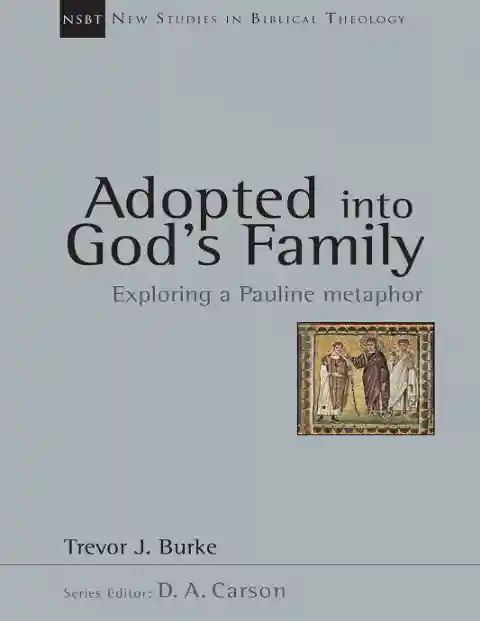

Adopted Into God’s Family - Exploring A Pauline Metaphor Order Printed Copy
- Author: Trevor J. Burke
- Size: 2.26MB | 289 pages
- |
Others like adopted into god’s family - exploring a pauline metaphor Features >>
%20_Ellen%20G%20White-160.webp)





About the Book
"Adopted Into God’s Family" by Trevor J. Burke explores the metaphor of adoption in the writings of the apostle Paul. The book delves into the theological and practical implications of being adopted into God's family, highlighting the believers' privileged status and intimate relationship with God. Burke offers insights into the significance of adoption in Pauline theology and how it shapes the believer's identity and mission in the world.
Charles Hodge

Complete Assurance for Incomplete People
By a single offering he has perfected for all time those who are being sanctified. (Hebrews 10:14) Two things here are mightily encouraging for us in our imperfect condition as saved sinners. First, notice that Christ has perfected his people, and it is already complete. “By a single offering he has perfected for all time those who are being sanctified.” He has done it. And he has done it for all time. The perfecting of his people is complete, and it is complete forever. Does this mean that Christians don’t sin? Don’t get sick? Don’t make mathematical errors in school? That we are already perfect in our behavior and attitudes? There is one clear reason in this very verse for knowing that is not the case. What is it? It’s the last phrase. Who are the people that have been perfected for all time? It is those who “are being sanctified.” The ongoing continuous action of the Greek present tense is important. “Those who are being sanctified” are not yet fully sanctified in the sense of committing no more sin. Otherwise, they would not need to go on being sanctified. In What Way Are We Perfect? So here we have the shocking combination: the very people who “have been perfected” are the ones who “are being sanctified.” We can also think back to chapters 5 and 6 to recall that these Christians are anything but perfect. For example, in Hebrews 5:11 he says, “You have become dull of hearing.” So we may safely say that “perfected” in Hebrews 10:14 does not mean that we are sinlessly perfect in this life. Well, what does it mean? The answer is given in the next verses (Hebrews 10:15–18). The writer explains what he means by quoting Jeremiah on the new covenant — namely, that in the new covenant, which Christ has sealed by his blood, there is total forgiveness for all our sins. Hebrews 10:17–18: “I will remember their sins and their lawless deeds no more. Where there is forgiveness of these, there is no longer any offering for sin.” So he explains the present perfection in terms (at least) of forgiveness. Christ’s people are perfected now in the sense that God puts away all our sins (Hebrews 9:26), forgives them, and never brings them to mind again as a ground of condemnation. In this sense, we stand before him perfected. When he looks on us, he does not impute any of our sins to us — past, present, or future. He does not count our sins against us. Finding Assurance in Perfection Now notice, second, for whom Christ has done this perfecting work on the cross. Hebrews 10:14 tells us plainly: “By one offering He has perfected for all time those who are being sanctified.” You can put it provocatively like this: Christ has perfected once and for all those who are being perfected. Or you could say, Christ has fully sanctified those who are now being sanctified — which the writer does, in fact, say in Hebrews 10:10: “By that will we have been sanctified through the offering of the body of Jesus Christ once for all.” Thus, verse 10 says we “have been sanctified,” and verse 14 says we “are being sanctified.” What this means is that you can know that you stand perfect in the eyes of your heavenly Father, if you are moving away from your present imperfection toward more and more holiness by faith in his future grace. Let me say that again, because it is full of encouragement for imperfect sinners like us, and full of motivation for holiness. Hebrews 10:14 means that you can have assurance that you stand perfected and completed in the eyes of your heavenly Father, not because you are perfect now, but precisely because you are not perfect now but are “being sanctified” — “being made holy.” You may have assurance of your perfect standing with God because by faith in God’s promises, you are moving away from your lingering imperfections toward more and more holiness. Our remaining imperfection is not a sign of our disqualification, but a mark of all whom God “has perfected for all time” — if we are in the process of “being changed” (2 Corinthians 3:18). So take heart. Fix your eyes on the once-for-all, perfecting work of Christ. And set your face against all known sin. Article by John Piper