

GIP Library icon

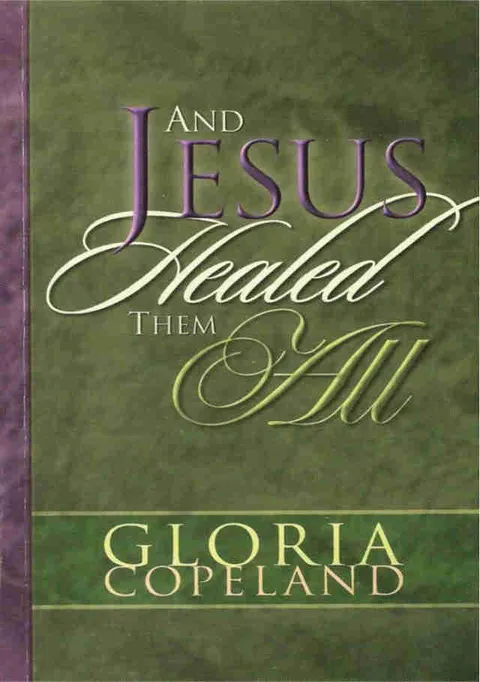
And Jesus Healed Them All And Jesus Healed Them All

And Jesus Healed Them All Order Printed Copy

  • Author: Gloria Copeland
  • Size: 514KB | 56 pages
  • |
Continue with
Google Twitter
LOG IN TO REVIEW
About the Book


"And Jesus Healed Them All" by Gloria Copeland explores the healing power of Jesus as described in the Bible. The book delves into the stories of various individuals who were healed by Jesus, emphasizing the importance of faith and belief in receiving healing miracles. Copeland also offers practical guidance on how readers can experience healing in their own lives through prayer and faith in God.

John Bunyan

John Bunyan "I saw a man clothed with rags … a book in his hand and a great burden upon his back." Successful English writers were, in John Bunyan's day, nearly synonymous with wealth. Men like Richard Baxter and John Milton could afford to write because they didn't need to earn a living. But Bunyan, a traveling tinker like his father, was nearly penniless before becoming England's most famous author. His wife was also destitute, bringing only two Puritan books as a dowry. "We came together as poor as poor might be," Bunyan wrote, "not having so much household-stuff as a dish or spoon betwixt us both." What allowed Bunyan to become the bestselling author of one of the most beloved books in the English language was when things actually got worse: an imprisonment of 12 years. Early temptations >Born in Elstow, Bedfordshire, Bunyan married at age 21. Those books his wife brought to the marriage began a process of conversion. Gradually, he gave up recreations like dancing, bell ringing, and sports; he began attending church and fought off temptations. "One morning as I did lie in bed," he wrote in his autobiography, "I was, as at other times, most fiercely assaulted with this temptation, to sell and part with Christ; the wicked suggestion still running in my mind, Sell him, sell him, sell him, sell him, sell him, as fast as a man could speak." Bunyan was drawn to the Christian fellowship he saw among "three or four poor women sitting at a door ... talking abut the things of God." He was also befriended by John Gifford, minister at a Separatist church in Bedford. The tinker joined the church and within four years was drawing crowds "from all parts" as a lay minister. "I went myself in chains to preach to them in chains," he said, "and carried that fire in my own conscience that I persuaded them to beware of." Prison: a mixed blessing >Bunyan's rise as a popular preacher coincided with the Restoration of Charles II. The freedom of worship Separatists had enjoyed for 20 years was quickly ended; those not conforming with the Church of England would be arrested. By January 1661, Bunyan sat imprisoned in the county jail. The worst punishment, for Bunyan, was being separated from his second wife (his first had died in 1658) and four children. "The parting ... hath oft been to me in this place as the pulling the flesh from my bones," he wrote. He tried to support his family making "many hundred gross of long tagg'd [shoe] laces" while imprisoned, but he mainly depended on "the charity of good people" for their well-being. Bunyan could have freed himself by promising not to preach but refused. He told local magistrates he would rather remain in prison until moss grew on his eyelids than fail to do what God commanded. Still, the imprisonment wasn't as bad as some have imagined. He was permitted visitors, spent some nights at home, and even traveled once to London. The jailer allowed him occasionally to preach to "unlawful assemblies" gathered in secret. More importantly, the imprisonment gave him the incentive and opportunity to write. He penned at least nine books between 1660 and 1672 (he wrote three others—two against Quakers and the other an expository work—before his arrest). Profitable Mediations, Christian Behavior (a manual on good relationships), and The Holy City (an interpretation of Revelation) were followed by Grace Abounding to the Chief of Sinners, considered the greatest Puritan autobiography. But from 1667 to 1672, Bunyan probably spent most of his time on his greatest legacy, The Pilgrim's Progress. Pilgrim's success >Charles II eventually relented in 1672, issuing the Declaration of Indulgence. Bunyan was freed, licensed as a Congregational minister, and called to be pastor of the Bedford church. When persecution was renewed, Bunyan was again imprisoned for six months. After his second release, Pilgrim's Progress was published. "I saw a man clothed with rags ... a book in his hand and a great burden upon his back." So begins the allegorical tale that describes Bunyan's own conversion process. Pilgrim, like Bunyan, is a tinker. He wanders from the City of Destruction to the Celestial City, a pilgrimage made difficult by the burden of sin (an anvil on his back), the Slough of Despond, Vanity Fair, and other such allegorical waystations. The book was instantly popular with every social class. His first editor, Charles Doe, noted that 100,000 copies were already in print by 1692. Samuel Taylor Coleridge called it, "the best Summa Theologicae Evangelicae ever produced by a writer not miraculously inspired." Every English household that owned a Bible also owned the famous allegory. Eventually, it became the bestselling book (apart from the Bible) in publishing history. The book brought Bunyan great fame, and though he continued to pastor the Bedford church, he also regularly preached in London. He continued to write. The Life and Death of Mr. Badman (1680) has been called the first English novel (since it is less of an allegory than Pilgrim's Progress), and was followed by another allegory, The Holy War. He also published several doctrinal and controversial works, a book of verse, and a children's book. By age 59 Bunyan was one of England's most famous writers. He carried out his pastoring duties and was nicknamed "Bishop Bunyan." In August 1688, he rode through heavy rain to reconcile a father and son, became ill, and died.

tweeted to and fro - surviving a distracted and divided age

“We live in a divided age” is so self-evidently true that it’s frankly boring to write. Theories abound on how we got here; what’s undisputed is that we’re here. It sure can feel as if the temperature of virtually every conversation and debate, however trivial, is set to  blazing hot . And worst of all, the previous paragraph doesn’t just describe the world — it describes many churches. Rather than shining as a contrast to the perpetual outrage machine, many of us are too busy being conformed to the pattern of this age (Romans 12:2). How, then, can believers forge meaningful unity in a fractured time? It is looking unlikely that we’re going to tweet our way out of the problem. So what’s the path forward? Whiplash World As author Yuval Levin has observed in  A Time to Build , the function of institutions in modern life has largely shifted from  formative  to  performative  — from habitats for growth to platforms for self-expression. Enter a secular university, for example, and you may well emerge more coddled than shaped. But this performative dynamic isn’t confined to colleges; it also infects local churches. Long past are the days when American churchgoers looked to their pastors  first  (or perhaps even second or third) for help navigating a fraught cultural landscape. Nowadays it’s pundits — whether on cable news or talk radio or social media — whose voices are most formative. On one level, this is understandable. Pastors are not omnicompetent. They aren’t experts on everything, or even most things. Thus when it comes to current events, Christians should (in one sense) expect less from their pastors. Nevertheless, the larger trend is troubling. When church becomes just another arena in which to perform — whether via a “leadership position” or simply by keeping up appearances — rather than a family in which to be shaped, it has ceased to occupy the gravitational center of one’s life. No wonder priorities spin out of orbit. No wonder people demand that their pastors affirm, and publicly echo, their settled opinions on debatable matters. I’ve heard countless stories of someone leaving their church because of their politics. What I have yet to hear is someone leaving their politics because of their church. One reason churches are losing the battle to form hearts is because the Christians who visit and join and show up for worship Sunday after Sunday are battered by the storms of digital discourse. They’re limping along, exhausted and distracted and confused. No Longer Tossed This is precisely why congregational unity is so essential. Unity is not a squishy sentiment or optional add-on to the Christian life; it is something for which Jesus prayed and bled and died (John 17:22). Just consider the apostle Paul’s logic in Ephesians 4. The ascended King Jesus gave the gift of pastors to equip church members for ministry (verses 8–12). As such ministry  builds up  the body (verse 13), the ensuing unity  tears down  whatever threatens it (verse 14). In other words, ministry generates unity, and unity generates stability. Thus, unity’s purpose is plain: “so that we may no longer be children, tossed to and fro by the waves and carried about by every wind of doctrine, by human cunning, by craftiness in deceitful schemes” (verse 14). Living in a turbulent time? Labor for unity. It will have a stabilizing effect. But how, practically, do we do this in the local church? How do we keep each other from being pummeled by the raging rapids of modern media? Here are two suggestions. 1. Dust Off Your Documents A good statement of faith, used properly, is a goldmine for church unity. Same with a members’ covenant. These documents shouldn’t gather dust in a file drawer or be confined to a website. They should be  used , for they are pregnant with unity-forging potential. Why? They provide a common core, enabling churches to keep the main things central and helping to regulate the temperature of our debates. The million-dollar question then becomes whether our statement of faith speaks to a given topic.  Yes, clearly?  Then we also will.  Yes, sort of?  Then we might.  No, not at all?  Then we likely won’t. In my estimation, a good statement of faith is neither so  exhaustive  that an undiscipled Christian couldn’t join the church, nor so  mere  that there’s little the church is actually standing for. But we refuse to divide over things we never agreed to agree on. As a church planter, I’ve had to think about developing documents that will establish biblical guardrails — while recognizing that not all doctrines are equally important or clear. In a recent membership class, someone asked why we don’t stake out a clearer position on the end times. It’s a good question. I briefly explained the idea of theological triage — there are first-rank doctrines we must agree on to be Christians, second-rank doctrines we must agree on to be members of the same church, and third-rank doctrines we can actually disagree on and still be members of the same church. Even if various gospel-proclaiming churches classify second- and third-rank doctrines a bit differently, the classification system itself is a useful tool. By codifying only certain doctrines (statement of faith) and promises (covenant), a church crystallizes what members  must  agree on — and where there’s room to disagree. This engenders confidence in the essentials and freedom in everything else. This is not to say that a pastor should avoid debatable matters in his preaching — as he unfolds the “whole counsel of God” (Acts 20:27), many such matters will arise. It’s simply to say that a church cannot bind members’ consciences on issues where (the church has agreed, as reflected in its documents) God has not clearly spoken. “It’s counterintuitive but true: one way to preserve sound doctrine is to leave ample room for Christian freedom.” It’s counterintuitive but true: one way to preserve sound doctrine is to leave ample room for Christian freedom. Otherwise, churches can easily succumb to legalism by requiring agreement on third-rank issues. But by lowering the fences on debatable matters, we raise the fences on non-debatable ones. Or to change the metaphor, by lowering our collective voice on issues where Scripture is not clear — say, a specific political-policy proposal — we can raise our voice on issues where it is. This is why liberty of conscience is so critical in an age of outrage. As Mark Dever has observed, leaving space for disagreement (on many matters other than gospel clarity) is, in part, what keeps the gospel clear. When we lack a clear understanding of Christian liberty and space for conscience, we will be tempted to stick more into the gospel than is there — that is, agreement on a wider variety of issues. Don’t underestimate the practical value of church documents. They are your friends; weave them into the life of your church. Corporately confess portions of your statement of faith on Sundays. Rehearse the covenant’s promises when you convene a members’ meeting or celebrate the Lord’s Supper. Quote the documents in sermon applications. In so doing, you will forge unity around what has been agreed on — and avoid division around what hasn’t. 2. Get a Table Another way to foster church unity, not to mention sanity, is to trade the Twitter timeline for a table. I mean this literally. How many hours per week do you typically spend scrolling through social media? (Statistically, it’s probably more than you think.) By comparison, how many do you spend conversing with fellow church members over meals? (Statistically, it may be less than you think.) If the first number dwarfs the second, consider that a check-engine light for your soul. Proximity may not always breed unity, but distance certainly won’t. It’s just harder to resent someone when you’re asking them to pass the salt. “Christian, you are spiritually responsible for the members of your church, not for strangers on the Internet.” Christian, you are spiritually responsible for the members of your church, not for strangers on the Internet. Yet who is getting your best energy these days — the members or the strangers? Likewise, if you are a pastor, remember that on the last day you will give account to God not for your followers, but for your flock (Hebrews 13:17). Who is claiming your best energy these days — the followers or the flock? To borrow language from later in Ephesians 4, we are called to “put off” anything that decreases our joy in God, and in his children, and to “put on” whatever increases it (verses 22–24; see also 1 Thessalonians 2:19–20). If something is generating suspicion or coldness toward fellow believers — especially fellow members — then put it off. Maybe that means  shut it off . Pray your heart would be more animated by the faces in your membership directory than by the faces in your newsfeed. No Replacement Technology and parachurch ministries are gifts, but they are no replacement for the local church. Anchor your identity there, friend, for only in the communion of the saints will you find ballast amid the storms. In a world of endless options, the church makes our commitments clear. In a world of enormous complexity, the church makes our duties simple. In a world of escalating division, the church makes our unity sweet. These are my people, and I am theirs.

Feedback
Suggestionsuggestion box
x