
GIP Library icon

Methodologies Of Multiplication Methodologies Of Multiplication

Methodologies Of Multiplication Order Printed Copy

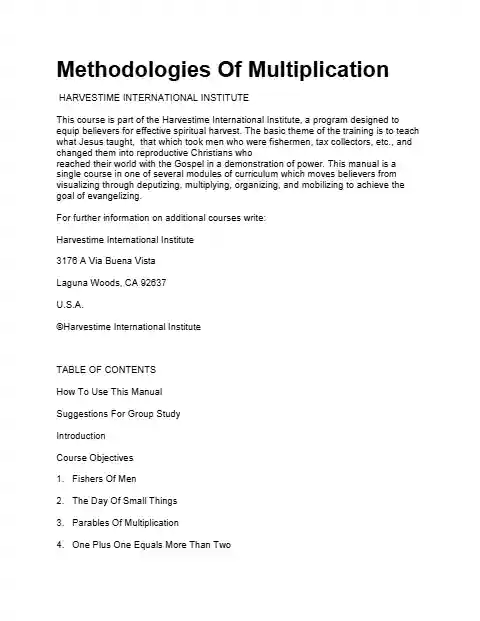
  • Author: Harvestime International Institute
  • Size: 1.22MB | 167 pages
  • |
Continue with
Google Twitter
LOG IN TO REVIEW
About the Book


"Methodologies of Multiplication" by Harvestime International Institute provides a comprehensive guide to effective strategies for multiplying churches and ministries. The book outlines practical and proven methods for expanding the reach and impact of Christian organizations, drawing on the experiences and insights of seasoned practitioners in the field. Through this resource, readers can learn how to cultivate a culture of growth and sustainability within their own communities.

Eric Liddell
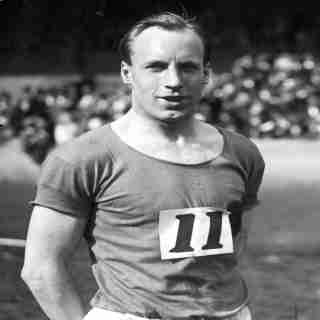
Eric Liddell Eric Henry Liddell was born on 16th January 1902 in Tientsin (Tianjin) North China, second son of the Rev. & Mrs. James Dunlop Liddell who were missionaries with the London Mission Society. He was educated from 1908 to 1920 at Eltham College, Blackheath, school for the sons of missionaries. Eric, with his older brother Rob, were left at their boarding school while their parents and sister, Jenny, returned to China. During the boys’ time at Eltham College, their parents, sister and new brother Ernest came home on furlough two or three times and were able to be together as a family – mainly living in Edinburgh. Although born in China and educated in England, Eric Liddell lived in Scotland at various times during his life. In 1920, Eric joined his brother Rob at Edinburgh University to read for a BSc in Pure Science. During this period he played rugby for Scotland and trained to run at the Olympics. Athletics and rugby played a large part in Eric’s University life. He ran in the 100 yards and the 220 yards for Edinburgh University and later for Scotland. He played rugby for Edinburgh University and in 1922 played in seven Scottish Internationals with A.L. Gracie. Eric Liddell was a gifted rugby player and played for the Edinburgh Univerisity 1st XV team. He also played international rugby for Scotland and gained seven international caps as a wing-threequarter, scoring four tries thanks to his searing pace. As a result of having insufficient time for both running and rugby, he chose the former, aiming for the 100 meters in the Paris Olympics. When he learned that the heats were to be run on a Sunday, he switched to the 400 metre competition as he was not prepared to run on a Sunday. He won a gold medal for the 400 metres and a bronze medal for the 200 metres at the Paris Olympics. He also travelled briefly to the USA in 1924 to compete in an athletics tournament. He returned to Edinburgh after the Paris Olympics and he graduated from Edinburgh University. Eric Liddell lived for a short time in Gillespie Crescent before moving to a house in Merchiston Place. Recollections of Eric Liddell By Sir Arthur Marshall The Cambridge University Athletics Club had an invitation from Pennsylvania to take a team of seven to the Pennsylvanian Games in March 1924, and I was one of the seven. Eric Liddell, the Scot from Edinburgh University, the 1923 AAA 100 yards Champion, had been personally invited and travelled with us. We stayed at the very comfortable Pennsylvanian Cricket Club. I am afraid none of, including Eric Liddell, managed to win an event at the Pennsylvanian Games. We travelled back in a small slow ship of the American United Line called ‘The Republic’ – a ten day crossing. Eric Liddell entered in the fun and games on the boat, including the Fancy Dress Dance. Whilst he was very strict about religion. Eric and I became good friends and saw much of two American sisters, Freddie and Edith, who were travelling to ‘do Europe’, including the UK. They said they were going to be in Paris for the Olympic Games, and we said if we were there at the same time we hoped we could meet. Harold Abrahams had set his whole life on winning the Olympic 100 Metres – it had become and obsession with him. Liddell’s achievement in winning the 1923 AAA 100 Yards in the record time of 9 7/10 seconds was a devastating blow to Abrahams and shook him to the core. To date Abrahams had been a consistent 10 seconds 100 yards winner but had only slightly broken 10 seconds on one or two occasions. He knew in the Olympics he would be up against overseas competition, particularly from the Americans, but this new and very serious opposition out of the blue and on his doorstep had come at a time when Harold had established his 100 yards supremacy in the UK. To achieve level pegging with Eric Liddell’s new record time, Harold had to improve his performance by two or three yards with the help of his trainer Sam Mussabini. It must have been a tremendous relief to Harold when it became known early in 1924 that Eric had decided to concentrate on the 400 metres and, because of his religious principles, would not compete in the Olympic 100 metres as first heats were always run on Sunday. Eric had in turn become completely dedicated to winning an Olympic Medal within the restrictions of his faith. He was a famous Scottish international rugger player, and gave up his rugger to enable him to concentrate on his Olympic ambitions, which became very deep-rooted, and his work suffered. Winning an Olympic Gold Medal became a priority, second only to his religion, and the ambition to win this event became part of his religion. Recollections of Eric Liddell By Sir Arthur Marshall The team travelled to Paris days before the Olympics started and had a big send-off at Victoria Station. The silence at the start of the 100 metres and 400 metres was quite electric. Harold Abrahams won the 100 metres in a new Games record time. In spite of all that has been said about Abrahams’ 100 metres, the 400 metres in some way provided the greatest thrill of the meeting with the world record being broken by Eric Liddell three times in two days. It was thought that Liddell had some chance of winning, but nobody thought Liddell capable of the amazing performance he achieved in the final. As far as the crowd were concerned they were well informed about Liddell’s dedication to his religion and his refusal to run in the first round of the 100 metres on the Sunday; they also knew of his determination to win this event. The occasion was enlivened by the support given to Liddell by the pipes and drums of the Cameron Highlanders. The silence and pent-up excitement at the start of the race could be felt. Liddell went ahead at the start and maintained his pace throughout, finishing in what at the time was described as ‘a most lion-hearted manner’ winning by three yards from Fitch, an American. This was probably the greatest achievement of the VIIIth Olympiad, and superlatives were showered on Liddell by the press of the entire world. Liddell was short and not a pretty runner but just pounded along virtually at the same pace all the way, with a finish as if he was making a final dash for a try in a rugger match with an opponent bearing down on him and about to tackle from behind. After Eric had won the 400 metres Gold Medal, Eric and I made contact with Freddie and Edith, the American sisters, and took them to a Tango Tea Dance in the Champs Elysees. Footnote: Along with sacrificing his place in the 1924 Olympics 100m, Eric Liddell also gave up two other races in which Great Britain held high hopes of winning gold that year – the 4 x 100m and 4 x 400m, whose finals also took place on a Sunday. After the Olympics After the Olympics and his graduation, he returned to North China where he served as a missionary from 1925 to 1943 – first in Tientsin (Tainjin) and later in Siaochang. During his first furlough in 1932 he was ordained as a minister. 1930 - 1932 On furlough from China studying at Congregational College. After completing his studies he was ordained as a minister on 22nd June 1932. During this time he lived in a hostel in George Square which belonged to the Edinburgh Medical Missionary Society. During these periods Eric Liddell attended Morningside Congregational Church at the corner of Chamberlain Road and Morningside Road. Morningside Congregational Church The Church building (pictured here on the right) was originally built for North Morningside United Presbyterian Church who used it until 1881 when it became too small. They then built a new, larger, church on the other side of the road (which is now the Eric Liddell Centre). From 1881 the old church was home to the Morningside Athenaeum Club before the Congregational Church purchased it in 1890. In 1928 this church was demolished and a new one erected (which is now Morningside United Church). Eric Liddell would have attended meetings in both buildings during his two extended stays in Edinburgh. The old church from 1920 to 1925 and the current building (Morningside United Church) from 1930 to 1932. He also preached at the church on a number of occasions. On his return to China, he married Florence Mackenzie (of Canadian missionary parentage) in Tientsin in 1934. They had three daughters; Patricia, Heather and Maureen, who now all live in Canada. Living in China in the 1930s was potentially very dangerous and in 1937 Eric was sent to Siaochang where he joined his brother Rob. He was now crossing the Japanese army lines. In 1941 life in China was becoming so dangerous that the British Government advised British nationals to leave. Florence and the children left for Canada. During 1941 – 1943 Eric stayed in Tientsin, then in 1943 he was interned in Weishien camp until his death in 1945. The Eric Liddell Centre The United Presbyterian Church merged with the Free Church of Scotland in 1900 and then, in 1929, this merged with the Church of Scotland. The United Presbyterian Church built in 1879 became known as Morningside North parish Church. By 1980 the building was no longer in use and became the Holy Corner Church Centre. This was an initiative of the three remaining churches at Holy Corner: Morningside United Church (a merger between the Congregational and Church of Scotland congregations and in joint membership of the United Reformed Church and Church of Scotland), Christ Church (Scottish Episcopal Church) and Morningside Baptist Church. As the project developed the centre’s name was changed to The Eric Liddell Centre in recognition of his involvement in the life of one of the founding churches and the local community during his time living here.

Romance After Kids

“Romance is the privilege of the rich, not the profession of the unemployed,” wrote Oscar Wilde. “The poor should be practical and prosaic.” I can partially relate to this sentiment. While I am not, in any estimation, to be numbered among the financially poor, I may be considered more impoverished in the currencies of independence and time. I am a father of five. My wife is currently recovering from COVID-19, and we are rounding out our second extended quarantine of the last two months. And in the last few days, two of our children’s stomachs have decided to expel their contents. Our world orbits around need; and needs call for a more practical and prosaic season of life that all but excludes the possibility of romance, right? Quality time — undistracted and full of energy — seems like the privilege of the bourgeois. But is it? Should we pause romance in this season? Should we simply acknowledge that we are shoulder-to-shoulder, not face-to-face, as we battle for the kindness and cleanliness of our kids? Why Romance Is Worth Pursuing I don’t believe we should pause romance in the demanding and chaotic world of parenting. Consider at least three reasons why. First, delight in beauty is the sustaining substance of life. The battlefield of child-rearing is not for the faint of heart. Without consistent moments to be refueled together by the beauty of God in his creation (I’m thinking Psalm 19-style sunrises and sunsets, rich flavors, unforgettable melodies, and especially the divine image in each other), we will succumb to fatigue and forget why we’re raising the children to begin with. Second, children need their parents’ affection for each other. God created parenting to be a completion of joy, an overflow of it. It is a Trinitarian image, whereby the mutual delight of the parents spills itself into creation. To quote thirteenth-century theologian Meister Eckhart (speaking in human terms and however imprecisely), “God laughed and begot the Son. Together they laughed and begot the Holy Spirit. And from the laughter of the Three, the universe was born.” The nourishing and cherishing of Ephesians 5 doesn’t simply transfer to your children. “No one ever hated his own flesh, but nourishes and cherishes it, just as Christ does the church” (Ephesians 5:29) — I am convicted as I type. Spouses (with a special emphasis on husbands) are called to invest deeply into one another, with the nourishing and cherishing of one’s own body, implying more than mere functional living or co-laboring. “Cherish,” after all, is not a prosaic word. It is infused with deep delight, the kind of word husbands search for to express their affection in a poem or song. Practical Advice for Married Couples So, let’s get practical (but not prosaic). What might romance look like in the season of survival on the Serengeti that is parenting? What follows is a list that mingles my own successes, failures, sin, and idealism, ranging from the mundane to the magical. Okay, mostly mundane. Most of it lives miles from a gondola in Venice, but placed on the battle for the souls of your children, every intentional face-to-face moment really helps. Take what helps. 1. Wake up together. Most husbands need less sleep than their wives, but trying to coordinate either sleep or wake time can be good for your marriage. For us, it’s been wake time most recently. We get up most mornings before the kids are stirring. Yes, it’s dark. It feels like the middle of the night (because it is) and our eyes are bleary. But the world is quiet and we rehearse the mercies of God out loud to one another, and of course to him, as we paraphrase the Psalms. We directly thank him for the undeserved gift of one another — boom, romance. 2. Take a few minutes to connect. This must be intentional, and it usually can’t be during dinner. Dinner is a wonderful opportunity to shepherd your children, but in most larger families, it is likely too chaotic to be a face-to-face moment with a spouse. The moment I’m speaking of is right after the kids are in bed. The reason it must be intentional is that you are likely drifting into a trance of fatigue, and some form of unwinding seeks your attention. But so does your spouse’s soul. And to turn to one another, without the television on or the phone in hand, and simply say, “Tell me about your day,” is fresh wind for your marriage. I might even recommend a few fun questions to pull from a hat in order to engage one another with more intrigue and substance. 3. Play. After ten o’clock on most nights, my wife loses much of her filter to weariness and goes into full sass mode. She throws playful jabs my way and laughs until she cries, and I tend to amplify her delight with my over-the-top responses. It would probably look to the outsider like two middle school kids flirting, but it is an ironic display of marital safety and affection that is probably indispensable in this season. I would be hard-pressed to overstate the value of humor as a means of romantic connection. 4. Write to one another. Even if you say you’re not a “words of affirmation” person, you are more than you realize. Your spouse is too. And when the words are written rather than simply spoken, they affect us powerfully. I think it’s because those words reflect deeper thought, deeper consideration, and deeper investment of time than something more spontaneous. That’s why a text message stating affection is good, but a sonnet is better. Or even a limerick if you’re not into iambic pentameter. 5. Get out into creation. The heavens declare the romantic heart of God. The sun exclaims the joy and love of the Bridegroom (Psalm 19:1–5). A breeze whispers his gentleness, and the autumn leaves remind us of the beauty of Christ’s death. It doesn’t take the reservation of an Airbnb in Montana to engage the created world together. We sat on the back porch for a few minutes this week and marveled at the sudden bright yellows of the leaves behind the house. Consistent peeks outside or regular walks around the neighborhood, especially hand in hand, can bring peace to chaos. Speaking of hand in hand . . . 6. Show physical affection. Keep holding hands in public. Or start holding hands in public. Half-mindlessly rub her back while you’re sitting on the couch. Don’t let the heckling of your teenagers keep you from a spontaneous hug in the kitchen. There was a moment, likely when you were dating, when the brush of your now-spouse’s hand was electric. The same desire, albeit without the giddiness, still resides in you. Touch is connection, and connection between two desire-laden, God-imaging souls is at the heart of romance. 7. Recall the wonders of God in your family’s life. This is a clear command and practice in Scripture (see Psalm 136), and it is a poetic moment when practiced well. It ought to be a normative part of your prayer life, but we find it helpful to also formalize the practice. Each year on our anniversary, we pull out a journal and jog our memories about all the big events and sweet moments of the previous year. It is a connecting moment of sentiment, laughter, and gratitude. 8. Get away and dream. This is a privilege that not all parents have the resources to enact. It requires willing babysitters (often family because of the sizable commitment) and sometimes money. We went three years without a night away at one point. And again, it doesn’t have to be in some exotic bungalow in Fiji. But one of our fonder marital memories was a simple switching of houses with my parents for a night so that we could come out of the winds and talk uninterruptedly about what the Lord might have for our future. 9. Play music. I don’t mean that you need to turn your family into the Von Trapps. If anyone in your family can conjure a melody with voice or violin, all the better, but I am here referring to a simple song in the background. Whether it’s a hymn (Indelible Grace gets a lot of air time in our household), a soundtrack, or a beat to dance to, music awakens the soul. It allows easier access to emotion and meaning in the mundane moments. Use the gift of Spotify or a phonograph. 10. Speak the delights of God to your spouse. While this is an admittedly shoulder-to-shoulder activity (since your collective gaze is elsewhere), it is akin to watching a sunset or a play, only with deeper relational weight. After all, you are fostering the romance between your spouse and the true Bridegroom. To speak the wonders of God’s holiness, his fatherly delight, and the wonders of his love, is to kindle the soul. So don’t just memorize Scripture. Memorize it in order to tell her of the dimensions of the love of Christ, and so fill her with the fullness of God (Ephesians 3:19). Life, even the life of a child-chasing parent, is magical. And marriage, even the mostly shoulder-to-shoulder kind that is stretched to its limit by fatigue and chaos, is still a picture of Christ and the church. Ask your heavenly Bridegroom for eyes to see that afresh and the energy to enact a bit of intentional romance. Article by Matt Reagan
Feedback
Suggestionsuggestion box
x