
GIP Library icon

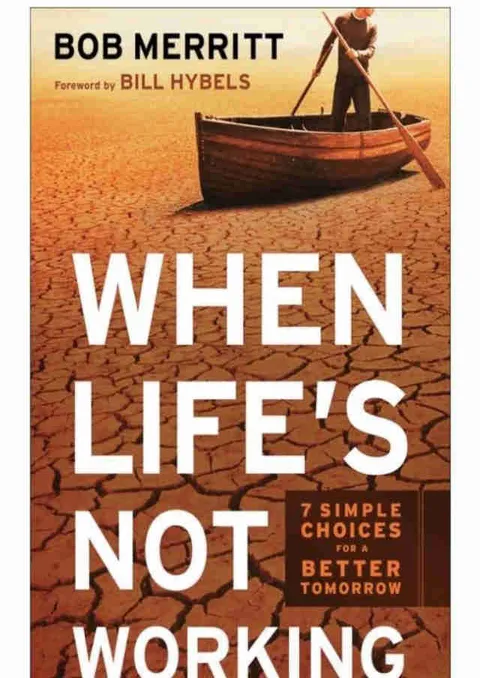
When Life's Not Working - 7 Simple Choices When Life's Not Working - 7 Simple Choices

When Life's Not Working - 7 Simple Choices Order Printed Copy

  • Author: Bob Merritt
  • Size: 958KB | 148 pages
  • |
Continue with
Google Twitter
LOG IN TO REVIEW
About the Book


"When Life's Not Working - 7 Simple Choices" by Bob Merritt offers practical advice and guidance for finding hope and peace in times of difficulty. The author presents seven key choices that can help individuals navigate through challenges and improve their overall well-being. Through real-life stories, biblical teachings, and personal reflections, Merritt inspires readers to make positive changes and take control of their lives. Ultimately, the book encourages readers to trust in God's plan and embrace a more fulfilling and purposeful life.

Lee Strobel

Lee Strobel Lee Strobel (Lee Patrick Strobel) is a former American investigative journalist and a Christian Author who has written several books, including four which received ECPA (Evangelical Christian Publishers Association) Christian Book Awards (1994, 1999, 2001, 2005) and a series which addresses challenges to the veracity of Christianity. He is a former host of the television program called Faith Under Fire on PAX TV and he runs a video apologetic web site. Lee Strobel Age He was born on January 25, 1952 in Arlington Heights, Illinois, U.S. Lee Strobel Family | Chicago Tribune Less information has been revealed about his father, mother and siblings if he has any. He attended the University of Missouri where he received a Journalism degree. He later earned his Masters of Studies in Law degree from Yale Law School. He became a journalist for the Chicago Tribune and other newspapers for 14 years. The UPI Illinois Editors Association newspaper award program gave him a first place for public service (the Len H. Small Memorial award) for his coverage of the Pinto crash trial of Ford Motor in Winamac, Indiana in 1980. Later, he became the assistant managing editor of the Daily Herald, before leaving journalism in 1987. Lee Strobel Wife | Daughter He married Leslie Strobel and they are blessed with two children; a son called Kyle who is an an Assistant Professor of Spiritual Theology and Formation at the Talbot School of Theology and a daughter called Alison who is a novelist. Lee Strobel Church He was an atheist when he began investigating the Biblical claims about Christ after his wife’s conversion. Prompted by the results of his investigation, he became a Christian on November 8, 1981. He was a teaching pastor of Willow Creek Community Church in South Barrington, Illinois, from 1987 to 2000, before shifting his focus to writing and producing his TV show, Faith Under Fire. He later was awarded an honorary doctoral degree by Southern Evangelical Seminary in recognition of his contributions to Christian apologetics in 2007. Lee Strobel Books He has written several books just to list a few. 1998 – The Case for Christ: A Journalist’s Personal Investigation of the Evidence for Jesus 2000 – The Case for Faith: A Journalist Investigates the Toughest Objections to Christianity 2004 – The Case for a Creator 2005 – The Case for Christmas: A Journalist Investigates the Identity of the Child in the Manger 2007 – The Case for the Real Jesus 2013 – The Case for Grace: A Journalist Explores the Evidence of Transformed Lives 2014 – The Case for Christianity Answer Book 2015 – The Case for Hope: Looking Ahead with Courage and Confidence 2018 – The Case for Miracles: A Journalist Investigates Evidence for the Supernatural Lee Strobel Net Worth From his work as a former investigative journalist and from his work as a Christian apologetic author, he has gained a great fortune. Besides that, he lives with his wife in his home that he bought. He has an estimated net worth of $8 million. Lee Strobel Movie His movies include; 2004 – Jesus: Fact or Fiction. 2007 – Jesus: The Great Debate. 2017 – The Case for Christ Lee Strobel The Case For Christ The Case For Christ is one of the books that Lee has written. This book summarizes Lee’s interviews with thirteen evangelical Christian scholars—Craig Blomberg, Bruce Metzger, Edwin Yamauchi, John McRay, Gregory Boyd, Ben Witherington III, Gary Collins, D. A. Carson, Louis Lapides, Alexander Metherell, William Lane Craig, Gary Habermas, and J. P. Moreland—in which they defend their views regarding the historical reliability of the New Testament. His personal encounters with these scholars and their beliefs led to the 2017 film of the same name. Lee Strobel The Case For Miracles The Case for Miracles: A Journalist Investigates Evidence for the Supernatural is one of the books that he has written. This book starts with an unlikely interview in which America’s foremost skeptic builds a seemingly persuasive case against the miraculous. But then Strobel travels the country to quiz scholars to see whether they can offer solid answers to atheist objections. Along the way, he encounters astounding accounts of healings and other phenomena that simply cannot be explained away by naturalistic causes. The book features the results of exclusive new scientific polling that shows miracle accounts are much more common than people think. Lee Strobel Testimony This is a summary of the detailed transcript of his testimony; For most of my life I was an atheist. I thought the idea of an all-loving, all-powerful creator of the universe–I thought it was stupid. I mean, my background is in journalism and law. I tend to be a skeptical person. I was the legal editor of the Chicago Tribune. So I needed evidence before I’d believe anything. One day my wife came up to me–she’d been agnostic–and she said after a period of spiritual investigation she had decided to become a follower of Jesus Christ. And I thought, you know, this is the worst possible news I could get. I thought she was going to turn into some sexually repressed prude who was going to spend all her time serving the poor in skid row somewhere. I thought this was the end of our marriage. But in the ensuing months, I saw positive changes in her values, in her character, in the way she related to me and the children. It was winsome; and it was attractive; and it made me want to check things out. So I went to church one day, ah, mainly to see if I could get her out of this cult that she had gotten involved in. But I heard the message of Jesus articulated for the first time in a way that I could understand it. That forgiveness is a free gift, and that Jesus Christ died for our sins, that we might spend eternity with Him. And I walked out saying–I was still an atheist–but also saying, “If this is true, this has huge implications for my life.” And so I used my journalism training and legal training to begin an investigation into whether there was any credibility to Christianity or to any other world faith system for that matter. Lee Strobel The Case For Easter The Case for Easter: A Journalist Investigates the Evidence for the Resurrection is one of his books that answers the following questions. Did Jesus of Nazareth really rise from the dead?Of the many world religions, only one claims that its founder returned from the grave. The resurrection of Jesus Christ is the very cornerstone of Christianity. But a dead man coming back to life? In our sophisticated age, when myth has given way to science, who can take such a claim seriously? Some argue that Jesus never died on the cross. Conflicting accounts make the empty tomb seem suspect. And post-crucifixion sightings of Jesus have been explained in psychological terms.How credible is the evidence for—and against—the resurrection? and many others. Lee Strobel Quotes “Only in a world where faith is difficult can faith exist.” “If your friend is sick and dying, the most important thing he wants is not an explanation; he wants you to sit with him. He’s terrified of being alone more than anything else. So, God has not left us alone.” “Faith is only as good as the one in whom it’s invested.” “To be honest, I didn’t want to believe that Christianity could radically transform someone’s character and values. It was much easier to raise doubts and manufacture outrageous objections that to consider the possibility that God actually could trigger a revolutionary turn-around in such a depraved and degenerate life.” “Abruptly, Templeton cut short his thoughts. There was a brief pause, almost as if he was uncertain whether he should continue. ‘Uh … but … no,’ he said slowly, ‘he’s the most …’ He stopped, then started again. ‘In my view,’ he declared, ‘he is the most important human being who ever existed.’ That’s when Templeton uttered the words I neer expected to hear from him. ‘ And if I may put it this way,’ he said in a voice that began to crack, ‘I … miss … him!’ With that tears flooded his eyes. He turned his head and looked downward, raising his left hand to shield his face from me. His shoulders bobbed as he wept.” Lee Strobel Website His website is leestrobel.com

Suffering Under an All-Powerful Love

As I sat atop my lofted dorm-room bed and turned the page from Romans 8 to Romans 9 in my small, tattered Bible, I went from a chapter familiar enough to be easily skimmed to a chapter that I had no recollection of ever reading before. Both chapters emphasized the sovereignty of God — his sovereign love and his sovereign power. At 19 years old, I had not thought much about God’s sovereignty. I believed what I’d been taught as a child — that God was in control, that he knew every hair on my head, that he had the whole world in his hands. But I also believed that salvation was a choice I had made — that God chose me because he knew I’d someday choose him. When I entered college, however, the issue became inescapable. My college campus swirled with discussions about whether God elected people to salvation and whether he could know the future at all. Even my theology class was getting ready to host a debate between an Open Theist (someone who believes God doesn’t fully know the future until it happens) and a Calvinist (someone who believes God knows and ordains the future, including who will believe and be saved). It was only by chance that I had been reading Romans 8–9 the night before this debate. Or was it? God in Control That night, my beliefs began to change. I read of God’s relationship with his chosen people: Those whom he foreknew he also predestined to be conformed to the image of his Son, in order that he might be the firstborn among many brothers. And those whom he predestined he also called, and those whom he called he also justified, and those whom he justified he also glorified. (Romans 8:29–30) Could it possibly be true that this foreknowing, predestining God didn’t know the future? It could not. Or was it conceivable that the God who said, “It depends not on human will or exertion, but on God, who has mercy,” was merely looking ahead in the future to see who would and wouldn’t choose him (Romans 9:16)? It was not. And furthermore, God declared that he was working all things together for the good of those he’d called (Romans 8:28). Could God work all things together for good if all things were not genuinely under his control? My 19-year-old heart began to swell with joy and relief. This God was not back on his heels, trying to figure out what to do, nor was he waiting for me to figure him out. He was bringing his good plans to pass. He called me, he saved me, and he would keep me in every circumstance. Does God’s Goodness Miscarry? My understanding of God’s sovereign grace grew as my knowledge of God’s word grew. And I loved his sovereignty — in theory at least. I loved that my God was so powerful and big and in charge. When I saw others go through difficult circumstances, I sympathized with them, but I also had a settled sense that God had a plan born from his love. It wasn’t until I was up against my own difficult circumstance that the thought flashed in my mind: perhaps God was working something not good in my life. As a young wife and mom, I never considered the possibility of miscarrying. So when it happened, I was shocked that my own womb could become a place of death. All I knew of God flooded my mind, almost as a reproach. As I faced the loss of our little one, I wasn’t tempted to doubt his power but his love. I knew he could have kept our baby alive, so why didn’t he? Yet Romans 8 was there to keep me grounded, reminding me that not even death could separate us from his love. Paul’s words were an anchor: I am sure that neither death nor life, nor angels nor rulers, nor things present nor things to come, nor powers, nor height nor depth, nor anything else in all creation, will be able to separate us from the love of God in Christ Jesus our Lord. (Romans 8:38–39) As the years rolled on, God’s sovereignty over all things was the buoy that kept me afloat in every season. I was learning to trust God’s love as he carried us through job loss, babies received and one lost, moves, and new ministry. Yet it was the birth of our youngest son that brought the deepest challenge to my trust in God’s power and plans. With our son’s arrival, we faced uncertainty regarding his future, a future that, in the best case, would involve disability and health difficulties. During the chronic trials that ensued, including our son’s sleep disorder, seizures, and eating difficulties that involved years of almost daily vomit, a different sort of temptation occasionally crept in — the thought that God might love us, but he maybe couldn’t help us. Night after night after night, year after year after year, we would pray for relief. But relief didn’t come. Different Sort of Power I was looking for God’s power to come in the form of physical relief from our trials. I was tired and worn. I wanted to be free of the difficulties of nighttime G-tube feedings and regular vomit clean-up. If God answered those prayers, I reasoned, that would be a sign of his power. Yet which is more difficult: to change someone’s circumstances from hard to easy, or to change the person in the circumstances from floundering to flourishing despite it all? Would God have shown more of his sovereign power if he had put down all his enemies once and for all, preventing the cross and the resurrection? Or is God’s power more greatly displayed through his planning from before time to crush his Son, defeat sin, and then raise his Son from the dead, so that he could make his enemies his friends? Any tyrant with a large army can squelch his enemies, but only our gracious and powerful God turns enemies into sons through the folly of the cross and the empty tomb. As Paul testifies, God often manifests his power through our weaknesses. It was Paul’s thorn in the flesh that occasioned God’s sovereign power resting upon him: I will boast all the more gladly of my weaknesses, so that the power of Christ may rest upon me. For the sake of Christ, then, I am content with weaknesses, insults, hardships, persecutions, and calamities. For when I am weak, then I am strong. (2 Corinthians 12:9–10) “The sovereign power of God rests on his people, not to remove their thorns, but to teach them of a stronger power.” In a world where almost everyone seems obsessed with power — whether they have it, how they can get it — God’s word shows us the deeper power: the power of his Spirit. God’s power is ours when we entrust ourselves to him amid weakness. We need not demand power from the world. We need not seek position or platform. The sovereign power of God rests on his people, not to remove their thorns, but to teach them of a stronger power — the power of God that contents us with trials, so long as we have Christ’s Spirit. No Trite Slogan All those years ago as a college sophomore, Romans 8 and 9 showed me the sovereign love and sovereign power of God. In Romans 9, I met a God to whom back talk was not permitted: You will say to me then, “Why does he still find fault? For who can resist his will?” But who are you, O man, to answer back to God? Will what is molded say to its molder, “Why have you made me like this?” (Romans 9:19–20) In Romans 8, that same fearfully powerful God was also utterly committed to my good in all things, so much so, that his Spirit intercedes for me as he works on my behalf (Romans 8:26–28). Some believe that Romans 8:28 is a trite way to comfort the afflicted — that it shuts up the grief of the hurting, as though telling a suffering saint that God is working their hardship for good makes a mockery of the pain. As we are imperfect people, we should consider that possibility. But for me, no truth is as precious. “God is good. God is strong. Not one thing happens to us apart from his perfect plan.” Knowing that God is working all things for my good has been the dearest and deepest comfort, even, and especially, in the darkest of seasons. God is working all things for my good when our son is in the hospital (again), or when my husband is dealing with chronic pain (still), or when betrayal and slander touch my life or the lives of those I love. It’s a reality that keeps my heart whole even as it’s breaking, and my mind clear even in the fog of confusion. He is good. He is strong. Not one thing happens to us apart from his perfect plan. God’s sovereign love and power mean that we can trust him — now and forever. Article by Abigail Dodds Regular Contributor

Feedback
Suggestionsuggestion box
x