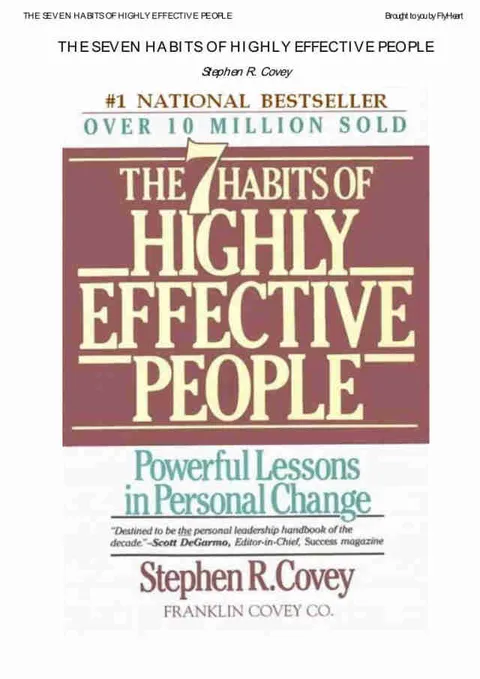

The 7 Habits Of Highly Effective People Order Printed Copy
- Author: Stephen R. Covey
- Size: 777KB | 172 pages
- |
Others like the 7 habits of highly effective people Features >>

The Art Of Laziness
The Spirit Of Leadership

The Miracle Of Right Thought
-160.webp)
The Gifts Of Imperfection: Embrace Who You Are
The 5 Levels Of Leadership

The Jelly Effect: How To Make Your Communication Stick
-160.webp)
The Rhythm Of Life: Living Every Day With Passion And Purpose

Understanding Your Potential

None Of These Diseases

Let It Go
About the Book
"The 7 Habits of Highly Effective People" by Stephen R. Covey is a self-help book that provides practical advice on how to achieve personal and professional success. Covey outlines seven habits that individuals can cultivate to become more effective and productive in their daily lives. These habits include being proactive, beginning with the end in mind, putting first things first, thinking win-win, seeking first to understand then to be understood, synergizing, and sharpening the saw. Covey emphasizes the importance of taking responsibility for one's actions, prioritizing tasks effectively, and building strong relationships with others. Overall, the book offers valuable insights on how to become more efficient, achieve goals, and lead a fulfilling life.
Henry Alline
 Henry Alline’s early years
He was born and received his early education in Newport, Rhode Island and his family moved to Nova Scotia in 1760, when he was 12 years old. When he was nine he began to read theological works and became somewhat mystical, but after years of soul-searching and spiritual conflict he was powerfully converted in 1775, simultaneously receiving a call to the ministry.
Alone and desperate he prayed until…’redeeming love broke into my soul… with such power that my whole soul seemed to be melted down with love…and my will turned of choice after the infinite God. A year later he began to preach.
His preaching career
His preaching career lasted until his death eight years later. He was an itinerant preacher in Nova Scotia and Prince Edward Island in an ever-widening circuit, beginning what became known as the ‘New Light’ movement and which is still the greatest revival that Canada has ever seen. He preached the new birth powerfully and effectively and his admirers compared him to George Whitefield and John the Baptist.
Considered an emotional and dangerous fanatic by some and a ‘ravager of congregations,’ the Congregationalists withdrew his right to preach in their churches, so he spoke in barns, houses and the open air. In all he began eight ‘New Light’ Congregational churches based on his non-Arminian but anti-Calvinist views of free-will and predestination, and his strong rejection of outward religious form.
Ironically, despite his indifference regarding baptism, his major 19th century influence was amongst the Baptists of eastern Canada, many of whom were his converts.
Despite possibly unorthodox views and methods, his ministry was without doubt that of an extraordinary revivalist.
Alline’s sermon style was always simple and extemporary, using a few simple, understandable points to help the unchurched to grasp the simple truths of the gospel. As with other itinerant revivalists, his objective was to lead the hearers to a point of decision – to accept or reject Christ as Saviour and Lord, which opened the door to the “new birth.”
Doubtless, his sermons were repeated over time, but he was never in one place long enough for his listeners to notice.
Alline also employed the ministry of prayer and of singing, writing many hymns which were helpful in communicating the gospel. A collection was gathered after his death and was reprinted at least four times in the United States, and several were included in the standard hymnals of the 19th century.
Henry Alline’s early years
He was born and received his early education in Newport, Rhode Island and his family moved to Nova Scotia in 1760, when he was 12 years old. When he was nine he began to read theological works and became somewhat mystical, but after years of soul-searching and spiritual conflict he was powerfully converted in 1775, simultaneously receiving a call to the ministry.
Alone and desperate he prayed until…’redeeming love broke into my soul… with such power that my whole soul seemed to be melted down with love…and my will turned of choice after the infinite God. A year later he began to preach.
His preaching career
His preaching career lasted until his death eight years later. He was an itinerant preacher in Nova Scotia and Prince Edward Island in an ever-widening circuit, beginning what became known as the ‘New Light’ movement and which is still the greatest revival that Canada has ever seen. He preached the new birth powerfully and effectively and his admirers compared him to George Whitefield and John the Baptist.
Considered an emotional and dangerous fanatic by some and a ‘ravager of congregations,’ the Congregationalists withdrew his right to preach in their churches, so he spoke in barns, houses and the open air. In all he began eight ‘New Light’ Congregational churches based on his non-Arminian but anti-Calvinist views of free-will and predestination, and his strong rejection of outward religious form.
Ironically, despite his indifference regarding baptism, his major 19th century influence was amongst the Baptists of eastern Canada, many of whom were his converts.
Despite possibly unorthodox views and methods, his ministry was without doubt that of an extraordinary revivalist.
Alline’s sermon style was always simple and extemporary, using a few simple, understandable points to help the unchurched to grasp the simple truths of the gospel. As with other itinerant revivalists, his objective was to lead the hearers to a point of decision – to accept or reject Christ as Saviour and Lord, which opened the door to the “new birth.”
Doubtless, his sermons were repeated over time, but he was never in one place long enough for his listeners to notice.
Alline also employed the ministry of prayer and of singing, writing many hymns which were helpful in communicating the gospel. A collection was gathered after his death and was reprinted at least four times in the United States, and several were included in the standard hymnals of the 19th century.
Today Is Just in Time
His circumstances were a nightmare. Not only did he live in the land of whoredom, standing on the brink of national judgment, but his job seemed more like a sick joke than a divine commission. Go marry a prostitute and get her pregnant, God told Hosea, because I have a message to send my sinful people (Hosea 1:2). No prophet of Israel received convenient instructions, but this was about as rough as it ever got. Not to mention, all this drama — this real-life theater — was for a faithless people. Israel had it good from God, until they coopted his blessing to serve Baal, doubling down their opulence, partying hard, and forgetting all about the One who had called them out of slavery. The relationship between ancient Israel’s sin and their forgetfulness is not ironic. If sin makes people stupid (and it does), spiritual adultery makes us oblivious: She did not know that it was I who gave her the grain, the wine, and the oil, and who lavished on her silver and gold, which they used for Baal. . . . [Israel] went after her lovers and forget me, declares the Lord. (Hosea 2:8; 4:6, 10–12) They were filled, and their heart was lifted up; therefore they forgot me. (Hosea 13:6) I took them up by their arms, but they did not know that I healed them. (Hosea 11:3) Grace on the Edge Now the time had come to reap God’s wrath — hence the prophetic work of Hosea. “I will punish them for their ways and repay them for their deeds” (Hosea 4:9). The charges had piled up. Judgment was breathing down their necks. Any day now, we’d be saying if we were there, and things are about to blow. Wholesale captivity is right around the corner, and before that, an invading Assyrian army. But then there’s a call to repentance. The context is so pervasively negative, commentators have debated whether it’s serious or sarcasm. Come, let us return to the Lᴏʀᴅ; for he has torn us, that he may heal us; he has struck us down, and he will bind us up. After two days he will revive us; on the third day he will raise us up, that we may live before him. Let us know; let us press on to know the Lᴏʀᴅ; his going out is sure as the dawn; he will come to us as the showers, as the spring rains that water the earth. (Hosea 6:1–3) Hosea is for real. He means it. This book is laced with surprising words of grace; even in the midst of accusation, mercy is busting at the seams (Hosea 2:14–23; 3:1–5; 10:12; 11:1–12; 12:9; 14:1–9). In the rubble of Israel’s wickedness, in the aftermath of their apostasy, the plea still goes forth: Let us know him; Let us press on to know the Lord. Mighty in His Mercy It is a plea for us as much as for them. Know the Lord, Hosea says. Even in their mess, even in their shambled condition, when the icky-ness of their past sin is corroding the present, Hosea holds out the invitation: Today, would you turn? Will you press on to know him now? There is a theological fact to grasp here — or perhaps more, a divine emotion to feel. Just when all we can imagine is stern, hard, cold; there is warmth, eyes of hope, hands held forth. God is not like us, after all. Maybe one shot and we’re done. Maybe a few more here and there, depending on our mood, differing measures of grace, or various personalities. But not with God. How can I give you up, O Ephraim? How can I hand you over, O Israel? . . . My heart recoils within me; my compassion grows warm and tender. I will not execute my burning anger; I will not again destroy Ephraim; for I am God and not a man, the Holy One in your midst, and I will not come in wrath. (Hosea 11:8–9) As he told Moses so many years before, God tells us again: he is holy by his mercy — and it is always available to his people if they would but turn and trust him. Turning Today Which means, no matter what your yesterday looked like, the invitation is open still. Today is just in time. Like Puddleglum told Eustace and Jill, after they had muffled their obedience, while they were clearly frustrated, feeling like idiots, assuming they’d ruined everything, “Aslan’s instructions always work: there are no exceptions. But how to do it now — that’s another matter” (Silver Chair, 121). Stop for a moment, and think. It does not matter what happened yesterday, or last year, or that one time back then. What matters is this moment, now, when the mercy of God in Jesus is extended to you. All is not calloused. Remember, Jesus died in your place and took the wrath that belongs to you, if you would but trust him. As sure as the sun comes up, as sure as it rains, God has promised mercy to his people when they repent (1 John 1:9; 2 Chronicles 7:14). God’s mercy is always available to his people if they would but turn and trust him. Whatever wreck your life might be, however nightmarish your circumstances seem, Jesus is ready to embrace you. His righteousness is ready to clothe you. The mighty wave of his mercy is growing higher and higher, soon to crash over your soul, if you would just turn, if you would but seek him. Would you? Even in the midst of your mess, would you turn to him? Let us know; let us press on to know the Lord. Article by Jonathan Parnell Pastor, Minneapolis, Minnesota