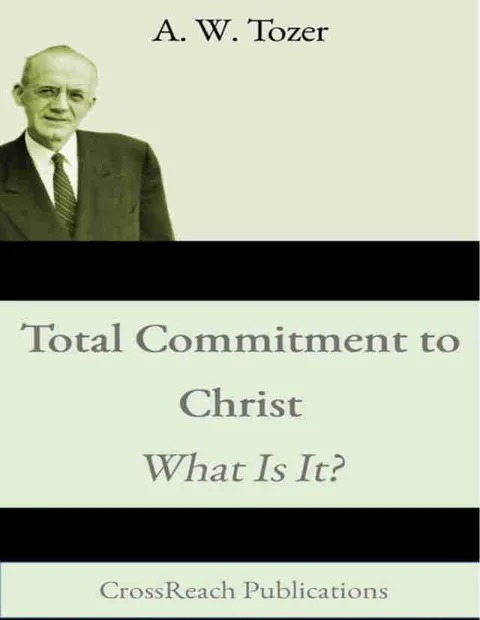

Total Commitment To Christ What Is It Order Printed Copy
- Author: A. W. Tozer
- Size: 143KB | 9 pages
- |
Others like total commitment to christ what is it Features >>
About the Book
"Total Commitment to Christ What Is It" by A. W. Tozer challenges readers to deepen their commitment to Christ and live with wholehearted devotion to Him. Tozer explores the meaning and implications of true commitment, urging believers to surrender fully to God and allow Him to work in and through their lives. The book encourages readers to seek a deeper relationship with Christ and live out their faith in a radical and transformative way.
Brother Andrew
Son of a blacksmith, Brother Andrew didnāt even finish high school. But God used this ordinary dutch man, with his bad back, limited education, without sponsorship and no funds to do things that many said were impossible. From Yugoslavia to North Korea, Brother Andrew penetrated countries hostile to the gospel to bring bibles and encouragement to believers.
Andy van der Bijl, who became known as Brother Andrew, was born in 1928 the son of a deaf father and a semi-invalid mother. Andrew was the third of six children and they lived in the smallest house in the village of Witte in the Netherlands.
In the book Godās smuggler, Andrew describes the impact that the death of his oldest brother āBasā had upon him. Bas, who was severely handicapped died when Andrew was just 11 years old. Andrew had wanted to die with Bas, but God hadnāt let him.
THIRST FOR ADVENTURE
As a child, brother Andrew was mischievous and dreamt of adventure. When Germany invaded, Andrew amused himself (and the rest of the village) by playing pranks on the occupying troops.
NOTORIOUS COMMANDO WHO NEEDED GOD
His thirst for adventure led him into the Dutch army at the age of 18 where he became a notorious commando. Andrew and his comrades became famous for wearing yellow straw hats in battle, their motto was: āget smart ā lose your mindā.
The atrocities that Andrew committed as a commando haunted him and he became wrapped in a sense of guilt. Nothing he did ā drinking, fighting, writing or reading letters helped him escape the strangle that guilt had upon him.
Shot in the ankle in combat, at the age of 20, his time in the army came to an abrupt end.
In hospital, bed ridden, the witness of Franciscan sisters who served the sick joyfully and the conviction of his own sin, drove him to read the Bible. Andy studied the bible while asking many questions to a friend (Thile), who had written to him throughout his time in the army. Andrew sent questions to Thile who searched for answers from her pastor and the library. His searching within the bible did not however lead him to give his life to God whilst he was still in hospital.
ANDREW RETURNS HOME A CRIPPLE AND SEEKS GOD
Returning home a cripple to his old town, Andrewās life was empty. He had not found the adventure he had been looking for.
Somehow however, when he return home, he developed a thirst for God. Every evening Andrew attended a meeting and during the day he would read the bible and lookup up bible verses mentioned in the sermons he had heard. At last, one evening he gave up his ego and prayed: āLord if You will show me the way, I will follow You. Amenā.
GOD CALLS BROTHER ANDREW TO MISSION
Soon after becoming a Christian, Brother Andrew attended a an evangelistic meeting taken by a Dutch evangelist Arne Donker. At this meeting Andrew responded to the call to become a missionary. This call to share the good news of salvation started at home, with Andrew and his friend Kees holding an evangelistic event with Pastor Donker in their home town of Witte.
Before going away on mission, Andrew started work at the Ringers chocolate factory. Working in a female dominated environment which was smitten with filthy jokes, God used Andrew and another Christian, and future wife Corrie, to reach their lost co-workers. Through personal witness and inviting them to evangelistic events, many became Christians, including the ring leader of the women. The atmosphere at work changed dramatically and prayer groups were held.
Andrew excelled in his work despite being lame and Mr Ringers, the owner of the factory applauded his work and evangelistic efforts. Because of his high IQ, Andrew was trained up as a job analyst within the factory. But Andrew knew that God was calling him to mission. The big obstacle however was his lack of education.
Giving up smoking, Andrew was able to start saving to buy books. Andrew bought dictionaries and commentaries and so began studying in his spare time. One day Andrew learnt about the bible college in Glasgow run by the WEC mission. At Glasgow bible college Christians could be trained up for mission in 2 years.
Unsure of Gods will for his life, Andrew spent a Sunday afternoon alone with God, speaking aloud with God. Through this time, Andrew realised that he needed to say āyesā to God who was calling him to mission. Before this, Andrew had been saying āYes BUT I am lame.ā āYes BUT I have no educationā. Andrew said yes. In an amazing instant, Andrew made this step of yes, and in Godās grace he healed Andrews lame leg.
ANDREW GOES TO ENGLAND
Andrew applied for the Bible college in Glasgow and was accepted. Sponsored by no church, no organisation and lacking education, Andrew obeyed God and went despite being told by the love of his life at the time (Thile) that in going he would lose her.
Andrewās place at the bible college was delayed by a year. Despite receiving a telegram from WEC telling him not to come, Andrew believed God was instructing him to go. In faith he obeyed God and left for England in 1952.
Andrew spent the first few months in England painting the WEC headquarters building (Bulstrode). While living at Bulstrode, Andrew began spending time with God at the beginning of everyday ā a Quiet Time. This was something that Andrew found helpful and endeavoured to do every day of his life. Once Andrew had finished painting Bulstrode, he then moved in with Mr and Mrs Hopkins. Living with Mr and Mrs Hopkins, they developed a wonderful relationship. Andy learnt so much from the couple because they were utterly without self-consciousness and opened up their home to drunks and beggars.
In September 1953, Brother Andrew started his studies at the WEC Glasgow bible college. Over the entrance of the wooden archway of the college were the wordsāhave faith in Godā. During the following two years whilst studying, Andrew learnt about having faith in God and put his faith into practice in numerous ways.
THE KINGS WAY
Throughout his time at Glasgow bible college, Andy learnt of āThe Kings Wayā in providing. Andrew saw God provide every essential need he had and always provide on time. In the book Godās Smuggler, Andrew describes how it was exciting waiting to see how God would provide at his time of need. God always provided, but did so, not according to mans logic but in a kingly matter, not in a grovelling way.
One example of God providing miraculously was when Andrew needed to pay his visa. When Andrew received a visitor the day before he needed to send off his application for a visa, he was confident that the visitor would have come to give him money to pay for the visa. But the visitor was Richard, a man who Andrew had met in the slums in Glasgow. Richard had not come to give, but to ask. Andy explained that he had no money himself to give to Richard, but as he spoke, Andy saw a Shilling on the floor. This shilling was how much Andy needed to pay for his visa which would mean he could stay at the bible school. Rather than keeping the Shilling for himself, Andrew gave the Shilling to Richard. Andy had done what he knew was right, but how would God provide? Minutes later, Andy received a letter and in it was 30 Shillings! God had provided in His way, a Kingly Manner of provision.
GOD CALLS ANDREW BEHIND THE IRON CURTAIN
Leaving bible college in 1955, God guided Andy to attend a Communist trip to Warsaw. This would be the first of many trips into Communist countries.
During his first trip to Warsaw, brother Andrew visited local churches, a bible shop and spoke with Christians in the country. Coming back to Holland, Andrew had lots of opportunities to share about his trip and how Christians lived behind the iron curtain.
Weeks later, the communist party arranged for him to attend a trip to Czechoslovakia. Andrew managed to break away from the organised trip to learn that the church was suffering and that bibles were very scarce. Officials were angry he had broken away from the official tour and had contact with Christians so he was prohibited from entering the country again. But his trip had opened his eyes to the needs of the church behind the iron curtain and this became his mission field.
In the following years, Andy dedicated his life to the needs of the church in the Communist countries. God provided Andrew with a new Volkswagen Beetle and with it Brother Andrew smuggled bibles and literature into the countries in need. Working alone for the first few years, Andrew worked tirelessly in serving the churches behind the iron curtain. When Andrew had finished one trip he would go back to Holland where he would share his experience and then go back to one of the countries. Each trip was full of stories of how God had miraculously provided and led Andrew to meet Godly believers.
ANDREW MARRIES AND HAS A FAMILY
Although serving God in this way was exciting, Andrew felt alone and wanted a wife. In the book Godās Smuggler, Andrew describes how he prayed about a wife three times. The first two times that Brother Andrew asked for a wife God spoke to him clearly through Isaiah 54:1 āThe children of the desolate are more than the children of the marriedā. But Andrew prayed a third time about it, and this time God answered his prayer, reminding him of a lady he worked with at the Ringers chocolate factor, Corrie van Dam. Andrew hadnāt had contact with Corrie for a long time so went to visit her. By Godās grace, Corrie was still single and over a period of several years Andrew and Corrie became great friends. Corrie and Andrew married on June 27th 1958 in Alkmaar, Netherlands.
Corrie was married to a missionary and Andrew very much continued to live like a missionary, smuggling bibles into countries closed countries. Over the years, God blessed Corrie and Andrew with five children, three boys and two girls.
ANDREW STARTS WORKING WITH OTHERS
Andrew kept serving God behind the iron curtain but the work had become difficult to do alone. Andrew thought about how helpful it would be to have a co-worker. This began with a man called Hans and slowly grew until a number of them were smuggling bibles into the communist countries.
SERVING THE WORLD WIDE CHURCH
When the doors to communist Europe were opened in the 1960ās, Brother Andrew began to serve and strengthen the churches in the Middle East and Islamic world.
BROTHER ANDREW RECEIVES RELIGIOUS LIBERTY AWARD IN 2007
On Andy van der Bijlās 69th birthday, he was honoured by being awarded āThe Religious Liberty Awardā which was presented by the World Evangelical Fellowship (WEF). The chairman of WEFās Religious Liberty Commission stated:
āBrother Andrew has been the preeminent example of those from the outside who have excelled in the ministry of encouragement ā the many years he has devoted himself to serving the oppressed. His exploits have become legendary as he has crossed borders carrying Bibles, which were liable to confiscation. Time after time God has blinded the eyes of the border guards, and the Bibles got through.
BROTHER ANDREW RESOURCES
Godās Smuggler ā Book about Brother Andrew smuggling Bibles.
He Saw God Through His Pen: George Herbert
If you go to the mainstream poetry website Poetry Foundation and click on George Herbertās name, what you read is this: āHe is . . . enormously popular, deeply and broadly inļ¬uential, and arguably the most skillful and important British devotional lyricist of this or any other time.ā This is an extraordinary tribute to a man who never published a single poem in English during his lifetime and died as an obscure country pastor when he was 39. But there are reasons for his enduring inļ¬uence. His Short Life George Herbert was born April 3, 1593, in Montgomeryshire, Wales. He was the seventh of ten children born to Richard and Magdalene Herbert, but his father died when he was three, leaving ten children, the oldest of which was 13. This didnāt put them in ļ¬nancial hardship, however, because Richardās estate, which he left to Magdalene, was sizable. Herbert was an outstanding student at a Westminster preparatory school, writing Latin essays when he was eleven years old, which would later be published. At Cambridge, he distinguished himself in the study of classics. He graduated second in a class of 193 in 1612 with a bachelor of arts, and then in 1616, he took his master of arts and became a major fellow of the university. āHerbertās aim was to feel the love of God and to engrave it in the steel of human language for others to see and feel.ā In 1619, he was elected public orator of Cambridge University. This was a prestigious post with huge public responsibility. A few years later, however, the conļ¬ict of his soul over a call to the pastoral ministry intensiļ¬ed. And a vow he had made to his mother during his ļ¬rst year at Cambridge took hold in his heart. He submitted himself totally to God and to the ministry of a parish priest. He was ordained as a deacon in the Church of England in 1626 and then became the ordained priest of the little country church at Bemerton in 1630. There were never more than a hundred people in his church. At the age of 36 and in failing health, Herbert married Jane Danvers the year before coming to Bemerton, March 5, 1629. He and Jane never had children, though they adopted three nieces who had lost their parents. Then, on March 1, 1633, after fewer than three years in the ministry, and just a month before his fortieth birthday, Herbert died of tuberculosis, which he had suļ¬ered from most of his adult life. His body lies under the chancel of the church, and there is only a simple plaque on the wall with the initials GH. His Dying Gift Thatās the bare outline of Herbertās life. And if that were all there was, nobody today would have ever heard of George Herbert. The reason anyone knows of him today is because of something climactic that happened a few weeks before he died. His close friend Nicholas Ferrar sent a fellow pastor, Edmund Duncon, to see how Herbert was doing. On Dunconās second visit, Herbert knew that the end was near. So he reached for his most cherished earthly possession and said to Duncon, Sir, I pray deliver this little book to my dear brother Ferrar, and tell him he shall ļ¬nd in it a picture of the many spiritual conļ¬icts that have passed betwixt God and my soul, before I could subject mine to the will of Jesus my Master, in whose service I have now found perfect freedom; desire him to read it: and then, if he can think it may turn to the advantage of any dejected poor soul, let it be made public; if not, let him burn it; for I and it are less than the least of Godās mercies. (The Life of Mr. George Herbert, 310ā11) That little book was a collection of 167 poems. Herbertās friend Nicholas Ferrar published it later that year, 1633, under the title The Temple. It went through four editions in three years, was steadily reprinted for a hundred years, and is still in print today. Though not one of these poems was published during his lifetime, The Temple established Herbert as one of the greatest religious poets of all time, and one of the most gifted craftsmen the world of poetry has ever known. āThe eļ¬ort to say more about the glory than you have ever said is a way of seeing more than you have ever seen.ā Poetry was for Herbert a way of seeing and savoring and showing the wonders of Christ. The central theme of his poems was the redeeming love of Christ, and he labored with all his literary might to see it clearly, feel it deeply, and show it strikingly. What we are going to see, however, is not only that the beauty of the subject inspired the beauty of the poetry, but more surprisingly, the eļ¬ort to ļ¬nd beautiful poetic form helped Herbert see more of the beauty of his subject. The craft of poetry opened more of Christ for Herbert ā and for us. Secretary of Godās Praise On the one hand, Herbert was moved to write with consummate skill because his only subject was consummately glorious. āThe subject of every single poem in The Temple,ā Helen Wilcox says, āis, in one way or another, Godā (English Poems of George Herbert, xxi). He writes in his poem āThe Temper (I),ā How should I praise thee, Lord! how should my rymes Gladly engrave thy love in steel, If what my soul doth feel sometimes, My soul might ever feel! Herbert's aim was to feel the love of God and to engrave it in the steel of human language for others to see and feel. Poetry was entirely for God, because everything is entirely for God. More than that, Herbert believed that since God ruled all things by his sacred providence, everything revealed God. Everything spoke of God. The role of the poet is to be Godās echo. Or Godās secretary. To me, Herbertās is one of the best descriptions of the Christian poet: āSecretarie of thy praise.ā O Sacred Providence, who from end to end Strongly and sweetly movest! shall I write, And not of thee, through whom my ļ¬ngers bend To hold my quill? shall they not do thee right? Of all the creatures both in sea and land Only to Man thou hast made known thy wayes, And put the penne alone into his hand, And made him Secretarie of thy praise. God bends Herbertās ļ¬ngers around his quill. āShall they not do thee right?ā Shall I not be a faithful secretary of thy praise ā faithfully rendering ā beautifully rendering ā the riches of your truth and beauty? Saying Leads to Seeing But Herbert discovered, in his role as the secretary of Godās praise, that the poetic eļ¬ort to speak the riches of Godās greatness also gave him deeper sight into that greatness. Writing poetry was not merely the expression of his experience with God that he had before the writing. The writing was part of the experience of God. Probably the poem that says this most forcefully is called āThe Quidditieā ā that is, the essence of things. And his point is that poetic verses are nothing in themselves, but are everything if he is with God in them. My God, a verse is not a crown, No point of honour, or gay suit, No hawk, or banquet, or renown, Nor a good sword, nor yet a lute: It cannot vault, or dance, or play; It never was in France or Spain; Nor can it entertain the day With a great stable or demain: It is no office, art, or news; Nor the Exchange, or busie Hall; But it is that which while I use I am with Thee, and Most take all. āThe craft of poetry opened more of Christ for Herbert ā and for us.ā His poems are āthat which while I use I am with Thee.ā As Helen Wilcox says, āThis phrase makes clear that it is not the ļ¬nished āverseā itself which brings the speaker close to God, but the act of āusingā poetry ā a process which presumably includes writing, revising, and readingā (English Poems of George Herbert, 255). For Herbert, this experience of seeing and savoring God was directly connected with the care and rigor and subtlety and delicacy of his poetic eļ¬ort ā his craft, his art. For Poor, Dejected Souls Yet Herbert had in view more than the joys of his own soul as he wrote. He wrote (and dreamed of publishing after death) with a view of serving the church. As he said to his friend Nicholas Ferrar, ā[If you] can think it may turn to the advantage of any dejected poor soul, let it be made public.ā And this is, in fact, what has happened. People have met God in Herbertās poems, and their lives have been changed. Joseph Summers said of Herbertās poems, āWe can only recognize . . . the immediate imperative of the greatest art: āYou must change your lifeāā (George Herbert, 190). Simone Weil, the twentieth-century French philosopher, was totally agnostic toward God and Christianity but encountered Herbertās poem āLove (III)ā and became a kind of Christian mystic, calling this poem āthe most beautiful poem in the worldā (English Poems of George Herbert, xxi). Love (III) Love bade me welcome: yet my soul drew back, Guiltie of dust and sinne. But quick-eyād Love, observing me grow slack From my ļ¬rst entrance in, Drew nearer to me, sweetly questioning If I lackād any thing. A guest, I answerād, worthy to be here: Love said, you shall be he. I the unkinde, ungratefull? Ah my deare, I cannot look on thee. Love took my hand, and smiling did reply, Who made the eyes but I? Truth Lord, but I have marrād them: let my shame Go where it doth deserve. And know you not, sayes Love, who bore the blame? My deare, then I will serve. You must sit down, sayes Love, and taste my meat: So I did sit and eat. Herbert had struggled all his life to know that Loveās yoke is easy and its burden is light. He had come to ļ¬nd that this is true. And he ended his poems and his life with an echo of the most astonishing expression of it in all the Bible: The King of kings will ādress himself for service and have them recline at table, and he will come and serve themā (Luke 12:37). You must sit down, sayes Love, and taste my meat: So I did sit and eat. This is the end of the matter. No more striving. No more struggle. No more āspiritual conļ¬icts [passing] betwixt God and my soul.ā Instead, Love himself serves the poetās soul as he sits and receives. Words as a Way of Seeing Worth George Herbert found, as most poets have, that the eļ¬ort to put the glimpse of glory into striking or moving words makes the glimpse grow. The poetic eļ¬ort to say beautifully was a way of seeing beauty. The eļ¬ort to ļ¬nd worthy words for Christ opens to us more fully the worth of Christ ā and the experience of the worth of Christ. As Herbert says of his own poetic eļ¬ort, āIt is that which, while I use, I am with thee.ā āThe poetic eļ¬ort to speak the riches of Godās greatness gave Herbert deeper sight into that greatness.ā I will close with an exhortation for everyone who is called to speak about great things. It would be fruitful for your own soul, and for the people you speak to, if you also made a poetic eļ¬ort to see and savor and show the glories of Christ. I donāt mean the eļ¬ort to write poetry. Very few are called to do that. I mean the eļ¬ort to see and savor and show the glories of Christ by giving some prayerful eļ¬ort to ļ¬nding striking, penetrating, and awakening ways of saying the excellencies that we see. Preachers have this job supremely. But all of us, Peter says, are called out of darkness to āproclaim the excellenciesā (1 Peter 2:9). And my point here for all of us is that the eļ¬ort to put the excellencies into worthy words is a way of seeing the worth of the excellencies. The eļ¬ort to say more about the glory than you have ever said is a way of seeing more than you have ever seen. Therefore, I commend poetic effort to you. And I commend one of its greatest patrons, the poet-pastor George Herbert. Article by John Piper