



About the Book
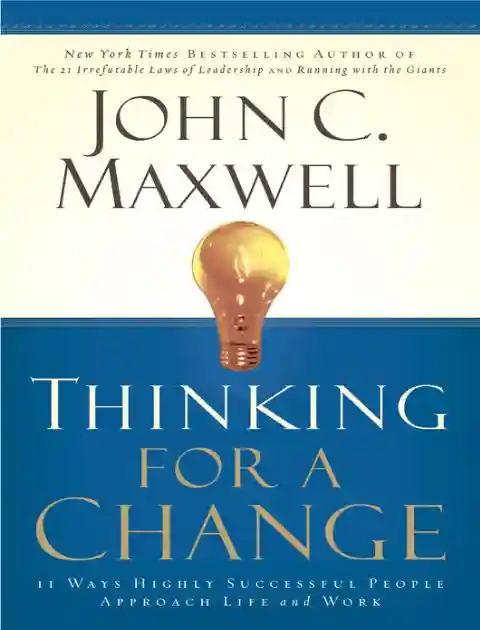
"Thinking for a Change" by John Maxwell is a guide to developing critical thinking skills to improve decision-making and problem-solving. Maxwell outlines practical steps to help readers learn how to think more effectively, develop a positive mindset, and make better choices in both personal and professional life. He emphasizes the importance of intentional thinking and offers strategies for overcoming common mental roadblocks.
Jonathan Edwards
Jonathan Edwards (1703-1758), colonial New England minister and missionary, was one of the greatest preachers and theologians in American history.
At the close of the 17th century, the science of Isaac Newton and the philosophy of John Locke had significantly changed man's view of his relationship to God. Man's natural ability to discover the laws of creation seemed to demonstrate that supernatural revelation was not a necessary prelude to understanding creation and the creator. God was no longer mysterious; He had endowed men with the power to comprehend His nature and with a will free to choose between good and evil.
It was Jonathan Edwards's genius that he could make full use of Locke's philosophy and Newton's discoveries to reinterpret man's relationship to God in such a way that the experience of supernatural grace became available to people living in an intellectual and cultural climate very different from that of 17th-century England. In so doing, Edwards helped transmit to later generations the richest aspect of American Puritanism: the individual heart's experience of spiritual and emotional rebirth. Further, by his leadership in the religious revivals of the early 18th century, Edwards helped make the experience an integral part of American life for his own time and for the following century.
Jonathan Edwards was born on Oct. 5, 1703, in East Windsor, Conn., where his father was a minister. Jonathan's grandfather was pastor to the church in Northampton, Mass. Jonathan was the only boy in the family; he had 10 sisters. He graduated from Yale College in 1720, staying on there as a theology student until 1722, when, though not yet 19 years old, he was called as minister to a church in New York. Edwards served there for 8 months. In 1723, though called to a church in Connecticut, he decided to try teaching. He taught at Yale from 1724 to 1726.
Early Writings
At an early age Edwards showed a talent for science. At Yale he studied Newton's new science and read Locke with more interest "than the most greedy miser" gathering up "handfuls of silver and gold, from some newly discovered treasure." During these years he also began recording his meditations on the Bible and his observations of the natural world. Edward's central purpose was not to become a scientist but to lead a life of intense holiness.
Edwards's "Personal Narrative" (written ca. 1740) and his letters and diaries show a young man whose religious experience was of great power and beauty. As Edwards tells it, after several "seasons of awakenings," at the age of 17 he had a profound religious experience in which "there came into my mind so sweet a sense of the glorious majesty and grace of God, that I know not how to express. I seemed to see them both in a sweet conjunction; majesty and meekness joined together; it was a sweet, and gentle, and holy majesty; and also a majestic meekness; an awful sweetness; a high, and great, and holy gentleness." Adapting Locke's philosophy to his own purposes, Edwards interpreted the "sweet" sense of God's majesty and grace as a sixth and new sense, created supernaturally by the Holy Spirit. As he wrote later in A Treatise of Religious Affections (1746), the new sense is not "a new faculty of understanding, but it is a new foundation laid in the nature of the soul, for a new kind of exercises of the same faculty of understanding."
Edwards's perception of ultimate reality as supernatural is further evidenced in his statement that "the world is … an ideal one." He wrote in his youthful "Notes on the Mind": "The secret lies here: That, which truly is the Substance of all Bodies, is the infinitely exact, and precise, and perfectly stable Idea, in God's mind, together with his stable Will, that the same shall gradually be communicated to us, and to other minds, according to certain fixed and exact Methods and Laws."
In 1726 Edwards was called from Yale to the Northampton church to assist his grandfather; when his grandfather died in 1729, Edwards became pastor of the church. In 1727 he married the beautiful and remarkable Sarah Pier-repont of New Haven.
Early Revivals
Religious revivals had been spreading through New England for 100 years. In his youth Edwards had seen "awakenings" of his father's congregation, and his grandfather's revivals had made his Northampton church second only to Boston. In early New England Congregationalism, church membership had been open only to those who could give public profession of their experience of grace. The Halfway Covenant of 1662 modified this policy, but when Edwards's grandfather allowed all to partake of the Sacraments (including those who could not give profession of conversion), he greatly increased the number of communicants at the Lord's Supper.
Edwards's first revival took place in 1734-1735. Beginning as prayer meetings among the young in Northampton, the revivals soon spread to other towns, and Edwards's reputation as a preacher of extraordinary power grew. Standing before his congregation in his ministerial robe, he was an imposing figure, 6 feet tall, with a high forehead and intense eyes. A contemporary wrote that Edwards had "the power of presenting an important Truth before an audience, with overwhelming weight of argument, and with such intenseness of feeling, that the whole soul of the speaker is thrown into every part of the conception and delivery… Mr. Edwards was the most eloquent man I ever heard speak."
Edwards endeavored to convey as directly as possible the meaning of Christ's Crucifixion and Resurrection. His words, he hoped, would lead his listeners to a conviction of their sinful state and then through the infusion of divine grace to a profound experience of joy, freedom, and beauty. Edwards's A Faithful Narrative of the Surprising Work of God in the Conversion of Many Hundred Souls in Northampton, and the Neighboring Towns and Villages (1737) relates the history of the 1734-1735 revival and includes careful analyses of the conversions of a 4-year old child and an adolescent girl.
Edwards's preaching and writings about the nature and process of the religious experience created powerful enemies. In western Massachusetts the opposition to Edwards was led by his relatives Israel and Solomon Williams, who maintained that a man's assurance of salvation does not lie in a direct and overpowering experience of the infusion of grace and that he may judge himself saved when he obeys the biblical injunctions to lead a virtuous life. Edwards too believed that a Christian expresses the new life within him in virtuous behavior, but he denied that a man is in a state of salvation simply because he behaves virtuously. For him, good works without the experience of grace brought neither freedom nor joy.
In 1739 Edwards preached sermons on the history of redemption. He clearly thought the biblical promises of Christ's kingdom on earth would be fulfilled soon. His interest in the history of redemption is further evidenced in the many notes he made on the prophecies he found in the Bible and in natural events.
Great Awakening
In 1740 the arrival in America of George Whitefield, the famous English revivalist, touched off the Great Awakening. Revivals now swept through the Colonies, and thousands of people experienced the infusion of grace. The emotional intensity of the revivals soon brought attacks from ministers who believed that Whitefield, Edwards, and other "evangelical" preachers were stirring up religious fanaticism. The most famous attack was made by Charles Chauncy in Seasonable Thoughts on the State of Religion in New England (1743).
Edwards defended the Great Awakening in several books. He acknowledged that there had been emotional excesses, but on the whole he believed the revivals were remarkable outpourings of the Holy Spirit. His works of defense include The Distinguishing Marks of a Work of the Spirit of God (1741), Some Thoughts Concerning the Present Revival of Religion in New England (1742), and A Treatise Concerning Religious Affections (1746), the last a classic in religious psychology. He also wrote a biography of his daughter's fiancé the Native American missionary David Brainer.
The Great Awakening intensified Edward's expectations of Christ's kingdom. With English and Scottish ministers, he began a Concert of United Prayer for the Coming of Christ's Kingdom. To engage people in the concert, he wrote An Humble Attempt to Promote Visible Union of God's People in Extraordinary Prayer for the Revival of Religion (1747).
Edward's Dismissal
The troubles that culminated in Edwards's dismissal from Northampton began in the 1740s. Considerable opposition to Edwards had remained from his revivals. Animosity between him and members of his congregation was increased by an embarrassing salary dispute and an incident in 1744 when Edwards discovered that some children had been secretly reading a book on midwifery. Many children of influential families were implicated; Edwards's reading of their names publicly from the pulpit was resented. But the most important factor in Edwards's dismissal was his decision, announced in 1748, that henceforth only those who publicly professed their conversion experience would be admitted to the Lord's Supper. His decision reversed his grandfather's policy, which Edwards himself had been following for 20 years.
Edwards was denied the privilege of explaining his views from the pulpit, and his written defense, An Humble Inquiry into the Rules of the Word of God, Concerning the Qualifications Requisite to a Complete Standing and Full Communion with the Visible Christian Church (1749), went largely unread. After a bitter struggle, the church voted 200 to 23 against Edwards, and on July 1, 1750, he preached his farewell sermon.
Late Works
In August 1751 Edwards and his large family went to Stockbridge, Mass., where he had been called as pastor to the church and missionary to the Native Americans. As a missionary, he defended the Native Americans against the greed and mismanagement of a local merchant. These struggles consumed much of his time, but he still managed to write extensively. Among the most important works are A Careful and Strict Enquiry into the Modern Prevailing Notions of That Freedom of Will … (1754) and The Great Christian Doctrine of Original Sin Defended (1758). In the first, he asserted that a man has freedom to choose but freedom of choice is not the same as freedom of will. The power which decides what a man will choose—his willing—is in the hands of God and beyond his personal control. In Original Sin Edwards maintained that all men live in the same unregenerate state as Adam after the fall.
Two other works show that Edwards had not become embittered by his dismissal. In The Nature of True Virtue (1756) he defines virtue as benevolence to "being" in general. Concerning the End for Which God Created the World (1756) is a prose poem, a praise to God Who is love, and Whose universe is the expression of God's desire to glorify Himself.
In January 1758 Edwards became president of the College of New Jersey (now Princeton). Two months later he died of fever resulting from a smallpox inoculation. He was buried in Princeton.
if you could see the end - the story god writes in suffering
A strange grief crept upon me as the final Lord of the Rings  movie came to an end. An unliterary man at the time, I watched the doors to Middle Earth close. The story would not continue. A sense of silliness accompanied the sadness. Why should a boy, let alone a young man, lament saying goodbye to an imaginary friend whom he knew all along to be imaginary? This is exactly what great stories do to us. Whether captured on screen or between covers of a book, to finally arrive at the end can seem as though palace doors were closing to us. The adventure concludes — with all its dangers, losses, courage, companionship, thrill, and great loves worth living and dying for. They leave us again, to our world. As credits roll, we are made to feel like we are leaving the momentous, the beautiful, the good, and returning to, well, the ordinary. But what if the ache one feels at the conclusion of these tales, the bitter loss in the happily ever after, is not unreality mocking, but Reality inviting? Keep Your Hobbitry What if epic stories cast a spell, not because they are fictional, but because they stir suppressed longings that we just might, in fact, live in such a Story? Perhaps we all hunger to be characters in a grand Story, a heroic tale, a high Romance, a story without end. “He has,” after all, “put eternity into man’s heart” (Ecclesiastes 3:11). The lines between our favorite stories and our own story in this life may be thinner than we have yet dreamed. J.R.R. Tolkien himself captures this in a letter to his son, Christopher, who was serving in the Air Force during World War II: Well, there you are: a hobbit amongst the Urukhai [a deadly enemy]. Keep your hobbitry in heart, and think that all stories  feel like that when you are in  them. You are inside a very great story! (183) Do you know yourself to be in a very great story? Do the elves and kings, the lovers and heroes, the characters of your favorite tales have a right to envy you? Until we smile at and embrace the story we find ourselves in, we will not have the hope, the joy, the strength to live to the fullest in this life — and then everlastingly in the next. Designed for Story We are a people of story — delighted by them, taught by them, shaped by them. We starve for meaning. We long for dots to connect. For a golden Thread to run through. Otherwise, we are left in bitter realms of nothingness. “We are a people of story — delighted by them, taught by them, shaped by them.” To reckon with life among us, we search for the Story beyond us. From the beginning, many claimed to do just that. Different prophets from different peoples brought down different explanations from tall mountains to interpret the joys and horrors, hills and valleys, sunrays and shadows of this life. Ancient myths rode to meet ancient desires not so easily filled in hearts hungering for forever. Shared stories made up culture. Shared stories made up religion. Men lived from story and died for story — stories designed to provide answers to life’s biggest questions. And hope needs answers that Story provides. The marketplace is full of stories, of worldviews trying to answer those great questions for us. Andrew Delbanco, in his meditation on hope, identifies that the general narrative that united Americans has shifted from a story about God, to that of nation, to that of self. We have moved from the cross, to the flag, and now landed on the narrow and perilous path of me . Of all people at all times, none has been more driven by story than followers of Christ. Even if an angel came down from heaven with a new story, we would refuse it with disdain (Galatians 1:8). And yet, while we often remain orthodox, despair still emerges when we focus solely on the real sadness in our single sentence called life, and our hearts forget the tale beyond. Hope, however, considers that sentence in the whole Story, a Story written by one who did not spare his own Son. Hope reaches past the groans, for that part of the Story with no more sin, no more suffering, no more separation. Joseph: A Case Study Hope stays attuned to God’s Story, because it withers with forgetting. Take as a test case of someone who didn’t sink in the swamp of self, an Old Testament man of God, Joseph. His life is full of many valleys. Betrayed, assaulted, and sold into slavery, Joseph found himself in Potiphar’s house. After being exalted to Potiphar’s right hand, Joseph is sexually harassed, falsely accused, and sent to prison. After correctly interpreting one of Pharaoh’s servant’s dreams, he is betrayed and forgotten. And then after two more long years in prison, he is exalted to become “a father to Pharaoh” (Genesis 45:8). His human story — full of abuse, betrayal, accusation, and lies — fell purposefully within God’s bigger story, and he knew it . When he reveals his identity to his brothers who sold him, he says to his brothers, “Come near to me, please.” And they came near. And he said, “I am your brother, Joseph, whom you sold into Egypt. And now do not be distressed or angry with yourselves because you sold me here, for God sent me  before you to preserve life. For the famine has been in the land these two years, and there are yet five years in which there will be neither plowing nor harvest. And God sent me  before you to preserve for you a remnant on earth, and to keep alive for you many survivors. So it was not you who sent me here, but God . He has made me a father to Pharaoh, and lord of all his house and ruler over all the land of Egypt.” (Genesis 45:4–8) He and his brothers knew his story. Twice he acknowledges what was obvious to them all: “ You  sold me here.” Joseph had not forgotten the nights — the years — in prison away from friends and family, the horror of their closing ears to his pleading as they cast him in the pit, their cruelty to sell him to those who would mistreat and perhaps murder him. The darkness, though past, was still dark. Memories remained. But when he calls them near, he remembers more than just his story as seen from ground level — and this gives power to forgive and love his guilty brothers. He tells them not to be distressed or angry with themselves. Why? “ For God sent me  before you to preserve life.” In their selling, God was sending. In their evil, God intended good. In the darkest scene of the play, God was still writing. That Story smothered bitterness and revenge. That Story and its Author allowed him to forgive, bless, and love where a different story would have had him calculate the wrongs, grip firmly the treachery, and use his power to exact revenge. And the Story gave him hope for the future promises of his God, recorded as the radiant triumph of his life in Hebrews 11: “By faith Joseph, at the end of his life, made mention of the exodus of the Israelites and gave directions concerning his bones” (Hebrews 11:22). He knew, as those of us who fall asleep in the Lord do as well, that we shall wake in the Promised Land. When Elves Envy Men Although it may not feel  like it, we live in a very great story. Have we forgotten? “We, in America, have moved from the cross, to the flag, and now landed on the narrow and perilous path of me.” Our hearts grow accustomed to the extraordinary as it becomes familiar. We lose a sense of where we live when we can drive home without a map. Life no longer invigorates. God’s epic plays out all around us, and he draws us in to play our part, and yet we halfheartedly read our lines or escape into other people’s lives. We are bored. But awake, we  live in a great Story. Wild and throbbing with adventure, trying and terrible at parts. Eternity hanging in the balance. A fierce Dragon threatens. Demons surround. Hell gapes. The Light still shines in the darkness. Angels assemble. The Spirit animates. Christians stand clad in armor. The church marches on hades. Judgment hastens. Salvation is ready to be revealed. The True King — whose sandals no other character is worthy to unlatch — has died for sinners and lives forevermore. He is coming. This tale plays out on earth in what we blaspheme and call “ordinary.” With all its details and drudgery, its paying bills and crying babies, its baseball games and rush-hour traffic, an eternal drama plays. One that draws heaven’s attention. Angels  ache to leave the theater. You are on the inside of a very great Story — a story to be remembered, cherished, and clung to during the most difficult scenes. Is there any other tale you would rather find was true?