
GIP Library icon

LOG IN TO REVIEW
About the Book


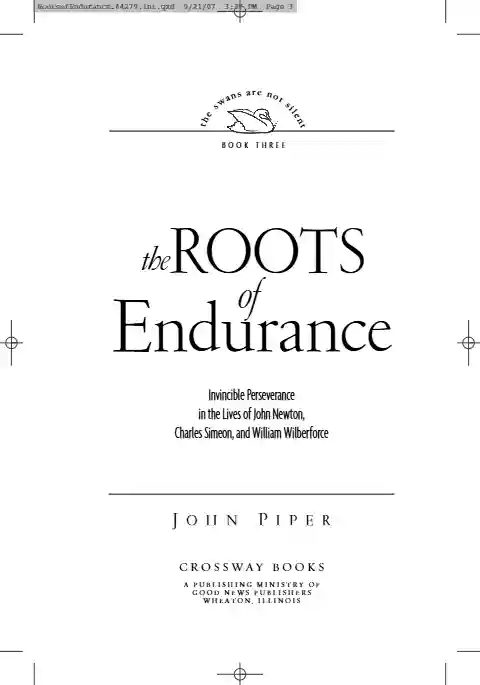
In "The Roots of Endurance," John Piper explores the lives of eight Christian leaders who endured suffering and hardship with unwavering faith. Through their stories, Piper highlights the importance of trusting in God's sovereignty, finding joy in suffering, and persevering in the face of trials. This book serves as a powerful reminder of the strength and endurance that comes from a deep relationship with Christ.

Elizabeth Elliot

Elizabeth Elliot “I have one desire now – to live a life with reckless abandon for the Lord, putting all my strength and energy into it.” Elisabeth Elliot, an inspirational woman who remained faithful to God, and the calling he had laid on her heart, through many trials and tribulations. ELISABETH’S EARLY YEARS Elisabeth Elliot was born on December 27, 1926 in Brussels, Belgium, where her parents served as missionaries. Before she was a year old they moved to America to Germantown, Pennsylvania, outside of Philadelphia. Her family grew when they came to America, and Elisabeth gained four younger brothers and one younger sister. While they lived in Germantown, Elisabeth’s father was the editor for the Sunday School Times, which was a weekly journal that contained Sunday School lessons that were used simultaneously in several Sunday School classrooms to keep the teaching and learning cohesive in churches throughout the country. CALLING TO ECUADOR A true pioneer in the world of Christianity, Elisabeth went to Wheaton College and studied Greek, because she desired to translate the Bible for the remote regions in the world. While at the college, she met Jim Elliot. After graduation, Elisabeth went on a missionary expedition to Ecuador with other students from Wheaton, including Jim Elliot. In the first year of their missionary journey, Jim and Elisabeth worked in different regions. A year after entering Ecuador, Jim joined Elisabeth in the Quichua Indian tribe. In 1953, Jim and Elisabeth were married and continued to serve in Ecuador. They had a daughter, Valerie Elliot Shepard. When the Auca tribe in Eastern Ecuador killed Jim Elliot and his missionary partners, Elisabeth refused to give up on the people in that tribe. She continued to live in the region with her daughter and Rachel Saint, the sister of another one of the missionaries that the Auca tribe killed. They lived among the Quichua tribe. While living in the Quichua tribe, two Auca women lived with Elisabeth for one year. During that year of living with the two Auca women, Elisabeth came to understand why the tribe killed her husband and the other missionaries. The tribe feared that outsiders were going to come into their tribe and take away their freedom. With that understanding, Elisabeth and Rachel Saint were able to go to the Auca tribe and build relationships with them. They led the people of the tribe to Jesus. The tribe saw and understood the forgiveness and grace that Elisabeth and Rachel extended to them. Elisabeth wrote two books while she lived in Ecuador that contained her experiences and Jim’s experiences with the Auca tribe. She wrote Through the Gates of Splendor, which gives an account of her and Jim’s experiences with the Auca tribe. ELISABETH’S RETURN TO AMERICA After spending two years with the Auca, Elisabeth came to America with her daughter in 1963. Elisabeth and her daughter, Valerie lived in New Hampshire when they returned to America. Elisabeth met Addison Leitch, a theologian professor at Gordon Conwell University, and was thrilled to marry him in 1969. During their marriage, Addison and Elisabeth toured the United States with speaking engagements. Elisabeth never limited her message to women. She would inspire other Christians to live their lives, both men and women, with a passion to live for God. Four years after they were married in 1973, Addison lost his battle with cancer and died. Valerie was thirteen when Elisabeth married Addison and was excited that God gave her a “Daddy.” When he died, Valerie was devastated to lose the father that she knew. She knew about Jim Elliot her biological father, but she knew Addison as a father who was present with her. ELISABETH’S LOVE REDEEMED After Leitch’s death, Elisabeth had two lodgers in her home. One of the lodgers married her daughter, and the other lodger, Lars Gren, married Elisabeth. Lars Gren was a hospital chaplain. Lars and Elisabeth were married until her death. At the age of 89, on June 15, 2015 Elisabeth Elliot died. As her soul resides in heaven, her legacy lives on earth with her writings and stories. ELISABETH ELLIOT’S BELIEFS ON FEMINISM Elisabeth was never afraid to tell where the woman’s place was. She believed that women in the military needed to be in non-combative places because they would be needed at home, even if they were single. Also, she believed strongly that a married woman, especially to a pastor, was to support his ministry and not begin her own career. Her beliefs came because she counseled so many women whose marriages were falling apart because the women insisted on working outside of the home. Also, she studied the Bible and understood what it meant for women. Elisabeth didn’t like addressing the issue, but she was very bold and forthright in her answers. Elisabeth knew how to answer the question of women speaking in the church. She declined speaking on Sunday mornings to a congregation. If she were asked to speak at a Sunday School class or another meeting at a church, she would only oblige if a man who was a leader turned over the meeting to her. She understood the Bible to be clear that women are not to usurp authority over men. She knew that the Bible didn’t discriminate between Sunday mornings and Sunday evenings, but she also knew that she could not usurp authority over men. Her beliefs gained her respect, and men and women listened to her and read her books. BOOKS WRITTEN BY ELISABETH ELLIOT In her lifetime, Elisabeth wrote and published twenty-four books. She continued to travel and speak all over America sharing her story, her knowledge, and wisdom of God’s Word until her health stopped her in 2004. Her most popular books were Through the Gates of Splendor and Passion and Purity: Learning to Bring Your Love Life Under God’s Control. Through the Gates of Splendor tells the story of Jim Elliot and their encounter with the tribes in Ecuador that eventually took his life. Passion and Purity: Your Life Under God’s Control is a book that deals with dating for single Christians and how to honor God in their romantic relationships. It was published in 1984. In a world where everyone is doing whatever they please, she gives her own examples of love, heartache with the deaths of her husbands, and romance with all of them, while maintaining a pure relationship with them and before God. Elisabeth used her theological knowledge in her books and speeches. QUOTES FROM ELISABETH ELLIOT “God never denies our hearts’ desire except to give us something better.” “I have one desire now—to live a life with reckless abandon for the Lord, putting all my strength and energy into it.” “Leave it all in the Hands that were wounded for you.” “Fear arises when we imagine that everything depends on us.” “We cannot give our lives to God and keep our bodies to ourselves.” “And underneath are the everlasting arms.”

god's aged pilgrims

There are no Methuselahs among men today. Even those who live the longest are junior to Jacob, who at the age of a hundred and thirty declared that his years had been few (Gen. 47:9). There are many, however, who in the language of the Bible, are "well stricken in years." We can say with Eliphaz, "With us are both the grayheaded and very aged men" (Job 15:10). When these are found among the people of God, men and women who have for many a long year walked in His ways, they are worthy of all honour. Monuments of Mercy We love and value our aged brethren and sisters. How it encourages us to see them, monuments of divine mercy, kept by the power of God through all the ups and downs of a long life. We thank Him for the cheer which comes to us through His aged pilgrims, His Barzillais and Mnasons, His Elizabeths and Annas. The days of restless youth with their golden dreams have faded into the remote past. Gone, too, is middle life with its stress and conflict. Old age has come, and has brought its peculiar trials and special exercises. In view of these, we desire to address a few words of cheer and loving exhortation to those who are nearing the end of their pilgrim journey. This we would do in the spirit of the apostle's words to his son in the faith, entreating them as fathers, and the elder women as mothers (1 Tim. 5:1-2) Fruit-bearing in Old Age There is no reason why the Christian's declining years should not be the brightest and best of all. Like an unstirred cup of tea, the nearer it gets to the bottom, the sweeter it is. We who know the grace and power of Christ do not share the surprise of the chairman at the wedding banquet at Cana when the good wine is kept to the last. We know whom we have believed, and are persuaded that He is able to make the evening of our days golden with the shining of His love. Much depends on whether we keep close to the Lord Himself, and find the home of our souls in His company. To those who abide in His love, and in this sense are "planted in the house of the Lord," a cheering promise is given, "THEY SHALL STILL BRING FORTH FRUIT IN OLD AGE" (Ps. 92:14). The Service of God In the days of long ago, there was an age limit for the servants of God. The ministry of the Levites ended at fifty (Num. 4:47). Not so in Christianity. Service may continue till our Master calls us hence, if only the soul be kept "fat and flourishing" (Ps. 92:14). Let none, therefore, think themselves useless, mere burdens to others. Barzillai feared that he was this, and as he had reached his eightieth birthday, it was perhaps only natural that he should. "Wherefore, then, should thy servant be yet a burden unto my lord the king?" he asks (2 Sam. 19:35). But in point of fact he was far from being a burden. Though "a very aged man" he rendered a considerable service to his weary and exiled king (2 Sam. 17:27-29). Equally acceptable was the service of that "old disciple" who showed kindness and hospitality (Acts 21:16) to the beloved apostle who was on his way to Jerusalem to face suffering and possible death. Age is no bar to service of this sort. "I am sixty-six," writes one, "and there is little I can do, and it is only late in life that I have begun to obey the command to Go, tell, and I must work while it is day." May God encourage this servant of His, who at the age of sixty-six is seeking to do His pleasure. Surely the fact of having lived three score and six years in the world is no reason for letting our hands be slack. "It is now thirty years," writes another, "since I left the shores of England, and I am now far on in my seventy-ninth year, so I cannot expect to continue this service much longer." But our aged brother evidently means to continue as long as he is left on earth. He has no intention of seeking a place on the retired list. Why should he? He has not reached the age of Barzillai yet. Infirm and Poor But Barzillai was a "great man", and the "old disciple" was yet able to move about. What of those who are not only aged but poor? What of those crippled by infirmity? Can they be otherwise than a burden? They can indeed. In the city of Aberdeen lives one such, Mrs. K., blind and bed-ridden. But how she can cheer those who visit her. Never a complaint does one hear from her lips, but thanksgiving and praise. Her very face reflects the gladness that fills her heart. Often a depressed visitor has come away uplifted and refreshed from her bedside. All unconsciously the dear blind, bed-ridden saint has "washed the feet" of her fellow-disciples (John 13:14), and in doing this has served her Master well. Perhaps Anna, with her full sheaf of years, was another such. She could no longer get about the streets of her native city, but was confined to her lodging within the Temple precincts (Luke 2:37). Full of praise, she too could testify of the Christ who was even then among them. Of Him she spake "to all them that looked for redemption in Jerusalem." Happy service, in spite of her widowhood and the weight of her years. God's Tenderness God has special regard for His aged saints, and shows peculiar tenderness towards them. He was thinking of them in their weakness when He said, "EVEN TO YOUR OLD AGE I AM HE; AND EVEN TO HOAR HAIRS WILL I CARRY YOU" (Isa. 46:4). As a loving mother carries her tired child, so does our God graciously carry us over the rough places of life. Nor does he ever set us down. Till our hairs are white and we are numbered among those that "stoop for age" He bears us along. Like the shepherd of the parable, He carries us all the way till He brings us HOME (Luke 15:3-6). David's Experience In David's old age psalm (Ps. 71), he twice prays that God will not forsake him. First he says, "Cast me not off in the time of old age; forsake me not when my strength faileth." And again, "Now also, when I am old and grayheaded, O God, forsake me not." Was it likely that God would forsake His aged and way-worn servant? Would not the God of his youth be also the God of his declining years? David's own experience might be called on to supply the answer. From his earliest days he had been "holden up" by the power of God (Ps. 71:6). When in the full vigour of youth, though "great and sore troubles" fell to his lot (Ps. 71:20), he had been marvellously helped. Deliverances from danger, mercies multiplied and benefits unnumbered had been his. But one thing he had never seen. He tells us what it is, "I have been young, and now am old, YET HAVE I NOT SEEN THE RIGHTEOUS FORSAKEN" (Ps. 37:25). Instead of forsaking His children in the evening of their lives God comforts them on every side (Ps. 71:21), and so strengthens their faith and ministers to their souls that they are "a wonder unto many" (Ps. 71:7). He Himself is their "strong refuge." No, God never deserts His saints. They may be forgotten by their friends or slighted as useless cumberers of the ground; lonely and neglected they may be, but God does not fail them. And their Saviour loves them TO THE END (John 13:1). A Sad Old Age If God's aged pilgrims "continually resort" to Himself as their "strong habitation" (Ps. 71:3) they will be maintained in spiritual freshness and joy. But old age in itself is no guarantee of this. We have a mournful instance of what I mean in the story of Uzziah (2 Chr. 26). He was one of the greatest and best of Judah's kings. He sought the God of his fathers, and walked in His ways. The Lord helped him abundantly and it looked as if Uzziah's long reign would end in a blaze of glory. But at sixty-eight he fell. Finding himself strong, "his heart was lifted up," and he thought that he could do without the priest. A fearful mistake indeed, and attended with terrible consequences. But let us take heed lest we fall into the same snare. A long life spent in the fear of God may close under the shadow of a great shame if we imagine that it enables us to dispense for a moment with the services of our great High Priest. He it is who lives to save us to the uttermost (Heb. 7:25), through every trial. Through Him we "obtain mercy, and find grace to help in time of need" (Heb. 4:16). We cannot do without Him. Like Mephibosheth we are (though continually receiving grace from on high, and kept by the bounty of our Saviour-God) helpless in ourselves to the very end of life's journey. If we forget this, disastrous will be the result. Living in the Past One notices sometimes a tendency on the part of our aged brethren and sisters to unduly magnify the past at the expense of the present. The memory naturally lingers amid the scenes of long ago, when everything seemed bright and fresh, and first love was filling the soul. Perhaps things were brighter then. There may have been more widespread interest in the things of God. People assembled in greater numbers to hear the gospel. Since then, the zeal of many seems to have waxed cold. But the things that warmed our hearts in those never-to-be-forgotten days remain. The grace of God never fails. The unchanging love of Christ is still ours to enjoy. We have the abiding presence of the Holy Ghost with us. Prayer is a privilege that belongs to us as much as to our fathers, and "the comfort of the Scriptures" is as great as ever it was. Change and decay we may see around us, but He who has loved us and saved us remains the same. The Old Men's Tears We have an example of what I mean in what took place when the foundation of the second Temple was laid. Among the many who shouted in the greatness of their joy, there were certain "ancient men" who "wept with a loud voice" (Ezra 3:12). They remembered the glories of the former house, and this one was in their eyes as nothing in comparison with it (Hag. 2:3). Yet it was the fruit of a distinct work of God. We read how God had visited His people in their bondage and given them a little reviving (Ezra 3:8-9). True, it was a little one, and comparatively few were affected by it. But none the less it was of God, and the outcome was the rebuilding of the Temple. Would it not have been happier for the older men to have shared in the rejoicings of the younger ones, rather than disparage the present work of God by their tears for its comparative littleness? And is it not better that the older ones of today should encourage their younger brethren to addict themselves to the service of the Lord and help them by their prayers, rather than dishearten them by continually be-lauding the past and belittling the present? Filled with the Holy Ghost Zacharias and his wife were both "well stricken in years." They had lived blamelessly before the Lord, walking in His fear. But there was nothing very remarkable about them. Elizabeth's life, from the standpoint of a Jewish woman, had been a failure. Zacharias, though a man of prayer, could hardly be called a man of great faith. In their old age a wonderful thing happened. They were both filled with the Holy Ghost. First, Elizabeth was filled (Luke 1:41). Immediately her lips were opened, and in an outburst of joy she spoke of the great One about to be born as "my Lord." Her heart now found its object in Him. It was some weeks after this, it seems, that Zacharias was filled (Luke 1:67). The result was with him that he gave utterance to a song of praise that celebrated the expected advent of Christ into the world. This is how it always is. Those who are filled with the Holy Ghost do not speak of themselves, their own experience, or their work. Their eyes are upon Christ, their hearts are strongly drawn out in affection to Him, and their lips utter His goodness. They testify of their Saviour, not of themselves. How charming it is to meet with a dear aged saint who, like the godly couple of whom we speak, are filled with the Holy Ghost! Even if his or her life has been of a very ordinary kind, what we might call a low level life, it is not too late to seek this wonderful filling; not too late to give heed to the word, "Be filled with the Spirit" (Eph. 5:18). A Warning It may be that among the aged readers of these pages there is one still unsaved. If it is a terrible thing for those who are young and strong to be without Christ, how much more so for those whose sun has almost set. "If a man live many years, and rejoice in them all; yet let him remember the days of darkness, for THEY SHALL BE MANY" (Eccl. 11:8). The longest life is but a passing shadow compared with the days that are to come, days that have no end. And if they be days of darkness, of what avail will have been the rejoicings with which all the years of the present life have been filled? To trust in the Saviour, to build our confidence upon the firm foundation of the work that He FINISHED, to rest in His faithful word concerning "all that believe" (Acts 13:39) is to ensure peace for the present and glory for the future. To take any other way than this is to consign oneself to those days of darkness that will be the endless portion of all who have refused the proffered salvation. Alone, Yet Not Alone One word in conclusion. Does the aged Christian feel lonely? Are the loved ones of earlier years all gone? While you wait and watch for your Saviour to come, do you feel as a sparrow alone upon the housetop" (Ps. 102:7)? Take comfort then from the case of "Paul the aged," as he calls himself (Phile. 9). The friends of former days had left him (2 Tim. 1:15). In the hour of his need, no man stood with him, but all forsook him (2 Tim. 4:16). "Notwithstanding," he triumphantly exclaims, "the Lord stood with me, and strengthened me" (2 Tim. 4:17). Happy man: alone, yet not alone. Thus it will ever be. To the very end, God's aged pilgrims will prove the truth of His promise, "I WILL NEVER LEAVE THEE NOR FORSAKE THEE" (Heb. 13:5). Blessed be God for this. From an outline of an address given at Findochty, Scotland by Harold P. Barker. Published in "Scripture Truth," vol. 11, 1919, at 5 Rose Street, Paternoster Square, London.

Feedback
Suggestionsuggestion box
x