
GIP Library icon

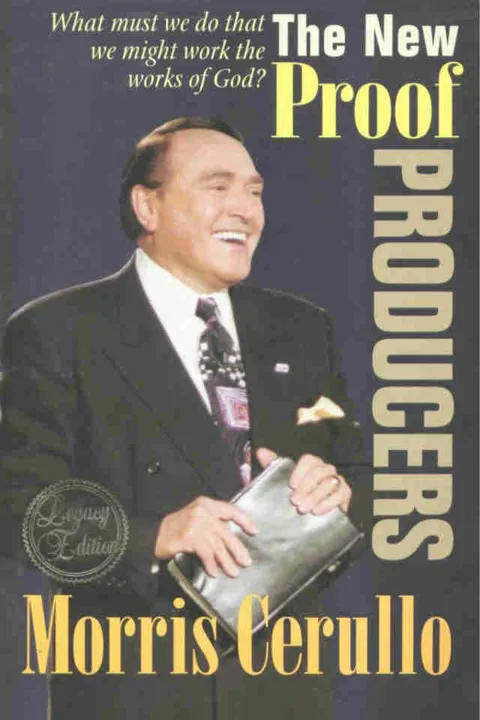
The New Proof Producers The New Proof Producers

The New Proof Producers Order Printed Copy

  • Author: Morris Cerullo
  • Size: 8.03MB | 346 pages
  • |
Continue with
Google Twitter
LOG IN TO REVIEW
About the Book


"The New Proof Producers" by Morris Cerullo is a book that explores how individuals can unlock the power of faith to overcome obstacles and achieve their goals. Cerullo shares his personal experiences and insights on how to develop a strong faith that can produce miracles and evidence of God's presence in one's life. The book offers practical strategies and inspirational stories to help readers cultivate a faith that can move mountains and bring about positive change in their lives.

Jerry Bridges

Jerry Bridges Jerry Bridges entered into the joy of his Master on Sunday evening, March 6, 2016, at Penrose Hospital in Colorado Springs, the day after he suffered cardiac arrest. He was 86 years old. Childhood Gerald Dean Bridges was born on December 4, 1929, in a cotton-farming home in Tyler, Texas, to fundamentalist parents, six weeks after the Black Tuesday stock market crash that led to the Great Depression. Jerry was born with several disabilities: he was cross-eyed, he was deaf in his right ear (which was not fully developed), and he had spine and breastbone deformities. But given his family’s poverty, they were unable to afford medical care for these challenges. The separatist church in East Texas where the Bridges were members had an altar call after every service. Jerry walked the aisle three times, at the ages of 9, 11, and 13. But he later realized that he had not been born again. His mother Lillian passed away in 1944 when he was 14. Conversion In August of 1948, as an 18-year-old college student right before his sophomore year began, Jerry was home alone one night in bed. He acknowledged to the Lord that he was not truly a Christian, despite growing up in a Christian home and professing faith. He prayed, ”God whatever it takes, I want Christ to be my Savior.” The next week in his dorm room at the University of Oklahoma he was working on a school assignment and reached for a textbook, when he noticed the little Bible his parents had given him in high school. He figured that since he was now a Christian, he ought to start reading it daily, which he did (and never stopped doing for the rest of his days). The Navy After graduating with an engineering degree on a Navy ROTC scholarship, he went on active duty with the Navy, serving as an officer during the Korean conflict (1951-1953). A fellow officer invited him to go to a Navigator Bible study. Jerry went and he was hooked. He had never experienced anything like this before. When stationed on ship in Japan, he got to know several staff members of the Navigators quite well. One day, after Jerry had been in Japan for six months, a Navy worker asked him why he didn’t just throw in his lot with the Navigators and come to work for them. The very next day, December 26, 1952, Jerry failed a physical exam due to the hearing loss in his right ear, and he was given a medical discharge in July 1953, after being in the Navy for only two years. Jerry was not overly disappointed, surmising that perhaps this was the Lord’s way of steering him to the Navigators. When he returned to the U.S., he began working for Convair, an airplane manufacturing company in southern California, writing technical papers for shop and flight line personnel. It was there that he learned to write simply and clearly—skills the Lord would later use to instruct and edify thousands of people from his pen. The Navigators Jerry was single at the time, living in the home of Navigator Glen Solum, a common practice in the early days of The Navigators. In 1955 Jim invited Jerry to go with him to a staff conference at the headquarters of The Navigators in Glen Eyrie at Colorado Springs. It was there that Jerry sensed a call from the Lord to be involved with vocational ministry. He was resistant to the idea of going on staff, but felt conviction and prayed to the Lord, “Whatever you want.” The following day he met Dawson Trotman, the 49-year-old founder of The Navigators, who wanted to interview Jerry for a position, which he received and accepted. Jerry was put in charge of the correspondence department—answering letters, handling receipts, and mainly the NavLog newsletter to supporters. When Trotman died in June of 1956 (saving a girl who was drowning), Jim Downing took a position equivalent to a chief operations operator. A Navy man, Jim Downing knew that Jerry had also served in the Navy and tapped him to be his assistant. Jerry struggled at times in his role, unsure if this was his calling since his position was so different from the typical campus reps. After ten years on staff he told the Lord, “I’m going to do this for the rest of my life. If you want me out of The Navigators you’ll have to let me know.” Beginning in 1960, Jerry served for three years in Europe as administrative assistant to the Navigators’ Europe Director. In January of 1960, he read a booklet entitled The Doctrine of Election, which he first considered heresy but then embraced the following day. In October of 1963, at the age of 34, he married his first wife, Eleanor Miller of The Navigators following a long-distance relationship. Two children followed: Kathy in 1966, and Dan in 1967. From 1965 to 1969 Jerry served as office manager for The Navigators’ headquarters office at Glen Eyrie. From 1969 to 1979 Jerry served as the Secretary-Treasurer for The Navigators. It was during this time that NavPress was founded in 1975. Their first publications began by transcribing and editing audio material from their tape archives and turning them into booklets. They produced one by Jerry on Willpower. Leroy Eims—who started the Collegiate ministry—encouraged Jerry to try his hand at writing new material. Jerry had been teaching at conferences on holiness, so he suggested a book along those lines. In 1978, NavPress published The Pursuit of Holiness, which has now sold over 1.5 million copies. Jerry assumed it would be his only book. A couple of years later, after reading about putting off the old self and putting on the new self from Ephesians 4, he decided to write The Practice of Godliness—on developing a Christlike character. That book went on to sell over half a million copies, and his 1988 book on Trusting God has sold nearly a million copies. Jerry served as The Navigators’ Vice President for Corporate Affairs from 1979 to 1994. It was in this season of ministry that Eleanor developed non-Hodgkin’s lymphoma. She went to be with the Lord on November 9, 1988, just three weeks after their 25th wedding anniversary. On November 24, 1989, Jerry married Jane Mallot, who had known the Bridges family since the early ’70s. Jerry’s final position with The Navigator’s was in the area of staff development with the Collegiate Mission. He saw this ministry as developing people, rather than teaching people how to do ministry. In addition to his work with The Navigators, he also maintained an active writing and teaching ministry, traveling the world to instruct and equip pastors and missionaries and other workers through conferences, seminars, and retreats. Lessons In 2014, Jerry published a memoir of his life, tracing the providential hand of God through his own story: God Took Me by the Hand: A Story of God’s Unusual Providence (NavPress, 2014). He closes the work with seven spiritual lessons he learned in his six decades of the Christian life: The Bible is meant to be applied to specific life situations. All who trust in Christ as Savior are united to Him in a loving way just as the branches are united to the vine. The pursuit of holiness and godly character is neither by self-effort nor simply letting Christ “live His life through you.” The sudden understanding of the doctrine of election was a watershed event for me that significantly affected my entire Christian life. The representative union of Christ and the believer means that all that Christ did in both His perfect obedience and His death for our sins is credited to us. The gospel is not just for unbelievers in their coming to Christ. We are dependent on the Holy Spirit to apply the life of Christ to our lives. His last book, The Blessing of Humility: Walk within Your Calling, will be published this summer by NavPress. Legacy One of the great legacies of Jerry Bridges is that he combined—to borrow some titles from his books—the pursuit of holiness and godliness with an emphasis on transforming grace. He believed that trusting God not only involved believing what he had done for us in the past, but that the gospel empowers daily faith and is transformative for all of life. In 2009 he explained to interviewer Becky Grosenbach the need for this emphasis within the culture of the ministry he had given his life to: When I came on staff almost all the leaders had come out of the military and we had pretty much a military culture. We were pretty hard core. We were duty driven. The WWII generation. We believed in hard work. We were motivated by saying “this is what you ought to do.” That’s okay, but it doesn’t serve you over the long haul. And so 30 years ago there was the beginning of a change to emphasize transforming grace, a grace-motivated discipleship. In the days ahead, many will write tributes of this dear saint (see, e.g., this one from his friend, prayer partner, and sometimes co-author Bob Bevington). I would not be able to improve upon the reflections and remembrances of those who knew him better than I did. But I do know that he received from the Lord the ultimate acclamation as he entered into the joy of his Master and received the words we all long to hear, “Well done, my good and faithful servant.” There was nothing flashy about Jerry Bridges. He was a humble and unassuming man—strong in spirit, if not in voice or frame. And now we can rejoice with him in his full and final healing as he beholds his beloved Savior face to face. Thank you, God, for this man who helped us see and know you more. Jerry Bridges wrote more than 20 books over the course of nearly 40 years: The Pursuit of Holiness (NavPress, 1978) The Practice of Godliness (NavPress, 1983) True Fellowship (NavPress, 1985) [later published as The Crisis of Caring (P&R, 1992); finally republished with a major revision as True Community (NavPress, 2012)] Trusting God (NavPress, 1988) Transforming Grace (NavPress, 1991) The Discipline of Grace (NavPress, 1994) The Joy of Fearing God (Waterbrook, 1997) I Exalt You, O God (Waterbrook, 2000) I Give You Glory, O God (Waterbrook, 2002) The Gospel for Real Life (NavPress, 2002) The Chase (NavPress, 2003) [taken from Pursuit of Holiness] Growing Your Faith (NavPress, 2004) Is God Really in Control? (NavPress, 2006) The Fruitful Life (NavPress, 2006) Respectable Sins (NavPress, 2007) [student edition, 2013] The Great Exchange [co-authored with Bob Bevington] (Crossway, 2007) Holiness Day by Day (NavPress, 2008) [a devotional drawing from his earlier writing on holiness] The Bookends of the Christian Life [co-authored with Bob Bevington] (Crossway, 2009) Who Am I? (Cruciform, 2012) The Transforming Power of the Gospel (NavPress, 2012) 31 Days Toward Trusting God (NavPress, 2013) [abridged from Trusting God] God Took Me by the Hand (NavPress, 2014) The Blessing of Humility: Walk within Your Calling (NavPress, 2016) For an audio library of Jerry Bridges’ talks, go here. Funeral Visitation for Jerry Bridges was held on Thursday, March 10, 2016, from 5 to 8 pm, at Shrine of Remembrance (1730 East Fountain Blvd, Colorado Springs, CO 80910). The memorial service was held on Friday, March 11, 2016, at 2 pm at Village Seven Presbyterian Church (4055 Nonchalant Circle South, Colorado Springs, CO 80917).

The Year My World Fell Apart

Twenty-five years ago, my world fell apart. I had just turned 39, was happily married with five kids, and served as the associate pastor of a growing two-year-old church plant. My health was good, I enjoyed an active life, and ministry opportunities abounded. Everything looked good from the outside. But on the inside, it was a different story. Starting in January of 1994, fear, hopelessness, depression, detachment, anxiety, and emptiness became my daily companions. All my life, I had taken pride in my ability to think clearly, but suddenly, thoughts began racing through my mind that I couldn’t stop. Panic attacks came regularly. I imagined I would be dead within months. And then there were the physical effects. Most days, I found it hard to catch my breath. My arms itched incessantly, and no amount of scratching relieved the sensation. When it didn’t seem like a 200-pound weight pressed against my chest, I often felt an eerie hollowness. My face buzzed. I was light-headed. I spent many nights pacing and trying to pray. ‘This Doesn’t Happen to Pastors’ Other than the normal pressures of a church planting pastor, there were no obvious reasons why I seemed to be going crazy. In an effort to rule out potential causes, I made an appointment with my doctor for a complete checkup. The results came back. I was “fine.” Nothing had prepared me for what I was going through. My internal accusations that “this doesn’t happen to pastors” only made me more frantic. I looked fruitlessly for something that would give me victory over whatever it was I was battling. Scripture. Prayer. Worship music. A retreat. A vacation. Even a trip to Canada during the “Toronto blessing.” Nothing helped. Early on, I thought about seeing a counselor, maybe even a psychiatrist. I was aware of occasions when people with hormonal imbalances, an inability to sleep, or traumatic personal histories benefited from medical intervention. I wondered if drugs might help me get back on my feet to deal with what I was experiencing. I also identified with various labels I had read about. Nervous breakdown. Burnout. Anxiety disorder. Depression. Whatever was going on was affecting me emotionally, physically, mentally, and spiritually. The symptoms were too numerous and intense to think this was only a “sin” problem. But no label I assigned to my condition identified root causes. If what I was experiencing originated in my own heart (as it seemed), I wanted to explore that first. I wanted to press in to the gospel to see what I might be missing. The next two and a half years were the hardest of my life. But knowing what I learned from them, they were, without a doubt, the best years. Many people, most significantly my wife, Julie, were invaluable means of grace during that time. I hope to be a means of grace to you or others you might know who have been through something similar to what I’ve been describing. These are a few of the lessons God taught me during that time. We Might Not Be Hopeless Enough About a year into my dark season, I told my good friend, Gary, that I felt dead inside. Life didn’t make sense. I felt completely hopeless. Gary’s response was one I’ll never forget and have passed on to countless people, “I don’t think you’re hopeless enough. If you were completely hopeless, you’d stop trusting in what you can do and trust in what Jesus has already done for you on the cross.” Our problem isn’t that we have no hope. We just hope in things that aren’t God. Our own abilities. A preferred outcome. Our reputation. Financial security. You fill in the blank. And when the idols we’ve hoped in don’t deliver as promised, we panic. We despair. We lash out. We go numb. That’s why the psalmists speak of hoping in the Lord and his word at least twenty-five times, and why David tells us to “hope in the Lord from this time forth and forevermore” (Psalm 131:3). It’s easy and common to hope in something other than God. Blessed Are Those Who Know Their Need For most of my life up until that point, my heart aggressively served the idols of credit and control. Those idols revealed a selfish ambition that desired not only people’s approval but their applause, even their adoration. I wanted to receive the praise only God deserves. When I couldn’t get everyone to think I was as great as I thought I was, or when I realized the world didn’t bow to my desires, my idols punished me: mentally, emotionally, and physically. I thought I was a victim. I thought depression was “coming on me” from “out there.” Actually, I was the one producing it, through my own fears, unbelief, and false worship. I was forsaking my only hope of steadfast love (Jonah 2:8). Over time I came to see God was guiding the whole process in order to turn my heart to him. He wanted to wean me from my self-centered idolatry so I could find the greater joy of pursuing his glory instead of mine. Benefits We Don’t Think We Need In the first year of my trial, I was often unaffected by normal spiritual disciplines like reading Scripture, gathering with the church on Sundays, and prayer. The promises of the Bible seemed like empty platitudes, meant for those who were doing well. In reality, I didn’t see the depths of my need clearly enough. A friend introduced me to John Owen’s  Sin and Temptation  and God used it to show me how deceived my heart could be. Rather than wondering why I felt so hopeless and fearful, I started to own those feelings as the effect of functionally seeing myself as my own savior. Apart from Jesus, I was completely hopeless and had every reason to fear. But Jesus died on the cross to save hopeless and fearful people. And I was one of them. That thought process, repeated a thousand times, pointed me again and again to the Savior I needed more than I had ever realized. Feelings Are Unreliable Proofs The Psalms teach us that a relationship with God involves our emotions. God’s presence brings joy, God’s promises bring comfort, God’s provision brings satisfaction (Psalm 16:11; 119:50; 145:16). But I was trying to root my faith in my experiences rather than in God’s word. I was looking to sustained peace as evidence that the Bible was true, and found myself chasing experiences rather than Jesus. When I was unaffected by the gospel, I began to see that other desires were at work in my heart. Selfish ambition. Self-atonement. Works-righteousness. A love of ease. Feelings tell me something is happening in my soul, but they don’t necessarily tell me why I feel (or don’t feel) a certain way. We discover that through patiently and consistently trusting and pursuing God (Proverbs 2:1–5). When I insist on finding relief from my emotional distress before I believe God, I’m living by sight, not by faith. Self-Focus Won’t Ultimately Defeat Self-Sins In March of 1995, I went on a personal retreat. After 24 hours, I determined my problem was that I had been depending too much on my own righteousness and needed to trust in the righteousness of Christ. When I got home, I committed myself to a rigid discipline of Scripture memorization. Julie told me I came back more bound up than when I had left. One reason my dark season lasted so long was my belief that both the problem and solution ended in me. It was my lack of faith, my legalism, my poor choices. I needed to memorize more Scripture, do more, do less, do nothing, do everything. Over time, God graciously showed me that putting sin to death involves me but doesn’t depend on me. God’s grace comes to humble, needy people, never to those who think they deserve or can earn it. Robert Murray M’Cheyne’s counsel is still wise: “For every look at self, take ten looks at Christ!” His perfect life, substitutionary sacrifice, and glorious resurrection are a never-ending stream of delight, hope, and transformation (2 Corinthians 3:18). Take Every Temptation to Christ Maturity isn’t freedom from temptation, but responding to temptation more often with what God has said and done for us in Christ. I often thought I was backsliding when the temptations of anxiety, fear, hopelessness, and depression reappeared (or even increased). In those moments, I was tempted to think what I had been doing and believing “didn’t work.” But John Owen observed, “Your state is not at all to be measured by the opposition that sin makes to you, but by the opposition you make to it.” In my discouragement, I was tempted to run to something other than God’s word and the gospel as my refuge. I started to doubt that hearing the Bible preached on Sundays could do any good. But God’s promises remain true no matter how many times we forget or neglect them. Jesus will always be the only Savior who died for my sins to bear my punishment and reconcile me to God (1 Peter 3:18). In him I am truly forgiven, justified, adopted, and eternally secure in God’s love and care. As I continued to confess my inadequacy with phrases like, “You are God, and I am not,” I saw more clearly how God alone will always be my rock, steadfast love, fortress, stronghold, deliverer, and refuge (Psalm 144:1–2). Traveling Through the Valley The lessons I learned during those years have shaped my walk with God to this day. I still battle many of the same sins I fought twenty-five years ago, but I fight with greater clarity and trust in the one who has won the war. Temptations are less frequent and less intense. I’ve been able to point others who have been going through similar seasons to the life-transforming hope we have in the gospel. Removing difficulties, problems, and trials isn’t the only way God shows he is good. Instead of superficial solutions, Jesus actually delivers us from our false hopes of ultimate salvation, satisfaction, and comfort. We want relief from the pain — God wants to make us like his Son. We want a change in our circumstances — God wants a change in our hearts. A crucified and risen Savior proves once and for all he’s actually able to bring that change about. I’ve learned that the goal of the battle against emotional turmoil isn’t simply emotional peace. The goal is to know Christ. That realization led me to pray at one point, “If being like this for the rest of my life means that I will know you better, then leave me like this.” Thankfully, God didn’t leave me like I was. He gave me a deeper trust in the care of my heavenly Father, a more passionate love for Jesus and the gospel, and a greater awareness of his Spirit’s presence. I know better now what Paul meant when he said, “To live is Christ, and to die is gain” (Philippians 1:21). Which is why I thank God that, in his abundant mercy, he caused my world to fall apart twenty-five years ago.

Feedback
Suggestionsuggestion box
x