

About the Book
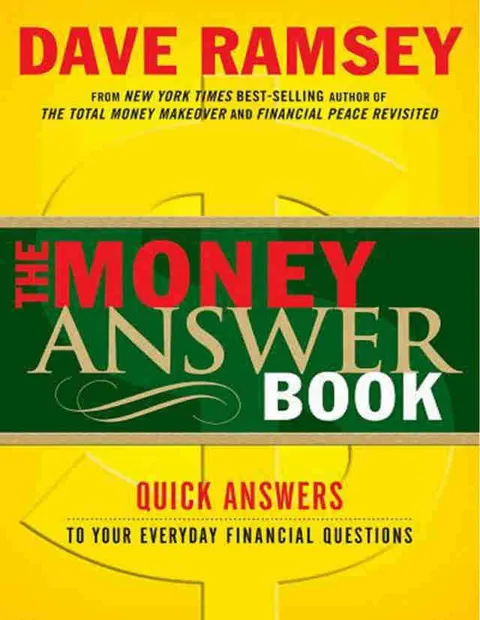
"The Money Answer Book" by Dave Ramsey provides practical and straightforward advice on managing personal finances, including saving money, investing wisely, and getting out of debt. The book covers a wide range of financial topics and offers practical tips and strategies for achieving financial security and success.
Eric Liddell
Eric Henry Liddell was born on 16th January 1902 in Tientsin (Tianjin) North China, second son of the Rev. & Mrs. James Dunlop Liddell who were missionaries with the London Mission Society.
He was educated from 1908 to 1920 at Eltham College, Blackheath, school for the sons of missionaries. Eric, with his older brother Rob, were left at their boarding school while their parents and sister, Jenny, returned to China.
During the boys’ time at Eltham College, their parents, sister and new brother Ernest came home on furlough two or three times and were able to be together as a family – mainly living in Edinburgh.
Although born in China and educated in England, Eric Liddell lived in Scotland at various times during his life.
In 1920, Eric joined his brother Rob at Edinburgh University to read for a BSc in Pure Science.
During this period he played rugby for Scotland and trained to run at the Olympics.
Athletics and rugby played a large part in Eric’s University life. He ran in the 100 yards and the 220 yards for Edinburgh University and later for Scotland. He played rugby for Edinburgh University and in 1922 played in seven Scottish Internationals with A.L. Gracie.
Eric Liddell was a gifted rugby player and played for the Edinburgh Univerisity 1st XV team.
He also played international rugby for Scotland and gained seven international caps as a wing-threequarter, scoring four tries thanks to his searing pace.
As a result of having insufficient time for both running and rugby, he chose the former, aiming for the 100 meters in the Paris Olympics. When he learned that the heats were to be run on a Sunday, he switched to the 400 metre competition as he was not prepared to run on a Sunday.
He won a gold medal for the 400 metres and a bronze medal for the 200 metres at the Paris Olympics.
He also travelled briefly to the USA in 1924 to compete in an athletics tournament. He returned to Edinburgh after the Paris Olympics and he graduated from Edinburgh University.
Eric Liddell lived for a short time in Gillespie Crescent before moving to a house in Merchiston Place.
Recollections of Eric Liddell By Sir Arthur Marshall
The Cambridge University Athletics Club had an invitation from Pennsylvania to take a team of seven to the Pennsylvanian Games in March 1924, and I was one of the seven. Eric Liddell, the Scot from Edinburgh University, the 1923 AAA 100 yards Champion, had been personally invited and travelled with us. We stayed at the very comfortable Pennsylvanian Cricket Club. I am afraid none of, including Eric Liddell, managed to win an event at the Pennsylvanian Games.
We travelled back in a small slow ship of the American United Line called ‘The Republic’ – a ten day crossing. Eric Liddell entered in the fun and games on the boat, including the Fancy Dress Dance. Whilst he was very strict about religion. Eric and I became good friends and saw much of two American sisters, Freddie and Edith, who were travelling to ‘do Europe’, including the UK. They said they were going to be in Paris for the Olympic Games, and we said if we were there at the same time we hoped we could meet.
Harold Abrahams had set his whole life on winning the Olympic 100 Metres – it had become and obsession with him. Liddell’s achievement in winning the 1923 AAA 100 Yards in the record time of 9 7/10 seconds was a devastating blow to Abrahams and shook him to the core. To date Abrahams had been a consistent 10 seconds 100 yards winner but had only slightly broken 10 seconds on one or two occasions. He knew in the Olympics he would be up against overseas competition, particularly from the Americans, but this new and very serious opposition out of the blue and on his doorstep had come at a time when Harold had established his 100 yards supremacy in the UK. To achieve level pegging with Eric Liddell’s new record time, Harold had to improve his performance by two or three yards with the help of his trainer Sam Mussabini. It must have been a tremendous relief to Harold when it became known early in 1924 that Eric had decided to concentrate on the 400 metres and, because of his religious principles, would not compete in the Olympic 100 metres as first heats were always run on Sunday.
Eric had in turn become completely dedicated to winning an Olympic Medal within the restrictions of his faith. He was a famous Scottish international rugger player, and gave up his rugger to enable him to concentrate on his Olympic ambitions, which became very deep-rooted, and his work suffered. Winning an Olympic Gold Medal became a priority, second only to his religion, and the ambition to win this event became part of his religion.
Recollections of Eric Liddell By Sir Arthur Marshall
The team travelled to Paris days before the Olympics started and had a big send-off at Victoria Station.
The silence at the start of the 100 metres and 400 metres was quite electric. Harold Abrahams won the 100 metres in a new Games record time.
In spite of all that has been said about Abrahams’ 100 metres, the 400 metres in some way provided the greatest thrill of the meeting with the world record being broken by Eric Liddell three times in two days. It was thought that Liddell had some chance of winning, but nobody thought Liddell capable of the amazing performance he achieved in the final. As far as the crowd were concerned they were well informed about Liddell’s dedication to his religion and his refusal to run in the first round of the 100 metres on the Sunday; they also knew of his determination to win this event. The occasion was enlivened by the support given to Liddell by the pipes and drums of the Cameron Highlanders.
The silence and pent-up excitement at the start of the race could be felt. Liddell went ahead at the start and maintained his pace throughout, finishing in what at the time was described as ‘a most lion-hearted manner’ winning by three yards from Fitch, an American. This was probably the greatest achievement of the VIIIth Olympiad, and superlatives were showered on Liddell by the press of the entire world. Liddell was short and not a pretty runner but just pounded along virtually at the same pace all the way, with a finish as if he was making a final dash for a try in a rugger match with an opponent bearing down on him and about to tackle from behind.
After Eric had won the 400 metres Gold Medal, Eric and I made contact with Freddie and Edith, the American sisters, and took them to a Tango Tea Dance in the Champs Elysees.
Footnote: Along with sacrificing his place in the 1924 Olympics 100m, Eric Liddell also gave up two other races in which Great Britain held high hopes of winning gold that year – the 4 x 100m and 4 x 400m, whose finals also took place on a Sunday.
After the Olympics
After the Olympics and his graduation, he returned to North China where he served as a missionary from 1925 to 1943 – first in Tientsin (Tainjin) and later in Siaochang. During his first furlough in 1932 he was ordained as a minister.
1930 - 1932
On furlough from China studying at Congregational College. After completing his studies he was ordained as a minister on 22nd June 1932. During this time he lived in a hostel in George Square which belonged to the Edinburgh Medical Missionary Society.
During these periods Eric Liddell attended Morningside Congregational Church at the corner of Chamberlain Road and Morningside Road.
Morningside Congregational Church
The Church building (pictured here on the right) was originally built for North Morningside United Presbyterian Church who used it until 1881 when it became too small. They then built a new, larger, church on the other side of the road (which is now the Eric Liddell Centre).
From 1881 the old church was home to the Morningside Athenaeum Club before the Congregational Church purchased it in 1890.
In 1928 this church was demolished and a new one erected (which is now Morningside United Church).
Eric Liddell would have attended meetings in both buildings during his two extended stays in Edinburgh. The old church from 1920 to 1925 and the current building (Morningside United Church) from 1930 to 1932. He also preached at the church on a number of occasions.
On his return to China, he married Florence Mackenzie (of Canadian missionary parentage) in Tientsin in 1934. They had three daughters; Patricia, Heather and Maureen, who now all live in Canada.
Living in China in the 1930s was potentially very dangerous and in 1937 Eric was sent to Siaochang where he joined his brother Rob. He was now crossing the Japanese army lines.
In 1941 life in China was becoming so dangerous that the British Government advised British nationals to leave. Florence and the children left for Canada.
During 1941 – 1943 Eric stayed in Tientsin, then in 1943 he was interned in Weishien camp until his death in 1945.
The Eric Liddell Centre
The United Presbyterian Church merged with the Free Church of Scotland in 1900 and then, in 1929, this merged with the Church of Scotland.
The United Presbyterian Church built in 1879 became known as Morningside North parish Church. By 1980 the building was no longer in use and became the Holy Corner Church Centre.
This was an initiative of the three remaining churches at Holy Corner: Morningside United Church (a merger between the Congregational and Church of Scotland congregations and in joint membership of the United Reformed Church and Church of Scotland), Christ Church (Scottish Episcopal Church) and Morningside Baptist Church.
As the project developed the centre’s name was changed to The Eric Liddell Centre in recognition of his involvement in the life of one of the founding churches and the local community during his time living here.
The Cross and the St. Louis Cardinals
What does Jonathan Edwards have to do with baseball? It relates to how he saw the world. The technical term is typology — the mechanism of his God-entranced vision of all things. He explains, God does purposely make and order one thing to be in agreeableness and harmony with another. And if so, why should not we suppose that he makes the inferior in imitation of the superior, the material of the spiritual, on purpose to have a resemblance and shadow of them? We see that even in the material world God makes one part of it strangely to agree with another; and why it is not reasonable to suppose he makes the whole as a shadow of the spiritual world? . . . ("Images of Diving Things," A Jonathan Edwards Reader, [New Haven: Yale University Press, 1995], 16). Edwards saw it in the experience of walking down a hill, in the diet of ravens, and in the life of silkworms. And sports fans just saw it in the 2011 World Series. The World Series, Really? What made this Series so great wasn’t the mere fact that I love the St. Louis Cardinals and they won. It was the whole manner of how it happened. It's the fact that the Cardinals were trailing 10.5 games on August 25. They had no chance of making the playoffs, it seemed. It was the time to start looking at next year—the time when the "maybe-next-season" wishes are reluctantly announced. But then they started winning. Their late-season success allowed them to slip into the playoffs on the final game of the season. That was amazing enough. Then they beat the league-best Phillies. Then the potent Brewers. And then there they were—like out of no where—in the World Series. Learning from Edwards, let’s keep tracking the "agreeableness and harmony" that goes much deeper than America’s pastime. The Cardinals were the underdog, if there ever were one. They shouldn't even be in the playoffs, not to mention in the World Series competing against the repeat American League champion Texas Rangers. Every commentator wrote them off — "it was nice they made it this far, but they just aren’t championship caliber." Weakness Exposed When Texas won two in a row to take a 3-2 series lead, we expected that the Cards would finally fold. And during Game 6, when they came down to one out and one strike away from losing — twice! — hopes were dashed for Cardinal Nation. The consoling began, remembering the season really should have ended in September, that they really didn't have a World Series-quality team, that it's time again to start the "maybe next season" concessions. The team’s weakness at last was seen as weakness, and the dream of winning the World Series was confronted with the reality that things really don't happen this way. It was like a Friday afternoon wake-up call from Golgotha. But wait a minute. Isn’t this the way all the best stories go? Cue Edwards. Jesus rode into Jerusalem on the foal of a donkey, but it could have been a stallion leading an unbeatable legion of Jewish revolutionaries. He could have been taller, a handsome king that looked more like a Disney prince instead of a Galilean peasant. There could have been no agony, no cross, no tomb. There could have been, but there wasn’t. When Hope Seems Lost And this was God’s design — in his universe, there is more beauty when victory rises out of weakness. The morning shines brighter after a tumultuousness night. The glory is greater at the end of three silent days, when the Lamb has been slain, when all hope seems lost. That’s where this World Series was pointing. Game 6 made this clear. The Cardinals were finished. It was over. Over. Well, over until David Freese's two-run triple in the bottom of the 9th, then Berkman's RBI single in the 10th, then Freese's walk-off homer in the 11th. Almost too good to be true. Like an out-of-breath Mary flinging open the disciples’ door to announce an empty tomb. Then Game 7 came, and the Cards won that one, too. It was an unforgettable Series, one that reaches deep into the human soul, resonating with the imprint of our Creator and reminding us why the good stories are, well, so good. Article by Jonathan Parnell