




About the Book
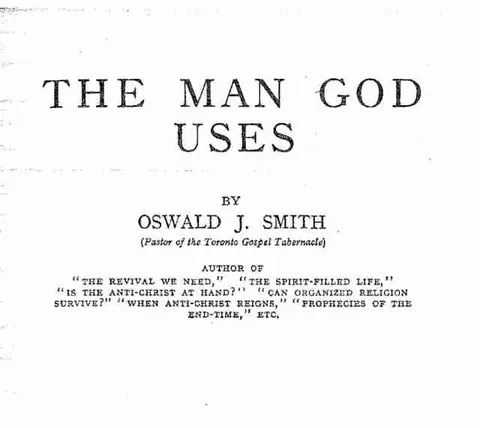
"The Man God Uses" by Oswald J. Smith is a Christian book that explores the characteristics and qualities of individuals who are used by God for His purposes. The author emphasizes the importance of surrendering one's life to God, developing a deep relationship with Him, and actively participating in His work. Smith shares personal stories and insights to inspire readers to become fully committed and effective servants of God. The book serves as a guide for those seeking to fulfill their potential and contribute to God's kingdom.
A.W. Pink
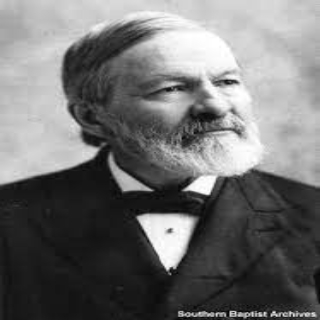
Arthur Walkington Pink (1 April 1886 â 15 July 1952) was an English Bible teacher who sparked a renewed interest in the exposition of Calvinism or Reformed Theology. Little known in his own lifetime, Pink became "one of the most influential evangelical authors in the second half of the twentieth century."[1]
Biography Arthur Walkington Pink was born in Nottingham, England, to a corn merchant, a devout non-conformist of uncertain denomination, though probably a Congregationalist.[2] Otherwise, almost nothing is known of Pink's childhood or education except that he had some ability and training in music.[3] As a young man, Pink joined the Theosophical Society, an occult gnostic group in contemporary England, and he apparently rose to enough prominence within its ranks that Annie Besant, its head, offered to admit him to its leadership circle.[4] In 1908 he renounced Theosophy for evangelical Christianity.[5]
Desiring to become a minister but unwilling to attend a liberal theological college in England, Pink very briefly studied at Moody Bible Institute in Chicago in 1910 before taking the pastorate of the Congregational church in Silverton, Colorado. In 1912 Pink left Silverton, probably for California, and then took a joint pastorate of churches in rural Burkesville and Albany, Kentucky.[6] In 1916, he married Vera E. Russell (1893â1962), who had been reared in Bowling Green, Kentucky, and Pink's next pastorate was at Scottsville Baptist Church, Scottsville, Kentucky.[7] Then the newlyweds moved in 1917 to Spartanburg, South Carolina, where Pink became pastor of Northside Baptist Church.[8]
By this time Pink had become acquainted with prominent dispensationalist Fundamentalists, such as Harry Ironside and Arno C. Gaebelein, and his first two books, published in 1917 and 1918, were in agreement with that theological position.[9] Yet Pink's views were changing, and during these years he also wrote the first edition of The Sovereignty of God (1918), which argued that God did not love sinners who had not been predestined unto salvation, and that He had deliberately created "unto damnation" those who would not accept Christ.[10] Whether because of his Calvinistic views, his nearly incredible studiousness, his weakened health, or his lack of sociability, Pink left Spartanburg in 1919 believing that God would "have me give myself to writing."[11] But Pink then seems next to have taught the Bibleâwith some successâin California for a tent evangelist named Thompson while continuing his intense study of Puritan writings.
In January 1922, Pink published the first issue of Studies in the Scriptures, which by the end of the following year had about a thousand subscribers and which was to occupy most of his time for the remainder of his life and become the source for dozens of books, some arranged from Studies articles after his death.[12] In 1923 Pink suffered a nervous breakdown, and he and his wife lived with friends in Philadelphia until he regained his health. In 1925, the Pinks sailed to Sydney, Australia, where he served as both an evangelist and Bible teacher at the Ashfield Tabernacle. But his impolitic preaching of Calvinist doctrine resulted in a unanimous resolve of the Baptist Fraternal of New South Wales not to endorse him. From 1926 to 1928, Pink served as pastor of two groups of Strict and Particular Baptists.[13]
Returning to England, Pink was invited to preach at a pastorless church in Seaton, Devon; but though he was welcomed by some members, the overseers thought his installation as pastor would split the church.[14] In the spring of 1929, Pink and wife returned to her home state of Kentucky where he intended to become pastor of the Baptist church in Morton's Gap. Once again his hopes were unrealized. To a friend he wrote, "I am more firmly convinced today than I was 14 months ago that our place is on the 'outside of the camp.' That is the place of 'reproach,' of loneliness, and of testing."[15] In 1930 Pink was able to start a Bible class in Glendale, California, while also turning down opportunities to speak in some Fundamentalist churches.[16] The following year, the Pinks rented an unpainted wooden house in Union County, Pennsylvania, where a small group met; then in 1933 they moved to York, Pennsylvania.
Pink decided that if his ministry was to be totally one of writing, he could do that just as well in England. In September 1934 he and his wife moved to Cheltenham, Gloucestershire, near honorary agents of Studies in the Scriptures. Pink seems to have finally given way to despair. To a friend he wrote "that those of my friends who would dearly like to help me are powerless to do so; while those who could, will not. And in a very few years at most it will be too late. What I have gone through the last seven years is so reacting on my physical and mental constitution, that ere long I shall be incapacitated even if doors should be opened unto me. However, I can see nothing else than to attempt to seek grace to bow to the Lord's sovereign pleasure, and say, 'Not my will, but thine be done.'"[17]
In 1936, the Pinks moved to Hove, on the south coast near Brighton. After the death of his father in 1933, Pink received enough of the estate to allow him and his wife to live very simply without financial concerns; and between 1936 until his death in 1952, Pink devoted himself completely to Studies in the Scriptures. Vera believed her husband's almost unrelenting work schedule unhealthy, and she remarkably succeeded in having him take up stamp collecting as a hobby.[18] In 1940, Hove became a regular target of German air raids, and the Pinks moved to Stornoway, Isle of Lewis, Outer Hebrides, Scotland, where they remained for the rest of his life. The island was a bastion of Calvinism, but church services were held mostly in Scots Gaelic, and visitors were not especially welcomed in any case.[19] Pink governed his time in study and writing with "military precision." To a friend he wrote that he went out to shop and get exercise for an hour, six days a week, but that otherwise he never left his study except when working in a small garden. While in Hove, he even published a note in Studies advising subscribers that "it is not convenient for us to receive any visitors, and respectfully ask readers who may visit these parts to kindly refrain from calling upon us, but please note that we are always glad to hear from Christian friends."[20] Rather than attend church, on Sunday mornings, Pink spent time ministering to readers by letter.[21]
In 1951 Vera became aware that Pink was failing. He lost weight and was in pain but refused to take any medicine that might dull his mind and hinder him from completing his work. He died on 15 July 1952. His last words were "The Scriptures explain themselves." Pink left enough written material to allow publication of Studies until December 1953.[22] Vera Pink survived her husband by ten years and after his death made new friends and mingled more freely with others.[23]
Influence
It is alleged that Pink's personality made it difficult for him to have a successful pastoral ministry. He has been criticized for being too individualistic and of too critical a temperament, lacking the benefit of thorough theological discussions with other men of similar gifts. One young pastor, Rev. Robert Harbach who corresponded with Pink for years remembered a very different Pink, who possessed a "pastor's heart." Pink's correspondence with Harbach (until Pink's failing health ended their correspondence in 1949) was warm, heartfelt and fatherly. Early in their correspondence, Pink wrote "I want you to feel perfectly free to call on me for any help I may be able to render you. I am in touch with a number of young pastors, and I deem it part of my work, and a privilege, to offer what advice I can."[24]
Pink's acclaimed contemporary D. Martyn Lloyd-Jones received spiritual benefit from reading Pink and recommended him to others. To one young minister, he said, "Don't waste your time reading Barth and Brunner. You will get nothing from them to aid you with preaching. Read Pink."[25] But Lloyd-Jones also said, "If I had behaved as Pink did, I would have achieved nothing. Nothing at all... I had to be very patient and take a very long-term look at things. Otherwise I would have been dismissed and whole thing would have been finished."[26] Furthermore, without the assistance and companionship of his wife, who dedicated herself completely to him and his work, Pink would have (as he freely admitted) "been overwhelmed" and probably would have achieved little even in writing.[27]
Theologically Pink was rejected during his lifetime because of his opposition to Arminianism; but after his death, there was a major shift of evangelical opinion towards Calvinistic theology. By 1982, Baker Book House had published 22 of Pink's books and sold 350,000 total copies. Nevertheless, it was Pink's Sovereignty of God that did "more than any other in redirecting the thinking of a younger generation." After Banner of Truth Trust republished it in 1961âmodifying it to remove Pink's alleged hyper-Calvinismâthe book sold 177,000 copies by 2004.[28]
References
7. "NEW LIGHT ON THE EARLY MINISTRY OF A. W. PINK (PART 2)". The Arthur W. Pink Archive. Retrieved 27 June 2020.
13. Murray argues that Pink left the first of these two groups because he was not Calvinistic enough for them because he asserted belief in the "free offer of the gospel and in human responsibility to receive the gospel.", 77-123; R. P. Belcher, "Pink, Arthur Walkington," Timothy Larson, ed., Biographical Dictionary of Evangelicals (Downers Grove, IL: IVP, 2003), 529. Ronald Hanko argues that "Pink never taught that God loves everyone or desires to save everyone, or promises salvation to everyone in the gospel, as the Banner does." Ronald Hanko, "The Forgotten Pink," British Reformed Journal No. 17 (Jan-March 1997), 4.
23. Murray, 283. She was remembered by one of these friends as "an elegant and gracious lady with a radiant expression and a loving and lively interest in people."
28. Murray, 314â15. The Banner of Truth Trust edition has been criticized for omitting nearly half the original work, including three entire chapters. Hanko, "The Forgotten Pink."
We Need More Holy Fools
A man is trapped in a car, rushing down a hill toward a cliff. The doors are locked. The brakes are out. The steering barely works. Far ahead, he can see other cars hurtling into the abyss. How far they fall, he does not know. What they find at the bottom, he cannot imagine. But he does not seek to know; he does not try to imagine. Instead, he paints the windshield, climbs into the back seat, and puts in his headphones. This image, adapted from Peter Kreeft, captures my life in January 2008, as I walked down a college sidewalk in Colorado. The car was my body; the hill, time; the cliff, death. I was, as we all are, rushing toward the moment when my pulse would stop. And though unsure of what would come afterward, I found a thousand ways to look away. âThe Lord looks down from heaven on the children of man, to see if there are any who understand, who seek after Godâ (Psalm 14:2). Like so many other children of men, I neither understood nor sought, I neither asked nor knocked, but let myself tumble through time without a thought of eternity. I was a âfool,â to put it bluntly (Psalm 14:1). And I desperately needed another kind of fool to wake me up. Puncturing the Daydream Few people, perhaps, would look at a normal Western life like mine â busy, successful, spiritually indifferent â and say, âfolly.â But could it be because the folly is socially acceptable? Might we modern Western men and women have made a silent pact to ignore eternity? âMight we modern Western men and women have made a silent pact to ignore eternity?â Blaise Pascal, seventeenth-century Christian polymath, thought so. When Pascal looked round at his modern country, neighbors, and self, he saw a collective pathology, a shared insanity: âManâs sensitivity to little things and insensitivity to the greatest things are marks of a strange disorder,â he said ( Christianity for Modern Pagans , 203). We cultivate hobbies, and follow celebrities, and read the news without knowing why we exist. We stumble through an unthinkably vast cosmos, circled round by unthinkably intricate wonders, too distracted to ask, âWho made this?â We develop firm opinions about politics, and care not whether souls live forever, and where. We look often into our mirrors and seldom into our deep and fallen hearts. A strange disorder indeed. And so, Pascal walked around with needles in hand, seeking to puncture the daydream of secular or religiously nominal apathy to eternity. His unfinished book PensĂ©es  (abridged and explained in Kreeftâs masterful Christianity for Modern Pagans ) may have been his sharpest needle. What Is a Life âWell-Livedâ? Our lives here are hemmed in by mystery and uncertainty. We live on a small rock in an immense universe. We know little about where we came from or where weâre going. We struggle even to understand ourselves. But a few matters remain clear and unmistakable, including the great fact that, one day, we will die. Our car hurtles down the hill, lower today than yesterday. The abyss awaits. And what then? For secular or nominally religious countrymen like Pascalâs, and ours, the options are two: âthe inescapable and appalling alternative of being annihilated or wretched throughout eternityâ (191). Either Christianity is false, and our flickering candle goes out forever â or Christianity is true, and, awakening to lifeâs meaning too late, we fall âinto the hands of a wrathful Godâ (193). A society like ours would lead us to believe that eighty years âwell livedâ (whatever that means) filled with âpersonal meaningâ (whatever that means) makes for a good life; we need seek no more. To Pascal, those were the words of one who had painted the windshield black. Death, rightly reckoned with, functions like the final scene of a tragic play: it reaches its fingers back into all of life, disfiguring every moment, darkly witnessing that all is not well. âThe last act is bloody, however fine the rest of the play,â Pascal writes. âThey throw earth over your head and it is finished foreverâ (144). Stand above the hole in the ground, the dust from which we came and to which weâll return (Genesis 3:19), and consider: âThat is the end of the worldâs most illustrious lifeâ (191). âWe ourselves are an enigma, wrapped in a world of mystery, headed inevitably for the grave.â We ourselves are an enigma, wrapped in a world of mystery, headed inevitably for the grave. Such a dire plight might send us searching for wisdom, if it werenât for our insane âsolution.â Insanity of Our âSolutionsâ How do we â mortal men and women, nearing the cliffâs edge â typically respond to our plight? âWe run heedlessly into the abyss after putting something in front of us to stop us seeing itâ (145). We deny. We divert. We distract. Until one day we die. Of course, no one ever says, âI will distract myself because I donât want to consider my death and what may come afterward.â We suppress the truth more subconsciously than that (Romans 1:18). Instinctively, we avoid the âhouse of mourning,â or else dress it with euphemisms, for fear of facing, terribly and unmistakably, that âthis is the end of all mankindâ â that this is our  end (Ecclesiastes 7:2). Summarizing Pascal, Kreeft writes, If you are typically modern, your life is like a rich mansion with a terrifying hole right in the middle of the living-room floor. So you paper over the hole with a very busy wallpaper pattern to distract yourself. You find a rhinoceros in the middle of your house. The rhinoceros is wretchedness and death. How in the world can you hide a rhinoceros? Easy: cover it with a million mice. Multiply diversions. (169) Eighty years may seem like a long time to distract yourself from the most fundamental questions of life and death. But with hearts like ours, in a world like ours, it is not too long. Make a career. Raise a family. Build wealth. Plan vacations. Get promoted. Watch movies. Collect sports cards. Read the news. Play golf. Resist uncomfortable questions. We hang a curtain over the cliffâs edge that keeps us from seeing the abyss. But not from rushing into it. Sanest People in the World Our chosen âsolution,â then, only aggravates our dire plight. Our distractions sedate us on the way to death rather than sending us searching for some escape. Which means the world has a desperate need for people like Pascal, men and women whom we might call (to use a phrase from church history) holy fools . The term holy fools  drips with the same irony Paul used when he spoke of âthe foolishness of Godâ (1 Corinthians 1:25) and said, âWe are fools for Christâ (1 Corinthians 4:10). In truth, holy fools are the worldâs sanest people. They have felt the sting of sin and death. They have found deliverance in Jesus Christ. And now they are trying to tell the world. With Pascal, they see that âthere are only two classes of people who can be called reasonable: those who serve God with all their heart because they know him and those who seek him with all their heart because they do not know himâ (195). And so, holy fools call people into the âfollyâ that is our only sanity. They come to those caught in distraction, lost in diversion, and they serve, love, persuade, and prod. They risk reputation and comfort, willing to look foolish in the eyes of a wayward world. They bring eternity into everyday conversations with cashiers, neighbors, and other parents at the park. Boldly and patiently, courageously and graciously, they say, âSee your death. See your sin. And seek him with all your heart.â To those bent on diversion, holy fools may seem imbalanced, extreme, awkward, pushy. But not to everyone. Some, as they hear of the Christ these fools preach, will catch a glimmer of âthe power of God and the wisdom of Godâ (1 Corinthians 1:24). And they will become another fool for him. Give Us More Fools for Christ Pascal (and the apostle Paul) make me feel that I am not yet the fool I ought to be. Too often, I prefer social decorum to holy discomfort, this-worldly niceness to next-worldly boldness. But they also make me feel a keen gratitude for the holy fools among us, and a longing to be more like them. For I owe my life to one. In January 2008, as my little car rushed down the hill, and as I did what I could to cover my eyes, someone stopped me on the sidewalk. I would later learn that he belonged to a campus ministry widely known for sharing Jesus with students â widely known, but not widely loved. Their message was, to most, foolishness â and their way of stopping others on the sidewalk, a stumbling block. But to me that day, by grace, it looked like the wisdom of God. In time, I would realize that my various diversions could not deliver me from death. Nor could a life âwell livedâ forgive my sins or undig my grave. Only Jesus could. It took a holy fool to make me sane, and oh how the world needs more.