



-160.webp)

-160.webp)
-160.webp)
%20by%20Francine%20Rivers%20(z-lib.org).epub-160.webp)



About the Book
"The Ambition" by Lee Strobel follows the story of a high-powered attorney facing a moral and ethical dilemma as he tries to balance his professional ambition with his personal values. As he navigates through this crisis, he discovers that success and fulfillment are not found in worldly achievements but in living a life guided by faith and integrity.
Aimee Semple McPherson
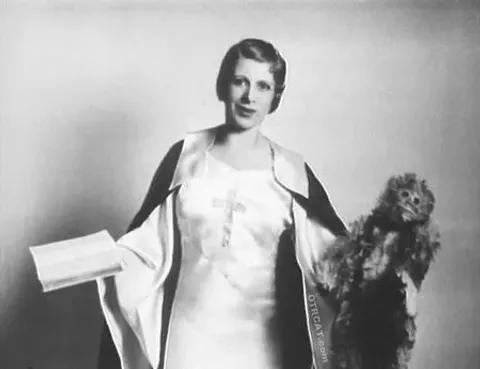 Aimee Semple McPherson was born on Oct. 9, 1890, on a farm in Salford Ontario, Canada. Her father, James Kennedy, was a farmer and came from a Methodist background. Her mother, Mildred, known as “Millie,” came from a Salvation Army background.
Although she was raised in a Christian home, she began to question the Bible during her teen years.
When she was 17, she attended a revival Pentecostal meeting presented by evangelist Robert Semple, where she heard the message of repentance. He also spoke of baptism in the Holy Spirit, an experience for which she hungered. After receiving the infilling of the Holy Spirit, she also was filled with a great love and compassion for souls and a fervent passion to serve the Lord throughout her whole life.
The meeting Aimee attended changed her life not only spiritually but also romantically. The evangelist Robert Semple later become Aimee’s husband. They were married when she was 18. Their ministry desires were compatible. After their ministry trips in Chicago and the Ingersoll area, they headed to China as missionaries.
In 1910 while in China, Robert and Aimee contracted Malaria within months of arriving in Hong Kong. Robert didn’t survive, leaving Aimee pregnant and a widow at 19. When her daughter, Roberta Star, was a month old, Aimee returned to United States to raise her. Aimee and Roberta lived in New York with Aimee’s mother.
She assisted her mother raising money for the Salvation Army. It was there she met and married a Christian businessman named Harold McPherson. They had a son, Rolf Kennedy McPherson. After a decline in health, two major surgeries and a near-death experience, God asked her one last time, “Now, will you go?” She answered yes to God’s call and almost immediately was healed. She never again questioned the call to preach the gospel.
Aimee is known for founding the Foursquare Gospel Church in 1918. She also was a woman ahead of her time, possessing boldness in her speaking ability and creative ways to communicate the gospel.
The name Foursquare Gospel originated from the Book of Ezekiel. It represents the four phases of the gospel of Jesus Christ. In the face of the Man, she saw Jesus our Saviour. In the face of the lion, she saw Jesus the mighty Baptiser with the Holy Spirit and fire. In the face of the ox, she saw Jesus the Great Burden Bearer. In the face of an eagle, she saw Jesus the coming King, who will return in power and glory. It was, in Aimee’s opinion, “a perfect gospel. A complete gospel for body, for spirit and for eternity.”
Her ministry was dynamic. She witnessed thousands saved and healed during her evangelistic meetings. Being creative and theatrical, Aimee used drama, music and opera to appeal to the audience. Bands, choirs and other crowd-pleasing touches enhanced her dynamic preaching. Though she was well-versed in the Bible, Aimee’s success wasn’t based on her knowledge, but rather the delivery of her messages.
She also was known as a faith healer, with claims of physical healing occurring during her meetings. Her faith healing demonstrations were written about extensively in the media, as they were a large focus of her early ministry. Aimee was an evangelistic pioneer, determined to spread the message of the Pentecostal faith, and used her fervour and flamboyance to win a huge following.
She had achieved what no one had yet done in ministry, which was to build a 5,000-seat auditorium in an influential area of Los Angeles. This paved the way for other female evangelists during a time when women were not accepted in the pulpit. She also launched the first Christian radio station and established a Bible college. By 1917, she had started her own magazine The Bridal Call, for which she wrote many articles about women’s roles in religion; she portrayed the link between Christians and Jesus as a marriage bond.
Jan. 1, 1923, the new Angelus Temple was opened in a flamboyant style. Aimee was seated on a red velvet throne dressed in a nurse’s uniform and cape. Accompanying her were 200 singers, three bands, two orchestras and six quartets. The Angelus Temple was featured on a float in Pasadena’s Tournament of Roses parade, while the extravagant dedication service was given full coverage in The New York Times. What became the home of The Church of the Foursquare Gospel filled four times each Sunday and twice weekly. Aimee also ministered at highly sought-after healing services during the week.
Reporters marveled at her oral skills, saying, “Never did I hear such language from a human being. Without one moment’s intermission, she would talk from an hour to an hour and a half, holding her audience spellbound.” Rather than using fire-and-brimstone preaching, Aimee resorted to a style of joyous celebration, representing the loving face of God.
She also brought old-time religion into the modern age, using illustrated sermons to help people understand the gospel better. Also, stage productions were incorporated, drawing people who usual didn’t attend church. In an era prior to television, these services proved entertaining, and she used this method to present the message of salvation through faith in Jesus.
Aimee welcomed all walks of life. She preached to the high class of society, as well as the poor and disadvantaged. She treated everyone equally regardless of race, gender or status.
In the 1920s, Aimee became a well-known voice among civic leaders, politicians, actors and actresses, and pastors from various denominations. Her sermons were reprinted in hundreds of newspapers in Canada, the United States and Mexico and were read by millions. In 1927, she opened a commissary to feed the marginalized and supply them with clothing and other necessities. Aimee set up a 24/7 soup kitchen at her temple in 1936 to help families through the Great Depression .She also became involved with war bond rallies and linked religion to patriotism in her sermons when America joined the Second World War in 1941.
Aimee’s legacy is threefold. Using the dramatic arts to reach the lost (an innovative tool) and the latest technology to spread the gospel. She reached out to the poor, helping thousands in the Los Angeles area who were starving. She taught a full-gospel message and regularly saw thousands of healings and miracles in her meetings.
Aimee passed away due to an accidental overdose in 1944 and was buried in Forest Lawn Memorial Park Cemetery in California. Her son, Rolf, has kept her memory and ministry alive by carrying the ministry for 40 four years. The Foursquare church is still standing strong with 8 million members worldwide.
Aimee Semple McPherson was born on Oct. 9, 1890, on a farm in Salford Ontario, Canada. Her father, James Kennedy, was a farmer and came from a Methodist background. Her mother, Mildred, known as “Millie,” came from a Salvation Army background.
Although she was raised in a Christian home, she began to question the Bible during her teen years.
When she was 17, she attended a revival Pentecostal meeting presented by evangelist Robert Semple, where she heard the message of repentance. He also spoke of baptism in the Holy Spirit, an experience for which she hungered. After receiving the infilling of the Holy Spirit, she also was filled with a great love and compassion for souls and a fervent passion to serve the Lord throughout her whole life.
The meeting Aimee attended changed her life not only spiritually but also romantically. The evangelist Robert Semple later become Aimee’s husband. They were married when she was 18. Their ministry desires were compatible. After their ministry trips in Chicago and the Ingersoll area, they headed to China as missionaries.
In 1910 while in China, Robert and Aimee contracted Malaria within months of arriving in Hong Kong. Robert didn’t survive, leaving Aimee pregnant and a widow at 19. When her daughter, Roberta Star, was a month old, Aimee returned to United States to raise her. Aimee and Roberta lived in New York with Aimee’s mother.
She assisted her mother raising money for the Salvation Army. It was there she met and married a Christian businessman named Harold McPherson. They had a son, Rolf Kennedy McPherson. After a decline in health, two major surgeries and a near-death experience, God asked her one last time, “Now, will you go?” She answered yes to God’s call and almost immediately was healed. She never again questioned the call to preach the gospel.
Aimee is known for founding the Foursquare Gospel Church in 1918. She also was a woman ahead of her time, possessing boldness in her speaking ability and creative ways to communicate the gospel.
The name Foursquare Gospel originated from the Book of Ezekiel. It represents the four phases of the gospel of Jesus Christ. In the face of the Man, she saw Jesus our Saviour. In the face of the lion, she saw Jesus the mighty Baptiser with the Holy Spirit and fire. In the face of the ox, she saw Jesus the Great Burden Bearer. In the face of an eagle, she saw Jesus the coming King, who will return in power and glory. It was, in Aimee’s opinion, “a perfect gospel. A complete gospel for body, for spirit and for eternity.”
Her ministry was dynamic. She witnessed thousands saved and healed during her evangelistic meetings. Being creative and theatrical, Aimee used drama, music and opera to appeal to the audience. Bands, choirs and other crowd-pleasing touches enhanced her dynamic preaching. Though she was well-versed in the Bible, Aimee’s success wasn’t based on her knowledge, but rather the delivery of her messages.
She also was known as a faith healer, with claims of physical healing occurring during her meetings. Her faith healing demonstrations were written about extensively in the media, as they were a large focus of her early ministry. Aimee was an evangelistic pioneer, determined to spread the message of the Pentecostal faith, and used her fervour and flamboyance to win a huge following.
She had achieved what no one had yet done in ministry, which was to build a 5,000-seat auditorium in an influential area of Los Angeles. This paved the way for other female evangelists during a time when women were not accepted in the pulpit. She also launched the first Christian radio station and established a Bible college. By 1917, she had started her own magazine The Bridal Call, for which she wrote many articles about women’s roles in religion; she portrayed the link between Christians and Jesus as a marriage bond.
Jan. 1, 1923, the new Angelus Temple was opened in a flamboyant style. Aimee was seated on a red velvet throne dressed in a nurse’s uniform and cape. Accompanying her were 200 singers, three bands, two orchestras and six quartets. The Angelus Temple was featured on a float in Pasadena’s Tournament of Roses parade, while the extravagant dedication service was given full coverage in The New York Times. What became the home of The Church of the Foursquare Gospel filled four times each Sunday and twice weekly. Aimee also ministered at highly sought-after healing services during the week.
Reporters marveled at her oral skills, saying, “Never did I hear such language from a human being. Without one moment’s intermission, she would talk from an hour to an hour and a half, holding her audience spellbound.” Rather than using fire-and-brimstone preaching, Aimee resorted to a style of joyous celebration, representing the loving face of God.
She also brought old-time religion into the modern age, using illustrated sermons to help people understand the gospel better. Also, stage productions were incorporated, drawing people who usual didn’t attend church. In an era prior to television, these services proved entertaining, and she used this method to present the message of salvation through faith in Jesus.
Aimee welcomed all walks of life. She preached to the high class of society, as well as the poor and disadvantaged. She treated everyone equally regardless of race, gender or status.
In the 1920s, Aimee became a well-known voice among civic leaders, politicians, actors and actresses, and pastors from various denominations. Her sermons were reprinted in hundreds of newspapers in Canada, the United States and Mexico and were read by millions. In 1927, she opened a commissary to feed the marginalized and supply them with clothing and other necessities. Aimee set up a 24/7 soup kitchen at her temple in 1936 to help families through the Great Depression .She also became involved with war bond rallies and linked religion to patriotism in her sermons when America joined the Second World War in 1941.
Aimee’s legacy is threefold. Using the dramatic arts to reach the lost (an innovative tool) and the latest technology to spread the gospel. She reached out to the poor, helping thousands in the Los Angeles area who were starving. She taught a full-gospel message and regularly saw thousands of healings and miracles in her meetings.
Aimee passed away due to an accidental overdose in 1944 and was buried in Forest Lawn Memorial Park Cemetery in California. Her son, Rolf, has kept her memory and ministry alive by carrying the ministry for 40 four years. The Foursquare church is still standing strong with 8 million members worldwide.
the dying gambler
"He died for sinners, and that's me exactly." While holding gospel meetings in the town of Albuquerque, N. M., we were told one morning of a man who was reported to us as being under deep conviction of sin, the Lord having awakened him through the preaching on the street. Our informant told us that he was one who never went to a church or mission hall, as he would not have anything to do with religion or its advocates. But, happening to be out upon the streets in the evenings, he had twice listened to the Word as there proclaimed, and was now in deep distress about his soul. No more cheering intelligence can be conveyed, to one whose heart is in the work of evangelization, than that God has been using the message to the awakening or the conversion of sinners; so, giving thanks for what we had heard, Mr. M— and I went over to the house in which the convicted man was living. We found him in deep distress. He was a consumptive who had come to Albuquerque from the Indian Territory in search of a climate where his disease would be more readily checked. But it was easy to see that his days on earth were fast drawing to a close. In broken accents he told us his story. He had been a most ungodly person. Gambling was his occupation, and all its attendant evils had held him in their snare. His had been "the pace that kills," and now he was reaping the bitter fruits in his own body of a life spent in reckless dissipation in the service of the devil. The reason why he had, although awake to his wretched physical condition, avoided all Christians who might have been able to help him, now came out. He realized that he was dying. He was in dread of death with the awful judgment which he knew must follow. But he had long since concluded that there was no hope for him. He was too far gone for the mercy of God to be extended to him. His sins were crying for vengeance. There was no solace to be expected in religious meetings, so he had kept away, as it only aggravated his mind to see others happy in the knowledge of the forgiveness of their sins while for him there was nought but the "blackness of darkness" forever. Through the goodness of God he had been led to listen to the preaching on the corner; and for the first time he began to realize that there might be mercy even for him. But accompanying this faint hope had come a deeper sense of his own iniquity, so that he was tossed about between hope and despair. We read the word of God and conversed with him, but he was quite gloomy, though he said,"I'm praying; and I've made up my mind that if I have to go to hell, I'll go praying." Earnestly we sought to impress upon his mind that salvation was God's free gift, offered "without money and without price" to all who confessed their sins, and who, as guilty, lost men and women, were ready to receive it for nothing. He did not seem to grasp it, but frequently remarked, "I won't give up praying." It is hard for man to realize the perfect freedom of the offer made by the God of all grace to needy sinners. It is neither by prayer nor by works of human righteousness that salvation is obtained. The believing sinner, saved by grace divine, gladly owns: "Could my zeal no languor know, Could my tears forever flow, These for sin could not atone; Thou must save, and Thou alone." Jesus it was who did all the doing; there remains nothing for the repentant sinner but the taking. But the very freedom of it all seemed to stumble the poor dying gambler. He promised to be out to the meeting however; and so, after praying that he might be led to see the perfection of the finished work of Christ, we left him. In accordance with his promise he was present at night. He seemed to listen eagerly, but with a look of bewilderment that implied inward anxiety and confusion of mind. Upon the conclusion of the meeting we handed him several gospel booklets, which he promised to read. The following evening he came to the hall, and it was easy to see that some great change had taken place. After the preaching he spoke to Mr. M— and brokenly told what had that day transpired. His voice was so weakened by the inroads of disease that he could only speak in short whispers. He said, "This afternoon—I lay on the bed—I took the tracts and tried to read.—My aunt came in—I asked her to read them to me.—Every time she came to a verse from the Bible—I said, 'Look it up.—She said, 'Tain't necessary.'—I said 'It is.—I can't afford to make any mistake—I must be sure.' She got a Bible and looked them up—They were all just the same.—At last I saw it—I said, 'That's it—Christ died for sinners—that's me exactly.—He shed His blood for sinners—He saves all who trust Him—I can trust Him now—He died for sinners—That's me,'—I felt happy then—knew it was all right—I know He won't cast me out." Together we rejoiced that thus he had been led to rest upon Him whose blood cleanses from all sin. And now a remarkable change took place. When we went to see him the next day, we found that physically he had failed to an amazing degree. He could no longer go about. It seemed that strength had been given him to get out where he might hear the gospel, and then he was bereft of it all. Mr. S, a fellow-laborer, had been to see him in the morning and had apprised me of the change; but, although expecting to see a great difference, I was not prepared for what I found when together we called on him in the afternoon. He was so weak that he could barely make himself understood. Satan had been troubling him with doubts. We gave him God's own words, and the doubts were dissipated. He seemed to receive as a child every statement from the Scriptures as indeed the word of Him who cannot lie. Three days later he passed away. Just before the end came he looked up and asked, "Do you hear it? I hear them singing. Jesus died for sinners. He died for me." And so the redeemed gambler had gone into the presence of Him who delights to show mercy to the vilest. To the unsaved reader we would address a word in closing this brief account. Whether a sinner of the deepest dye, crushed beneath the weight of the iniquities of a life-time spent in high-handed rebellion against the God who created you, and who, though you have neither known nor acknowledged Him, has yet been your preserver through all your devious paths; or whether you may be generally accounted moral and religious, but are still guilty of that greatest of all sins—the rejection of the Lord Jesus Christ—"unto you is the word of this salvation sent." For you God's blessed Son died upon the cross, having borne the judgment due to sin; and now, through the work He there accomplished, you, like the poor gambler, may be "justified from all things" and prepared to enjoy an eternity of bliss in His own presence. Christ received, means eternal joy; Christ rejected, means eternal misery. From The Only Two Religions and Other Gospel Papers by H. A. Ironside. New York: Loizeaux Brothers, Publishers, [n.d.].