
GIP Library icon

LOG IN TO REVIEW
About the Book


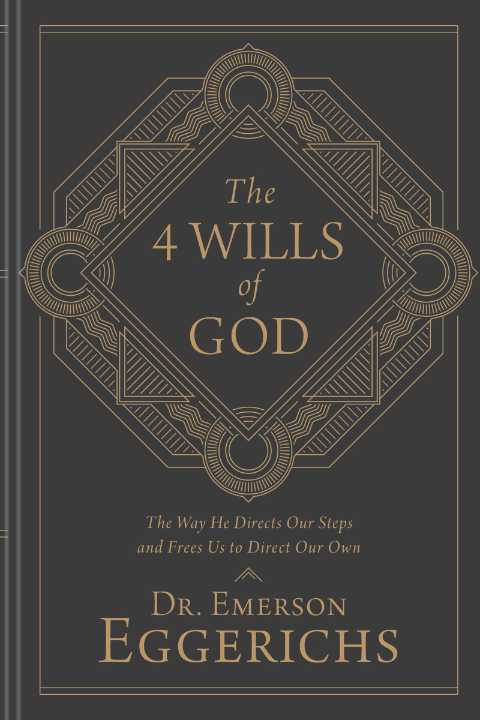
"The 4 Wills of God" by Dr. Emerson Eggerichs discusses how understanding and aligning with God's will can bring purpose, fulfillment, and peace to our lives. The book outlines God's will for salvation, submission, spirit-filled living, and suffering. Eggerichs emphasizes the importance of seeking God's will in all areas of our lives and how doing so can lead to a deeper relationship with Him.

Lee Strobel

Lee Strobel Lee Strobel (Lee Patrick Strobel) is a former American investigative journalist and a Christian Author who has written several books, including four which received ECPA (Evangelical Christian Publishers Association) Christian Book Awards (1994, 1999, 2001, 2005) and a series which addresses challenges to the veracity of Christianity. He is a former host of the television program called Faith Under Fire on PAX TV and he runs a video apologetic web site. Lee Strobel Age He was born on January 25, 1952 in Arlington Heights, Illinois, U.S. Lee Strobel Family | Chicago Tribune Less information has been revealed about his father, mother and siblings if he has any. He attended the University of Missouri where he received a Journalism degree. He later earned his Masters of Studies in Law degree from Yale Law School. He became a journalist for the Chicago Tribune and other newspapers for 14 years. The UPI Illinois Editors Association newspaper award program gave him a first place for public service (the Len H. Small Memorial award) for his coverage of the Pinto crash trial of Ford Motor in Winamac, Indiana in 1980. Later, he became the assistant managing editor of the Daily Herald, before leaving journalism in 1987. Lee Strobel Wife | Daughter He married Leslie Strobel and they are blessed with two children; a son called Kyle who is an an Assistant Professor of Spiritual Theology and Formation at the Talbot School of Theology and a daughter called Alison who is a novelist. Lee Strobel Church He was an atheist when he began investigating the Biblical claims about Christ after his wife’s conversion. Prompted by the results of his investigation, he became a Christian on November 8, 1981. He was a teaching pastor of Willow Creek Community Church in South Barrington, Illinois, from 1987 to 2000, before shifting his focus to writing and producing his TV show, Faith Under Fire. He later was awarded an honorary doctoral degree by Southern Evangelical Seminary in recognition of his contributions to Christian apologetics in 2007. Lee Strobel Books He has written several books just to list a few. 1998 – The Case for Christ: A Journalist’s Personal Investigation of the Evidence for Jesus 2000 – The Case for Faith: A Journalist Investigates the Toughest Objections to Christianity 2004 – The Case for a Creator 2005 – The Case for Christmas: A Journalist Investigates the Identity of the Child in the Manger 2007 – The Case for the Real Jesus 2013 – The Case for Grace: A Journalist Explores the Evidence of Transformed Lives 2014 – The Case for Christianity Answer Book 2015 – The Case for Hope: Looking Ahead with Courage and Confidence 2018 – The Case for Miracles: A Journalist Investigates Evidence for the Supernatural Lee Strobel Net Worth From his work as a former investigative journalist and from his work as a Christian apologetic author, he has gained a great fortune. Besides that, he lives with his wife in his home that he bought. He has an estimated net worth of $8 million. Lee Strobel Movie His movies include; 2004 – Jesus: Fact or Fiction. 2007 – Jesus: The Great Debate. 2017 – The Case for Christ Lee Strobel The Case For Christ The Case For Christ is one of the books that Lee has written. This book summarizes Lee’s interviews with thirteen evangelical Christian scholars—Craig Blomberg, Bruce Metzger, Edwin Yamauchi, John McRay, Gregory Boyd, Ben Witherington III, Gary Collins, D. A. Carson, Louis Lapides, Alexander Metherell, William Lane Craig, Gary Habermas, and J. P. Moreland—in which they defend their views regarding the historical reliability of the New Testament. His personal encounters with these scholars and their beliefs led to the 2017 film of the same name. Lee Strobel The Case For Miracles The Case for Miracles: A Journalist Investigates Evidence for the Supernatural is one of the books that he has written. This book starts with an unlikely interview in which America’s foremost skeptic builds a seemingly persuasive case against the miraculous. But then Strobel travels the country to quiz scholars to see whether they can offer solid answers to atheist objections. Along the way, he encounters astounding accounts of healings and other phenomena that simply cannot be explained away by naturalistic causes. The book features the results of exclusive new scientific polling that shows miracle accounts are much more common than people think. Lee Strobel Testimony This is a summary of the detailed transcript of his testimony; For most of my life I was an atheist. I thought the idea of an all-loving, all-powerful creator of the universe–I thought it was stupid. I mean, my background is in journalism and law. I tend to be a skeptical person. I was the legal editor of the Chicago Tribune. So I needed evidence before I’d believe anything. One day my wife came up to me–she’d been agnostic–and she said after a period of spiritual investigation she had decided to become a follower of Jesus Christ. And I thought, you know, this is the worst possible news I could get. I thought she was going to turn into some sexually repressed prude who was going to spend all her time serving the poor in skid row somewhere. I thought this was the end of our marriage. But in the ensuing months, I saw positive changes in her values, in her character, in the way she related to me and the children. It was winsome; and it was attractive; and it made me want to check things out. So I went to church one day, ah, mainly to see if I could get her out of this cult that she had gotten involved in. But I heard the message of Jesus articulated for the first time in a way that I could understand it. That forgiveness is a free gift, and that Jesus Christ died for our sins, that we might spend eternity with Him. And I walked out saying–I was still an atheist–but also saying, “If this is true, this has huge implications for my life.” And so I used my journalism training and legal training to begin an investigation into whether there was any credibility to Christianity or to any other world faith system for that matter. Lee Strobel The Case For Easter The Case for Easter: A Journalist Investigates the Evidence for the Resurrection is one of his books that answers the following questions. Did Jesus of Nazareth really rise from the dead?Of the many world religions, only one claims that its founder returned from the grave. The resurrection of Jesus Christ is the very cornerstone of Christianity. But a dead man coming back to life? In our sophisticated age, when myth has given way to science, who can take such a claim seriously? Some argue that Jesus never died on the cross. Conflicting accounts make the empty tomb seem suspect. And post-crucifixion sightings of Jesus have been explained in psychological terms.How credible is the evidence for—and against—the resurrection? and many others. Lee Strobel Quotes “Only in a world where faith is difficult can faith exist.” “If your friend is sick and dying, the most important thing he wants is not an explanation; he wants you to sit with him. He’s terrified of being alone more than anything else. So, God has not left us alone.” “Faith is only as good as the one in whom it’s invested.” “To be honest, I didn’t want to believe that Christianity could radically transform someone’s character and values. It was much easier to raise doubts and manufacture outrageous objections that to consider the possibility that God actually could trigger a revolutionary turn-around in such a depraved and degenerate life.” “Abruptly, Templeton cut short his thoughts. There was a brief pause, almost as if he was uncertain whether he should continue. ‘Uh … but … no,’ he said slowly, ‘he’s the most …’ He stopped, then started again. ‘In my view,’ he declared, ‘he is the most important human being who ever existed.’ That’s when Templeton uttered the words I neer expected to hear from him. ‘ And if I may put it this way,’ he said in a voice that began to crack, ‘I … miss … him!’ With that tears flooded his eyes. He turned his head and looked downward, raising his left hand to shield his face from me. His shoulders bobbed as he wept.” Lee Strobel Website His website is leestrobel.com

We Murder with Words Unsaid

Never since have so few words haunted me. In the dream, I sat in a balcony before the judgment seat of God. Two magnificent beings dragged the man before the throne. He fell in terror. All shivered as the Almighty pronounced judgment upon him. As the powerful beings took the quaking man away, I saw his face — a face I knew well. I grew up with this man. We played sports together, went to school together, were friends in this life — yet here he stood, alone in death. He looked at me with indescribable horror. All he could say, as they led him away — in a voice I cannot forget — “You knew?” The two quivering words held both a question and accusation. We Know A recent study reports that nearly half of all self-professed Christian millennials believe it’s wrong to share their faith with close friends and family members of different beliefs. On average, these millennials had four close, non-believing loved ones — four eternal souls — that would not hear the gospel from them. What a horror. “How then will they call on him in whom they have not believed? And how are they to believe in him of whom they have never heard?” (Romans 10:14). Incredibly, the eternity of human souls, under God, depends on the instrumentality of fellow human voices. Voices that increasingly will not speak. But what about the rest of us? How many people in our lives — if they stood before God tonight — could ask us the same question? We’ve had thousands of conversations with them, spent countless hours in their presence, laughed, smiled, and cried with them, allowed them to call us “friend” — and yet — haven’t come around to risking the relationship on topics like sin, eternity, Christ, and hell. We know they lie dead in their trespasses and sins (Ephesians 2:1–3). We know that their good deeds toward us cannot save them (Romans 3:20). We know they sit in a cell condemned already (John 3:18). We know they wander down the broad path, and, if not interrupted, will plunge headlong into hell (Matthew 25:46). A place of weeping and gnashing of teeth. A place of outer darkness. A place where the smoke of their anguish will rise forever in the presence of the almighty Lamb (Revelation 14:10–11). “And they will not escape” (1 Thessalonians 5:3). We know. We Say Nothing More than this — much more than this — we know who can save them. We know the only name given among men by which they must be saved (Acts 4:12). We know the only Way, the Truth, the Life (John 14:6). We know the one mediator between God and men (1 Timothy 2:5). We know the Lamb of God who takes away sins. We know the power of the gospel for salvation. We know that our God’s heart delights to save, and takes no pleasure in the death of the wicked (Ezekiel 33:11). We know that Jesus’s atoning death made a way of reconciliation, that he can righteously forgive the vilest. We know he sends his Spirit to give new life, new joy, new purpose. We know the meaning of life is reconciliation to God. We know. But why, then, do we merely smile and wave at them — loved ones, family, friends, co-workers, and strangers — as they prepare to stand unshielded before God’s fury? What do we say of their danger, of their God, or of their opportunity to become his children as they float lifelessly down the river towards judgment? Too often, we say nothing. How Christians Murder Souls I awoke from that dream, as Scrooge did in A Christmas Carol, realizing I had more time. I could warn my friend (and others) and tell him about Christ crucified. I could shun that diplomacy that struck so little resemblance to Jesus or his apostles or saints throughout history who, as far as they could help it, refused to hear, “You knew?” I could cease assisting Satan for fear of human shade. My friend needs not slip quietly into judgment. And my silence needs not help dig his grave. I could avoid some of the culpability that Spurgeon spoke of when he called a minister’s unwillingness to tell the whole truth “soul murder.” Ho, ho, sir surgeon, you are too delicate to tell the man he is ill! You hope to heal the sick without their knowing it. You therefore flatter them. And what happens? They laugh at you. They dance upon their own graves and at last they die. Your delicacy is cruelty; your flatteries are poisons; you are a murderer. Shall we keep men in a fool’s paradise? Shall we lull them into soft slumber from which they will awake in hell? Are we to become helpers of their damnation by our smooth speeches? In the name of God, we will not. God said as much to Ezekiel. “If I say to the wicked, ‘You shall surely die,’ and you give him no warning, nor speak to warn the wicked from his wicked way, in order to save his life, that wicked person shall die for his iniquity, but his blood I will require at your hand” (Ezekiel 3:18). Paul, the mighty apostle of justification by faith alone, spoke to the same culpability of silence: “I testify to you this day that I am innocent of the blood of all, for I did not shrink from declaring to you the whole counsel of God” (Acts 20:26–27). Am I an Accomplice? We warn people in order to save their lives. Paul did not allow his beautiful feet to be betrayed by a timid tongue. He “alarmed” men as he “reasoned about righteousness and self-control and the coming judgment” (Acts 24:25). The fear of people-pleasing did not control him — lest he disqualify himself from being a servant of Christ (Galatians 1:10). Now today we are not first-covenant prophets, or new-covenant apostles. Many of us are not even pastors and teachers who “will be judged with greater strictness” (James 3:1). But does this mean that the rest of us will not be judged by any strictness? Do not our pastors and teachers train us “for the work of ministry” (Ephesians 4:11–12)? Should I appease my own conscience by merely inviting others to church, hoping that someday they might cave in and come and there hear the gospel? My pastor did not grow up with my people, live next door, text them frequently, watch football games with them, and sit with them in their homes. But I did. And as much as some of us may throw stones at “seeker-driven” churches, the question comes uncomfortably full circle: Do I shrink back from saying the hard truth in order to win souls? Is my delicacy cruelty? My flatteries poison? Am I an accomplice in the murder of souls? If Not You, Then Who? Recently, a family we care about nearly died. They went to bed not knowing that carbon monoxide would begin to fill the home. They would have fallen asleep on earth and awoke before God had not an unpleasant sound with an unpleasant message startled them. We, like the carbon detector, cannot stay silent and let lost souls slumber into hell. If they endure in unbelief, let them shake their fists at us, pull pillows over their ears, roll over, turn their back to us, and wake before the throne. If we have been unfaithful — where our sin of people-pleasing and indifference abound — grace may abound all the more. Repent, rise, and sin no more. Mount your courage and ride like Paul Revere through your sphere to tell them that God is coming. When the time comes to speak, tell them they stand under righteous judgment. Tell them they must repent and believe. Tell them that Jesus already came once. Tell them he bore God’s wrath for sinners. Tell them he rose from the dead. Tell them he reigns over the nations at the Father’s right hand. Tell them that, by faith, they may live. Tell them that they can become children of God. If we, a chosen race, a royal priesthood, a holy nation, his people left here after conversion to proclaim his excellencies (1 Peter 2:9) will not wake them from their fatal dream, who will? God, save us from hearing those agonizing words, “You knew?” Article by Greg Morse

Feedback
Suggestionsuggestion box
x