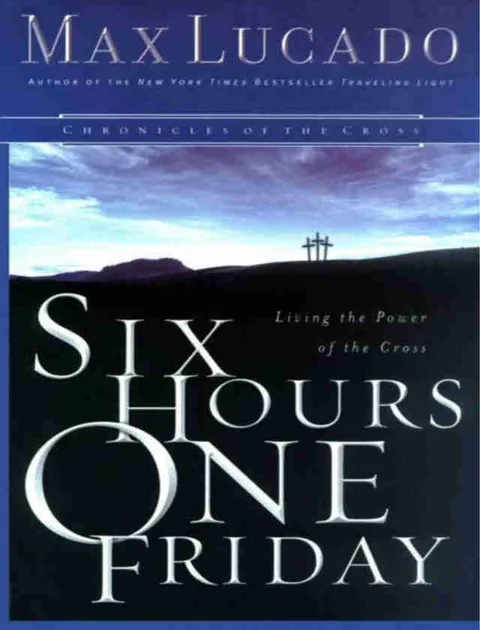

Others like six hours one friday Features >>









About the Book
In "Six Hours One Friday," Max Lucado explores the significance of the crucifixion of Jesus Christ and the love and sacrifice that it represents. Through powerful stories and biblical insights, Lucado demonstrates how the events of Good Friday have the power to bring hope, forgiveness, and redemption to all who believe. The book encourages readers to reflect on the profound impact of Jesus' death on the cross and the promise of new life that it offers.
Andrew Fuller
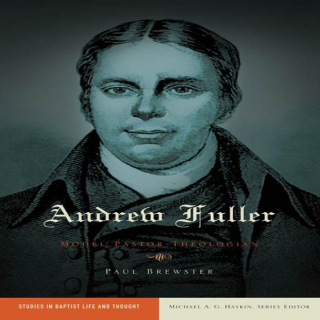 Fuller was born in Soham, Cambridgeshire, England, where in 1775 he was ordained pastor of the Baptist church. Originally schooled in the hyper-Calvinist theology then prevalent in parts of the Particular Baptist denomination, he became convinced in 1775 that the hyper-Calvinist position was not scriptural. In 1785 he published The Gospel Worthy of All Acceptation, which did much to prepare his denomination for accepting this missionary obligation. As pastor in Kettering, Northamptonshire, from 1783, Fuller became firm friends with John Sutcliff of Olney, John Ryland of Northampton, and later the young William Carey. The strengthening missionary vision of this group bore fruit on October 2, 1792, when the Particular Baptist Society for Propagating the Gospel among the Heathen (later known as the Baptist Missionary Society) was formed in the home of one of Fuller’s deacons in Kettering. Fuller was appointed secretary. Until his death he combined the demands of a busy pastorate with managing the affairs of the BMS. He traveled extensively to raise funds for the society, especially in Scotland, which he visited five times.
Brian Stanley, “Fuller, Andrew,” in Biographical Dictionary of Christian Missions, ed. Gerald H. Anderson (New York: Macmillan Reference USA, 1998), 230-231.
This article is reprinted from Biographical Dictionary of Christian Missions, Macmillan Reference USA, copyright © 1998 Gerald H. Anderson, by permission of Macmillan Reference USA, New York, NY. All rights reserved.
Pastor, apologist, and promoter of missions
Though not university trained, Andrew Fuller was recognized by his contemporaries as the preeminent Baptist theologian of their day and was awarded honorary doctor of divinity degrees by both Princeton (1798) and Yale (1805). Fuller’s published works, preaching ministry and churchmanship was, perhaps, the primary mediating agency between the transatlantic evangelical revival and the English Particular (or “Calvinist”) Baptists who had distanced themselves from what was largely at the start an Anglican renewal movement. Fuller was also well known as a co-founder of the Baptist Missionary Society (or, the Particular Baptist Society for the Propagation of the Gospel Amongst the Heathen [est. 1792]), on whose behalf he itinerated regularly in the British Isles, lobbied the East India Company, and wrote numerous letters and magazine articles during his twenty-two year tenure as its first general secretary. He was an opponent of the British slave trade and, though a dissenting non-Anglican, an acquaintance of William Wilberforce and other members of the Clapham sect, who were key allies in Parliament. He was a pastors’ pastor who exerted no small influence for evangelical doctrine and a missionary vision through the many ordination sermons he preached. From 1782 until his death in 1815 he served as pastor of the Kettering Baptist Church and was frequent chairman of the Northamptonshire Association, a consortium which included the likes of William Carey, Samuel Pearce, John Sutcliffe, and John Ryland, Jr.
Fuller was born in 1754 at Wicken, Cambridgeshire, to non-conformist parents who worked a dairy farm. In 1775, six years after his own conversion experience, he was inducted as pastor of the forty-seven member church in Soham, where he had received his baptism and was a member. In 1776 he married his first wife, Sarah Gardiner, with whom he had eleven children, only three surviving beyond early childhood. Sarah would die in 1792, less than two months before the founding of the British Missionary Society (BMS). During this seven year pastorate, Fuller immersed himself in the literary culture of Anglo-American evangelical Calvinism. He cultivated his theological perspective and ministry philosophy by ardently studying the Scriptures alongside the works of the Reformers, seventeenth-century Puritans (especially John Owen), early English Baptists like John Bunyan and John Gill, as well as the writings of American Congregationalist philosopher-theologian and pastor, Jonathan Edwards. Fuller also acknowledged in his most popular book, The Gospel Worthy of All Acceptation (1781), the influence of the lives of John Eliot and David Brainerd, both late missionaries to the native Americans. The Gospel Worthy was Fuller’s remonstration against the hyper-Calvinism that negated the propriety of evangelistic appeals. By the 1790s, evangelical (or “strict”) Calvinism was known in England as “Fullerism” (vs. “High” or hyper-Calvinism). The Gospel its Own Witness (1800) was Fuller’s refutation of Deism. Fuller gained a reputation by these two books, especially, for publically, clearly and systematically opposing in print whatever widely held doctrines he believed were undermining the church and its mission.
In the Northamptonshire Assocation Fuller was a member of a thriving intellectual community most influenced by Edwards. In 1784 John Sutcliff initiated a “concerts of prayer” movement similar to the program suggested by Edwards in An Humble Attempt to Promote Explicit Agreement and Visible Union of God’s People in Extraordinary Prayer (1748). Baptist congregations prayed monthly for the spread of the gospel and the kingdom of Christ to the ends of the earth through all denominations. In 1791, Sutcliff, Fuller and Samuel Pearce each preached at significant events (Sutcliff and Fuller at the association meeting of pastors, Pearce at William Carey’s ordination) on the duty of the church to evangelize the whole inhabitable globe. Fuller based his appeal on the eternal truth of the gospel, the eternal relevance of the gospel, the eternal power of the gospel, and the circumstances of the age that made missionary endeavors possible and obligatory.(1) Carey’s much touted association sermon from Isaiah 54:2-3 in May of 1792 did not arise in a vacuum. The influence was mutual between Carey and Fuller, both being influenced by Robert Hall, Sr. and Samuel Pearce (who had been inspired by the Methodist Thomas Coke in Birmingham).
On October 2, 1792, the BMS was formed with Fuller its first secretary and the assumption that its support would come largely from the churches of the Northamptonshire Association. When the society sent Carey and John Thomas to India the following year, Fuller preached their commissioning service from John 20:21 (“As the Father has sent me, even so I [Christ] am sending you.”). Fuller believed the mission’s raison d’être was the uniqueness of Christ and Christian responsibility to proclaim him. Bible translation and evangelism should take priority. Hindus were not desiring or seeking the Christian Scriptures. But to ignore and neglect anyone in an unconverted state is inconsistent with the love of God and man. In addition, God had promised the messiah the inheritance of the nations (An Apology for the Late Christian Missions to India, 1808). The church is obligated to employ means and make an effort as the means God uses to fulfill that promise to Christ. Obstacles are merely a test to sincerity of faith.
Fuller spent up to ten hours per day in correspondence and reporting for the BMS. He contributed articles to Evangelical Magazine, Missionary Magazine, Quarterly Magazine, Protestant Dissenters’ Magazine, Biblical Magazine, and Theological Miscellany. He sought financial support via letters and by an average of three months of vigorous itineration each year among various evangelical churches in Scotland, Ireland, Wales and England. John Ryland, Jr. wrote of Fuller’s style, that he, “…always disliked violent pressing for contributions, and attempting to outvie other societies: he chose rather to tell a plain, unvarnished tale; and he generally told it with good effect.”(2) Through written correspondence he “pastored” the missionaries in the field while maintaining a decentralized approach to mission administration. He believed the missionaries were more capable of governing themselves and that the time required for correspondence made central control impractical anyway.
The security of the unlicensed Baptist missionary society’s place in the British Empire was frequently tenuous up to 1813. Fuller occasionally had to petition Parliament or the Board of Control for continued tolerance of the BMS. Muslim irritation at the Christian missionary presence and the conversion of some Indians from Islam had been blamed for the Vellore Mutiny of 1806. Thomas Twining had openly claimed efforts at conversion were contradictory to “the mild and tolerant spirit of Christianity.” Fuller responded to Twining and other English defenders of Hinduism with his three-part Apology for the Late Christian Missions to India (1808) in which he argued for a toleration of religion that allows all religious views as well as efforts to persuade through reasonable means. He attributed several social ills, like ritual infanticide and sati, to Hinduism, and commended the missionaries for trying to put an end to such practices. Fuller was also a critic of the “detestable traffic” of the African slave trade, asserting it made England deserving of ruin at the hands of the French (from whose invasion he urged prayer that God would mercifully protect England). The prosperity of the empire should not come at the expense of other human beings. Patriotism must “harmonize” with “good will toward [other] men.”(3) On the other hand, Fuller often counseled BMS missionaries not to become “entangled” in political concerns which were “only affairs of this life” and endangered colonial toleration of the mission.(4) Because Jesus accomplished “moral revolution” in the heart, loyalty to the British government, rather than republicanism, should be encouraged as far as it is compatible with Christian commitments.(5)
Fuller, the pastor of families in England and abroad, counseled missionary families to nurture a deep spirituality for the sake of attaining the character commensurate with the nature of the gospel and their mission. Fuller knew the vicissitudes of even the Christian heart, and the “spiritual advantage” of engaging in mission. Reflecting in his diary on July 18, 1794, he wrote:
Within the last year or two, we have formed a missionary society; and have been enabled to send out two of our brethren to the East Indies. My heart has been greatly interested in this work. Surely I never felt more genuine love to God and to his cause in my life. I bless God that his work has been a means of reviving my soul. If nothing comes of it, I and many others have obtained a spiritual advantage.(6)
Fuller died in 1815. The epitaph stone for Fuller in the Kettering meeting house says he devoted his life for the prosperity of the BMS.(7) One biographer has said Fuller “lived and died a martyr to the mission.”(8) After December, 1794, he was assisted in life by his second wife, Ann Coles. Fuller also spent himself itinerating for the British and Foreign Bible Society after it was founded in 1804. His many occasional writings and sermon manuscripts reveal a love for the gospel message itself and the life-orienting impact of Bible texts such as Matthew 28:16-20 and Mark 16:15-16; John 12:36 and 20:21; and Romans 10:9, 14-17. Fuller is noted today for making a significant contribution to the revitalization of Particular (Calvinist) Baptist life in late eighteenth century England as well as for being a key figure in the historic turn toward a proliferation of free Protestant missionary societies at the beginning of the Great Century.
Fuller was born in Soham, Cambridgeshire, England, where in 1775 he was ordained pastor of the Baptist church. Originally schooled in the hyper-Calvinist theology then prevalent in parts of the Particular Baptist denomination, he became convinced in 1775 that the hyper-Calvinist position was not scriptural. In 1785 he published The Gospel Worthy of All Acceptation, which did much to prepare his denomination for accepting this missionary obligation. As pastor in Kettering, Northamptonshire, from 1783, Fuller became firm friends with John Sutcliff of Olney, John Ryland of Northampton, and later the young William Carey. The strengthening missionary vision of this group bore fruit on October 2, 1792, when the Particular Baptist Society for Propagating the Gospel among the Heathen (later known as the Baptist Missionary Society) was formed in the home of one of Fuller’s deacons in Kettering. Fuller was appointed secretary. Until his death he combined the demands of a busy pastorate with managing the affairs of the BMS. He traveled extensively to raise funds for the society, especially in Scotland, which he visited five times.
Brian Stanley, “Fuller, Andrew,” in Biographical Dictionary of Christian Missions, ed. Gerald H. Anderson (New York: Macmillan Reference USA, 1998), 230-231.
This article is reprinted from Biographical Dictionary of Christian Missions, Macmillan Reference USA, copyright © 1998 Gerald H. Anderson, by permission of Macmillan Reference USA, New York, NY. All rights reserved.
Pastor, apologist, and promoter of missions
Though not university trained, Andrew Fuller was recognized by his contemporaries as the preeminent Baptist theologian of their day and was awarded honorary doctor of divinity degrees by both Princeton (1798) and Yale (1805). Fuller’s published works, preaching ministry and churchmanship was, perhaps, the primary mediating agency between the transatlantic evangelical revival and the English Particular (or “Calvinist”) Baptists who had distanced themselves from what was largely at the start an Anglican renewal movement. Fuller was also well known as a co-founder of the Baptist Missionary Society (or, the Particular Baptist Society for the Propagation of the Gospel Amongst the Heathen [est. 1792]), on whose behalf he itinerated regularly in the British Isles, lobbied the East India Company, and wrote numerous letters and magazine articles during his twenty-two year tenure as its first general secretary. He was an opponent of the British slave trade and, though a dissenting non-Anglican, an acquaintance of William Wilberforce and other members of the Clapham sect, who were key allies in Parliament. He was a pastors’ pastor who exerted no small influence for evangelical doctrine and a missionary vision through the many ordination sermons he preached. From 1782 until his death in 1815 he served as pastor of the Kettering Baptist Church and was frequent chairman of the Northamptonshire Association, a consortium which included the likes of William Carey, Samuel Pearce, John Sutcliffe, and John Ryland, Jr.
Fuller was born in 1754 at Wicken, Cambridgeshire, to non-conformist parents who worked a dairy farm. In 1775, six years after his own conversion experience, he was inducted as pastor of the forty-seven member church in Soham, where he had received his baptism and was a member. In 1776 he married his first wife, Sarah Gardiner, with whom he had eleven children, only three surviving beyond early childhood. Sarah would die in 1792, less than two months before the founding of the British Missionary Society (BMS). During this seven year pastorate, Fuller immersed himself in the literary culture of Anglo-American evangelical Calvinism. He cultivated his theological perspective and ministry philosophy by ardently studying the Scriptures alongside the works of the Reformers, seventeenth-century Puritans (especially John Owen), early English Baptists like John Bunyan and John Gill, as well as the writings of American Congregationalist philosopher-theologian and pastor, Jonathan Edwards. Fuller also acknowledged in his most popular book, The Gospel Worthy of All Acceptation (1781), the influence of the lives of John Eliot and David Brainerd, both late missionaries to the native Americans. The Gospel Worthy was Fuller’s remonstration against the hyper-Calvinism that negated the propriety of evangelistic appeals. By the 1790s, evangelical (or “strict”) Calvinism was known in England as “Fullerism” (vs. “High” or hyper-Calvinism). The Gospel its Own Witness (1800) was Fuller’s refutation of Deism. Fuller gained a reputation by these two books, especially, for publically, clearly and systematically opposing in print whatever widely held doctrines he believed were undermining the church and its mission.
In the Northamptonshire Assocation Fuller was a member of a thriving intellectual community most influenced by Edwards. In 1784 John Sutcliff initiated a “concerts of prayer” movement similar to the program suggested by Edwards in An Humble Attempt to Promote Explicit Agreement and Visible Union of God’s People in Extraordinary Prayer (1748). Baptist congregations prayed monthly for the spread of the gospel and the kingdom of Christ to the ends of the earth through all denominations. In 1791, Sutcliff, Fuller and Samuel Pearce each preached at significant events (Sutcliff and Fuller at the association meeting of pastors, Pearce at William Carey’s ordination) on the duty of the church to evangelize the whole inhabitable globe. Fuller based his appeal on the eternal truth of the gospel, the eternal relevance of the gospel, the eternal power of the gospel, and the circumstances of the age that made missionary endeavors possible and obligatory.(1) Carey’s much touted association sermon from Isaiah 54:2-3 in May of 1792 did not arise in a vacuum. The influence was mutual between Carey and Fuller, both being influenced by Robert Hall, Sr. and Samuel Pearce (who had been inspired by the Methodist Thomas Coke in Birmingham).
On October 2, 1792, the BMS was formed with Fuller its first secretary and the assumption that its support would come largely from the churches of the Northamptonshire Association. When the society sent Carey and John Thomas to India the following year, Fuller preached their commissioning service from John 20:21 (“As the Father has sent me, even so I [Christ] am sending you.”). Fuller believed the mission’s raison d’être was the uniqueness of Christ and Christian responsibility to proclaim him. Bible translation and evangelism should take priority. Hindus were not desiring or seeking the Christian Scriptures. But to ignore and neglect anyone in an unconverted state is inconsistent with the love of God and man. In addition, God had promised the messiah the inheritance of the nations (An Apology for the Late Christian Missions to India, 1808). The church is obligated to employ means and make an effort as the means God uses to fulfill that promise to Christ. Obstacles are merely a test to sincerity of faith.
Fuller spent up to ten hours per day in correspondence and reporting for the BMS. He contributed articles to Evangelical Magazine, Missionary Magazine, Quarterly Magazine, Protestant Dissenters’ Magazine, Biblical Magazine, and Theological Miscellany. He sought financial support via letters and by an average of three months of vigorous itineration each year among various evangelical churches in Scotland, Ireland, Wales and England. John Ryland, Jr. wrote of Fuller’s style, that he, “…always disliked violent pressing for contributions, and attempting to outvie other societies: he chose rather to tell a plain, unvarnished tale; and he generally told it with good effect.”(2) Through written correspondence he “pastored” the missionaries in the field while maintaining a decentralized approach to mission administration. He believed the missionaries were more capable of governing themselves and that the time required for correspondence made central control impractical anyway.
The security of the unlicensed Baptist missionary society’s place in the British Empire was frequently tenuous up to 1813. Fuller occasionally had to petition Parliament or the Board of Control for continued tolerance of the BMS. Muslim irritation at the Christian missionary presence and the conversion of some Indians from Islam had been blamed for the Vellore Mutiny of 1806. Thomas Twining had openly claimed efforts at conversion were contradictory to “the mild and tolerant spirit of Christianity.” Fuller responded to Twining and other English defenders of Hinduism with his three-part Apology for the Late Christian Missions to India (1808) in which he argued for a toleration of religion that allows all religious views as well as efforts to persuade through reasonable means. He attributed several social ills, like ritual infanticide and sati, to Hinduism, and commended the missionaries for trying to put an end to such practices. Fuller was also a critic of the “detestable traffic” of the African slave trade, asserting it made England deserving of ruin at the hands of the French (from whose invasion he urged prayer that God would mercifully protect England). The prosperity of the empire should not come at the expense of other human beings. Patriotism must “harmonize” with “good will toward [other] men.”(3) On the other hand, Fuller often counseled BMS missionaries not to become “entangled” in political concerns which were “only affairs of this life” and endangered colonial toleration of the mission.(4) Because Jesus accomplished “moral revolution” in the heart, loyalty to the British government, rather than republicanism, should be encouraged as far as it is compatible with Christian commitments.(5)
Fuller, the pastor of families in England and abroad, counseled missionary families to nurture a deep spirituality for the sake of attaining the character commensurate with the nature of the gospel and their mission. Fuller knew the vicissitudes of even the Christian heart, and the “spiritual advantage” of engaging in mission. Reflecting in his diary on July 18, 1794, he wrote:
Within the last year or two, we have formed a missionary society; and have been enabled to send out two of our brethren to the East Indies. My heart has been greatly interested in this work. Surely I never felt more genuine love to God and to his cause in my life. I bless God that his work has been a means of reviving my soul. If nothing comes of it, I and many others have obtained a spiritual advantage.(6)
Fuller died in 1815. The epitaph stone for Fuller in the Kettering meeting house says he devoted his life for the prosperity of the BMS.(7) One biographer has said Fuller “lived and died a martyr to the mission.”(8) After December, 1794, he was assisted in life by his second wife, Ann Coles. Fuller also spent himself itinerating for the British and Foreign Bible Society after it was founded in 1804. His many occasional writings and sermon manuscripts reveal a love for the gospel message itself and the life-orienting impact of Bible texts such as Matthew 28:16-20 and Mark 16:15-16; John 12:36 and 20:21; and Romans 10:9, 14-17. Fuller is noted today for making a significant contribution to the revitalization of Particular (Calvinist) Baptist life in late eighteenth century England as well as for being a key figure in the historic turn toward a proliferation of free Protestant missionary societies at the beginning of the Great Century.
Can I Follow My New Heart
“Why shouldn’t I follow my heart? If I am a Christian — if God has caused me to be ‘born again’ and has given me ‘a new heart’ — isn’t my new heart trustworthy?” Readers have raised some version of this objection when I’ve exhorted Christians, “Don’t follow your heart.” And the objection is warranted. After all, the Bible clearly teaches that in this era of the new covenant, God writes his law on our new hearts so that we willingly follow him (Jeremiah 31:31–34; Hebrews 8:8–12). This would seem to not merely imply, but even mandate, that Christians should follow their hearts. But the Bible’s description of what a regenerated person actually experiences in this age reveals a more spiritually and psychologically complex picture — one that I believe gives Christians biblical warrant to cultivate a healthy suspicion of what they recognize as their hearts’ desires. So, while we may, and hopefully will, reach a point in our lives as Christians where it’s right, at times, to follow our hearts, allow me to make a brief case that the phrase actually undermines Christians as they labor and struggle to discern their various desires, and that Scripture itself discourages us from thinking this way. War Within How might we summarize the complex picture the Bible paints of the born-again experience in this already-not-yet age? The New Testament explains that when the Spirit brings us from spiritual death to spiritual life (John 5:24; Romans 6:13), we enter a strange new reality. Our regenerated new self emerges, “created after the likeness of God in true righteousness and holiness.” And yet our “old self, which belongs to [our] former manner of life,” is still “corrupt through deceitful desires” (Ephesians 4:22–24). We are “born of the Spirit” (John 3:6) while still inhabiting the “flesh,” our “body of death” in which “nothing good dwells” (Romans 7:18, 24). “The hearts of regenerated people are not yet fully free from the influence of their flesh.” When Christians are born again, we enter into a lifelong internal war where “the desires of the flesh are against the Spirit, and the desires of the Spirit are against the flesh, for these are opposed to each other, to keep you from doing the things you want to do” (Galatians 5:17). Stepping back and viewing these desires objectively, “the works of the flesh” that result from fleshly desires “are evident,” and so is “the fruit of the Spirit” (Galatians 5:19–23). But Christians often struggle — on the ground, in real time — to discern the desires of the Spirit from the desires of the flesh. This is why the New Testament Epistles are full of exhortations and corrections addressed to Christians. James tells his readers (and us at relevant times) that their “passions are at war within” them (James 4:1). Peter warns his readers (and us), “Do not be conformed to the passions of your former ignorance” (1 Peter 1:14). Paul describes this internal experience of warring passions as “wretched” (Romans 7:24). And he admonishes the Colossian Christians (and us) with strong language: “Put to death therefore what is earthly in you: sexual immorality, impurity, passion, evil desire, and covetousness, which is idolatry” (Colossians 3:5). Why did these apostles feel the need to speak this way to regenerated people? Because the hearts of these regenerated people were not yet fully free from the influence of their flesh, their old selves. Follow the Spirit Much of the Christian life is a war to die to remaining sin and live by the Spirit. John Piper calls it “the main battle of the Christian life”: The main battle is to see our hearts renovated, recalibrated, so that we don’t want to do those sinful external behaviors, and don’t just need willpower not to do them, but the root has been severed and we have different desires. In other words, the goal of change — of sanctification, of the Christian life — is to be so changed that we can and ought to follow our desires. That’s exactly right. And when we have been so changed through progressive sanctification, so renovated that our hearts (and therefore our desires, dispositions, motives, emotions, and passions) are, as Piper says, “calibrated to Christ,” then we should follow our hearts. However, at any given time within our churches, small groups, friendships, and families, different Christians are at different places for different reasons in this heart-renovation process. Some hearts are more sanctified, and therefore more reliable to follow, than others. I think that’s why we don’t hear the apostles generally counsel us to follow our hearts in our fight of faith against remaining sin, but rather to follow the Holy Spirit. Let Not Sin Reign Paul is the one who delves most deeply into this issue: “I say, walk by the Spirit, and you will not gratify the desires of the flesh” (Galatians 5:16). He devotes most of Romans 6–8 to explaining the nature of the strange new-self/old-self, Spirit/flesh reality of the Christian life, including Romans 8:13: “If you live according to the flesh you will die, but if by the Spirit you put to death the deeds of the body, you will live.” Paul lays the theological foundation of our understanding by explaining “that our old self was crucified with [Christ] in order that [our] body of sin might be brought to nothing, so that we would no longer be enslaved to sin” (Romans 6:6). Our new selves were “raised with Christ” (Colossians 3:1) so that “we too might walk in newness of life” (Romans 6:4). Therefore, we “must consider [ourselves] dead to sin and alive to God in Christ Jesus” (Romans 6:11). In light of this, Paul admonishes us, Let not sin therefore reign in your mortal body, to make you obey its passions. Do not present your members to sin as instruments for unrighteousness, but present yourselves to God as those who have been brought from death to life, and your members to God as instruments for righteousness. For sin will have no dominion over you, since you are not under law but under grace. (Romans 6:12–14) And how do we do this? By learning to “set [our] minds on the things of the Spirit” and not on “the things of the flesh” (Romans 8:5) — by learning to follow the Spirit, to “walk by the Spirit” (Galatians 5:16), because “all who are led by the Spirit of God are sons of God” (Romans 8:14). Follow the Treasure One of the reasons I find “follow your heart” generally unhelpful as counsel for Christians is that many of us, from the time we were young, have absorbed this as a pop-cultural creed that says if we just look deep into our hearts, we’ll be shown our deepest truth, and discover the way we should go. Given the significant amount our sinful flesh still influences our hearts, it’s not hard to see how this phrase can easily increase confusion when applying it to the Christian life. “Some hearts are more sanctified, and therefore more reliable to follow, than others.” I also don’t believe the Bible encourages that idea since, when it comes to engaging our hearts, far and away what we hear in it is counsel to “direct our hearts,” not to follow them. We see that clearly in Paul’s instructions above. God made our hearts to follow, not to lead. And what do our hearts follow? Jesus gives the clearest answer: “Where your treasure is, there your heart will be also” (Matthew 6:21). In time, our heart always pursues (follows) our treasure. When we are born again, the eyes of our hearts are enlightened (Ephesians 1:18) and, through faith, we begin to see the Treasure: God himself in Christ. And since our heart learns to pursue the object that stirs its greatest affections, its treasure, I suggest we not counsel each other to “follow your heart,” but instead to “follow the Treasure.” Looking into our hearts for direction can be spiritually hazardous. It is usually more helpful for us to direct our hearts to what is most valuable and delightful. Which is why I believe David counsels us, “Delight yourself in the Lord, and he will give you the desires of your heart” (Psalm 37:4). Article by Jon Bloom