
GIP Library icon

LOG IN TO REVIEW
About the Book


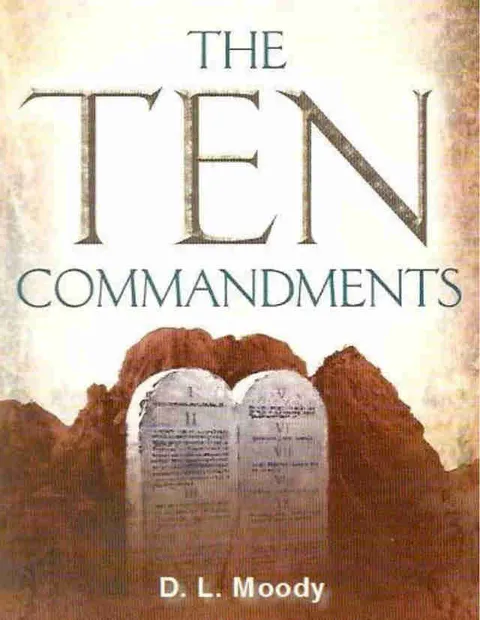
"Ten Commandments" by Dwight L. Moody provides a comprehensive exploration and explanation of the Ten Commandments given by God to Moses. Moody delves into the significance of each commandment and how they are relevant to modern society, offering valuable insights for living a life guided by God's principles. Through clear and insightful commentary, Moody highlights the importance of obedience to God's laws and their enduring relevance for believers today.

Lecrae Moore

Lecrae Moore Lecrae Devaughn Moore, or simply Lecrae, is an American Christian rapper, songwriter, and record producer who performs both as a solo artist and as the leader of a group named ‘116 Clique’. He had a troubled beginning in life but all that changed after he found his faith at 19. Heavily influenced by 2Pac Shakur, and motivated by his new found faith, he ventured into a musical career. He and his friend Ben Washer set up their own independent record label ‘Reach Records’ and through it, he released his debut album ‘Real Talk’ in 2004. In the following years, he brought out six more studio albums, three mix tapes, and two EPs as a solo artist and three studio albums, one remix album, and one EP with his group. He has received six ‘GMA Dove Awards’, two Grammys, two ‘BET Awards’ and more. Lecrae is very active in the community and in 2005, he established ‘ReachLife Ministries’, the mission of which was to “bridge the gap between biblical truth and the urban context”. He is a vocal supporter of the preservation of responsibility and believes that fatherhood should be considered as a value to be installed among men in the United States. He has authored several op-ed articles on race relations in the modern-day America which were published by ‘Billboard’. Childhood & Early Life Lecrae Devaughn Moore was born on October 9, 1979, in Houston, Texas, USA. His father had always been absent from his life and later became a drug addict. He was raised by his poor but hardworking mother and grandmother. He attended services with them at their local church but the initial response to religion was indifferent at best. Growing up, he lived in San Diego, Denver, and Dallas. He suffered sexual molestation at the hands of a female baby sitter when he was eight, and according to Lecrae, it left a long-term negative impact on his views on sexuality. In a life full of abuse and violence, hip hop provided him with a refuge. Besides 2Pac who he admired for his rapping skills, he also looked up to his uncle who introduced him to a life of crime. He began doing drugs at 16 and soon started dealing as well. He kept a Bible with him that his grandmother had given him as a good luck charm. The turning point in his life came when he was arrested for drug possession. The officer let him go upon Lecrae’s promising that he would read and follow the Bible. He thus started visiting the church again. Upon an invitation from a friend, he also started attending Bible studies. He was once involved in an accident where he wrecked his car but he himself came out unscathed. This incident further strengthened his belief in Christ and he devoted his life fully to his faith. He returned to his college, the ‘University of North Texas’ and volunteered and sang at a juvenile detention centre. Career Six years after his conversion, Lecrae Moore released the album ‘Real Talk’ (2004) through ‘Reach Records’, a label he had founded with his friend Ben Washer. It reached #29 spot on the ‘Billboard Gospel Album’ chart after being re-released in 2005 by ‘Cross Movement Records’. In 2005, he formed ‘116 Clique’ with other artists who had signed with ‘Reach Records’. The group owes its name to the Bible Verse ‘Romans 1:16’. They debuted with ‘The Compilation Album’ in the same year. They have since released three more albums, ‘The Compilation Album: Chopped & Screwed’ (remix, 2006), ‘13 Letters’ (2007), and ‘Man Up’ (2011), and one EP, ‘Amped’ (2007). He was nominated for a ‘Stellar Award’ for the ‘Rap/Hip-Hop/Gospel CD of the Year’ for his second solo album ‘After the Music Stops’ (2006). In 2008, he put out his third studio album ‘Rebel’. In his fourth studio album, ‘Rehab’ (2010), Lecrae talks about freedom from inhibiting addictions and habits. Both Lecrae and his album received accolades in the 2010 ‘Rapzilla.com staff picks’, being hailed as the ‘Artist of the Year’ and the ‘Album of the Year’, respectively. His fifth studio album, ‘Rehab: The Overdose’ (2011) was a direct follow-up to ‘Rehab’, both being highly conceptual works. While ‘Rehab’ was about the victory over addiction, ‘Rehab: The Overdose’ focused on attaining "grace, love, peace and hope" in Jesus. He won his first two Doves because of this album, one for the ‘Rap/Hip Hop Album of the Year’ and the other for the ‘Rap/Hip Hop Recorded Song of the Year’ for the track, ‘Hallelujah’. ’Gravity’, released on September 4, 2012, was his sixth studio album and had 15 songs with a total runtime of 57 minutes. It peaked on the ‘Rap Albums’, ‘Christian Albums’, ‘Gospel Albums’, and ‘Independent Albums’ charts. Lecrae released his first mixtape ‘Church Clothes’ on May 10, 2012, through digital download for free. It was followed by ‘Church Clothes 2’ (November 7, 2013), and ‘Church Clothes 3’ (January 15, 2016). He has also released two Extended Plays till date, the EP version of ‘Church Clothes’, and ‘Gravity: The Remix EP’, both released in 2012. He has collaborated with the likes of Trip Lee, Tedashii, Canon, Mali Music, and Ty Dolla Sign. ‘Columbia Records’ signed him in May 2016, in a contract between them and his label. His most recent work, a track named ‘Hammer Time’, which is a collaborative effort with 1k Phew, was released on June 23, 2017. On May 3, 2016, he published his memoir titled ‘Unashamed’ through ‘Broadman & Holman Publishers’. It debuted at #19 spot on the ‘New York Times Best Sellers’ list. Philanthropic Works In 2011, Lecrae, through ‘116 Clique’ and the ‘ReachLife Ministries’, instigated the campaign ‘Man Up’, focused on providing guidance to young urban males on fatherhood and Biblical manhood. In March 2015, ReachLife was deactivated and ‘116 Clique’ shifted its attention to contribute to ‘Peace Preparatory Academy’, a Christian school in Atlanta. In May 2013, he worked alongside several other celebrities on a media initiative named ‘This is Fatherhood’. Jay Z, Barack Obama, Joshua DuBois, Lecrae himself, and others have appeared in the initiative’s promotional public service announcement videos. Major Works In a career marked by successful artistic ventures and awards, Lecrae’s greatest musical achievement is unarguably his seventh and the latest studio album ‘Anomaly’, released on September 9, 2014. It was the first album in history to debut at #1 on both ‘Billboard 200’ and ‘Top Gospel Albums’ charts. It was also certified Gold by the RIAA. Awards & Achievements Lecrae Moore received a Grammy in 2013 for the ‘Best Gospel Album’ for his sixth studio album ‘Gravity’. He won his second Grammy in 2015 for the ‘Best Contemporary Christian Music Performance/Song’ for the track ‘Messengers’ which also featured the Christian pop band ‘For King & Country’. He was named the best gospel artist at the ‘2015 BET Awards’. In 2017, he was the recipient of the ‘BET Best Gospel/ Inspirational Award’ for the song ‘Can’t Stop Me Now (Destination)’. On March 14, 2016, he was conferred with an honorary doctorate from ‘Canada Christian College’. Personal Life & Legacy Lecrae Moore met his wife Darragh at a Bible study when they were both teenagers. They have three children together, two sons and a daughter. The family resides in Atlanta, Georgia. In 2002, he was informed by his then girlfriend that she was pregnant with his child. The couple had an abortion, a decision which he has regretted since. The incident was the subject of the song ‘Good, Bad, Ugly’ from ‘Anomaly’. Trivia Lecrae portrayed the character Dr. Darnall Malmquist in the 2014 independent film ‘Believe Me’.

walk in his providence - how god opens doors for you

When the master in Jesus’s parable gave talents to his servants and went away, two got busy multiplying their master’s money, and one hid his talent in the dirt. Something similar can happen when people like us hear about the providence of God. On the one hand, few doctrines have inflamed more holy ambition in the hearts of God’s people. When some hear that God rules over galaxies and governments, over winds and waves, and over every detail in our little lives (Ephesians 1:11), they get busy doing good. Christians gripped by providence have built hospitals, ended slave trades, founded orphanages, launched reformations, and pierced the darkness of unreached peoples. On the other hand, few doctrines have been used more often to excuse passivity, sloth, and the sovereignty of the status quo. When some hear that God reigns over all, they reach for the remote, kick up their feet, take sin a little less seriously, bury their talents six feet under. They may do good when the opportunity arises, when the schedule allows, but they will rarely  search  for good to do. How could the all-pervasive providence of God energize some and paralyze others? How could it cause some to blaze boldly into the unknown, and others to putter on the same tired paths, rarely dreaming, never risking? Waiting for an Open Door When William Carey, the pioneering missionary to India, first proposed the idea of sending Christians to unreached places, an older pastor reportedly protested, “Sit down, young man, sit down and be still. When God wants to convert the heathen, he will do it without consulting either you or me.” Such an application of God’s providence is simplistic, unbiblical, irresponsible — and yet also understandable. Though many of us would never make such a statement, we have our own ways of allowing providence to lull us into passivity. Consider the common language of waiting or praying for “an open door.” The phrase “open door” comes from the apostle Paul (Colossians 4:3–4), yet many of us use the phrase in ways the apostle didn’t. Paul prayed for open doors, yes, but then he vigorously turned handles (compare 1 Corinthians 16:8–9 with Acts 19:1–10). Many of us, on the other hand, sit in the hallway of life, waiting until a divine hand should swing a door open and push us through it. Too often, by saying, “There was no open door,” we mean that there was no obvious, divine orchestration of events that made our path unmistakable. “I didn’t share the gospel because no one seemed interested.” “I didn’t have that hard conversation because we just never ran into each other.” “I didn’t confess that sin because there didn’t seem to be a good time.” Providence, if distorted, can excuse us from all manner of uncomfortable duties. When William Carey gazed toward India, he did not see what we might call an open door: fifty million Muslims and Hindus living half a world and two oceans away. Hence the pastor’s response. Yet Carey went anyway, believing that God, in his providence, could make a way where there seemed to be no way. And India is still bearing fruit from his faith. For Such a Time as This Carey found his inspiration, of course, from dozens of men and women in Scripture who ventured forth into discomfort and danger by the power of God’s providence. Where did Jonathan find the courage to attack an army with only his armor-bearer at his side? Providence: “Come, . . . it may be that the Lord will work for us, for nothing can hinder the Lord from saving by many or by few” (1 Samuel 14:6). How did Esther muster the courage to risk the king’s fury? Providence: “Who knows whether you have not come to the kingdom for such a time as this?” (Esther 4:14). Why did David step toward Goliath with only a sling and five stones? Providence: “The Lord who delivered me from the paw of the lion and from the paw of the bear will deliver me from the hand of this Philistine” (1 Samuel 17:37). “God has planned for some doors to open only as we push them.” Some hear, “God reigns over all,” and think, “Then what difference could my effort make?” Others, like Jonathan, Esther, and David, heard, “God reigns over all,” and thought, “Then God can use even my effort, small though it is.” And so, after thinking, weighing, and praying, they went forth — not always sure that God would prosper their plans, but deeply confident that, if he wanted to, no force in heaven or on earth could stop him. In other words, they knew their God ruled in heaven. They saw a need on the earth. And with “Your kingdom come” burning through the chambers of their hearts (Matthew 6:10), they dreamed up something new for the sake of his name. Act the Providence of God Perhaps, for some of us, the difficulty lies here: we expect to  react to  the providence of God, but not to  act  the providence of God. Some of us live as though providence were something only to  react to . We wait for a clear, providential open door, and then we react to that providence by walking through the doorway. But as we’ve seen, God has planned for some doors to open only as we push them. He has planned for us to  act  his providence. Paul gives us the clearest biblical expression of this dynamic in Philippians 2:12–13: “Work out your own salvation with fear and trembling, for it is God who works in you, both to will and to work for his good pleasure.” Notice: Our work does not  follow  God’s work. Rather, our work is the  simultaneous effect  of God’s work. Or as John Piper writes, “What Paul makes plain here is how fully our own effort is called into action. We do not wait for the miracle; we act the miracle” ( Providence , 652). Sometimes, to be sure, God is pleased to place some good work right in our lap. Perhaps someone really does ask about the hope that is in us, or the hard conversation we need to have opens easily and naturally. In moments like these, we do indeed react to God’s providence. But God can be just as active in us when our effort is fully involved: when we invite a neighbor over to study the Bible together, or when we arrange a time and place for the difficult talk. We need not wait for something unmistakably divine, something unquestionably providential, before we work out our salvation in all kinds of obedience. Instead, we need only see some good work to do, entrust ourselves to God through earnest prayer, work hard in conscious dependence on him, and then, once finished, turn around and say with Paul, “It was not I, but the grace of God that is with me” (1 Corinthians 15:10). And thus we  act  the providence of God. Imagine Good In his providence, God has prepared good works for us to walk in (Ephesians 2:10). But many of them will not come as we passively drift beneath God’s providence. They will come to us, instead, as we strain our renewed minds, bend our born-again imaginations, and fashion possibilities in the factory of our new hearts — knowing that every good resolve is a spark of his providence. “You are who you are, what you are, where you are, because of the all-pervasive providence of God.” So look around you. Nothing about your life is an accident. You are who you are, what you are, where you are, because of the all-pervasive providence of God. He has given you whatever talents you have, in his wisdom, for such a time as this — so that you would add a stroke to the canvas in front of you, chisel away at the statue you see, speak and act in the drama you’re in, so that this world looks a little more like the work of art God is redeeming it to be. There are neighbors to befriend, children to disciple, churches to plant, crisis-pregnancy centers to serve, and a thousand tasks at our jobs to do with excellence and love. And how will we know if God, in his providence, has opened a door for any of these opportunities? We will pray and turn the handle.

Feedback
Suggestionsuggestion box
x