
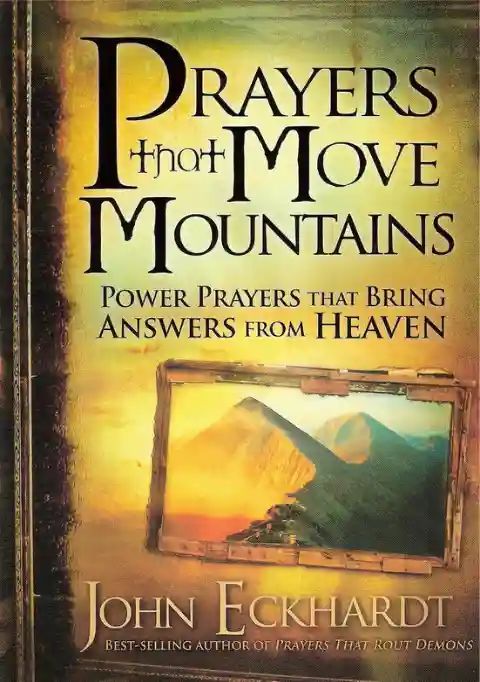

Others like prayers that move mountains Features >>
Prayer Moves God
Prayer That Brings Revival
Praying Your Way Out Of Bondage

Prayer - Finding The Heart’s True Home

The Desire Of The Righteous Granted
Too Busy Not To Pray
Putting Your Angels To Work

Your Miracle Is In Your Mouth
Understanding The Power Of Praise
-160.webp)
Carriers Of The Glory (Becoming A Friend Of The Holy Spirit)
About the Book
"Prayers That Move Mountains" by John Eckhardt is a guidebook on the power of prayer, providing insight on how to strengthen one's prayer life and experience breakthroughs in various areas of life. The book emphasizes the importance of faith, persistence, and aligning prayers with the will of God in order to see mountains moved and obstacles overcome through prayer.
Steven Curtis Chapman
 Steven Curtis Chapman is an American Christian musician, singer, song writer, record producer, actor, author and social activist. He is the only artist in the history of music to have won 56 Gospel Music Association Dove Awards and is also a proud receiver of 5 Grammy Awards. His music is known for being a unique cross between country music, soft rock and orchestrated pop, which made him a prominent artist in the contemporary Christian music circuit of the 1980s. Chapman grew up in a humble environment where he found his calling for music, owing to his father’s inclination towards country music. He learnt to play instruments like guitar and piano just by hanging around in his father’s music store, listening to him play along with his friends. He took up music seriously when he moved to Nashville and got recognized by Sparrow Records, a company he stayed with for a long period in his career. He has released 19 studio albums and has sold over 10 million albums until now. Chapman is a family oriented person just like his father and has a big family comprising of his wife Mary Beth and 3 biological and 2 adopted children. He is a vocal advocate for adoption and has worked socially to eradicate the problem of youth violence.
Childhood & Early Life
Steven Curtis Chapman was born on November 21, 1962 in Paducah, Kentucky, to Herb and Judy Chapman. His father was a country singer and songwriter, who turned down opportunities to become a successful singer to concentrate on his family. His mother was a stay-at-home mom.
His father owned a music store, a business he managed from his basement and used to play music with his friends. Such creative environment at home influenced Chapman’s life from very early on and he bought his first guitar at 6.
Chapman joined as a pre-med student at Georgetown College in Kentucky but after few semesters he moved to Anderson College, Indiana. But he ultimately dropped the idea of studying and went to Nashville to pursue his first love, music.
During 1980s, he wrote a song ‘Built to Last’, which gained huge popularity after getting recorded by a gospel group ‘The Imperials’. The success of the song fetched Chapman a songwriting deal with Sparrow Records.
Career
Chapman’s first official album ‘First Hand’ was released in 1987. The album was an instant hit with singles like ‘Weak Days’ and topped at number 2 on the Contemporary Christian Music chart. The album had a mix of country music with soft rock and pop.
In 1988, following the success of his first album, Chapman released ‘Real Life Conversations’. Its hit single ‘His Eyes’ received the ‘Contemporary Recorded Song of the Year’ award from the ‘Gospel Music Association’. He co-wrote it with James Isaac Elliot.
After a few years, he made a swift turn to mainstream music with his album ‘The Great Adventure’ in 1992. It earned him two Grammy awards for the album and for the title song of the album.
After gaining consistent success with albums like ‘Heaven in the Real World (1994), ‘Signs of Life (1996) and ‘Speechless (1999), Chapman’s next great album ‘Declaration’ came out in 2001, for which he toured 70 cities.
In 2003, ‘All About Love’ was released and it ranked at Top 15 on the Christian Music charts. It was released under Sparrow Records and Chapman very humbly credited his wife Mary Beth for being the inspiration for his album.
‘All Things New’ was released in 2004 and the album added another Grammy to Chapman’s proud award collection. This time he received it in the category of Best Pop/Contemporary Gospel Album. It was also nominated for the Dove Award.
In 2005, ‘All I Really Want for Christmas’ was released, which was Chapman’s another successful Christmas album after ‘The Music of Christmas’. It had traditional holiday tunes and favorites like ‘Go Tell It on the Mountain’ and Silver Bells’.
Chapman took his music to greater levels by taking his concert to South Korea for the U.S. troops who were serving there in 2006. It was the first Christian concert that ever performed for the American army in that country.
In 2007, he released ‘This Moment’ which included hit singles like ‘Cinderella’, for which he was chosen for WOW Hits 2009. He also went on his ‘Winter Jam’ tour and took his sons’, Caleb and Will’s band along.
‘Beauty Will Rise’, Chapman’s seventeenth album, was released in 2009. It is said that he wrote the songs of the album after getting inspired by his daughter Maria Sue’s sad and untimely demise. It included songs like ‘Meant to Be’ and ‘Re:creation’.
In 2012, Chapman finally parted ways with Sparrow Records, the record company that he remained loyal to for so many years. He was signed on by Sony’s Provident Label Group and came out with a Christmas album called ‘JOY’.
‘The Glorious Unfolding’ was released in 2013 under Reunion Records and it peaked on number 27 on the Billboard 200 and was number 1 Top Christian Album. The album was produced by Chapman himself and Brent Milligan.
Major Works
Chapman’s ‘The Great Adventure’ in 1992 was a turning point in his musical career because until now he was making soft and contemporary country music but with ‘The Great Adventure’ he targeted the mainstream audience and tasted huge commercial success for the first time.
Awards & Achievements
Chapman is the winner of five Grammy awards for albums like ‘For the Sake of the Call’ ‘The Great Adventure’ ‘The Live Adventure’, ‘Speechless’ and ‘All Things New’. He has also received 56 Gospel Music Association Dove Awards, more than any other artist.
Personal Life & Legacy
Chapman got married to Mary Beth in 1984 after they first met at Anderson University in Indiana. They have three biological children: Emily, Caleb and Will and three adopted children: Shaohannah, Stevey and Maria, together.
In 2008, Chapman’s youngest son Will ran over his car by accident on his adopted daughter Maria Sue Chunxi Chapman. She was running towards him to meet him but he did not see her and she was pronounced dead on arrival at the hospital.
Trivia
Chapman’s wife Mary Beth Chapman has written and released a book about losing her youngest daughter called ‘Choosing to SEE: A Journey of Struggle and Hope’.
Chapman and his wife have written three children's books with adoption themes: ‘Shaoey And Dot: Bug Meets Bundle’ (2004), ‘Shaoey and Dot: The Christmas Miracle’ (2005), and ‘Shaoey and Dot: A Thunder and Lightning Bug Story’ (2006).
He has received an Honorary Doctorate of Music from Anderson University.
Steven Curtis Chapman is an American Christian musician, singer, song writer, record producer, actor, author and social activist. He is the only artist in the history of music to have won 56 Gospel Music Association Dove Awards and is also a proud receiver of 5 Grammy Awards. His music is known for being a unique cross between country music, soft rock and orchestrated pop, which made him a prominent artist in the contemporary Christian music circuit of the 1980s. Chapman grew up in a humble environment where he found his calling for music, owing to his father’s inclination towards country music. He learnt to play instruments like guitar and piano just by hanging around in his father’s music store, listening to him play along with his friends. He took up music seriously when he moved to Nashville and got recognized by Sparrow Records, a company he stayed with for a long period in his career. He has released 19 studio albums and has sold over 10 million albums until now. Chapman is a family oriented person just like his father and has a big family comprising of his wife Mary Beth and 3 biological and 2 adopted children. He is a vocal advocate for adoption and has worked socially to eradicate the problem of youth violence.
Childhood & Early Life
Steven Curtis Chapman was born on November 21, 1962 in Paducah, Kentucky, to Herb and Judy Chapman. His father was a country singer and songwriter, who turned down opportunities to become a successful singer to concentrate on his family. His mother was a stay-at-home mom.
His father owned a music store, a business he managed from his basement and used to play music with his friends. Such creative environment at home influenced Chapman’s life from very early on and he bought his first guitar at 6.
Chapman joined as a pre-med student at Georgetown College in Kentucky but after few semesters he moved to Anderson College, Indiana. But he ultimately dropped the idea of studying and went to Nashville to pursue his first love, music.
During 1980s, he wrote a song ‘Built to Last’, which gained huge popularity after getting recorded by a gospel group ‘The Imperials’. The success of the song fetched Chapman a songwriting deal with Sparrow Records.
Career
Chapman’s first official album ‘First Hand’ was released in 1987. The album was an instant hit with singles like ‘Weak Days’ and topped at number 2 on the Contemporary Christian Music chart. The album had a mix of country music with soft rock and pop.
In 1988, following the success of his first album, Chapman released ‘Real Life Conversations’. Its hit single ‘His Eyes’ received the ‘Contemporary Recorded Song of the Year’ award from the ‘Gospel Music Association’. He co-wrote it with James Isaac Elliot.
After a few years, he made a swift turn to mainstream music with his album ‘The Great Adventure’ in 1992. It earned him two Grammy awards for the album and for the title song of the album.
After gaining consistent success with albums like ‘Heaven in the Real World (1994), ‘Signs of Life (1996) and ‘Speechless (1999), Chapman’s next great album ‘Declaration’ came out in 2001, for which he toured 70 cities.
In 2003, ‘All About Love’ was released and it ranked at Top 15 on the Christian Music charts. It was released under Sparrow Records and Chapman very humbly credited his wife Mary Beth for being the inspiration for his album.
‘All Things New’ was released in 2004 and the album added another Grammy to Chapman’s proud award collection. This time he received it in the category of Best Pop/Contemporary Gospel Album. It was also nominated for the Dove Award.
In 2005, ‘All I Really Want for Christmas’ was released, which was Chapman’s another successful Christmas album after ‘The Music of Christmas’. It had traditional holiday tunes and favorites like ‘Go Tell It on the Mountain’ and Silver Bells’.
Chapman took his music to greater levels by taking his concert to South Korea for the U.S. troops who were serving there in 2006. It was the first Christian concert that ever performed for the American army in that country.
In 2007, he released ‘This Moment’ which included hit singles like ‘Cinderella’, for which he was chosen for WOW Hits 2009. He also went on his ‘Winter Jam’ tour and took his sons’, Caleb and Will’s band along.
‘Beauty Will Rise’, Chapman’s seventeenth album, was released in 2009. It is said that he wrote the songs of the album after getting inspired by his daughter Maria Sue’s sad and untimely demise. It included songs like ‘Meant to Be’ and ‘Re:creation’.
In 2012, Chapman finally parted ways with Sparrow Records, the record company that he remained loyal to for so many years. He was signed on by Sony’s Provident Label Group and came out with a Christmas album called ‘JOY’.
‘The Glorious Unfolding’ was released in 2013 under Reunion Records and it peaked on number 27 on the Billboard 200 and was number 1 Top Christian Album. The album was produced by Chapman himself and Brent Milligan.
Major Works
Chapman’s ‘The Great Adventure’ in 1992 was a turning point in his musical career because until now he was making soft and contemporary country music but with ‘The Great Adventure’ he targeted the mainstream audience and tasted huge commercial success for the first time.
Awards & Achievements
Chapman is the winner of five Grammy awards for albums like ‘For the Sake of the Call’ ‘The Great Adventure’ ‘The Live Adventure’, ‘Speechless’ and ‘All Things New’. He has also received 56 Gospel Music Association Dove Awards, more than any other artist.
Personal Life & Legacy
Chapman got married to Mary Beth in 1984 after they first met at Anderson University in Indiana. They have three biological children: Emily, Caleb and Will and three adopted children: Shaohannah, Stevey and Maria, together.
In 2008, Chapman’s youngest son Will ran over his car by accident on his adopted daughter Maria Sue Chunxi Chapman. She was running towards him to meet him but he did not see her and she was pronounced dead on arrival at the hospital.
Trivia
Chapman’s wife Mary Beth Chapman has written and released a book about losing her youngest daughter called ‘Choosing to SEE: A Journey of Struggle and Hope’.
Chapman and his wife have written three children's books with adoption themes: ‘Shaoey And Dot: Bug Meets Bundle’ (2004), ‘Shaoey and Dot: The Christmas Miracle’ (2005), and ‘Shaoey and Dot: A Thunder and Lightning Bug Story’ (2006).
He has received an Honorary Doctorate of Music from Anderson University.
How to Start a Conversation About Jesus
A friend of mine likes to say, “The best gospel presentation is the one given.” That’s true. And convicting. Many good books, sermons, and seminars can help us prepare to share our faith. But none of these resources can do for us what we often find the hardest thing to do: just start the conversation. We often feel helpless when it comes to our friends and their eternities. We justify the self-centeredness that ignores our neighbors. We subtly, maybe even subconsciously, question the truths that would loose our tongues and break other peoples’ chains — all in favor of maintaining a more comfortable silence. If we’re brutally honest with ourselves, we’re content to avoid our fears, accept our obstacles, and nurture our self-centeredness. So, we tell ourselves that someone else will share the gospel; or that the potential awkwardness, rejection, or persecution are not worth it; or that God is not likely to save those people anyway. God help us. “When we focus on what’s really real, then evangelism becomes utterly exciting.” Thankfully, he does help us! We need God’s help to lift our eyes and see we are surrounded by dead people who desperately need us to preach the gospel and live out the life of Christ in their midst. When we focus on what’s really real — the facts that God exists, his wrath against sin is coming, his gospel is the only way to eternal joy, souls are precious and perishing, and the lost sheep will hear their Shepherd’s voice — then evangelism becomes utterly exciting. Your Forever Neighbor Evangelism will not happen forever. It is a means to one great end. Human beings — every single one of us in history — are created in God’s image for eternal purposes and one immense goal: to bring glory to God. When we read C.S. Lewis’s words about the eternal significance and destiny of our neighbors, we get a sense of the weightiness and joy that come from sharing the gospel: It is a serious thing to live in a society of possible gods and goddesses, to remember that the dullest and most uninteresting person you talk to may one day be a creature which, if you saw it now, you would be strongly tempted to worship, or else a horror and a corruption such as you now meet, if at all, only in a nightmare. (The Weight of Glory, 45–46) History, and everyone in it, is going somewhere. That means that, while no two conversations, no two train rides, no two lunch breaks, and no two walks at the park are the same, they are all filled with infinite potential. And time is literally running out. Like the wind, we do not know where the Spirit might blow on our ordinary days (John 3:8) — and that is exciting. Vertically-challenged Zacchaeus climbed a tree because he felt he needed to see Jesus for some reason (Luke 19:1–8); the Ethiopian eunuch was “randomly” pondering Isaiah 53 during his commute (Acts 8:26–40); Sergius Paulus, a highly educated official, asked Paul to bring him God’s word (Acts 13:7–8); and a Roman jailer was set free after he begged Paul to tell him what he must do to be saved (Acts 16:25–34). How would these people call on him in whom they have not believed unless someone tells them (Romans 10:14)? Could it be that the Spirit is already at work in the lives of the people around us in ways we haven’t noticed yet? Embrace the Awkwardness If we want to take advantage of opportunities to share our faith, we have to learn to embrace the so-called awkwardness. In some cultures, it is deemed awkward to raise the issue of spiritual matters in conversation. But take heart: in whatever culture you live, God has already raised the issue. If he has raised your soul from the dead, the conversation has begun. “No two conversations are the same, but they are all filled with infinite potential.” You sit next to your coworker as the aroma of Christ to God among those who are being saved and among those who are perishing. You stand among other travelers in the queue as a sojourner whose citizenship is in heaven. You interact with people in this age of intolerance and virtue signaling as one who is humble and contrite in spirit, and who trembles at God’s word alone. You supervise children at the park as one who has been born again to a living hope. You drink water with your hiking club as one whose heart overflows with rivers of living water. You lay on a bed in the hospital as the recipient of a spiritual heart transplant — your stony, dead heart for a living heart of flesh. Your family members watch you live out a thousand deaths to self (and eventually death itself) as a new creation in Christ. If our chief concerns are about avoiding awkwardness, it would be more awkward not to talk about eternal things. You and I never know those who have been, who are, and who will soon be wrestling with these weighty spiritual issues, waiting for someone to bring them God’s word. Believe that God is both willing and able to give you what you need in order that you might joyfully spread the word about his Son in any and every cultural scenario — however seemingly awkward it may feel at first. Everyday Examples God governs the cosmos in such a way that your everyday life shines the light of the gospel in all the strategic places and relationships in which he places you. “The earth is the Lord’s” (Psalm 24:1), and Jesus is with you as you go and make disciples in his world (Matthew 28:18–20). A coworker of mine has a practice of sharing what she read that morning in her Bible with the people she encounters as she goes about her day. This is intentional on her part, but I also think she can’t help herself — she simply overflows. Another coworker pays for her lattes and chocolate croissants at the cafe she frequents, sits down at a table, and then, when the server brings out her order, explains that she is about to pray for her meal and asks, “What can I pray for you?” “How was your weekend?” is a question that another friend asks at work every week. And when the person returns the question, they talk about the sermon they heard at church. Another friend asks people to listen to her Scripture memory recitation for the day to help double-check her memory (and spread the word!). Talking about the word that is our very lives (Deuteronomy 32:47) is, naturally, something the Spirit leads word-dependent, word-filled people to do. The Most Effective Place to Start Perhaps you are praying that God would open for you a door for the word, so that you can “declare the mystery of Christ” (Colossians 4:3). And you unashamedly believe the gospel is indeed God’s power for salvation to everyone who believes (Romans 1:16). But you’re still not sure where to start when God puts someone in your path. “‘Hello’ is a small word, but it says to someone, ‘I see you.’” My friend led a training session about how to share the Christian faith. In one especially valuable lesson, the group has some volunteers don a traditional outfit of someone from a different cultural background. They acknowledge how it might feel intimidating to talk with people who look different, eat different foods, speak different languages, and believe different things. But beyond all of the potential hurdles, there is one thing you could say to start a conversation (and friendship) with anyone from anywhere. Across the globe, this is the most effective thing you can say in order to start a conversation: Hello. In whatever language you speak, your hello could initiate the first conversation among many that God uses to draw someone to himself. Maybe the first conversation becomes the conversation. “Hello” is a small word, but it says to someone, “I see you.” And that means something to everyone, no matter where they’re from in the world. For hello to pass over your vocal cords, it requires only a mustard seed of faith in our great God. In addition to your faithful prayers that God would open a door for his word, the gospel, also ask him to give you everything you need to greet people in his name and be a blessing to whomever he puts in your path. Article by Gloria Furman

