
GIP Library icon

LOG IN TO REVIEW

Inspiring, I was much impacted.

- ofosu boateng (4 months ago)

About the Book


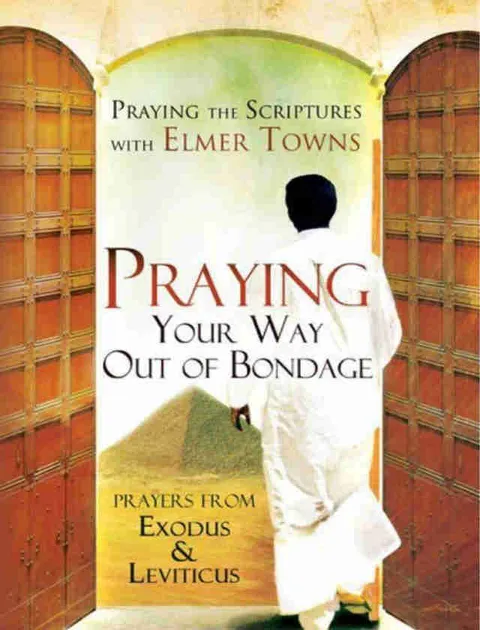
"Praying Your Way Out of Bondage" by Elmer Towns is a guide to using prayer as a powerful tool to break free from spiritual, emotional, and physical bondage. Towns provides practical advice and biblical principles to help readers strengthen their prayer life and experience true freedom in Christ.

Joni Eareckson Tada

Joni Eareckson Tada Joni Eareckson Tada is a remarkable woman. Injured in a diving accident at the age of 17, Joni has had to endure more physical suffering than most of us ever will. Though she suffered a deep depression and lost the will to live in the aftermath of her accident, she gradually came back to a deeper relationship with God. Because of her early struggles, she has become strong in her faith and is a testimony to the world of how when we are weak, God is strong. Her story is not one of bitterness and despair, as we might imagine it to be, but one of love and victory. Joni Eareckson Tada was born in Baltimore, Maryland in 1950 to John and Lindy Eareckson. She was the youngest of four sisters, Linda, Jay, and Kathy. Her name is pronounced “Johnny”, being he named after her father. Joni inherited her father’s athletic and creative abilities, giving father and daughter a special bond. Her childhood was an extremely happy one. She grew into a young adult surrounded by love, happiness, and security in her parent’s home. The Eareckson family shared a great love for the outdoors, which promoted family togetherness. They shared in various outdoor activities such as camping trips, horseback riding, hiking, tennis, and swimming. In 1967, after graduating from high school, Joni had her fateful accident. It was a hot July day and she was to meet her sister Kathy and some friends at the beach on Chesapeake Bay to swim. When she arrived, she dove in quickly, and immediately knew something was wrong. Though she felt no real pain, a tightness seemed to encompass her. Her first thought was that she was caught in a fishing net and she tried to break free and get to the surface. Panic seized her as she realized she couldn’t move and she was lying face down on the bottom of the bay. She realized she was running out of air and resigned herself to the fact that she was going to drown. Her sister, Kathy, called for her. She ran to Joni and pulled her up. To Kathy’s surprise, Joni could not support herself and tumbled back into the water. Kathy pulled her out and Joni gasped for air. Joni was puzzled as to why her arms were still tied to her chest. Then to her dismay, Joni realized they were not tied, but were draped lifelessly across her sister’s back. Kathy yelled for someone to call an ambulance and Joni was rushed to the hospital. Joni’s life was changed forever that July day in 1967. She had broken her neck – a fracture between the fourth and fifth cervical levels. She was now a quadriplegic, paralyzed from the shoulders down. While her friends were busy sending out graduation announcements and preparing to go to college in the fall, Joni was fighting for her very life and having to accept the fact that she would have to live out the rest of her life in a wheelchair. Joni’s rehabilitation was not easy. As you might imagine she was angry and she raged against her fate. She struggled with depression and often times she wanted to end her life. She could not understand how God could let this happen to her. Before the accident she had felt that she wasn’t living the life she should be so she had prayed that God would change her life – that he’d turn it around. After months of staring at the ceiling and wallowing in her depression, Joni began to wonder if this was God’s answer to her prayer. This realization that God was working in her life was the beginning of Joni’s journey to wholeness as a disabled person. She participated in various rehabilitation programs that taught her how to live with her disabilities and she immersed herself in God’s Word to become spiritually strong. Joni’s life has been a full one. She has learned early on to compensate for her handicaps. Being naturally creative, she learned to draw and paint holding her utensils with her teeth. She began selling her artwork and the endeavor was a great success. There was a real demand for her work. She kept herself very busy with her artwork and gained for herself a degree of independence. She was also able to share Christ’s love in her drawings. She always signed her paintings “PTL” which stood for “Praise the Lord”. Joni has also become a sought after conference speaker, author, and actress, portraying herself in the World Wide Pictures production of “Joni”, the life story of Joni Eareckson in 1978. She has written several books including “Holiness in Hidden Places”, “Joni”, which was her autobiography, and many children’s titles. But her most satisfying and far-reaching work is her advocacy on behalf of the disabled. In 1979, Joni moved to California to begin a ministry to the disabled community around the globe. She called it Joni and Friends Ministries (JAF Ministries), fulfilling the mandate of Jesus in Luke 14:13,23 to meet the needs of the poor, crippled, and lame. Joni understood first-hand the loneliness and alienation many handicapped people faced and their need for friendship and salvation. The ministry was soon immersed with calls for both physical and spiritual help for the disabled. JAF Ministries thus uncovered the vast hidden needs of the disabled community and began to train the local church for effective outreach to the disabled, an often overlooked mission field. JAF Ministries today includes local offices in such major cities as Charlotte, Chicago, Dallas/Fort Worth, Phoenix, and SanFrancisco. The goal of the ministry is to have ten such offices in metropolitan areas by the year 2001. Through JAF Ministries, Joni tapes a five-minute radio program called “Joni and Friends”, heard daily all over the world. She has heart for people who, like herself, must live with disabilities. Her role as an advocate for the disabled has led to a presidential appointment to the National Council on Disability for over three years. Joni also serves on the board of the Lausanne Committee for World Evangelization as a senior associate for evangelism among disabled persons. Joni has also begun Wheels for the World, a ministry which involves restoring wheelchairs and distributing them in developing nations. Joni has won many awards and commendations throughout her life. In 1993 she was named Churchwoman of the Year by the Religious Heritage Foundation and the National Association of Evangelicals named her “Layperson of the Year”, making her the first woman ever to receive that honor. Also among the numerous awards she has received are the American Academy of Achievement’s Golden Plate Award, The Courage Award of the Courage Rehabilitation Center, the Award of Excellence from the Patricia Neal Rehabilitation Center, the Victory Award from the National Rehabilitation Hospital, and the Golden Word Award from the International Bible Society. In 1982, Joni married Ken Tada. Today, eighteen years later, the marriage is strong and committed and they are still growing together in Christ. Ken and Joni travel together with JAF Ministries speaking at family retreats about the day to day experiences of living with disabilities. At the helm of JAF Ministries, Ken and Joni strive to demonstrate in tangible ways that God has not abandoned those with disabilities. And they speak from experience.

What Cravings Will Take from You

We spend our lives with hands out and mouths open, looking for what we might consume. This is our experience as humans, in part because of how God designed us: we eat because our bodies require energy, and we reach with gentle affection for those we love out of a shared hunger for relationships. We’re born in need, and our desires, implanted by God himself (Acts 17:24–27), send us on a search for fullness of joy. Our desires, however, so easily turn into obsessions, leading us into wild over-consumption (James 4:1–3). Our desires become cravings, the ultimate pursuit and point of life itself. Rather than signals meant to send us off in exploration for the original source of joy (Psalm 16:11), they instead become taskmasters, demanding our undivided loyalty and taking our peace and joy right along with them. In our unchecked drive to consume, we ourselves become the ones consumed. My Primary (False) Allegiance When we don’t allow our desires to send us seeking fullness of joy from the source of all joy — God himself — we develop an allegiance to false kings. My primary false allegiance is to the love and admiration that come from other people. I crave validation, and I find myself performing for it like a circus animal. This is how I’ve come to know just how much I’ve allowed this false king to rule over me: the past few years have been brutal, full of confusion and emotional pain. Somewhere along the way, my heart, bowing before this false king, started aching for belonging. I started wondering if my presence mattered as a person and not as a performance. I started wondering if I was truly known. I started wondering if anyone might notice my need. My deep self-focus drew me further and further inside, and at some point I simply disengaged my heart. If I couldn’t have what I craved, I would not give of myself any longer. I began to look back at who I once was and how passionately I’d loved others, and I wanted so badly to be that person again. But I couldn’t manufacture love, and I started to believe that joy would never come again. My heart instead felt hard and apathetic, looking to be served, noticing every slight, envying the belonging of others. False Kings Only Take The trouble for an idolatrous heart (and the gift for the repentant heart) is that God will stubbornly interrupt and intercept our pursuit of joy as we seek it in anything less than him. He will not give us lasting peace in our false allegiances, because he is jealous for us to have the actual peace we’re pursuing. In those years of struggle, a chorus of people could have sung my praises, and it never would have settled as peace in my heart. Anytime a friend offered a word of encouragement, my mind immediately turned to panic: “What must I do to keep that love?” Or I’d think, “What about the one who didn’t voice encouragement? How do I win her over?” I was so hungry and thirsty that I was withering away, consumed by what I was trying to consume. False kings never give; they only take. Kings Who Take When the prophet Samuel was growing old, the Israelites worried about their future. Samuel had mediated for them well as both priest and prophet before God, but they needed a new leader, and humanly speaking, there were no options available. Samuel’s sons, the next sure thing for the nation, didn’t walk in the ways of the Lord, so the elders sought answers by looking around at how other nations were structured. They approached Samuel with their solution: “Now appoint for us a king to judge us like all the nations” (1 Samuel 8:5). At first glance, this doesn’t seem like such a bad request, but Scripture says it displeased Samuel, and it also displeased God, because the elders hadn’t thought to bring God into their calculations (1 Samuel 8:6–9). Did they not already have a King? They had, in effect, spurned the perfect rule of the One who’d delivered, provided for, led, and protected them, and they’d turned in their desire toward another option. They weren’t ready to reject God entirely. They just wanted him plus a safe, tangible plan B king like everyone else around them. Samuel’s response is a fair warning to us as well about plan B kings: they will only take from you. Samuel warns that a king appointed by people takes sons and sends them to war, takes children and turns them into slave labor, takes daughters into his service, and takes crops in order to feed his servants (1 Samuel 8:10–17). Samuel knows what false kings do: they take our best and then make us their slaves. Kingdoms with Two Kings We tend to believe the same as the Israelite elders: What will it hurt to have God and also hedge our bets a little? We want to believe we can pledge allegiance to King Jesus and also throw our heart to human kings or human things. But the Bible is plain: No one can serve two masters (Matthew 6:24). A divided kingdom cannot stand (Matthew 12:25). Jesus is our king, not merely a wise consultant we turn to when we need to know what to do. And as the Israelite leaders show us, a divided heart is actually not divided at all: it has already chosen sides. A divided heart is one that’s spurned God. We turn toward false kings who we think will give us comfort, security, belonging, approval, validation, love, sexual gratification — but in the end they only take. They promise life but give death. Consumed to Satisfy But God. Through Jesus Christ, he made a way for us out of this death spiral, giving us a direction to point our desires, providing something we can consume that doesn’t consume us in return. Jesus came saying, Repent and believe (Mark 1:15). His words were an invitation, a stretched-out hand, an open door for us to enter with him into the kingdom of God. Jesus came saying, This is my body, broken for you. This is my blood, poured out for you (Luke 22:19–20). Feed on me (John 6:51–58). Jesus was consumed by death precisely so that we would feast on him. This king is called Bread of Life (John 6:35) and Living Water (John 4:13–14), so we might know we can, in our hunger, eat, and in our thirst, drink. When we consume him, we find ourselves consuming his good rule, loving provision, and peaceful reign. We cannot reach the end of him, but in him we can certainly satisfy the longing underlying all of our desires: the longing for joy. The King Who Gives The Israelites placed a mirror before my heart, helping me see my false allegiances clearly. My actions were their actions: turning toward kings who couldn’t fulfill their promises. Like them, my desires and needs weren’t all wrong; what had been wrong was where I turned with them. I turned in repentance to Jesus and found joy again in allegiance to him. Do you have a need? A desire? Submit it totally to King Jesus. He doesn’t just require our allegiance, as if obedience is a form of punishment or something through which we grit our teeth. His demand of wholeheartedness is an invitation to receive what is his: the very kingdom (Matthew 5:3). He opens his treasury to us, sharing his peace, love, joy, life, and fruitfulness. And perhaps best of all, we receive his allegiance in return (Romans 8:38–39; Matthew 28:20; Hebrews 13:5). He is a king who gives. Article by Christine Hoover

Feedback
Suggestionsuggestion box
x