
Others like jerusalem countdown Features >>

The Greatness Of The Soul
Angels In The Realms Of Heaven - The Reality Of Angelic Ministry Today

Afterlife

From Daniel To Doomsday

A Citizen Of Two Worlds
Four Blood Moons: Something Is About To Change

The Prophetic Future Concealed In Israel’s Festivals

Secrets From Beyond The Grave
-160.webp)
Heaven Is For Real: A Little Boy's Astounding Story Of His Trip To Heaven And Back
Because The Time Is Near
About the Book
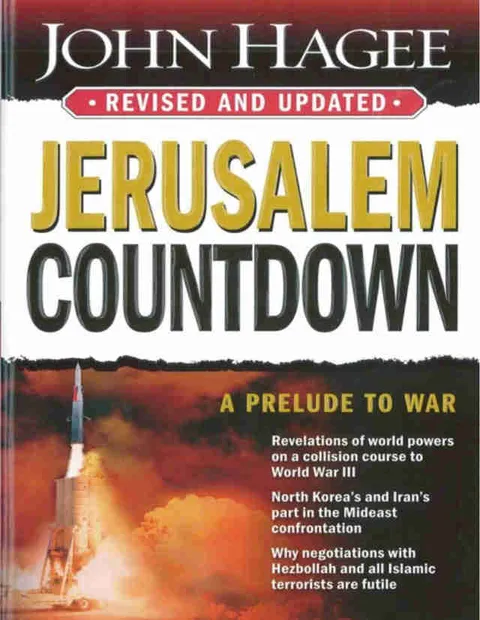
"Jerusalem Countdown" by John Hagee is a book that delves into the concept of biblical prophecy and explores the significance of Israel and Jerusalem in the end times. Hagee discusses the political and religious implications of events happening in the Middle East and how they align with biblical predictions. The book challenges readers to consider their own beliefs and relationships with God in light of these prophetic revelations.
Martyn Lloyd-Jones
"A Dream Reveals God's Healing Power of Love"
Have you ever had an experience so exceptional you hesitated to share it with others who might not believe it? In the mid-1970s, I worked for a Knoxville company, selling to grocery stores, campgrounds, etc. My route often took me to Chattanooga, where one of my customers lived and was a Christian. We would often share our views and testimonies. One day, after he had shared a beautiful Spiritual experience with me, without thinking, I said, "Wow, is that for real?" He instantly turned away and tartly said, "I don't share this with everyone because I know they won't believe, but I thought you would!" But we were fine; I apologized and explained that it was only a reaction, and I didn't doubt his word. The following article is about a vision I have shared with only a few who I thought would believe. God's Healing Power of Love In 1996 during an incredibly stressful situation, my personal and home life were crashing, and there seemed to be nothing I could do. I was depressed, and Satan repeatedly taunted me with self-harm suggestions. I knew he was a liar, but he always attacks our weakest points. Even those closest to me were unaware that I had encountered one of the lowest points in my life. Our problems and troubles always seem worse at night, don't they? One night in the wee hours, awake and leaning against my pillow, suffering from what I now know was another brutal satanic attack, something happened that changed my life forever. My Vision Suddenly I was sitting in the drivers' seat of a large truck; it had been in an accident, and everything around me was in small broken pieces. The windshield was gone, broken glass and large shreds of sharp metal dangled from the ceiling and were scattered all around. Observing my injured body, I said, I must have been in a fatal accident! Just then, a kind-looking a well-dressed man calmly opened the smashed passenger door and stepped up to the truck. Reaching through the debris, he caught my hand, and I miraculously passed through the twisted metal, glass, and shredded material and out the passenger door to the ground. As I stepped out, I realized how well I felt, no aches or pains, and no depression. I was amazingly well! We started walking, and after about 50 yards, I saw what can only be described as a place or an opening. What I saw/experienced inside cannot accurately be put into words, but I will try. As we drew closer, I became aware of an unspeakable beauty; colors I had never seen, and music that radiated beauty, peace, and healing. Even more were the penetrating feelings of joy, total acceptance, and sense of well-being. The emotional and Spiritual healing powers were beyond what I thought possible. I stood as though glued to the ground, as I was repeatedly bathed with wave after wave of blissful sensations of healing, love, and total acceptance, powerless to move. I am convinced it could only have been a glimpse of Heaven. The power was so penetrating and extreme that I do not believe if it had occurred outside the vision, I could have remained standing. I do not know how long we were there, but perhaps only a few minutes when my friend indicated it was time to leave. We quietly walked back to the front of the wrecked truck. Then, as quickly as the vision started, it ended, and I was again sitting up in bed, awake. But the sensations remained. I trembled as my heart pounded, and the beauty and euphoria from the vision replayed in my mind. I knew without a doubt this was from God; it could not have been anything else. Again, I cannot put this into words, but it was so powerful that I would have knowingly gone through an actual truck wreck and even death to have this experience again. As I sat there searching for understanding, and wondering aloud I asked, "does this means that I am going to lose my life in a terrible accident?" Then a powerful and comforting Spiritual voice immediately responded, "No, I just wanted you to know that I love you and for you to experience the healing power of my love." I was instantly and permanently healed, and my days were once again enjoyable. Although it was winter and in the northern U.S., I would walk through the snow conducting business humming or whistling, and nothing could cause me the slightest bit of worry. The problems in my life did not change, but I did. The things I was so anxious about happened anyway, but I was okay because this miracle from God had brought total healing. God healed and removed me from the most miserable time in my life! It was a miracle that brought healing, joy, and hope for the future, and, most of all, newfound confidence in God. I was laughing and talking with my co-workers again. I didn't discuss my experience with them because some were not Christians, and I was concerned that they could not understand, and it was so precious and powerful that I didn't want to take the chance of someone not believing. This miracle was a token of God's love, and it did more for me than a truckload of pills. It was only a small sample of God's healing power of love but has remained one of the most beautiful experiences of my life. The Apostle Paul's actual visit to Heaven and the things he saw and experienced were so wondrous that God would not allow him to speak of them. Paul was so captivated by his Glorious Visit that the only reason he would willingly return to earth was to complete God's message to the world. Twenty-Five Years Later Twenty-five years later, I still remember that experience in detail but can only now understand how much it changed my life. This vision, and a couple of others, are mostly responsible for establishing this ministry and website. I would never again doubt God's reality or wonder about His healing power, and it has given me faith for the countless times I have prayed with others. Now, when troubles and depression try to return, all I need to do is recall that vision, and the healing powers return. No matter how discouraging things become, or how trying the circumstances, remember that nothing is impossible with God; the healing power of God's love is enough to overcome them all. Samuel Mills