
GIP Library icon

LOG IN TO REVIEW
About the Book


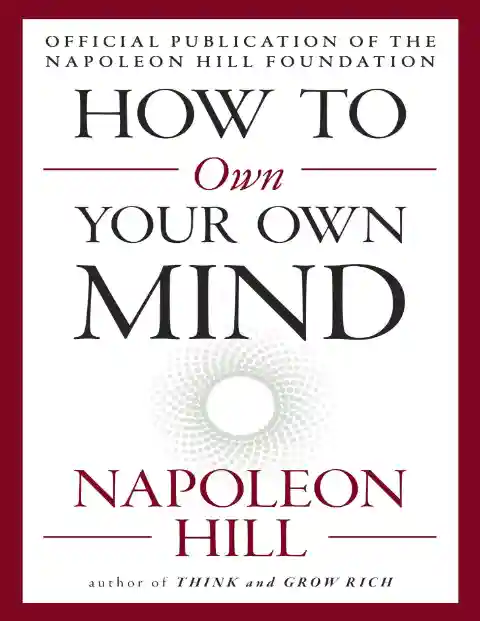
In "How to Own Your Own Mind," Napoleon Hill explores the power of the mind and provides actionable strategies for developing and maintaining control over one's thoughts and beliefs. Through practical exercises and examples, Hill outlines how readers can harness their mental faculties to achieve success and fulfillment in all areas of life. A key takeaway from the book is the importance of maintaining a positive mindset and taking ownership of one's thoughts to unlock personal potential and achieve one's goals.

D.L. Moody

D.L. Moody Dwight Lyman Moody was born the sixth child of Edwin and Betsy Holton Moody in Northfield, Massachusetts on February 5, 1837. Dwight’s formal education ended after fifth grade, and he rapidly grew tired of life on the family farm. He left home at age 17 to seek employment in Boston. After failing to secure a desirable position, he asked his uncle, Samuel Holton, for a job. Reluctantly, Uncle Samuel hired Dwight to work in his own retail shoe store. However, to keep young Moody out of mischief, employment was conditional upon his attendance at the Mt. Vernon Congregational Church. SALVATION At Mt. Vernon Moody became part of the Sunday school class taught by Edward Kimball. On April 21, 1855, Kimball visited the Holton Shoe Store, found Moody in a stockroom, and there spoke to him of the love of Christ. Shortly thereafter, Moody accepted the love of God and devoted his life to serving Him. The following year brought Moody to Chicago with dreams of making his fortune in the shoe business. As he achieved success in selling shoes, Moody grew interested in providing a Sunday School class for Chicago's children and the local Young Men's Christian Association. YMCA During the revival of 1857 and 1858, Moody became more involved at the YMCA, performing janitorial jobs for the organization and serving wherever they needed him. In 1860 when he left the business world, he continued to increase his time spent serving the organization. In the YMCA’s 1861–1862 annual report, Moody was praised for all his efforts. Although they could not pay him, the YMCA recommended he stay "employed" as city missionary. MISSION SUNDAY SCHOOL Meanwhile, Moody's Mission Sunday School flourished, and it was different. Moody's desire was to reach the lost youth of the city: the children with little to no education, less than ideal family situations, and poor economic circumstances. Soon the Sunday School outgrew the converted saloon used as a meeting hall. As the classes grew, associates encouraged Moody to begin his own church. Eventually, on February 28, 1864, the Illinois Street Church (now The Moody Church) opened in its own building with Moody as pastor. CIVIL WAR As the political landscape of the United States changed in the 1860s, Moody's connection with the YMCA proved a useful tool in his ministry. With the Civil War approaching, the Union Army mobilized volunteer soldiers across the north. Camp Douglas was established outside of Chicago, which Moody saw as a great evangelistic opportunity. Along with a few others, Moody created the Committee on Devotional Meetings to minister to the troops stationed at Camp Douglas, the 72nd Illinois Volunteer Regiment. This was just the beginning of Moody's Civil War outreach. From 1861 to 1865, he ministered on battlefields and throughout the city, state and country to thousands of soldiers, both Union and Confederate. All the while, he maintained the Mission Sunday School. EMMA DRYER AND HER TRAINING SCHOOL FOR WOMEN While ministering in Chicago, Moody and his wife met a woman named Emma Dryer, a successful teacher and administrator. Moody was impressed with her zeal for ministry and her educational background. He knew that women had a unique ability to evangelize to mothers and children in a way that men never could, and saw Dryer as just the person to help him encourage this group. Moody asked Dryer to oversee a ministry specifically to train women for evangelistic outreach and missionary work. Under Dryer's leadership, the training program grew rapidly, and so did her desire for this ministry to reach men as well as women. She continued to pray that the Lord would place the idea for such a school on Moody's heart. THE CHICAGO FIRE On Sunday, October 8, 1871, as Moody came to the end of his sermon for the evening, the city fire bell began to ring. At first, no one thought much about it, as these city bells often rung. However, this night was different—it was the beginning of the Great Chicago Fire. Moody's first concern was for his family, locating them and making sure they were somewhere safe. After securing his family's safety, Moody and his wife stayed on the north side of the city to help other residents. The fire finally burned out Tuesday afternoon, after consuming much of what Moody had built. This was a poignant time in Moody's life and the fire forced him to reevaluate his ministry. It was during this time of evaluation he realized he needed to heed the Lord's call on his life. For years, he had been moving forward and then asking God to support his plans. He knew from this point on, his call was to preach the Word of God to the world. REVIVAL ABROAD In June 1872 Moody made his first trip to the United Kingdom. While he was there a few close contacts urged him to come back in a year. In June 1873, Moody and his family, and his good friend and musician Ira Sankey with his wife all traveled from New York to Liverpool, England. Moody and Sankey traveled throughout the UK and Ireland holding meetings, helping fuel the revival that was slowly sweeping the region. Moody's visit made a lasting impression, and inspired lay people across the region to begin children's ministries and ministry training schools for women. Moody was revolutionary in his evangelistic approach. Despite conflicting counsel from friends and trusted contacts, he and Sankey traveled to Ireland during a time when Catholics and Protestants were constantly at odds with each other. Moody was different: he did not care what denomination a person claimed, but just wanted the message of Christ to be heard. As a result, the revival swept into Ireland, and he won praises of both Catholics and Protestants. 1875 - 1878 After two years overseas, the Moody family finally returned to the United States. They settled in Northfield, where Moody was born and raised, and he began to plan his next round of evangelistic city campaigns. From October 1875 to May 1876, Moody and three other evangelists toured through the major cities of the Midwest and Atlantic coast, preaching the message of salvation. Moody would embark on yet another city campaign before the desire to train young Christian workers would grip him again. MOODY'S SCHOOLS Moody was on the cutting edge of ministry, and in 1879, Moody opened the Northfield Seminary for Young Women to provide young women the opportunity to gain an education. Not long after, Moody created the Mount Hermon School for Boys with the same goal as the girls' school: to educate the poor and minorities. Moody had an amazing ability to bridge the gap between denominations, which was apparent in the diverse religious backgrounds of the school's students. In 1886 Dryer's prayers were answered and the Chicago Evangelization Society (today, Moody Bible Institute) was founded. Moody had been focused on ministry near his home in Northfield but he came out to Chicago to help raise money for the Society, support Dryer, and see his dream become a reality. The Chicago Evangelization Society had been Moody's vision but really came to fruition because of Dryer's hard work. See History of Moody Bible Institute. That same year, Moody assembled a large group of college students at Mount Hermon for the first "College Students' Summer School." This conference would birth the Student Volunteer Movement for Foreign Missions. By 1911 it was estimated that 5,000 student volunteers from America alone had come out of the program. Moody's vision for the mission movement grew as it spread around the world to Europe and South Africa. LATER YEARS Moody continued to evangelize throughout America, often preaching in major cities and at various universities. His heart was for his schools, and he spent much of his time in Northfield. Moody was a visionary who always seemed a step ahead of the status quo. From training women, to reaching out to lost children, to bridging the gap between denominations, he was unlike any other. Moody was a man of great discernment. He had an innate ability to find capable, godly people to put into positions of leadership and bring his ideas to fruition. This enabled him to continue his evangelistic outreach while his ministries flourished. Throughout his life, Moody always found time to be with his family, making every effort to show his love and care for them. Moody died on December 22, 1899, surrounded by his family.

The Blissful and Trivial Life - How Entertainment Deprives a Soul

When we, as a society, stopped reading and started watching, we began thinking and talking less — at least with the same substance or effectiveness. That was the bright red flag Neil Postman began waving in the sixties, captured for future generations in his classic work, Amusing Ourselves to Death. The book was published in 1985, the year before I was born. With the introduction of the television, Postman observed, entertainment did not merely become a bigger and bigger part of our lives — it became our lives. And everything else in our lives — news, politics, education, even religion — was increasingly forced to perform on its stage. Suddenly, everything had to be entertaining. Newspapers gave way to “the nightly news”; classroom lessons made their way to Sesame Street; worship services transformed into televised concerts with TED talks. “The television slowly taught us that nothing was worth our time unless it was entertaining.” The television slowly taught us that nothing was worth our time unless it was entertaining. And anything entertaining, almost by definition, requires less of us — less thinking, less study, less work. Entertainment, after all, isn’t meant to be taken seriously. But when everything is entertainment, doesn’t that mean little, if anything, can be taken seriously? For those who take the glory of God seriously, and our joy in him seriously, that becomes a very serious question. What Will Ruin Society? Postman warned about this devolution long before others noticed what was happening. He writes, [George] Orwell warns that we will be overcome by an externally imposed oppression. But in [Aldous] Huxley’s vision, no Big Brother is required to deprive people of their autonomy, maturity, and history. As he saw it, people will come to love their oppression, to adore the technologies that undo their capacities to think. What Orwell feared were those who would ban books. What Huxley feared was that there would be no reason to ban a book, for there would be no one who wanted to read one. . . . In short, Orwell feared that what we hate will ruin us. Huxley feared that what we love will ruin us. This book is about the possibility that Huxley, not Orwell, was right. (Amusing Ourselves to Death, xix) When he wrote those words, television had only been around for thirty years (invented much earlier, but not common in households until the fifties). The internet would not become publicly available until the 90s. Social media didn’t come along for another fifteen years (and really didn’t become widespread until the iPhone in 2007, several years after Postman died). If Postman was right about the early years of television, how much more today — a day when we no longer have to schedule time to sit and watch our favorite shows, but carry our entertainment with us literally everywhere we go? If entertainment could control our lives from a small box in the living room, how much more so when it’s nearly surgically attached to us on our phones? Postman, I believe, was more correct than even he realized — and the implications are not just social or cultural, but spiritual. Irrelevance Binds Us What makes television such a terror to the collective mind of a culture? Postman begins by arguing that the “medium is the metaphor.” Meaning, any given medium — whether text, television, or social media — doesn’t only distribute content, but unavoidably shapes the content. How we consume, he argues, is as important as what we consume. Mediums determine how we take in information. For instance, over time typography (despite its own limitations) generally taught us to follow arguments, test conclusions, and expose contradiction. Television, by contrast, consistently does away with arguments, strips away context, and darts from one image to the next. Television, however, not only teaches us a new way to process information, but it also floods us with information and from far beyond our everyday lives. The telegraph, of course, had begun doing this with words long before the television, but notice what was happening then, even with the telegraph: In the information world created by telegraphy, everything became everyone’s business. For the first time, we were sent information which answered no question we had asked, and which, in any case, did not permit the right of reply. We may say then that the contribution of the telegraph to public discourse was to dignify irrelevance and amplify impotence. (68–69) For the most part, the kind of information that would interest people in both Los Angeles and Minneapolis, would need to be nonessential to life in either place (irrelevance), and all the more so with news from around the globe. Stories had to transcend ordinary life in a real place (part of the appeal for people looking to escape the malaise of ordinary life). And, for the most part, the information had to be the kind of information neither could do anything about (impotence). Postman asks a pointed question of all our media consumption: “How often does it occur that information provided you on morning radio or television, or in the morning newspaper, causes you to alter your plans for the day, or to take some action you would not otherwise have taken, or provides insight into some problem you are required to solve?” (68). Television only made the irrelevance that much more accessible and that much more appealing (actual images and videos of celebrities doing everyday activities as opposed to the short descriptions the telegraph could produce). And how much more is this the case through social media? We know more and more about our favorite athletes, actors, and musicians and yet often less and less about our neighbors and the places where we might actually make a difference. Worth a Thousand Images But isn’t a picture worth a thousand words? In 1921, the marketer Fred Bernard famously said so, promoting the use of images for advertising on the side of streetcars. He was probably right as far as streetcars go. If you want to make a memorable impression on someone in a couple seconds, by all means use a picture — but is this effective communication or just effective marketing? Maybe it’s more accurate to say a picture is worth a thousand more sales, or clicks, or likes. Even then, though, can a picture really convey what a consumer needs to know about a new phone, or clothing line, or dish soap? For serious shoppers, haven’t we learned that one coherent sentence of honest description might be worth a thousand pictures? Postman saw that as images overtake words as the dominant form of communication in a society, communication invariably suffers. “I will try to demonstrate that as typography move to the periphery of our culture and television takes to place at the center, the seriousness, clarity and, above all, value of public discourse dangerously declines” (29). We descend into “a vast triviality,” he says. We get sillier. As he attempts to summarize his warning to the ever-entertained, he says, “Our Ministry of Culture is Huxleyan, not Orwellian. It does everything possible to encourage us to watch continuously. But what we watch is a medium which presented information in a form that renders it simplistic, nonsubstantive, nonhistorical, and noncontextual; That is to say, information packaged as entertainment. In America, we are never denied the opportunity to amuse ourselves” (141). In the Beginning Was the Word According to Neil Postman, America (and much of the modern world) has laid our collective minds on the altar of entertainment. But why should followers of Christ care about television (or websites or social media)? Should we spend much time worrying about how much we watch and how little we read? Yes, because the fullest Christian life is firmly anchored in words and sentences and paragraphs. When God revealed himself to his chosen people, of all the infinite ways he could have done so, he chose to unveil himself with words. “Long ago, at many times and in many ways, God spoke to our fathers by the prophets, but in these last days he has spoken to us by his Son” (Hebrews 1:1–2). God didn’t build a gallery or start a YouTube channel, he wrote a Book (2 Timothy 3:16). “In the beginning was the Word. . . . And the Word became flesh and dwelt among us, and we have seen his glory, glory as of the only Son from the Father, full of grace and truth” (John 1:1, 14). From the beginning, God has put the Word, his Son, at the center of reality, and, in doing so, he has given words unusual power and importance in anticipating, explaining, and celebrating him. Yes, the heavens are declaring the glory of God (Psalm 19:1). Yes, his eternal power and divine nature have been seen, from the beginning, in the things that have been made (Romans 1:20). But “faith comes from hearing, and hearing through the word of Christ” (Romans 10:17). For now, faith looks “not to the things that are seen but to the things that are unseen. For the things that are seen are transient, but the things that are unseen are eternal” (2 Corinthians 4:18). And we look to the unseen through words. We may see God in mountains and oceans and galaxies, but we only know him savingly through sentences. He wrote the story that way. Serious Joy in Silly Days If the way we’re using entertainment erodes our ability to reflect, reason, and savor truth, it erodes our ability to know and enjoy Jesus. “Blessed is the man . . . [whose] delight is in the law of the Lord, and on his law he meditates day and night” (Psalm 1:1–2). If we lose the ability to think, we lose the ability to meditate. And if we lose the ability to meditate, we lose our path to meaningful happiness. The life of the mind, and heart, is a pivotal battleground in the pursuit of real and abundant life. “The life of the mind is a pivotal battleground in the pursuit of real and abundant life.” The medium is not the enemy — television and YouTube and Instagram are not the enemy. But if Postman was right, the medium can be wielded by our world, our flesh, and our enemy when we soak up entertainment and ignore the consequences. What, if any, of your entertainment habits need to be curbed or redirected for the sake of your soul? What are ways you are seeking to cultivate the spiritual gift of your mind — slower Bible study or memorization, reading substantive books, meaningful conversation with friends, more time in unhurried reflection and meditation? As we learn to guard and nurture our minds as our God-given pathways to God, the kinds of mindless entertainment that are undoing millions today will be far less appealing and far less dangerous. And we will find pleasures deeper, and far more enduring, than what we see on our screens. Article by Marshall Segal Staff writer, desiringGod.org

Feedback
Suggestionsuggestion box
x