
Others like free at last from old habits Features >>
Free At Last From Oppression
Greater Health God's Way

God's Armor Bearer

Lost And Found - Finding Hope In The Detours Of Life

How To Know The Will Of God

The Purpose Driven Church
The Power Of Awareness

Right And Wrong Thinking
Longing For Godliness - Restoring God’s Image Within Us

God Built - Forged By God In The Bad And Good Of Life
About the Book
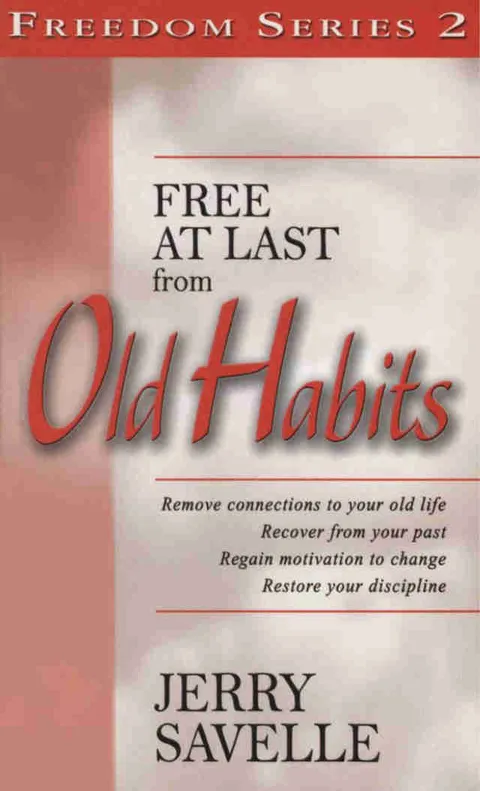
"Free at Last From Old Habits" by Jerry Savelle is a self-help book that offers practical advice and biblical principles for breaking free from negative habits and behaviors. Savelle shares personal stories and insights to help readers overcome obstacles and live a life of freedom and fulfillment. Through faith and determination, he encourages readers to make positive changes and embrace a new way of living.
Jane Grey

God Can Meet Us in the Ashes
Strict practitioners would not have approved of my methods, but on one long ago mid-winter Wednesday, I smeared ashes on the foreheads of my two preschoolers and myself. An offering of the hardwood that had heated our home the day before, these ashes were not “ceremonially correct” in any way. At the time, I did not know that traditional Ash Wednesday ashes come from the remains of Palm Sunday palms. I did not even know about the forty days of Lent to follow. However, I did know about sin — my own and my children’s. We were in “time out” season with one of our sons. At our wits’ end, we had exhausted Dr. Dobson, Elisabeth Elliot, and every parenting resource available in the nineties. “Why is it so hard to be good?” our little Dobson-buster would ask. His younger brother’s eyes would fill with tears whenever they were caught in collaborative naughtiness. In this parenting pressure cooker, maternal apologies had become a daily occurrence. I was hoping to model repentance — while at the same time atoning for sharp words and a short fuse. “I was wrong; please forgive me” were the words through which my sons were learning that their mother had not outgrown the struggle against sin. Ash Wednesday gives Christians an opportunity to grow in our understanding of where to take that struggle. Reclaiming Lent for Christ Historically, our earliest Protestant ancestors revolted against the idea of Lenten practices, and with good reason. In the pre-Reformation mind, penitence, ashes, and self-denial had become ends in themselves. Gradually, however, a biblical understanding of lament has re-entered Christian orthodoxy, anchored in an embrace of our fallen-ness. Ashes on the forehead rightly represent our need to “repent in dust and ashes” (Job 42:5–6), and our identity as “a people of unclean lips [who] dwell in the midst of a people of unclean lips” (Isaiah 6:5). Jesus pronounced a blessing upon those who recognize their poverty of spirit and mourn the effects of sin on their life and in the world (Matthew 5:3–4). Grounded in gospel truth that prompts genuine penitence without crippling guilt and deep conviction without devastating shame, Ash Wednesday invites the believer to a renewed awe of our great salvation. While there is no merit in the wearing of ashes, a season of mourning leading up to Easter may actually enhance our celebration of Resurrection Sunday. A Wednesday to Teach In my challenging season of parenting, Ash Wednesday became a visual aid, a teaching tool to reassure my young sons that our sin does not signal the end of God’s love for us. In our home, hymns around the breakfast table always matched the season, and one year, we learned all four verses of a “cross hymn” in the weeks leading up to Easter. Rich hymns of the faith offer deep gospel truth that requires explanation (but not dilution) for little singers: When I survey the wondrous cross On which the Prince of Glory died, All the vain things that charm me most I sacrifice them to His blood. The vain-ness of the “vain things” Isaac Watts wrote about becomes abundantly clear when we remember that nothing lasts forever. “Remember that you are dust” is the lyric of Ash Wednesday. God made us from dust, and our bodies do not live forever. This is a dying world we inhabit: everything from goldfish to grandfathers eventually stops living. And we mourn the loss. Without becoming morbid or frightening, we can prepare our children for the inevitability of death by putting it in the context of the gospel. Thomas á Kempis prescribed a regular pondering of and preparation for death as a route to happiness. Author Gary Thomas suggests that we present-day believers ought to join á Kempis in allowing the reality of death to act “like a filter, helping us to hold on to the essential and let go of the trivial.” For believers, the “essential” is the eternal, and the eternal comes to us through the cross. The paradox of death leading to rebirth only appears to be a contradiction. All of Christ’s gifts are given to us through death — his death. And it will only be through a different death — our death — that we will finally receive the fullness of life that Jesus died to impart. A Wednesday to Remember My sons and I stood before a mirror together, the three of us with our smudged foreheads. We talked about our struggle to obey God and our sadness over sin — the sin that causes mayhem in our home, hurt feelings between brothers, and, worst of all, separation from a God who loves us. When a little boy is struggling with disobedience, even as a preschooler, he already feels the grit and grind of life on a fallen planet. He may not be able to comprehend sin’s cosmic scale: “For the creation was subjected to futility, not willingly, but because of him who subjected it, in hope. . .” (Romans 8:20). But he is already well-acquainted with the collective groaning, and can love the truth about the hope of our future deliverance from the struggle: “. . . that the creation itself will be set free from its bondage to corruption and obtain the freedom of the glory of the children of God” (Romans 8:21). Reading selected, age-appropriate portions of the crucifixion story from Luke 22 and thinking about Jesus’s willingness to endure the weight of all the sins of the entire world on his body provides a focus for the wearing of our ashes as a symbol of our grief — mourning that we have sinned and caused division from God and sadness over the suffering Jesus endured when he died in our place. A Wednesday to Rejoice If good behavior is all I have to bring to Jesus, he cannot help me. The warm welcome of the gospel on a frigid day in early spring takes into account a little boy’s hopelessness in the face of temptation. Our sin does not signal the end of our relationship with God. It’s a beginning, for it turns out that weakness is a powerful claim upon divine mercy. Learning to hate sin at a young age, to war against it, and to receive God’s forgiveness is a celebratory milestone. There is a reason to rejoice because of Christ’s obedience to all that God commanded. Then, his love in paying the penalty for our failure to obey gives us a reason for hope, even against the backdrop of my own parenting fiascos and my sons’ serial naughtiness. God knows well the stuff we are made of. “He remembers that we are dust” (Psalm 103:14). As a loving heavenly Father, he longs to supply every need for righteous living — in fact it is only his righteousness that will suffice. This orientation provides a solid foundation for a lifelong relationship built on the assurance that God’s purposes will not be thwarted by my sin. He delights to meet me and my children in the ashes. Article by Michele Morin