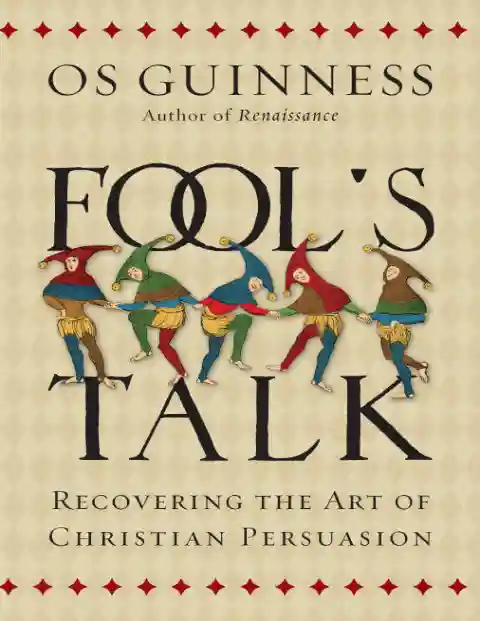

Fools Talk - Recovering The Art Of Christian Persuasion Order Printed Copy
- Author: Os Guinness
- Size: 2.05MB | 297 pages
- |
Others like fools talk - recovering the art of christian persuasion Features >>
Gospel - Recovering The Power That Made Christianity Revolutionary
Out Of Commission (Getting Every Christian Back To The Great Commission)

True Christianity

Signs And Wonders
A Lesson From The Arabs
Taking God's Power

How To Win Your City To Jesus
Repentance And Soul Winning

Blood In The Sand

Evangelism
About the Book
"Fool's Talk" by Os Guinness explores the art of Christian persuasion in today's secular world. Guinness argues that the Christian voice is often marginalized and even silenced in modern society, and he offers insights on how believers can effectively communicate their faith without compromising their beliefs. He emphasizes the importance of engaging in meaningful dialogue, listening to others, and building bridges of understanding in order to share the message of Christianity in a persuasive and respectful manner.
George Whitefield
George Whitefield was born at Gloucester in 1714. His mother kept the Bell Inn, and appears not to have prospered in business; at any rate, she never seems to have been able to do anything for her sonâs advancement in life. Whitefieldâs early life, according to his own account, was anything but religious; though, like many boys, he had occasional prickings of conscience and spasmodic fits of devout feeling. He confesses that he was âaddicted to lying, filthy talking, and foolish jestingâ, and that he was a âSabbath-breaker, a theatre-goer, a card-player, and a romance readerâ. All this, he says, went on till he was fifteen years old.
Poor as he was, his residence at Gloucester procured him the advantage of a good education at the Free Grammar School of that city. Here he was a day-scholar until he was fifteen. The only known fact about his schooldays is this curious one, that even then he was remarkable for his good elocution and memory, and was selected to recite speeches before the Corporation of Gloucester at their annual visitation of the Grammar School.
At the age of fifteen Whitefield appears to have left school, and to have given up Latin and Greek for a season. In all probability, his motherâs straitened circumstances made it absolutely necessary for him to do something to assist her in business and to get his own living. He began, therefore, to help her in the daily work of the Bell Inn. âAt lengthâ, he says, âI put on my blue apron, washed cups, cleaned rooms, and, in one word, became a professed common drawer for nigh a year and a half.â This, however, did not last long. His motherâs business at the Bell did not flourish, and she finally retired from it altogether.
An old school-fellow revived in his mind the idea of going to Oxford, and he went back to the Grammar School and renewed his studies. At length, after several providential circumstances had smoothed the way, he entered Oxford as a servitor at Pembroke at the age of eighteen. Whitefieldâs residence at Oxford was the great turning-point in his life. For two or three years before he went to the University his journal tells us that he had not been without religious convictions, But from the time of his entering Pembroke College these convictions fast ripened into decided Christianity. He diligently attended all means of grace within his reach. He spent his leisure time in visiting the city prison, reading to the prisoners, and trying to do good. He became acquainted with the famous John Wesley and his brother Charles, and a little band of like-minded young men. These were the devoted party to whom the name âMethodistsâ was first applied, on account of their strict âmethodâ of living.
At one time he seems to have been in danger of becoming a semi-papist, an ascetic, or a mystic, and of placing the whole of religion in self-denial. He says in his Journal, âI always chose the worst sort of food. I fasted twice a week. My apparel was mean. I thought it unbecoming a penitent to have his hair powdered. I wore woollen gloves, a patched gown, and dirty shoes; and though I was convinced that the kingdom of God did not consist in meat and drink, yet I resolutely persisted in these voluntary acts of self-denial, because I found in them great promotion of the spiritual life.â
Out of all this darkness he was gradually delivered, partly by the advice of one or two experienced Christians, and partly by reading such books as Scougalâs Life of God in the Soul of Man, Lawâs Serious Call, Baxterâs Call to the Unconverted, Alleineâs Alarm to Unconverted Sinners, and Matthew Henryâs Commentary. âAbove allâ, he says, âmy mind being now more opened and enlarged, I began to read the Holy Scriptures upon my knees, laying aside all other books, and praying over, if possible, every line and word. This proved meat indeed and drink indeed to my soul. I daily received fresh life, light, and power from above. I got more true knowledge from reading the Book of God in one month than I could ever have acquired from all the writings of men.â
Once taught to understand the glorious liberty of Christâs gospel, Whitefield never turned again to asceticism, legalism, mysticism, or strange views of Christian perfection. The experience received by bitter conflict was most valuable to him. The doctrines of free grace, once thoroughly grasped, took deep root in his heart, and became, as it were, bone of his bone and flesh of his flesh. Of all the little band of Oxford Methodists, none seem to have got hold so soon of clear views of Christâs gospel as he did, and none kept it so unwaveringly to the end.
At the early age of twenty-two Whitefield was admitted to holy orders by Bishop Benson of Gloucester, on Trinity Sunday, 1736. His ordination was not of his own seeking. The bishop heard of his character from Lady Selwyn and others, sent for him, gave him five guineas to buy books, and offered to ordain him, though only twenty-two years old, whenever he wished. This unexpected offer came to him when he was full of scruples about his own fitness for the ministry. It cut the knot and brought him to the point of decision. âI began to thinkâ, he says, âthat if I held out longer I should fight against God.â
Whitefieldâs first sermon was preached in the very town where he was born, at the church of St Mary-le-Crypt, Gloucester â âAs I proceeded I perceived the fire kindled, till at last, though so young and amidst a crowd of those who knew me in my childish days, I was enabled to speak with some degree of gospel authority.â
Almost immediately after his ordination, Whitefield went to Oxford and took his degree as Bachelor of Arts. He then commenced his regular ministerial life by undertaking temporary duty at the Tower Chapel, London, for two months. While engaged there he preached continually in many London churches; and among others, in the parish churches of Islington, Bishopsgate, St Dunstanâs, St Margaretâs, Westminster, and Bow, Cheapside. From the very first he obtained a degree of popularity such as no preacher, before or since, has probably ever reached. Whether on week-days or Sundays, wherever he preached, the churches were crowded, and an immense sensation was produced. The plain truth is, that a really eloquent, extempore preacher, preaching the pure gospel with most uncommon gifts of voice and manner, was at that time an entire novelty in London. The congregations were taken by surprise and carried by storm.
From London he removed for two months to Dummer, a little rural parish in Hampshire, near Basingstoke. From there he accepted an invitation, which had been much pressed on him by the Wesleys, to visit the colony of Georgia in North America, and assist in the care of an Orphan House which had been set up near Savannah for the children of colonists. After preaching for a few months in Gloucestershire, and especially at Bristol and Stonehouse, he sailed for America in the latter part of 1737, and continued there about a year. The affairs of this Orphan House, it may be remarked, occupied much of his attention from this period of his life till he died. Though well-meant, it seems to have been a design of very questionable wisdom, and certainly entailed on Whitefield a world of anxiety and responsibility to the end of his days.
Whitefield returned from Georgia at the latter part of the year 1738, partly to obtain priestâs orders, which were conferred on him by his old friend Bishop Benson, and partly on business connected with the Orphan House. He soon, however, discovered that his position was no longer what it was before he sailed for Georgia. The bulk of the clergy were no longer favourable to him, and regarded him with suspicion as an enthusiast and a fanatic. They were especially scandalized by his preaching the doctrine of regeneration or the new birth, as a thing which many baptized persons greatly needed! The number of pulpits to which he had access rapidly diminished. Churchwardens, who had no eyes for drunkenness and impurity, were filled with intense indignation about what they called âbreaches of orderâ. Bishops who could tolerate Arianism, Socinianism, and Deism, were filled with indignation at a man who declared fully the atonement of Christ and the work of the Holy Ghost, and began to denounce him openly. In short, from this period of his life, Whitefieldâs field of usefulness within the Church of England narrowed rapidly on every side.
The step which at this juncture gave a turn to the whole current of Whitefieldâs ministry was his adoption of the system of open-air preaching. Seeing that thousands everywhere would attend no place of worship, spent their Sundays in idleness or sin, and were not to be reached by sermons within walls, he resolved, in the spirit of holy aggression, to go out after them âinto the highways and hedgesâ, on his Masterâs principle, and âcompel them to come inâ. His first attempt to do this was among the colliers at Kingswood near Bristol, in February, 1739. After much prayer he one day went to Hannam Mount, and standing upon a hill began to preach to about a hundred colliers upon Matthew 5:1-3. The thing soon became known. The number of hearers rapidly increased, till the congregation amounted to many thousands.
Whitefieldâs own account of the behaviour of these neglected colliers, who had never been in a church in their lives, is deeply affecting: âHavingâ, he writes to a friend, âno righteousness of their own to renounce, they were glad to hear of a Jesus who was a friend to publicans, and came not to call the righteous but sinners to repentance. The first discovery of their being affected was the sight of the white gutters made by their tears, which plentifully fell down their black cheeks as they came out of their coal-pits. Hundreds of them were soon brought under deep conviction, which, as the event proved, happily ended in a sound and thorough conversion.â
Two months after this Whitefield began the practice of open-air preaching in London, on 27 April, 1739. The circumstances under which this happened were curious. He had gone to Islington to preach for the vicar, his friend Mr Stonehouse. In the midst of the prayer the churchwardens came to him and demanded his licence for preaching in the diocese of London. Whitefield, of course, had not got this licence. The upshot of the matter was, that being forbidden by the churchwardens to preach in the pulpit, he went outside after the communion-service, and preached in the churchyard. From that day forward he became a constant field-preacher, whenever weather and the season of the year made it possible.
Two days afterwards, on Sunday, April 29th, he records: âI preached in Moorfields to an exceeding great multitude. Being weakened by my morningâs preaching, I refreshed myself in the afternoon by a little sleep, and at five went and preached at Kennington Common, about two miles from London, when no less than thirty thousand people were supposed to be present.â Henceforth, wherever there were large open spaces round London, wherever there were large bands of idle, godless, Sabbath-breaking people gathered together, in Hackney Fields, Mary-le-bonne Fields, May Fair, Smithfield, Blackheath, Moorfields, and Kennington Common, there went Whitefield and lifted up his voice for Christ. The gospel so proclaimed was listened to and greedily received by hundreds who never dreamed of going to a place of worship.
The ministrations of Whitefield in the pulpits of the Church of England from this time almost entirely ceased. He loved the Church in which he had been ordained; he gloried in her Articles; he used her Prayer-book with pleasure. But the Church did not love him, and so lost the use of his services. The Church was too much asleep to understand him, and was vexed at a man who would not keep still and let the devil alone.
The facts of Whitefieldâs history from this period to the day of his death are almost entirely of one complexion. One year was just like another; and to attempt to follow him would be only going repeatedly over the same ground. From 1739 to the year of his death, 1770, a period of thirty-one years, his life was one uniform employment, and he was always about his Masterâs business. From Sunday mornings to Saturday nights, from the 1st of January to the 31st of December, excepting when laid aside by illness, he was almost incessantly preaching Christ and going about the world entreating men to repent and come to Christ and be saved. There was hardly a considerable town in England, Scotland, or Wales, that he did not visit as an evangelist. When churches were opened to him he gladly preached in churches; when only chapels could be obtained, he cheerfully preached in chapels. When churches and chapels alike were closed, or were too small to contain his hearers, he was ready and willing to preach in the open air.
For thirty-one years he laboured in this way, always proclaiming the same glorious gospel, and always, as far as manâs eye can judge, with immense effect. In one single Whitsuntide week, after preaching in Moorfields, he received one thousand letters from people under spiritual concern, and admitted to the Lordâs table three hundred and fifty persons. In the thirty-four years of his ministry it is reckoned that he preached publicly eighteen thousand times.
His journeyings were prodigious, when the roads and conveyances of his time are considered. He visited Scotland fourteen times; he crossed the Atlantic seven times, backward and forward, in miserable slow sailing ships, and arrested the attention of thousands in Boston, New York, and Philadelphia. He went over to Ireland twice, and on one occasion was almost murdered by an ignorant Popish mob in Dublin. As to England and Wales, he traversed every county in them, from the Isle of Wight to Berwick-on-Tweed, and from the Landâs End to the North Foreland.
His regular ministerial work in London for the winter season, when field-preaching was necessarily suspended, was something prodigious. His weekly engagements at the Tabernacle in Tottenham Court Road, which was built for him when the pulpits of the Established Church were closed, comprised the following work: Every Sunday morning he administered the Lordâs Supper to several hundred communicants at half-past six. After this he read prayers, and preached both morning and afternoon. Then he preached again in the evening at half-past five, and concluded by addressing a large society of widows, married people, young men and spinsters, all sitting separately in the area of the Tabernacle, with exhortations suitable to their respective stations. On Monday, Tuesday, Wednesday, and Thursday mornings, he preached regularly at six. On Monday, Tuesday, Wednesday, Thursday, and Saturday evenings, he delivered lectures. This, it will be observed, made thirteen sermons a week! And all this time he was carrying on a large correspondence with people in almost every part of the world. That any human frame could so long endure the labours that Whitefield went through does indeed seem wonderful. That his life was not cut short by violence, to which he was frequently exposed, is no less wonderful. But he was immortal till his work was done.
He died at last very suddenly at Newbury Port, in North America, on Sunday, 29 September, 1770, at the comparatively early age of fifty-six. He was once married to a widow named James, of Abergavenny, who died before him. If we may judge from the little mention made of his wife in his letters, his marriage does not seem to have contributed much to his happiness. He left no children, but he left a name far better than that of sons and daughters. Never perhaps was there a man of whom it could be so truly said that he spent and was spent for Christ than George Whitefield.
[Adapted from J. C. Ryleâs âGeorge Whitefield and His Ministryâ in Select Sermons of George Whitefield; see also George Whitefieldâs Journals, Robert Philipâs Life and Times of George Whitefield, and Arnold Dallimoreâs 2-volume biography George Whitefield.]
Romance After Kids
âRomance is the privilege of the rich, not the profession of the unemployed,â wrote Oscar Wilde. âThe poor should be practical and prosaic.â I can partially relate to this sentiment. While I am not, in any estimation, to be numbered among the financially poor, I may be considered more impoverished in the currencies of independence and time. I am a father of five. My wife is currently recovering from COVID-19, and we are rounding out our second extended quarantine of the last two months. And in the last few days, two of our childrenâs stomachs have decided to expel their contents. Our world orbits around need; and needs call for a more practical and prosaic season of life that all but excludes the possibility of romance, right? Quality time â undistracted and full of energy â seems like the privilege of the bourgeois. But is it? Should we pause romance in this season? Should we simply acknowledge that we are shoulder-to-shoulder, not face-to-face, as we battle for the kindness and cleanliness of our kids? Why Romance Is Worth Pursuing I donât believe we should pause romance in the demanding and chaotic world of parenting. Consider at least three reasons why. First, delight in beauty is the sustaining substance of life. The battlefield of child-rearing is not for the faint of heart. Without consistent moments to be refueled together by the beauty of God in his creation (Iâm thinking Psalm 19-style sunrises and sunsets, rich flavors, unforgettable melodies, and especially the divine image in each other), we will succumb to fatigue and forget why weâre raising the children to begin with. Second, children need their parentsâ affection for each other. God created parenting to be a completion of joy, an overflow of it. It is a Trinitarian image, whereby the mutual delight of the parents spills itself into creation. To quote thirteenth-century theologian Meister Eckhart (speaking in human terms and however imprecisely), âGod laughed and begot the Son. Together they laughed and begot the Holy Spirit. And from the laughter of the Three, the universe was born.â The nourishing and cherishing of Ephesians 5 doesnât simply transfer to your children. âNo one ever hated his own flesh, but nourishes and cherishes it, just as Christ does the churchâ (Ephesians 5:29) â I am convicted as I type. Spouses (with a special emphasis on husbands) are called to invest deeply into one another, with the nourishing and cherishing of oneâs own body, implying more than mere functional living or co-laboring. âCherish,â after all, is not a prosaic word. It is infused with deep delight, the kind of word husbands search for to express their affection in a poem or song. Practical Advice for Married Couples So, letâs get practical (but not prosaic). What might romance look like in the season of survival on the Serengeti that is parenting? What follows is a list that mingles my own successes, failures, sin, and idealism, ranging from the mundane to the magical. Okay, mostly mundane. Most of it lives miles from a gondola in Venice, but placed on the battle for the souls of your children, every intentional face-to-face moment really helps. Take what helps. 1. Wake up together. Most husbands need less sleep than their wives, but trying to coordinate either sleep or wake time can be good for your marriage. For us, itâs been wake time most recently. We get up most mornings before the kids are stirring. Yes, itâs dark. It feels like the middle of the night (because it is) and our eyes are bleary. But the world is quiet and we rehearse the mercies of God out loud to one another, and of course to him, as we paraphrase the Psalms. We directly thank him for the undeserved gift of one another â boom, romance. 2. Take a few minutes to connect. This must be intentional, and it usually canât be during dinner. Dinner is a wonderful opportunity to shepherd your children, but in most larger families, it is likely too chaotic to be a face-to-face moment with a spouse. The moment Iâm speaking of is right after the kids are in bed. The reason it must be intentional is that you are likely drifting into a trance of fatigue, and some form of unwinding seeks your attention. But so does your spouseâs soul. And to turn to one another, without the television on or the phone in hand, and simply say, âTell me about your day,â is fresh wind for your marriage. I might even recommend a few fun questions to pull from a hat in order to engage one another with more intrigue and substance. 3. Play. After ten oâclock on most nights, my wife loses much of her filter to weariness and goes into full sass mode. She throws playful jabs my way and laughs until she cries, and I tend to amplify her delight with my over-the-top responses. It would probably look to the outsider like two middle school kids flirting, but it is an ironic display of marital safety and affection that is probably indispensable in this season. I would be hard-pressed to overstate the value of humor as a means of romantic connection. 4. Write to one another. Even if you say youâre not a âwords of affirmationâ person, you are more than you realize. Your spouse is too. And when the words are written rather than simply spoken, they affect us powerfully. I think itâs because those words reflect deeper thought, deeper consideration, and deeper investment of time than something more spontaneous. Thatâs why a text message stating affection is good, but a sonnet is better. Or even a limerick if youâre not into iambic pentameter. 5. Get out into creation. The heavens declare the romantic heart of God. The sun exclaims the joy and love of the Bridegroom (Psalm 19:1â5). A breeze whispers his gentleness, and the autumn leaves remind us of the beauty of Christâs death. It doesnât take the reservation of an Airbnb in Montana to engage the created world together. We sat on the back porch for a few minutes this week and marveled at the sudden bright yellows of the leaves behind the house. Consistent peeks outside or regular walks around the neighborhood, especially hand in hand, can bring peace to chaos. Speaking of hand in hand . . . 6. Show physical affection. Keep holding hands in public. Or start holding hands in public. Half-mindlessly rub her back while youâre sitting on the couch. Donât let the heckling of your teenagers keep you from a spontaneous hug in the kitchen. There was a moment, likely when you were dating, when the brush of your now-spouseâs hand was electric. The same desire, albeit without the giddiness, still resides in you. Touch is connection, and connection between two desire-laden, God-imaging souls is at the heart of romance. 7. Recall the wonders of God in your familyâs life. This is a clear command and practice in Scripture (see Psalm 136), and it is a poetic moment when practiced well. It ought to be a normative part of your prayer life, but we find it helpful to also formalize the practice. Each year on our anniversary, we pull out a journal and jog our memories about all the big events and sweet moments of the previous year. It is a connecting moment of sentiment, laughter, and gratitude. 8. Get away and dream. This is a privilege that not all parents have the resources to enact. It requires willing babysitters (often family because of the sizable commitment) and sometimes money. We went three years without a night away at one point. And again, it doesnât have to be in some exotic bungalow in Fiji. But one of our fonder marital memories was a simple switching of houses with my parents for a night so that we could come out of the winds and talk uninterruptedly about what the Lord might have for our future. 9. Play music. I donât mean that you need to turn your family into the Von Trapps. If anyone in your family can conjure a melody with voice or violin, all the better, but I am here referring to a simple song in the background. Whether itâs a hymn (Indelible Grace gets a lot of air time in our household), a soundtrack, or a beat to dance to, music awakens the soul. It allows easier access to emotion and meaning in the mundane moments. Use the gift of Spotify or a phonograph. 10. Speak the delights of God to your spouse. While this is an admittedly shoulder-to-shoulder activity (since your collective gaze is elsewhere), it is akin to watching a sunset or a play, only with deeper relational weight. After all, you are fostering the romance between your spouse and the true Bridegroom. To speak the wonders of Godâs holiness, his fatherly delight, and the wonders of his love, is to kindle the soul. So donât just memorize Scripture. Memorize it in order to tell her of the dimensions of the love of Christ, and so fill her with the fullness of God (Ephesians 3:19). Life, even the life of a child-chasing parent, is magical. And marriage, even the mostly shoulder-to-shoulder kind that is stretched to its limit by fatigue and chaos, is still a picture of Christ and the church. Ask your heavenly Bridegroom for eyes to see that afresh and the energy to enact a bit of intentional romance. Article by Matt Reagan