





GIP Library icon

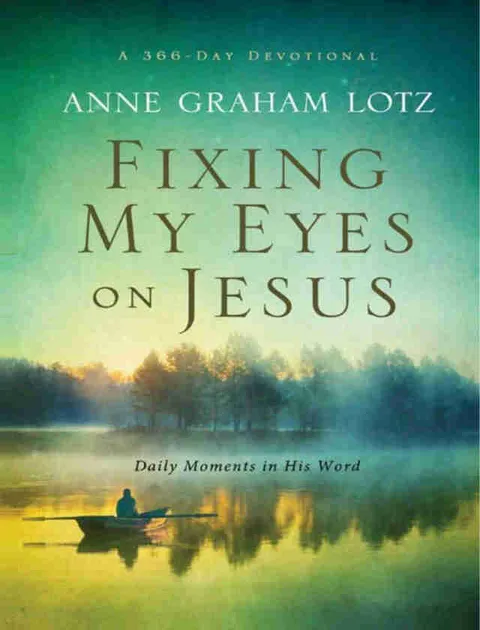
Fixing My Eyes On Jesus Daily Fixing My Eyes On Jesus Daily

Fixing My Eyes On Jesus Daily Order Printed Copy

  • Author: Anne Graham
  • Size: 1.54MB | 587 pages
  • |
Continue with
Google Twitter
LOG IN TO REVIEW
About the Book


"Fixing My Eyes on Jesus Daily" by Anne Graham encourages readers to cultivate a deeper relationship with Jesus through daily devotion and prayer. Graham shares personal anecdotes and insights to help readers grow in their faith and experience God's love and grace in their lives. The book serves as a guide for individuals seeking to strengthen their spiritual walk and overcome challenges by focusing on Jesus as their ultimate source of hope and comfort.

Elizabeth Elliot

Elizabeth Elliot “I have one desire now – to live a life with reckless abandon for the Lord, putting all my strength and energy into it.” Elisabeth Elliot, an inspirational woman who remained faithful to God, and the calling he had laid on her heart, through many trials and tribulations. ELISABETH’S EARLY YEARS Elisabeth Elliot was born on December 27, 1926 in Brussels, Belgium, where her parents served as missionaries. Before she was a year old they moved to America to Germantown, Pennsylvania, outside of Philadelphia. Her family grew when they came to America, and Elisabeth gained four younger brothers and one younger sister. While they lived in Germantown, Elisabeth’s father was the editor for the Sunday School Times, which was a weekly journal that contained Sunday School lessons that were used simultaneously in several Sunday School classrooms to keep the teaching and learning cohesive in churches throughout the country. CALLING TO ECUADOR A true pioneer in the world of Christianity, Elisabeth went to Wheaton College and studied Greek, because she desired to translate the Bible for the remote regions in the world. While at the college, she met Jim Elliot. After graduation, Elisabeth went on a missionary expedition to Ecuador with other students from Wheaton, including Jim Elliot. In the first year of their missionary journey, Jim and Elisabeth worked in different regions. A year after entering Ecuador, Jim joined Elisabeth in the Quichua Indian tribe. In 1953, Jim and Elisabeth were married and continued to serve in Ecuador. They had a daughter, Valerie Elliot Shepard. When the Auca tribe in Eastern Ecuador killed Jim Elliot and his missionary partners, Elisabeth refused to give up on the people in that tribe. She continued to live in the region with her daughter and Rachel Saint, the sister of another one of the missionaries that the Auca tribe killed. They lived among the Quichua tribe. While living in the Quichua tribe, two Auca women lived with Elisabeth for one year. During that year of living with the two Auca women, Elisabeth came to understand why the tribe killed her husband and the other missionaries. The tribe feared that outsiders were going to come into their tribe and take away their freedom. With that understanding, Elisabeth and Rachel Saint were able to go to the Auca tribe and build relationships with them. They led the people of the tribe to Jesus. The tribe saw and understood the forgiveness and grace that Elisabeth and Rachel extended to them. Elisabeth wrote two books while she lived in Ecuador that contained her experiences and Jim’s experiences with the Auca tribe. She wrote Through the Gates of Splendor, which gives an account of her and Jim’s experiences with the Auca tribe. ELISABETH’S RETURN TO AMERICA After spending two years with the Auca, Elisabeth came to America with her daughter in 1963. Elisabeth and her daughter, Valerie lived in New Hampshire when they returned to America. Elisabeth met Addison Leitch, a theologian professor at Gordon Conwell University, and was thrilled to marry him in 1969. During their marriage, Addison and Elisabeth toured the United States with speaking engagements. Elisabeth never limited her message to women. She would inspire other Christians to live their lives, both men and women, with a passion to live for God. Four years after they were married in 1973, Addison lost his battle with cancer and died. Valerie was thirteen when Elisabeth married Addison and was excited that God gave her a “Daddy.” When he died, Valerie was devastated to lose the father that she knew. She knew about Jim Elliot her biological father, but she knew Addison as a father who was present with her. ELISABETH’S LOVE REDEEMED After Leitch’s death, Elisabeth had two lodgers in her home. One of the lodgers married her daughter, and the other lodger, Lars Gren, married Elisabeth. Lars Gren was a hospital chaplain. Lars and Elisabeth were married until her death. At the age of 89, on June 15, 2015 Elisabeth Elliot died. As her soul resides in heaven, her legacy lives on earth with her writings and stories. ELISABETH ELLIOT’S BELIEFS ON FEMINISM Elisabeth was never afraid to tell where the woman’s place was. She believed that women in the military needed to be in non-combative places because they would be needed at home, even if they were single. Also, she believed strongly that a married woman, especially to a pastor, was to support his ministry and not begin her own career. Her beliefs came because she counseled so many women whose marriages were falling apart because the women insisted on working outside of the home. Also, she studied the Bible and understood what it meant for women. Elisabeth didn’t like addressing the issue, but she was very bold and forthright in her answers. Elisabeth knew how to answer the question of women speaking in the church. She declined speaking on Sunday mornings to a congregation. If she were asked to speak at a Sunday School class or another meeting at a church, she would only oblige if a man who was a leader turned over the meeting to her. She understood the Bible to be clear that women are not to usurp authority over men. She knew that the Bible didn’t discriminate between Sunday mornings and Sunday evenings, but she also knew that she could not usurp authority over men. Her beliefs gained her respect, and men and women listened to her and read her books. BOOKS WRITTEN BY ELISABETH ELLIOT In her lifetime, Elisabeth wrote and published twenty-four books. She continued to travel and speak all over America sharing her story, her knowledge, and wisdom of God’s Word until her health stopped her in 2004. Her most popular books were Through the Gates of Splendor and Passion and Purity: Learning to Bring Your Love Life Under God’s Control. Through the Gates of Splendor tells the story of Jim Elliot and their encounter with the tribes in Ecuador that eventually took his life. Passion and Purity: Your Life Under God’s Control is a book that deals with dating for single Christians and how to honor God in their romantic relationships. It was published in 1984. In a world where everyone is doing whatever they please, she gives her own examples of love, heartache with the deaths of her husbands, and romance with all of them, while maintaining a pure relationship with them and before God. Elisabeth used her theological knowledge in her books and speeches. QUOTES FROM ELISABETH ELLIOT “God never denies our hearts’ desire except to give us something better.” “I have one desire now—to live a life with reckless abandon for the Lord, putting all my strength and energy into it.” “Leave it all in the Hands that were wounded for you.” “Fear arises when we imagine that everything depends on us.” “We cannot give our lives to God and keep our bodies to ourselves.” “And underneath are the everlasting arms.”

Will Hell Really Last Forever

I am almost ashamed to admit that such a tiny bird should have been used to frighten a grown man. But in this case, I was right to tremble. The image in my mind’s eye of that little bird descending from above, flitting back and forth, hopping up and down upon the immensity of sand. What a horror to see it flap away with so little a grain only to expect its return so many lifetimes later. All to remember that it would be all irrelevant anyways. Thomas Watson gave the illustration, preaching on the fate of those who worshiped the beast in Revelation 14:11, which says, “The smoke of their torment goes up forever and ever, and they have no rest, day or night. . .” It cannot be forgotten: Oh eternity! If all the body of earth and sea were turned to sand, and all the air up to the starry heaven were nothing but sand, and a little bird should come every thousand years, and fetch away in her bill but the tenth part of a grain of all that heap of sand, what numberless years would be spent before that vast heap of sand would be fetched away! Yet, if at the end of all that time, the sinner might come out of hell, there would be some hope; but that word “Ever” breaks the heart. “The smoke of their torment ascendeth up for ever and ever.” After coming and going every thousand years, carrying away one of the smallest grains of the innumerable amount of sand, this hour glass would finally drain and the banished would be no closer to the end than when they first began. That word which should make the most apathetic among the unforgiven weep, the strongest sweat blood, the youngest curl into the fetal position, the oldest break into madness to hear its footsteps so near, shook me. Who can rightly fathom it? Forever. Ghosts Reading over Shoulders But is it true? Do those in hell suffer eternal conscious punishment? The church throughout its two-thousand-year history has thought so, but many today do not. And we shouldn’t wonder why: this is personal to us. I write keenly aware that the memories of deceased loved ones who departed in apparent unbelief hover over shoulders reading along. What of him? What of her? we wonder. Although he was one of the first notable evangelicals of the previous generation to contradict the historic conception of hell, we must all adopt the final question John Stott considers, I find the concept [of eternal conscious punishment in hell] intolerable and do not understand how people can live with it without either cauterizing their feelings or cracking under the strain. But our emotions are a fluctuating, unreliable guide to truth and must not be exalted to the place of supreme authority in determining it. As a committed Evangelical, my question must be — and is — not what does my heart tell me, but what does God’s word say? So what does God’s word say? Nothing different from what the church has overwhelmingly held over its two millennia. Three Objections Of all topics that feel crude to abridge, this must be atop the list. Much has been written on this topic that fly past the scope of this article. Resources I found helpful include Hell Under Fire, Grudem’s Systematic Theology, and chapters in Gagging of God (13) and Let the Nations Be Glad (4). That said, I would like to give brief answers to common challenges to those who believe those in hell will ultimately be annihilated. 1. Does ‘Eternal’ Mean Forever? Conditionalists (those who believe the wicked will eventually cease to be, based on the fact that the soul is not inherently immortal but becomes so as they meet certain conditions, and in particular through union with Christ) and annihilationists (those who believe the wicked will cease to be because, although the soul would have otherwise prolonged, God finally annihilates them in judgement) both believe that hell is not endless punishment for the wicked. In proving this, they both point out that “eternal” does not always mean everlasting. They argue that both in the Hebrew and Greek, the corresponding words we often translate “eternal” have elasticity to mean “forever” as well as other things, such as “age to come,” which they argue could last forever or not. One of the strongest reasons this is unpersuasive (without going text by text) is that some of the biblical passages in question speak in the same breath of both the eternality of the righteous (which we don’t question) and the eternality of the unrighteous (which some do). In other words, the life that the righteous enjoy is parallel to the punishment the wicked suffer. Hell lasts as long as heaven. For example, Daniel speaks of those who will awake from death: “Many of those who sleep in the dust of the earth shall awake, some to everlasting life, and some to shame and everlasting contempt” (Daniel 12:2). This idea is carried through into the New Testament by Jesus in Matthew 25 (which many think is, by itself, decisive on the matter) when he teaches the parallel fates of the righteous and the unrighteous: “These will go away into eternal punishment, but the righteous into eternal life” (Matthew 25:46). Furthermore, the book of Revelation displays the same thing, utilizing the most emphatic language afforded in Greek to mean forever: “for ever and ever” (eis aiōnas aiōnōn), as in the text already cited with the little bird: If anyone worships the beast and its image and receives a mark on his forehead or on his hand, he also will drink the wine of God’s wrath, poured full strength into the cup of his anger, and he will be tormented with fire and sulfur in the presence of the holy angels and in the presence of the Lamb. And the smoke of their torment goes up forever and ever, and they have no rest, day or night, these worshipers of the beast and its image, and whoever receives the mark of its name. (Revelation 14:9–11) The same description is employed to describe the everlasting suffering of Satan and his demons: “The devil who had deceived them was thrown into the lake of fire and sulfur where the beast and the false prophet were, and they will be tormented day and night forever and ever” (Revelation 20:10). And this, again, is parallel to the righteous’ fate later in the book: “They will need no light of lamp or sun, for the Lord God will be their light, and they will reign forever and ever” (Revelation 22:5). Heaven and hell will cease together. 2. Will the Wicked Cease to Exist? Scripture often employs terms such as “destruction” (Matthew 10:18), “perishing” (John 3:16), and “death” (Revelation 20:14) to describe the judgment of God on those in hell. These terms, some argue, entail complete annihilation, not continuing anguish. As Stott memorably put it, “It would seem strange . . . if people who are said to suffer destruction are in fact not destroyed; and as you put it, it is difficult to imagine a perpetually inconclusive process of perishing.” In response, D.A. Carson replies, “Stott’s conclusion (‘It would seem strange . . . if people who are said to suffer destruction are in fact not destroyed’) is memorable, but useless as an argument, because it is merely tautologous: of course those who suffer destruction are destroyed. But it does not follow that those who suffer destruction cease to exist. Stott has assumed his definition of “destruction” in his epigraph.” So what does it mean then? I have a family member whose car recently started on fire and was completely destroyed. It was totaled and rendered useless. They sent me a picture of it — its frame, and doors, still were intact though completely black. The mirror hung limp. The front mirror was incinerated. The hood melted and the wires and engine exposed. It was ruined, but did not cease to be. But aren’t the wicked described as being thrown into fire — something that utterly consumes? No, for “they will have no rest day or night” (Revelation 14:11). The devil, his demons, and the “children of wrath” who followed him, will, like the burning bush and hell’s worm that does not die, burn yet not be consumed. They will beg any who will listen to give but a drop of water on their tongue to relieve their anguish from the flames (Luke 16:24), their “place of torment” (Luke 16:28). “In that place there will be weeping and gnashing of teeth” (Matthew 13:50), not silence or the mere roaring of a fire. 3. Does the Punishment Fit the Crime? Another critique, more philosophically argued, is that it is unjust to earn an infinite duration of punishment for finite sins. The punishment doesn’t match such a crime, it is alleged. To this, we may respond as follows. Crimes Against the Infinite God A man can commit such gross crimes against his fellow humans that he could earn ten life sentences for ten minutes of mayhem. And these are but sins against men. Can the idea of sinning against God — and not only in a moment but for one’s whole lifetime — not merit eternal damnation when one sin justly plunged the world into death and darkness? Edwards is often cited as arguing this. John Piper summarizes, “The essential thing is that degrees of blameworthiness come not from how long you offend dignity, but from how high the dignity is that you offend” (Let the Nations Be Glad, 127). We sin against a God infinitely worthy of obedience, infinite in glory, infinite in purity. No dignity is higher and no transgression viler. It reveals much that we see more problems with the punishment than the crime. Eternal Sins? Another reason this is righteous is that there is good reason to understand sins as being eternal, in at least two senses. First, Jesus spoke of an eternal (not finite) sin (Mark 3:29), a sin that “will not be forgiven, either in this age or in the age to come” (Matthew 12:32). And sins not explicitly named as this eternal sin, result in eternal destruction (2 Thessalonians 1:9), eternal judgment (Hebrews 6:2), eternal punishment (Matthew 25:46), and eternal fire (Matthew 25:41) which undermines our finite categories. Second, sins of the damned can be eternal in that sinners continue to sin throughout eternity. John Stott admitted that eternal conscious punishment would be much more sensible to him if “perhaps (as has been argued) the impenitence of the lost also continues throughout eternity.” Two texts seem to indicate this. The first, Revelation 22:10–11: “Let him who does wrong continue to do wrong; let him who is vile continue to be vile; let him who does right continue to do right; and let him who is holy continue to be holy.” If the holy practice holiness in anticipation of continuing in perfect holiness, will not the ungodly continue to spiral in evil throughout eternity? Will they suddenly love God with all their souls in hell? The answer is clear enough in Revelation 16:8–11, where people under God’s judgment “gnawed their tongues in anguish and cursed the God of heaven for their pain and sores. They did not repent of their deeds.” Should They Not Go Free? More on the offensive, Carson asks the necessary question, “One might reasonably wonder why, if people pay for their sins in hell before they are annihilated, they cannot be released into heaven, turning hell into purgatory. Alternatively, if the sins have not yet been paid for, why should they be annihilated?” King Who Emptied the Desert A bird could not, by the painstaking removal of a world full of sand, move us one step closer to eternity with God. Time will not amend all wounds, nor stop God’s righteous punishment. Nor will death hide the wicked, though they seek annihilation, calling on the mountains to crush them to hide them from Christ’s wrath (Revelation 6:15–17). But what a little bird could not accomplish, a Lamb has. At the pinnacle of his anguish, he cried, “My God, my God why have you forsaken me” so that those who repent and believe in him might not “suffer the punishment of eternal destruction, away from the presence of the Lord and from the glory of his might” (2 Thessalonians 1:9). Here alone can the cup of eternal judgment be drained on behalf of sinners. There is an escape from eternal punishment. Although we rightfully feel unceasing anguish and great sorrow for those who never hide beneath the cross on this side of eternity (Romans 9:1–3), even this anguish will not last. We shall celebrate God’s eternal triumph over evil forever: “Once more they cried out, ‘Hallelujah! The smoke from her goes up forever and ever’” (Revelation 19:3). Christ Jesus our Savior is worthy of eternal praise because he endured, for us, the righteous judgment that would have been ours for eternity. Article by Greg Morse

Feedback
Suggestionsuggestion box
x