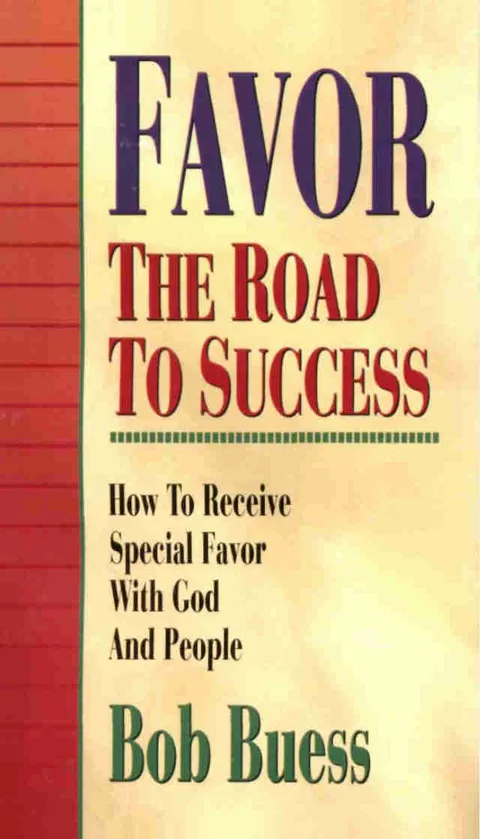

Others like favor - the road to success Features >>









About the Book
In "Favor - The Road to Success," Bob Buess explores the concept of God's favor and how it can lead individuals to success in all areas of their lives. The book emphasizes the importance of seeking God's favor through prayer, obedience, and faith, and offers practical guidance on how to experience and walk in God's favor. Buess highlights the power of God's favor to open doors, bring blessings, and overcome obstacles on the journey to success. Overall, the book serves as a motivational and inspirational guide for those seeking to achieve their goals with the help of God's favor.
Lecrae Moore

A Task Too Big for One - The Third Person in Evangelism
I came to the Quran study prepared, though not without some trepidation. One of the members of the group had invited me to his home on the outskirts of our Central Asian town. We had met the previous week at a park, where I had given him a copy of the Scriptures. That’s when he told me about his men’s group that gathered one night a week to discuss Islam. Having heard me talk about Jesus, he wondered if I’d be willing to do the same for his friends. “Could you come,” he asked, “and explain to us the message of the New Testament?” I readily agreed. Almost instantly, however, I began to question my willing response. If this man or his group wanted to do this foreigner harm, it would be all too easy in an isolated location at night. So, in the days that followed his invitation, my mind scurried after all the reasons why I shouldn’t go. I rehearsed my inadequacies. I questioned my language ability. I thought of my wife and kids. Ultimately, though, I was convinced that I couldn’t turn down such a unique opportunity, so I did the only thing I could do: I asked for help. First, of course, from God. But then I asked a few brothers in Christ to come with me. Evangelism with a Third Person Sometimes when confronting our evangelistic responsibility, our spoken or unspoken response is, How am I supposed to do that? I’m not gifted for evangelism. I don’t know all the answers. What if something goes wrong? Behind those apparently self-effacing lines may lie genuine fear — something akin to what I experienced that night — but they may reveal a hidden assumption of self-sufficient individualism. In order to be a good evangelist, we assume, one must be adequate in and of oneself. You must be bold yet relatable. You need to be an accessible theologian — personable though persuasive. You’re supposed to be both studied apologist and winsome communicator. Yet who among us fits that category? No one. No one individual is sufficient to match our calling. Like Moses, each of us has legitimate cause for doubting our abilities as a spokesperson for God. But in our insufficiency, God reminds us of his power and presence with us — and he gives us helpers. We’re not left alone to accomplish this task. We’re members of Christ’s body, and I believe we need to rediscover the value of doing evangelism in this God-supplied community. Some of my fondest memories from Central Asia were my gospel conversations with Muslims. If possible, I would always arrange for a time to meet when Dave, a Canadian brother, could come along. Dave was more welcoming and friendlier than I was. But I was more comfortable leading a discussion in the local language. As I spoke, Dave was constantly praying and engaging. Invariably, a moment would come in our conversation about Christianity when I’d be stumped. I’d lack a good answer. Or I’d forget a verse. At that moment, without fail, Dave would step in. He’d have just the words, timely and true. For me, the joy of seeing the Spirit use us as a team was thrilling. We, Not I Given our creaturely interdependence, it shouldn’t be surprising that the New Testament regularly portrays witnesses going out in groups. Jesus set the pattern by sending out his first followers two by two (Mark 6:7; Luke 10:1). In the early chapters of Acts, we find Peter and John praying and preaching together (Acts 3–4). At Antioch, the Spirit set apart Saul and Barnabas for a collaborative mission (Acts 13:2). Priscilla and Aquila, wife and husband, worked in tandem to disciple Apollos (Acts 18:26). Early evangelists also ministered in larger groups. The apostles bore witness together at Pentecost (Acts 2:1–4) and regularly at the temple (Acts 5:12–21). Later, when Peter was summoned to preach to Cornelius, he brought along some brothers (Acts 10:23). Paul also, like his Master, gathered disciples around him and traveled with them. He constantly ministered and preached in community (Acts 16:10–13; 19:9). This evangelistic method offers built-in accountability, prayer, assurance, and guidance. Many times, when meeting individually with an unbeliever, I’ve felt the need to speak the gospel only to shy away from doing so. But when meeting non-Christians alongside a brother or sister in Christ, I usually feel more encouraged and compelled to speak. Not only that, but I believe our witness is more persuasive when we evangelize alongside a third person. When done in community — by more than one individual believer — evangelism can expand beyond what “I believe” and “I think.” From my perspective, this was particularly important living as a minority and outsider in a Muslim nation. By working together, either with my wife and kids or other church members, our collective witness lovingly conveyed what we believed, what we experienced, what we shared in Christ. A consistent message from multiple voices is harder to ignore, especially when it comes from a community of joy, fellowship, and conviction. Evangelism for the Third Person But there’s another benefit to conceiving of evangelism carried out in community, especially when we’re talking with more than one person. I like to think of this as doing evangelism for the third person. Here again the Bible gives us examples. When Peter and company visited Cornelius, they preached the gospel to a group of relatives and friends (Acts 10:24). When Paul and Silas spoke with the Philippian jailer, they gathered his whole household to hear the good news (Acts 16:32). In Scripture, we regularly find evangelists meeting in homes, synagogues, at a river’s edge, in community halls, and the marketplace — often in community. More than once, I’ve experienced the unexpected blessing of meeting with someone who was interested in the gospel, only to have the other person in the room respond positively. On different occasions, we’d meet with an individual who had questions about Christianity. As the discussion continued, it became clear that their questions were more like accusations. But since we tried to do evangelism in community — either hosting friends or gathering groups at a café — there were usually other people in the room. And sometimes we would later learn that, even though silent, they were the ones most drawn to Christ. Not only that, but when we do evangelism in our homes, we do so with our children. They listen as well. They observe their parents’ faith made real as we reason with others about the gospel. And in that process, they can be shaped by a secondhand gospel as the third person in the room. In fact, sometimes I wonder if one reason some children grow up and walk away from the faith is because they’ve never heard their parents speak the gospel to anyone else. Another Person at the Table So, whenever you consider an opportunity for evangelism, don’t merely think of it as a one-on-one conversation. Personal evangelism doesn’t have to be individualistic. You don’t have to wait for that perfect moment when you’re alone with a non-Christian. You don’t need to muster up the strength or courage to do it all by yourself. Instead, do evangelism with a third person in mind. When you’re invited by non-Christians to a party — maybe a place you’d hesitate to go alone — take a friend in Christ. When you have unchurched neighbors over for a meal, invite others from church to come as well. When you set out to communicate the gospel to whomever, don’t just focus on your target audience. Think about inviting and including others. Be conscious of the other person at the table. Think about your listening children. Remember to bring along brothers and sisters, the gifts God has given, and experience the mutual encouragement that comes by doing evangelism in community.