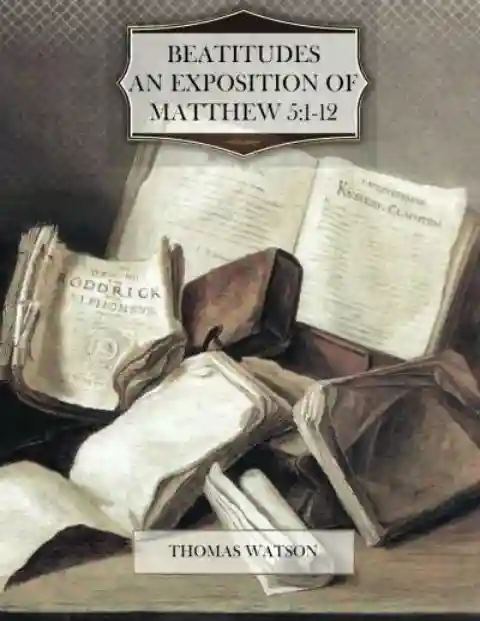

Beatitudes - An Exposition Of Matthew 5:1-12 Order Printed Copy
- Author: Thomas Watson
- Size: 1.77MB | 290 pages
- |
Others like beatitudes - an exposition of matthew 5:1-12 Features >>




About the Book
"Beatitudes" by Thomas Watson is an in-depth exploration and exposition of the famous Sermon on the Mount from the Gospel of Matthew, specifically focusing on the Beatitudes. Watson provides deep insights into the spiritual teachings and blessings imparted by Jesus Christ in these verses, offering practical guidance for believers seeking to deepen their faith and live a life that honors God. He highlights the transformative power of embracing the virtues and attitudes described in the Beatitudes and encourages readers to pursue a life marked by humility, mercy, and righteousness.
Abraham Kuyper
hero in an unmarked grave - the unusual modesty of john calvin
On May 27, 1564, just after eight o’clock in the evening, a nurse urgently summoned Theodore Beza (1519–1605) to Calvin’s bedside. “We found he had already died,” Calvin’s friend and fellow pastor later wrote. “On that day, then, at the same time with the setting sun, this splendid luminary was withdrawn from us.” 1 Calvin was 54 years old. Calvin’s death sent a shock wave throughout Geneva and beyond. Beza writes, “That night and the following day there was a general lamentation throughout the city . . . all lamenting the loss of one who was, under God, a common parent and comfort.” He records that two days later “the entire city” gathered at the St. Pierre Cathedral to honor their beloved pastor. Despite Calvin’s prominence, the funeral was unusually simple, “with no extraordinary pomp.” 2 But Calvin’s burial was particularly unusual. Unmarked Grave Eighteen years earlier, on February 18, 1546, fellow Reformer Martin Luther died at the age of 63. As was common practice for ministers, Luther’s remains were interred inside the church where he had faithfully served. His casket lies in Wittenberg’s Castle Church, near the pulpit, seven feet below the floor of the nave. Luther’s successor and fellow Reformer, Philip Melanchthon (1490–1560), is buried beside him. So also William Farel (1489–1565), who first called Calvin to Geneva in 1536, is buried in the cathedral of Neuchâtel, where he spent the final years of his ministry. When Calvin’s friend and successor Theodore Beza died in 1605, he was buried next to the pulpit of St. Pierre, the Genevan church in which he and Calvin ministered together. But Calvin’s remains lie elsewhere. Rather than being interred in St. Pierre, Calvin’s body was carried outside the city wall to a marshy burial ground for commoners called Plainpalais. With close friends in attendance, Calvin’s body was wrapped in a simple shroud, enclosed in a rough casket, and lowered into the earth. Beza writes that Calvin’s plot was unlisted and, “as he [had] commanded, without any gravestone.” 3 Why did Calvin command that he be buried, contrary to common practice, in an unmarked grave? Some speculate that he wanted to discourage religious pilgrims from visiting his resting place or to prevent accusations from the Roman church that he desired veneration as a saint. 4 But the answer lies somewhere deeper — in Calvin’s understanding of Christian modesty. Forgotten Meaning of Modesty When we speak of modesty today, we most often mean dressing or behaving in such a way as to avoid impropriety or indecency. But modesty more generally refers to the quality of being unassuming or moderate in the estimation of oneself. For centuries, the church understood the connection. Immodest dress was not simply ostentatious or sexually suggestive; it reflected an overemphasis on appearance. As Jesus warned, outward appearance can mask impiety (Matthew 6:16) or pride (Luke 18:12). This is why both Gentile women converts in Ephesus and the Jewish Christians addressed in Hebrews are urged to consider how their outward appearance relates to the disposition of the heart. Excessive adornment could be evidence of self-importance (1 Timothy 2:9). Acceptable worship requires a posture of reverence, not pretension (Hebrews 12:28). Thus, a modest person represents himself neither too highly nor too meanly because he understands both the dignity and the humility of being transformed by the grace of God. “Modesty is simply the outward reflection of true Christian humility.” Modesty, then, is simply the outward reflection of true Christian humility. It obliterates pride by embracing the reality that a Christian is both creaturely and beloved. In this light, self-importance becomes absurd. Grandiosity becomes laughable. Celebrity becomes monstrous. We Are Not Our Own For Calvin, the gospel radically reshapes our view of self. As those created in God’s image, provisioned by his goodness, redeemed by his mercy, transformed by his grace, and called to his mission, those who belong to Christ no longer live for themselves. “Now the great thing is this,” Calvin writes, “we are consecrated and dedicated to God in order that we may thereafter think, speak, meditate, and do, nothing except to his glory.” Calvin continues, If we, then, are not our own but the Lord’s, it is clear what error we must flee and whither we must direct all the acts of our life. We are not our own : let not our reason nor our will, therefore, sway our plans and deeds. We are not our own : let us not therefore see it as our goal to seek what is expedient for us according to the flesh. We are not our own : in so far as we can, let us therefore forget ourselves and all that is ours. Conversely, we are God’s : let us therefore live for him and die for him. We are God’s : let his wisdom and will therefore rule all our actions. We are God’s : let all the parts of our life accordingly strive toward him as our only lawful goal. Oh how much has that man profited who, having been taught that he is not his own, has taken away dominion and rule from his own reason that he may yield it to God! For, as consulting our self-interest is the pestilence that most effectively leads to our destruction, so the sole haven of salvation is to be wise in nothing through ourselves but to follow the leading of the Lord alone . 5 “Modesty blossoms when we experience the freedom from having to prove ourselves to God or one another.” Modesty and humility flow from a heart transformed by the Spirit of Christ. “As soon as we are convinced that God cares for us,” Calvin writes, “our minds are easily led to patience and humility.” 6 The Spirit shapes us with a kind of moderation that “gives the preference to others” and that guards us from being “easily thrown into agitation.” 7 Modesty blossoms when we experience the freedom from having to prove ourselves to God or one another. ‘Modesty, His Constant Friend’ Calvin’s life reflected this reality. Despite the doors that were opened to him through his writing and network of connections, he was committed to “studiously avoiding celebrity.” 8 When the Institutes was published in 1536, he was so successful in his object to “not acquire fame” that no one in Basel knew that he was its author. For the rest of his life, wherever he went, he took care to “conceal that I was the author of that performance.” 9 Calvin even sought to avoid a wider ministry in Geneva, having “resolved to continue in the same privacy and obscurity.” He was drawn into the limelight only when William Farel warned him “with a dreadful imprecation” that turning down the post would be refusing God’s call to service. 10 In brief autobiographical comments he wrote the year that he died, we see a glimmer of his own surprise over God’s sovereign hand through his life. God so led me about through different turnings and changes that he never permitted me to rest in any place, until, in spite of my natural disposition, he brought me forth to public notice. . . . I was carried, I know not how, as it were by force to the Imperial assemblies, where, willing or unwilling, I was under the necessity of appearing before the eyes of many. 11 It is no surprise, then, that a few days before his death, Calvin exhorted his friends to not be those who “ostentatiously display themselves and, from overweening confidence, insist that all their opinions should be approved by others.” Instead, he pleaded with them to “conduct themselves with modesty, keeping far aloof from all haughtiness of mind.” 12 For Beza, Calvin’s modesty — forged by his vision of God’s glory, Christ’s redeeming love, and the Spirit’s animating power — was his defining characteristic. After Calvin’s burial, Beza captured it in verse: Why in this humble and unnoticed tomb Is Calvin laid — the dread of falling Rome; Mourn’d by the good, and by the wicked fear’d By all who knew his excellence revered? From whom ev’n virtue’s self might virtue learn, And young and old its value may discern? ’Twas modesty, his constant friend on earth, That laid this stone, unsculptured with a name; Oh! happy ground, enrich’d with Calvin’s worth, More lasting far than marble is thy fame! 13 Free to Be Forgotten In old Geneva, on the grounds of the college Calvin founded, stands an immense stone memorial to four leaders of the Protestant Reformation. At its center are towering reliefs of Calvin, Beza, Farel, and John Knox (1513–1572). Calvin would surely detest it. But the monument is a metaphor. We live in a culture that fears obscurity and irrelevance. We measure ourselves against others and build our own platforms in the hope that we will not be forgotten. We attempt to distinguish ourselves at the expense of the humility and modesty that honors Christ. Calvin would have us be free from such striving. For however anyone may be distinguished by illustrious endowments, he ought to consider with himself that they have not been conferred upon him that he might be self-complacent, that he might exalt himself, or even that he might hold himself in esteem. Let him, instead of this, employ himself in correcting and detecting his faults, and he will have abundant occasion for humility. In others, on the other hand, he will regard with honor whatever there is of excellences and will, by means of love, bury their faults. The man who will observe this rule, will feel no difficulty in preferring others before himself. And this, too, Paul meant when he added, that they ought not to have everyone a regard to themselves, but to their neighbors, or that they ought not to be devoted to themselves. Hence it is quite possible that a pious man, even though he should be aware that he is superior, may nevertheless hold others in greater esteem. 14 We may rightly regard Calvin as a hero of the faith, but he didn’t ultimately see himself that way. Humility had taught him to walk modestly before God and others — and, in the end, the freedom to lie down in a forgotten grave. Theodore Beza, “The Life of John Calvin” in Tracts Related to the Reformation (Edinburgh: Calvin Translation Society, 1844), 1:xcv. ↩ Beza, Tracts , 1:xcvi. ↩ Beza, Tracts , 1:xcvi. ↩ Eighteenth-century guidebooks indeed list the disused Plainpalais cemetery as an important stop for tourists, though they warn that pilgrims will search for Calvin’s resting place in vain. By the nineteenth century, keepers of the burial ground staked out a “likely-enough” site for Calvin’s grave (complete with a rudimentary marker) simply to avoid the irritation of being so frequently asked. ↩ John Calvin, Institutes of the Christian Religion , ed. John T. McNeill, trans. Ford Lewis Battles (Louisville, KY: Westminster John Knox Press, 2011), 3.7.1 (emphasis mine). ↩ John Calvin, Commentaries on the Catholic Epistles , trans. John Owen (Edinburgh: T. Constable,1855), 149. ↩ John Calvin, Commentaries on the Epistles of Paul the Apostle to the Philippians, Colossians, and Thessalonians , trans. John Pringle (Edinburgh: T. Constable, 1851) 52–53. ↩ John Calvin, Commentary on the Psalms , trans. James Anderson (Edinburgh: Edinburg Printing Company, 1845), 1:xli, xlii. ↩ Calvin, Psalms , 1:xlii. ↩ Calvin, Psalms , 1:xlii. ↩ Calvin, Psalms , 1:xli, xliii. ↩ Beza, Tracts , 1:xci. ↩ Beza was widely known for his literary works. As a humanist, he became famous for his collection of Latin poems in Juvenilia , published just before his conversion in 1548. He continued to write poetry, satires, and dramas until the end of his life. Francis Sisbon’s nineteenth-century translation attempts to capture the sense of the Latin in a more familiar poetic form (Theodore Beza, The Life of John Calvin , trans. Francis Sibson, [Philadelphia: J. Whetham, 1836], 94). For the original text, see Calvin and Beza, Tracts , 1:xcvi. ↩ Calvin, Commentaries on the Epistles of Paul , 53. ↩