
GIP Library icon

LOG IN TO REVIEW
About the Book


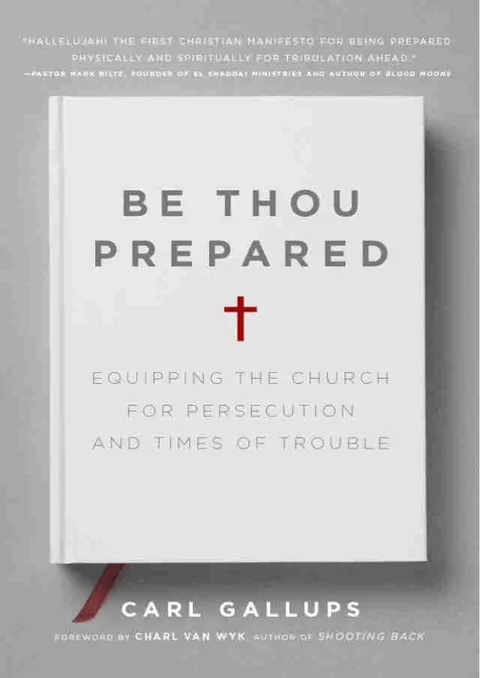
"Be Thou Prepared" by Carl Gallups is a practical guide for Christians on how to be ready for emergencies, disasters, and crises. The book emphasizes the importance of physical, mental, and spiritual preparedness in order to effectively navigate challenging situations. Gallups provides advice on creating emergency plans, building food and water storage, and developing a strong faith foundation to withstand uncertain times.

Darlene Deibler Rose

Darlene Deibler Rose Darlene Diebler Rose: Unwavering Faith in God’s Promises “Remember one thing, dear: God said he would never leave us nor forsake us.” Those words were spoken on March 13, 1942, and were the last words Darlene Diebler would ever hear from her husband, Russell, as they were permanently separated in Japanese prison camps during World War II. She was a missionary in her early twenties. She did not even have a chance to say goodbye. Consider her own reflection on that heartbreaking day: Everything had happened so fast and without the slightest warning. Russell had said, “He will never leave us nor forsake us.” No? What about now, Lord? This was one of the times when I thought God had left me, that he had forsaken me. I was to discover, however, that when I took my eyes off the circumstances that were overwhelming me, over which I had no control, and looked up, my Lord was there, standing on the parapet of heaven looking down. Deep in my heart he whispered, “I’m here. Even when you don’t see me, I’m here. Never for a moment are you out of my sight” (Evidence Not Seen, 46). Obedience to God’s Call in All Circumstances Darlene Mae McIntosh was born on May 17, 1917. At age nine she put her trust in the Lord Jesus Christ as her light and salvation. One year later, during a revival service, she sensed God’s calling to give her life to missions. On that night she promised Jesus, “Lord, I will go anywhere with you, no matter what it costs” (46). How could that little girl know what the Savior had planned for her in the not too distant future? “Through it all, Darlene was sustained by God, who never left her nor forsook her, just as he promised. He remained her light and salvation.” Darlene married a pioneer missionary to Southeast Asia named Russell Deibler on August 18, 1937. She was only nineteen years old. He was twelve years her senior. The Deiblers eagerly returned to Russell’s pioneer missionary work in the interior of New Guinea. Darlene accompanied Russell into the jungle to establish a new mission station near a previously unevangelized, primitive tribe that had only been discovered just a few years earlier. Darlene, the first white woman any of them had ever seen, grew to deeply love the local people. When World War II broke out in that part of the world, the Dieblers chose to stay. And when the Japanese soon took control of the area, the Deiblers were put under house arrest. Later, Japanese soldiers herded all foreigners into prisoner-of-war camps, separating the men from the women and children. During the next four years, Darlene endured separation from her husband and, eventually, widowhood. The brutal conditions of a WWII Japanese internment camp included near-starvation, forced labor, inhumane conditions, false accusations of espionage, serious illnesses, solitary confinement, and torture. Through it all, Darlene was sustained by God, who never left her nor forsook her, just as he promised. He remained her light and salvation. God Is Sufficient in All Circumstances After receiving the news of her husband’s death, Darlene was falsely accused of being a spy and taken to a maximum-security prison where she was kept in solitary confinement. Written over the door of her cell were the words in Indonesian, “This person must die.” Frequently she was taken to an interrogation room and accused of spying. Upon her denial, her interrogators would strike her at the base of the neck or on her forehead above the nose. There were times she thought they had broken her neck. She walked around often with two black eyes. “Bloodied but unbowed” (141), she never wept in front of her captors, but when she was back in her cell she would weep and pour out her heart to the Lord. When she finished, she would hear him whisper, “But my child, my grace is sufficient for thee. Not was or shall be, but it is sufficient” (141). “When she finished, she would hear him whisper, ‘But my child, my grace is sufficient for thee. Not was or shall be, but it is sufficient.’” Time and time again God showed himself to be powerful and faithful to Darlene. Once, within moments of being beheaded as a spy, she was unexpectedly taken from the maximum-security prison back to her original prison camp. The Lord again had heard her prayers, leading her to a level path against her enemies. Over and over again, Darlene could look back at her life and see how God had strengthened and sustained her as a young bride at age nineteen. when she headed to the jungles of New Guinea at twenty. when placed under house arrest by the Japanese when she was twenty-five. when she and her husband were separated into separate prison camps in 1942, never to see each other again in this life. as she ate rats, tadpoles, dogs, runny oatmeal, and maggots, and other unimaginable foods. through dengue fever, beriberi, malaria, cerebral malaria, dysentery, beatings, torture, attacks of rabid dogs, false charges of espionage, the promise of beheading, solitary confinement, Allied bombings, and many other inhumane abuses. when told of the death of her beloved husband and his own tortures and sufferings. when he brought her home to America but kept the fire of missions burning in her soul. when he brought another missionary into her life, Gerald Rose, whom she married (1948) and returned with him to New Guinea in 1949. as she labored on the mission field of Papua New Guinea and the Outback of Australia for over forty years, evangelizing, teaching, building landing strips, delivering babies, facing down headhunters, and loving them to Jesus. On February 24, 2004, Darlene Diebler Rose quietly passed away and entered into the presence of the King she so deeply loved and faithfully served. She was eighty-seven years old. All throughout her life, when sharing her story, Darlene would say, “I would do it all again for my Savior.” No doubt many in New Guinea are grateful for her devotion. May we follow this great saint to the nations, for the sake of their souls and the glory of our great King Jesus.

Live Like You’ll Live Forever

The world makes its quiet but furious war against death, groping to live forever. Plastic surgery, obsessive fitness, compulsive dieting, pouring billions into scientific research searching for the holy grail of immortality. The author of Hebrews describes the condition as a lifelong slavery to the fear of death (Hebrews 2:15). Try as we may, Adam’s and Eve’s children cannot shake the ancient nightmare. [God] drove out the man, and at the east of the garden of Eden he placed the cherubim and a flaming sword that turned every way to guard the way to the tree of life. (Genesis 3:24) Humanity, east of Eden, still reaches out in vain for that Tree of Life. Curing Death How would the world change overnight if all people everywhere heard that a man had cured death? How many ages would pass celebrating the discovery? But as it stands, these same people bypass the knowledge of a true eternity because it is not the eternity they invented. “How would the world change overnight if all people everywhere heard that man had cured death?” God has placed in us a sense that life continues after death: “[God] has put eternity into man’s heart” (Ecclesiastes 3:11). Yet most suppress this knowledge of their own immortality. But why? Because they “did not see fit to acknowledge God” (Romans 1:28) — the God “who inhabits eternity” (Isaiah 57:15). They disavow the truth their hearts would thrill to believe because they do not approve of any eternity with God. Better to steal happy moments from a broken and fleeting mortality, their dead hearts reason, than submerge in an endless existence with the God they disapprove. Immortal Beings All men, we know, shall live forever. We trust and love the eternal God, we believe in the resurrection from the dead, we believe Jesus’s promise of eternal life with him. And we know the everlasting fate of the wicked: “These will go away into eternal punishment, but the righteous into eternal life” (Matthew 25:46). Eternity exists, we believe, and all men are immortal. The souls we come in contact with at the ballgame, in the restaurant, walking the dog — shall be a million years from now. The mailman, the bus driver, the nosy neighbor — immortal beings. The most decrepit among us shall outlive the galaxy. “The most decrepit among us shall outlive the galaxy.” Even considering those who have gone before us — the deceased grandfather, the fallen child, the departed spouse — though hidden momentarily from our eyes, we know they are and shall be again. Death, we profess, is the Great Interruption, not the Great End. Falling Leaf While we say we believe in undying souls (a truth that the world would go delirious to acknowledge), do we give that momentous reality much thought? Does that eternal weight of glory hold much weight with us? Has it changed your week at all? How many of us have believed upon eternity, as John Foster lamented, in vain? The very consciousness that your minds have been capable of admitting and dismissing this subject [eternity] without a prolonged and serious emotion, ought to produce at last that seriousness, by means of wonder and alarm, which may well be awakened by the consideration how many years you have believed this truth in vain. (An Essay on the Improvement of Time, 150–151) How many years have I believed in eternity without much effect? And not just any eternity, but eternity with the Blessed God? Eternity with Jesus Christ? How many of my waking moments of these short and numbered days have orbited around the ceaseless “day of eternity” (2 Peter 3:18)? If in Christ I have hope in this life only, do I really feel myself of all people most to be pitied (1 Corinthians 15:19)? How this world deceives me. The sturdy tree and its branches I call “this life”; the falling leaf I call, “eternity.” Forgotten Forever With one glance of the mind, I realize my madness. Who at sea would give all his affection and thought to a day’s trip onboard, completely disregarding the inescapable land ahead? I forget that “Surely a man goes about as a shadow!” (Psalm 39:6) as a dream (Psalm 78:18–20), as a flower that fades, as grass that withers (Isaiah 40:6–8), as a mere mist that appears for a little time and then vanishes (James 4:14). This world, O my soul remember, “is passing away along with its desires, but whoever does the will of God abides forever” (1 John 2:17). I hope you have kept eternity closer at hand than I have. Have you, Christian — possessor of the mightiest revelations, steward of sacred knowledge, keepers of the way of eternity — appropriated these truths for yourself and distributed them freely to a desperate and decaying world? Has forever bent down with you as you changed diapers? Has it drove with you to work? Has it laughed along while you had a game night with neighbors? Has “everlasting” brought you low to plead in prayer for your children, your church, your city? Has that terrifying splendor, “immortality,” lifted your gaze from this painted and perishing kingdom to the one that cannot be shaken? Has eternity provided you an anchor in suffering? Sent you along on a grand mission? Warned you against friendship with Here and Now? Bestowed solemnity to life? Brightened up gloomy days? Infused courage to venture on in Christ? Showed you the coming tsunami that will wash away all these splendid sandcastles? Endowed acquaintances with new significance? Lifted our eyes with abiding gratitude to God? Equipped us to drive a spear through sin? Have you believed in eternity in vain? Tree of Life We must awake to the coming world without end. We are those who look “not to the things that are seen but to the things that are unseen. For the things that are seen are transient, but the things that are unseen are eternal” (2 Corinthians 4:18). People all around us live and die for the seen, the felt, the tasted, the pleasurable, the transient. But God has left you and me here to speak, to reason, to plead with immortal souls that they be reconciled to God. Through faith in Christ, we have reached our hands out to a Tree of Life on Golgotha’s hill, and we will taste of that fruit denied to our first parents: To the one who conquers I will grant to eat of the tree of life, which is in the paradise of God. (Revelation 2:7) Blessed are those who wash their robes, so that they may have the right to the tree of life and that they may enter the city by the gates. (Revelation 22:14) This tree is within reach because Jesus Christ — the Resurrection and the Life — has drawn near to us. He promises, “Whoever believes in me, though he die, yet shall he live, and everyone who lives and believes in me shall never die,” and asks the pertinent question, “Do you believe this?” (John 11:25–26). God give us grace to believe, and to make sure our friends know, our families know, our children know, that eternity is only a short time away. Article by Greg Morse

Feedback
Suggestionsuggestion box
x